
High up, in the crown of the world-ash Yggdrasil, sits an eagle. The sources give it no name, yet they say it knows a great deal. It is the highest lookout of the cosmos: from here it surveys the nine worlds, the dripping of the branches, the coming and going of the gods. And between its eyes perches a second bird – a hawk, a falcon, whom Snorri in the Prose Edda (Gylfaginning 16) calls Veðrfölnir. A bird upon a bird, a gaze above a gaze, far over everything that lives.
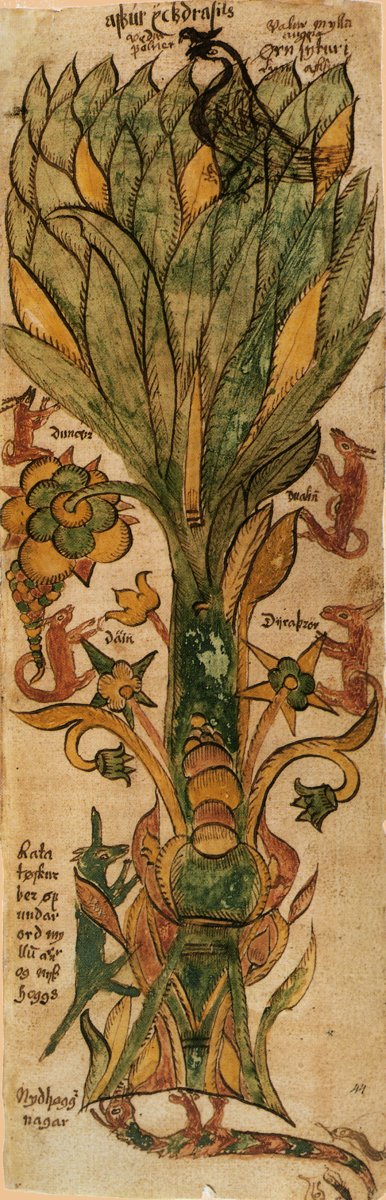
The Edda paints Yggdrasil as a living structure, teeming with animals: harts nibble the leaves, the serpent Níðhöggr gnaws at the root, and above them all the eagle presides. It is no minor figure but the counterpole to the depths. Where destructive forces dwell below, above them a watchful, knowing creature holds its post. That the eagle „knows much" is more than a phrase – in many old cultures the bird is a messenger between heaven and earth, the animal nearest the light.
The hawk Veðrfölnir appears only in Snorri, and even there he remains a riddle. His name is usually read as „wind-" or „weather-faded", „storm-pale" – a bird the colour of the drifting sky. Yet the derivation is uncertain, and scholars argue over what the second bird is really for. Is he an image of an even sharper, even loftier perception? An offshoot of the eagle, a watcher of the watcher? The texts fall silent. What remains is a striking picture: a bird of prey crouched on the head of a greater bird of prey, right at the top of the tree of the world.
Between the eagle in the crown and the dragon Níðhöggr at the root there is enmity. And as in some ancient quarrel, there is one who carries the spiteful words back and forth: the squirrel Ratatöskr, darting the whole trunk up and down.
Ratatosk is the squirrel who there shall run
On the ash-tree Yggdrasil;
From above the words of the eagle he bears,
And tells them to Nithhogg beneath.Grímnismál 32, translation by Henry Adams Bellows 1923
Ratatöskr is the bringer of discord, the gossip-carrier of the cosmos – anyone who wants to know more about him and the gnawing dragon will find the full story in our articles on Ratatöskr and Níðhöggr. For the eagle, one thing matters most here: he is one side of a very old opposition.
Many interpretations read a cosmic order out of this image: the eagle above stands for sky, spirit, breadth; the dragon below for the underworld, chaos, the devouring. Between them Yggdrasil stretches as the world axis, the link of above and below, tirelessly run by the squirrel. It is a fine and fitting picture – but it is the reading of later minds, not a statement of the sources themselves. The Edda describes the animals; the grand meaning behind them is something we bring to it.
The idea of „bird in the treetop against serpent at the root" is remarkably widespread – without that proving any contact or borrowing. In India the sun-bird Garuda battles the serpent beings, the Nāgas. In Mesopotamia there is the lion-headed eagle Anzu. Among many peoples of North America the thunderbird is the power of the upper world. Humans, it seems, reach again and again for the same opposition when they want to order the world into height and depth. The Norse image of the eagle and the gnawing dragon is an independent branch on this widely spreading tree – neither its origin nor its copy.
Evidence: The eagle in Yggdrasil's crown and the squirrel Ratatöskr carrying its words to the dragon appear in the Poetic Edda (Grímnismál 32). The hawk Veðrfölnir between the eagle's eyes is preserved only in Snorri's Prose Edda (Gylfaginning 16).
Myth-check: The eagle in the crown is expressly UNNAMED in the sources. The equation with „Hræsvelgr" often found online is wrong: Hræsvelgr is a wholly different being – an eagle-giant at the edge of the world who makes the wind with the beat of his wings (Vafþrúðnismál 37), not the bird in the tree. A name „Fjalar" for this eagle is likewise attested nowhere and is a modern invention. To name the eagle is to make things up – the Edda deliberately does not.
Anyone who wants to understand the eagle in Yggdrasil's crown must first look carefully at where he actually stands. For between what the old poems truly hand down and the familiar overall picture found in every handbook today lies a fine but important gap. Much of what we take to be „the Edda" is in fact Snorri Sturluson's ordering synthesis from the 13th century. For a bird said to survey everything, this sharp look is especially worthwhile.
In the older, verse-composed Poetic Edda the eagle appears only indirectly. In the Grímnismál, the great mnemonic poem about Yggdrasil and its dwellers, he is named – but only as the one pole of that ancient quarrel which the squirrel Ratatöskr carries up and down the trunk. The eagle „has words" that are borne down to the dragon. The verse says no more. It describes no shape, no plumage, no task. It does not even state that the eagle is wise. The poem simply takes him for granted, as though every listener knew that an eagle thrones high in the crown.
The other animals of the tree, too, are spread across a few stanzas of the Grímnismál: the four harts with their names, the host of serpents beneath the root, the gnawing Níðhöggr. The tree suffers, it says, more than men can guess – the hart bites it from above, at its side it rots, below the dragon tears at it. In this fabric of decay and eternal cycle the eagle has his fixed but taciturn place. He is part of the order, not its explainer.
It is Snorri who first fills the blanks. In the Gylfaginning, the mythological part of his Prose Edda, it is said that an eagle sits in the branches of the ash, and that he is „knowing of many things". And only here, in this very sentence, does the second bird appear: between the eagle's eyes sits a hawk named Veðrfölnir. Both – the eagle's express wisdom and the hawk between his eyes – stand in no surviving poem. It is Snorri's addition, his compression and adornment of an image the verses had only hinted at.
That does not make it wrong, but it makes it younger and more literary than many believe. Snorri wrote some two centuries after the conversion of Iceland, a learned Christian who wanted to preserve and order the old lore for poets. He was a magnificent systematiser – and precisely for that reason one must always ask of him: am I looking at old tradition here, or at Snorri's clever completion? For the wise eagle and the hawk Veðrfölnir the honest answer is: we cannot be sure. It is possible that Snorri drew on verses now lost. It is equally possible that he himself rounded out the image.
There is a second, quite different eagle in the Poetic Edda, often confused with the bird of the crown. He appears at the end of the Völuspá, in the great vision of the world's return after Ragnarök. When the earth rises anew from the sea and grows green, an eagle flies over it and hunts for fish along the cliffs.
Now do I see the earth anew
Rise all green from the waves again;
The cataracts fall, and the eagle flies,
And fish he catches beneath the cliffs.Völuspá 59, translation by Henry Adams Bellows 1923
This eagle is no guardian of the world-tree but a plain, powerful sign of returned life: where an eagle flies again and catches fish, there the order of nature has renewed itself after the ending. He belongs to the new world, not to the tree of the old. That an eagle stands at both the beginning and the end of the handed-down cosmology – one in the crown of the living tree, one over the reborn earth – is a lovely echo. To melt them into a single bird, however, would be exactly the kind of simplification the sources warn against.
Evidence: The tree's eagle is named in the Poetic Edda only indirectly, through Ratatöskr (Grímnismál 32), without any wisdom or hawk ascribed to him. That the eagle „knows much" and that the hawk Veðrfölnir sits between his eyes stands solely in Snorri's Prose Edda (Gylfaginning). The fishing eagle above the newly rising earth is a separate image from the Völuspá and belongs to the world's re-creation after Ragnarök, not to the crown of Yggdrasil.
Few beings of Norse tradition are at once so famous and so thinly attested as the hawk Veðrfölnir. A single sentence in Snorri – that is the whole of the evidence. All the more has been puzzled over his name and his meaning.
The name divides cleanly into two parts. The first element, Old Norse „veðr", means „weather, wind, storm" – the same word lies in English „weather" and German „Wetter". The second element is usually related to „fölr", „pale, wan, faded". Put together, this gives roughly „the weather-pale one", „the storm-wan", „the wind-bleached": a bird the colour of the drifting, hazy sky, in which a high falcon all but vanishes. Anyone who has watched a bird of prey far aloft against low-hanging cloud grasps the image at once – grey-pale plumage that blurs into the weather itself.
It has also been considered whether the second element might rather mean „the one who makes pale" or „who fades", a bird, then, that comes and goes with the weather. None of these readings is certain. Old Norse names are often poetically dark, deliberately many-sided, and for a being named only once there is no context against which to test the meaning. „Weather-pale" is the most common and the most beautiful reading – but it remains a reasoned conjecture, not a proof.
Harder even than the name is the question of what this second bird is for in the first place. The eagle alone already surveys the nine worlds – what does a hawk between his eyes add? Scholarship has offered several answers, and none has prevailed.
One line reads Veðrfölnir as an intensification: if the eagle is already the highest lookout, then the hawk sits one step higher still, the gaze above the gaze, the sharpened, keenest perception at the very tip of the cosmos. The hawk would then be, as it were, the eye of the eye. Another line sees in him rather an accessory, an attribute of the eagle, as a king bears his sceptre – an added token of loftiness and far sight, not an independently acting being. Others again have soberly supposed the hawk to be a learned embellishment of Snorri's, a poetic detail that made the already dense image of the world-tree richer still.
One may add that a bird of prey crouched on the head of a greater bird of prey was by no means absurd to a rural, hunting audience. Whoever knew falconry knew the quiet sitting of a hawk on a raised perch, the motionless, focused watching. The image may well feed on familiar sight. Yet that too remains interpretation. Honest alone is the finding: the text names the hawk but does not explain him. We stand before one of the most elegant and at the same time most insoluble small riddles of Norse mythology.
Myth-check: The reading „Veðrfölnir = weather-pale/storm-wan" is plausible and widespread, but not linguistically secured – the name is handed down only once, without a context that could confirm the meaning. Likewise every „task" of the hawk (watcher, eye of the eye, soul-bird) is modern interpretation. The source names him plainly and leaves his sense open.
The crown-eagle is not the only one of his kind in the North. The eagle was a highly charged image for the Viking Age – bird of the heights, of the wind, of war and of transformation. Only in comparison with his kin does it become clear how peculiar the silent watcher in the tree really is.
The most famous other eagle stands at the outermost edge of the world and is named in the Vafþrúðnismál, the contest of wisdom between Odin and the giant Vafþrúðnir. Asked whence comes the wind that travels over the sea, the giant answers with one of the most striking images in all the Edda.
Hræsvelg is he who at heaven's end
Sits in an eagle's guise;
And from his wings, they say, the wind comes forth
To move o'er the world of men.Vafþrúðnismál 37, translation by Henry Adams Bellows 1923
Hræsvelgr – the name means roughly „corpse-swallower" – is thus no bird in the tree, but a giant natural power at the world's rim, whose wingbeat makes the wind. That is a wholly distinct conception: the eagle as the origin of an element. And here lies the commonest confusion online today. Again and again the nameless crown-eagle is equated with Hræsvelgr, or lent the name of the wind-eagle. That is wrong. The sources keep the two cleanly apart: here the knowing watcher in Yggdrasil's crown, there the wind-making giant on the horizon. Two eagles, two roles, two texts.
In the North the eagle is also a shape of transformation, and at the highest level: Odin himself becomes an eagle. In the tale of the theft of the mead of poetry, which Snorri tells at length, Odin wins from the giantess Gunnlöd the precious mead of verse, changes into an eagle and flies with it to Asgard. The giant Suttungr, to whom the mead belongs, likewise takes eagle shape and gives chase. So two eagles race through the sky, and above the walls of Asgard Odin spews the mead into waiting vessels – a few drops, though, go astray, and that, told with a wink, is the portion of bad poets.
Two things matter here for our theme. First: the eagle is, in Norse thought, the very flight-garb of wisdom and poetry – whoever flies as an eagle bears the highest knowledge away. That fits seamlessly with the „much-knowing" bird in the crown. Second, the scene shows that shape-shifting into bird form belongs to the fixed repertoire of the myths. The eagle is not merely an animal on the tree, but a cipher for lofty, all-surveying power.
Beyond the texts, too, the bird is met. On the Gotlandic picture stones, those painted memorial slabs of soft limestone, great birds appear again and again, and eagles or eagle-like beings belong to the formal repertoire of the Viking-age animal styles. Yet here one must be careful: a carved or incised bird is not straightforwardly Veðrfölnir or the crown-eagle. The images are rarely captioned, and their reading remains almost always interpretation. Certain is only that the eagle belonged to the familiar stock of images – as a sign of war (think of the grim kenning of the eagle waiting over the battlefield for carrion) as much as a sign of height and power. The bird in the world-tree thus stands within a broad, well-attested visual tradition, even if no stone shows him beyond doubt.
There is a darker side to the eagle-image, without which the Norse esteem for this bird cannot be fully understood. In the heroic poetry of the North and of the Anglo-Saxon world, eagle, raven and wolf form a fixed trio – the so-called „beasts of battle". They appear before and after the fight to feed on the fallen: the wolf howls, the raven croaks, and the eagle circles over the field and reddens beak and claw in the blood of the slain. In skaldic verse it is virtually a formula of honour for a warrior that he „gave the eagle food" or „sated the eagle" – meaning that he made rich slaughter of his foes. The same image returns in Old English poetry, for instance in the battle poems, where the dark-feathered eagle belongs as a matter of course to the retinue of war.
This trait explains why the eagle was so highly charged in the North: he is at once the animal of the heights and of death, the lofty gaze from above and the ravenous witness of the battle. The taciturn watcher in Yggdrasil's crown carries something of this fullness of meaning with him. He is no harmless ornamental bird, but a being that in the Viking-age imagination was bound up with the last, greatest things – with war, death and the vastness over all.
Veðrfölnir is rendered as a hawk, often also as a falcon – and that summons a second, far more tangible world: that of the birds of prey. For falcons and hawks were in the North not only creatures of myth but precious possessions, marks of status and goods of long-distance trade.
In the myths the flight-garb belongs above all to a goddess: Freyja owns a feather- or falcon-cloak with which its wearer can turn into a bird and fly. Again and again Loki borrows this cloak to travel swiftly between the worlds – as in the Þrymskviða, when Thor's hammer is stolen and a fast messenger is needed in the land of the giants, or in the tale of Iðunn and the giant Þjazi, where Loki in falcon-dress brings the abducted goddess home. The falcon-cloak is thus the mythic counterpart to real falconry: an image of the human wish to make the abilities of the bird of prey – height, speed, the view from above – one's own. That, of all places, a hawk sits between the eyes of the all-seeing eagle fits this esteem for the bird of prey as the noblest, keenest-sighted of animals.
Falconry was, in the Viking Age and the early Middle Ages, the privilege of the upper class. To carry a trained hawk was to display rank. Especially coveted was the white gyrfalcon of Iceland and Greenland – a bird of the high North, passed on as a princely gift right across Europe and into the courts of the Islamic world. Icelandic and Greenlandic falcons were among the most valuable export goods of the North at all; a single gyrfalcon could be worth a small fortune. In the Norwegian legal texts of the High Middle Ages there are separate provisions for hawk and hunting bird, and the boat graves of the Swedish elite – for instance from Vendel and Valsgärde – contained, beside horses and dogs, birds of prey as marks of status for the journey into the beyond.
This real background gives weight to the mythic image. When listeners heard of a hawk on the head of the world-eagle, they thought not of some exotic fabulous beast, but of the most precious, noblest animal a lord could own. The bird at the tip of the cosmos thus carried the lustre of lordship, hunting and prestige – a detail especially lovely for a workshop of Norse motifs, because here myth and the lived Viking world touch.
Evidence: Freyja's feather- or falcon-cloak, which Loki borrows for his flights, is attested in the Poetic Edda (Þrymskviða) and in Snorri's Prose Edda (the tale of Iðunn and Þjazi). The high importance of falconry is well secured by grave finds with birds of prey in Scandinavian boat burials, by the documented long-distance trade in Icelandic and Greenlandic gyrfalcons, and by separate provisions in medieval Norwegian legal texts.
The opposition of eagle in the crown and serpent at the root is so vivid that it recurs far beyond the North, in many cultures. That is fascinating – and it easily tempts one to false conclusions. Let us look more closely at the most famous parallels before asking honestly what they actually prove.
In Indian myth Garuda is the mighty sun-bird, half eagle, half man, the mount of the god Vishnu. His eternal enemies are the Nāgas, the serpent beings of the underworld and the waters. The myth tells of the enmity between the bird-mother and the serpent-mother, and of how Garuda steals the drink of immortality to free his mother from the serpents' bondage. Here, many thousands of miles and centuries from Yggdrasil, stands the same basic pattern: the bright, high bird against the dark, deep serpent folk. To this day the eagle-like Garuda shapes the crests and symbols of South and Southeast Asia.
Nearer still to the Norse image lies a very old Mesopotamian tale. In the Sumerian poem about the goddess Inanna and her world-tree, the huluppu tree, three beings settle in: in the crown roosts the Anzu-bird, a mighty, storm-like eagle; in the trunk dwells a demon; and at the root lies a serpent that no charm can drive off. Only a hero drives all three away. That here – millennia before the Edda – a tree is handed down with an eagle in the crown and a serpent at the root is among the most astonishing correspondences in the history of religion. The Anzu himself, moreover, is bound up, quite like Hræsvelgr, with storm and weather.
In Slavic tradition, too, the world-tree – usually an oak – is found with an eagle or bird in the crown and a serpent at the root. In the basic conception reconstructed by part of scholarship, the thunder-god Perun stands above and the serpentine Veles below in eternal enmity, and the tree joins their realms. That is a temptingly exact counterpart to the Norse image. One must know, however, that this Slavic „basic myth" in its clear form is a scholarly reconstruction of the 20th century, not a coherently handed-down text. It is likely, but not to be read that way in any single old source.
In the face of so many parallels the thought lies near that an age-old shared inheritance is sounding here – perhaps an Indo-European archetype of the tree that joins heaven and underworld, guarded by bird and serpent. Related, too, are the many combat myths of sky-god against serpent: Indian Indra against Vritra, Greek Zeus against Typhon, Norse Thor against the Midgard Serpent. It is an appealing idea, and a grain of truth lies in it. But caution: similarity is no proof of kinship. Almost everywhere humans order the world into above and below, into light and depth, and reach in doing so for the same strong images – bird and serpent, crown and root. Such correspondences may rest on common inheritance, on chance parallel, or on the plain fact that all people live under the same sky and above the same earth. Between „strikingly similar" and „demonstrably related" lies a line that honest scholarship does not cross lightly.
Myth-check: The worldwide parallel „bird above, serpent below" is typological – it shows how similarly humans think, not that one culture copied from another. The term „world axis" (axis mundi) is moreover a modern analytic model from religious studies (associated above all with Mircea Eliade), not a statement of the old sources themselves. And the Slavic „basic myth" of Perun and Veles at the world-tree is a 20th-century reconstruction, not a uniformly handed-down text. The parallels are real and fascinating – proof of contact or common origin they are not.
Why does this nameless bird in the crown still move us today? Because he embodies an image that needs no explanation. The eagle is the eye of the tree. While below there is nibbling, gnawing and destruction, while in the middle the harts feed and the squirrel hurries to and fro with its spiteful words, above a single being holds still and looks. He does not act, he watches. He is the stillness at the top of a tree in which everything else is caught in motion, strife and decay.
The eagle stands for far sight in the literal sense – for the ability to survey the whole where others see only their own branch. In a cosmos whose dwellers are mostly trapped in their roles, he is the one who looks from the very top. That he „knows much" means just this: not book-learning, but the knowledge of one who has the overview, who recognises coming and going because he sits high enough. And the hawk between his eyes intensifies this image to the utmost – as though upon vigilance there sat a keener vigilance still.
Within the great fabric of Yggdrasil, then, the eagle fits as the upper boundary point. The world-tree joins the realms, and at its ends stand the opposites: below the serpent that corrodes, above the eagle that surveys. Between them stretches life. The eagle thus preserves – without a single word, without a single deed – the idea that above all gnawing and quarrelling there is a quiet, high point from which the whole can still be recognised as a whole.
The eagle in Yggdrasil's crown is one of the most beautiful figures of Norse tradition, precisely because it gives away so little of itself. No name, hardly a word, only a bird high in the treetop who knows much, and on his head a hawk the colour of the weather. The sources resist the temptation to explain everything – and in just that lies their greatness. They show us a view from the very top and leave it to us to follow it. Whoever engraves or beholds the eagle honours no spelled-out dogma, but an image: the vigilance at the summit of the world, the calm, wide gaze over all that lives and passes.
Yggdrasil – the world tree · Niðhöggr – the gnawer at the root · The nine worlds · The Norns · Heiðrún – the mead-goat.
All Beings & Creatures articles →
Without the giants there would be no Norse world – in the most literal sense. Out of a giant it arose, against the …
Read more →In Valhalla an eternal feast holds sway – provided by a single animal that never runs out: the boar Sæhrimnir.
Read more →Two wolves race across the firmament – one after the sun, the other after the moon. It is the oldest chase in the …
Read more →Eight legs, a one-eyed rider and a road that leads all the way down into the realm of the dead: Sleipnir is no ordinary …
Read more →