Sleipnir is the grey, eight-legged horse of the god Odin – according to the Edda the best of all steeds, and his mother is none other than Loki, who had turned himself into a mare. Odin rides Sleipnir down to the realm of the dead, and on his back Hermóðr leaps the gate of Hel. Here you'll find which sources really tell of him, what his name means, where the eight-legged horse is carved in stone, and which explanations of those legs scholars take seriously – and which they don't.
Picture a grey horse: powerful, fast, calm-eyed. Now count the legs. Eight. No other creature in Norse mythology is so easy to recognise and so hard to explain as Sleipnir. He is the mount of Odin, the one-eyed All-Father who never stays put – always hunting for knowledge, for dead who can still speak, for giants who want to test him. A god who wanders between worlds needs an animal that can follow. Sleipnir does.
His family is strange to begin with. His father is a stallion called Svaðilfari, who helped a giant build a wall. His mother is a god – Loki, the shape-shifter, who took the form of a mare to rescue the gods from a mess of his own making. That makes Sleipnir the half-brother of the wolf Fenrir, the Midgard Serpent and Hel, mistress of the dead. Of all Loki's children he is the only one who serves the gods instead of threatening them.
Before we get to the stories, a word on sources. Nearly everything we know about Sleipnir comes from Iceland and was written down in the thirteenth century, roughly two hundred years after the conversion to Christianity: in the Poetic Edda, a collection of older mythological and heroic poems, and in the Prose Edda of Snorri Sturluson, a handbook for poets. On top of that we have older picture stones from Gotland that show an eight-legged horse. If you want an overview of this tradition, see our article on the Edda. For Sleipnir the rule is simple: the stories are late, the image is old.
The name is quickly explained and still revealing. It belongs to the Old Norse adjective sleipr, "smooth, slippery". Sleipnir is "the gliding one" or "the slippery one" – a horse that moves so fluidly it seems to slide over the ground rather than pound it with hooves. Rudolf Simek gives the name this sense in his Dictionary of Northern Mythology.
So the name says nothing about eight legs and nothing about death. It describes motion: effortless, fast, impossible to catch. That fits the stories in which Sleipnir carries his rider over sea and sky and across borders where others fail. And it fits his mother, who is the slipperiest figure in the whole mythology.
The fullest story is in Snorri's Gylfaginning ("The Deluding of Gylfi"), chapter 42. We give only the outline here, because a full version is in our article on the building of Asgard's wall.
Early in time, Snorri says, a craftsman came to the gods. He offered to build a stronghold within three half-years that would hold against mountain giants and frost giants. As payment he wanted the goddess Freyja as his wife, plus the sun and the moon. The gods conferred and set a condition they thought impossible: he had to finish in a single winter, with no help from any man. If anything was unfinished on the first day of summer, he would forfeit his reward.
The builder asked for one exception: he wanted his horse Svaðilfari to work with him. This is where Loki comes in. He advised the gods to grant the request. They did. A horse – what difference could that make?
Quite a lot. Svaðilfari hauled stones by night, in such enormous loads that the gods were astonished. Snorri says, in effect, that the horse did twice as much heavy work as the builder. Three days before summer the wall was nearly finished; only the gateway remained. Now the gods were afraid. They asked who had advised marrying Freyja off to giant-land and robbing the sky of its lights. The answer was obvious: Loki. They threatened him with a nasty death unless he fixed it.
That same evening, as the builder went out with Svaðilfari to fetch stone, a mare sprang out of a wood and whinnied at the stallion. Svaðilfari broke loose and ran after her, the builder after him. The chase went on all night and no work got done. Next day it was clear the wall would not be finished in time. The builder flew into a giant's rage – and his disguise fell away. He was a mountain giant. The gods called for Thor, who paid the wages, as Snorri drily notes, not with the sun and moon but with his hammer. One blow was enough.
Then comes the sentence everything turns on. Loki, we are told, had had such dealings with Svaðilfari that some time later he gave birth to a foal. It was grey, it had eight feet, and it was the best horse among gods and men. That is Sleipnir.
You can laugh at this episode, and the storytellers probably meant you to. At the same time it is a key to Loki's role. He puts the gods in danger, saves them with a method no other god would ever choose, and leaves them a gift of immeasurable value. In Lokasenna, stanza 23, Odin taunts Loki with having spent eight winters beneath the earth as a woman and having borne children. Sleipnir isn't named there, but the jibe shows that Loki's change of sex counted as a disgrace. All the more striking that Odin of all gods rides the result.
Grímnismál ("The Lay of Grímnir") is one of the great wisdom poems of the Poetic Edda. Odin sits unrecognised and tortured between two fires and reveals the structure of the world piece by piece. Near the end he lists what is best of every kind. Henry Adams Bellows translated the stanza in 1923:
The best of trees must Yggdrasil be, Skithblathnir best of boats; Of all the gods is Othin the greatest, And Sleipnir the best of steeds …Grímnismál 44, trans. Henry Adams Bellows (1923)
The list goes on with Bifröst as best of bridges, Bragi best of poets, the hawk Hábrók and the hound Garm. Sleipnir thus stands in a row of superlatives that together sketch the order of the world. He isn't just any magical beast; he is the measure of all horses, as Yggdrasil is the measure of all trees.
The second great scene belongs to the story of Odin's son Balder. In the short Eddic poem Baldrs draumar ("Balder's Dreams") the gods learn that Balder is troubled by evil dreams. Odin wants to know what they mean. In stanza 2 he rises, lays the saddle on Sleipnir and rides down to Niflhel, the misty underworld. On the way he meets a hound coming from Hel, blood on its chest, which bays long at the father of magic songs.
Odin rides on until, east of Hel's door, he comes to the grave of a seeress. He wakes the dead woman with spell-songs and forces her to speak. She tells him Balder will die, and by whose hand. The scene is dark and dense, and Sleipnir is more than transport. He is the animal that carries a living man alive into the world of the dead – and back again.
Balder dies anyway, struck by the mistletoe; the full story is in Balder's Death. Afterwards Frigg asks who will earn her favour by riding to Hel to ransom Balder. Hermóðr the Bold, a son of Odin, volunteers. And Snorri tells us: Sleipnir, Odin's horse, was fetched and led forward, and Hermóðr mounted and galloped away.
For nine nights he rides through dark, deep valleys where he can see nothing, until he reaches the river Gjöll and crosses the gold-roofed bridge Gjallarbrú. The maiden who guards it, Móðguðr, is puzzled: the day before, five companies of dead men crossed the bridge, yet it rings louder under him alone than under all of them. And he doesn't have the colour of a dead man. The way to Hel, she says, lies downward and to the north.
Then comes the moment that has become an icon. Before the gate of Hel, Hermóðr dismounts, tightens the girth, mounts again and spurs the horse. Sleipnir leaps so high over the gate that he comes nowhere near touching it. Hermóðr finds Balder in the high seat of Hel's hall and stays the night. Hel sets her famous condition: Balder may return if everything in the world, living and dead, weeps for him. Balder sends the ring Draupnir back to Odin as a keepsake. The whole journey is told in our article on Hermod.
Sleipnir can also simply be fast. In Snorri's Skáldskaparmál, chapter 17, Odin rides him to Jötunheim to visit the giant Hrungnir. Hrungnir asks who this is in the golden helmet riding over sky and sea, and praises the horse. Odin wagers his head that no horse in Jötunheim is as good. Hrungnir reckons his own Gullfaxi ("Golden Mane") is better, leaps on and chases Odin – so furious that he doesn't notice he has thundered after him through the gates of Asgard. That leads to the famous duel between Hrungnir and Thor. Gullfaxi ends up with Thor's son Magni, much to Odin's displeasure.
In Heiðreks gátur, the riddles of Hervarar saga, Sleipnir turns up in a riddle whose answer is Odin on his horse: two who between them have ten feet, three eyes and one tail. Do the arithmetic – it works.
Two short passages show how far Sleipnir reaches into heroic legend. In the Eddic Sigrdrífumál the awakened valkyrie Sigrdrífa lists the places where runes were carved. In stanza 15 she names, among others, Sleipnir's teeth and the straps of a sledge. The poem doesn't explain what that means, but it places Sleipnir among magically charged objects to which rune-lore clings. You can read the whole sequence in our Sigrdrífumál reader.
Even better is Völsunga saga, chapter 13. The young Sigurd is to choose a horse. An old man with a long beard meets him and tells him to drive the horses into a river. Only one grey stallion refuses to come back to the bank. This horse, says the old man, is of Sleipnir's kin, and Sigurd should raise it well. Then he vanishes. The reader knows: that was Odin. Sigurd names the horse Grani, and on Grani's back he later rides through the wall of flame to Brynhild.
So Sleipnir has descendants among men. The best horse of the gods becomes the forefather of the best horse of the heroes – a deliberate bridge between divine and heroic legend.
Now we leave the parchment for older witnesses. On the Baltic island of Gotland stand hundreds of picture stones, large limestone slabs carved with scenes and made between roughly 400 and 1100. You can read more in our article on the picture stones of Gotland. Two of them are central to Sleipnir.
The Tjängvide I stone was found in 1844 at Tjängvide farm in Alskog parish, a few kilometres west of Ljugarn. It dates from around 700–900 and now stands in the Swedish History Museum in Stockholm, which even uses the rider as its logo. In the upper field a small figure rides a large horse with eight legs. A woman holds out a drinking horn. Below, a longship sails under a great sail. Along the edge runs a runic inscription in short-twig runes naming a dead man.
The Ardre VIII stone from Ardre church, also on Gotland and also from about the eighth or ninth century, shows a crowded jumble of scenes, among them another rider on an eight-legged horse. It too is in Stockholm.
Who is the rider? The usual reading: Odin on Sleipnir, or a dead man arriving at Valhalla on Odin's horse and welcomed by a valkyrie with a horn. That suits the stones' function as memorials. But there are dissenting views. Some read the scene as Sigurd on Grani, others as a living man whose horse is marked as especially fast by its extra legs. The images carry no label naming Odin or Sleipnir. "Eight-legged horse = Sleipnir" is an obvious and widely accepted identification – an interpretation, not a proof.
The sources never explain the eight legs. Snorri mentions them, Grímnismál takes them for granted, the stones show them. What they mean is a matter of interpretation, and it pays to look closely.
Speed. The simplest explanation: eight legs signal extraordinary pace. Multiplying legs is a way to show rapid movement found in the art of many cultures. John Lindow, in his handbook, names great speed as one possible meaning, alongside a link to cult activity.
The funeral bier. Hilda Ellis Davidson proposed a striking reading in Gods and Myths of Northern Europe (1964). A bier with a corpse is carried by four men. Seen from the side, this "creature" has eight legs, and the dead man "rides" it to the grave. Davidson drew on a funeral dirge of the Gond people of central India, recorded by the ethnographer Verrier Elwin, in which exactly this image of the bier as an eight-legged horse appears. The comparison reaches a long way across cultures, but it neatly explains why Sleipnir of all horses leads to the dead.
The shaman's steed. Davidson added a second line of thought. The historian of religion Mircea Eliade had reported a Buryat shaman in Siberia whose helping spirit was an eight-legged foal. From this grew the theory that Sleipnir was originally a shamanic mount and that Odin himself has shamanic traits – he rides to the underworld, questions the dead, hangs nine nights on the tree. The reading is popular and has its supporters among scholars.
The mediator between worlds. More recent work, for instance by the Danish scholar Ulla Loumand, stresses a broader role: in Old Norse thought the horse in general was a mediator between worlds, and Sleipnir is its most concentrated form. The eight legs would then simply mark a horse that can do more than any other. This reading commits to less than the bier or shaman theories – and is harder to refute for exactly that reason.
Our view: none of these explanations is proven, and they don't rule each other out. What is certain is the evidence itself: a horse tied in word and image to death, border-crossing and Odin.
Archaeology shows very concretely that horses and death belonged together in the Viking Age. In the ship burial at Oseberg in Norway, whose burial chamber is dated by tree rings to autumn 834, two women were laid to rest with more than a dozen horses, along with dogs and an ox, four decorated sledges and a carved wagon. The animals had been killed to accompany the dead.
In the Danish ship grave at Ladby on Funen, laid out around 925 and excavated in 1935, archaeologists found eleven horse skeletons and four or five dogs. The horses resemble modern Icelandic horses in size and build, and only one wore a bridle. Read more about such graves in our article on boat burial, and about the animals themselves in The Horses of the Vikings.
In north-east Iceland, in what is now Vatnajökull National Park, lies a canyon shaped like a giant horseshoe: Ásbyrgi. Sheer cliffs enclose a wooded floor, with a rock ridge rising in the middle. Icelandic folk tradition explains the shape: this is where Sleipnir, on his way through sky and sea, once touched the ground with a hoof.
Geologists are more prosaic. Ásbyrgi was carved by catastrophic glacial floods of the river Jökulsá á Fjöllum, which bit into the basalt in several events. So the legend is no source for Viking Age myth but later folklore, and when it was first recorded is hard to say. Still, it shows that Sleipnir never quite disappeared from Iceland.
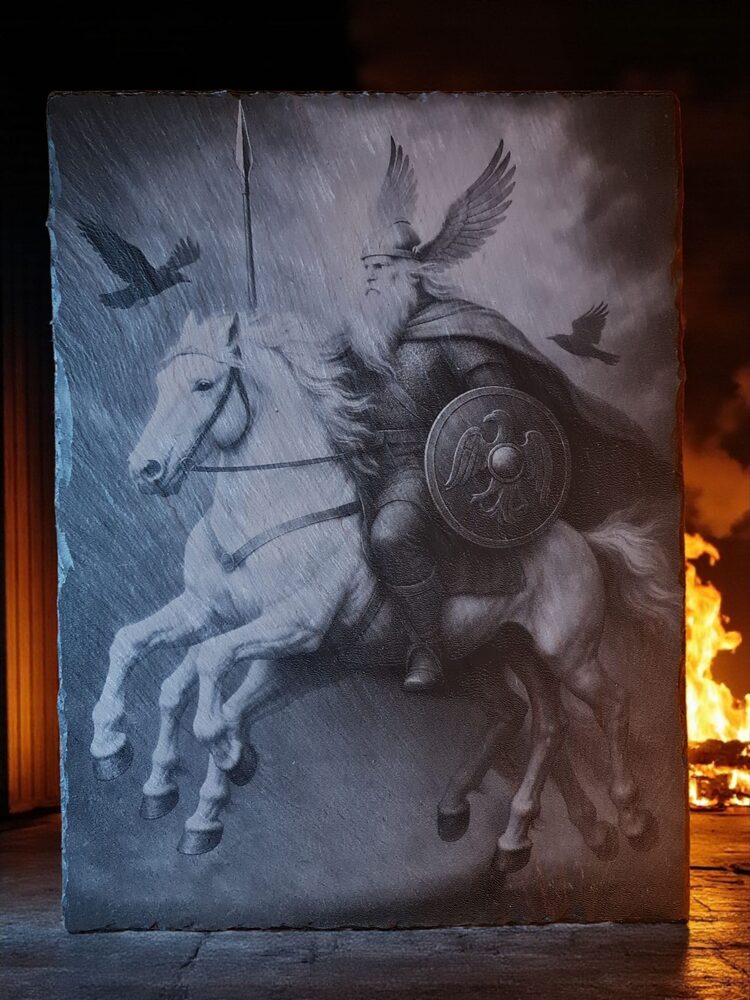
When we engrave Sleipnir in slate, wood or glass, we take our cue from the originals, not from fantasy posters. The best model is the Tjängvide rider: a slender, almost weightless horse's body, eight legs in rhythmic sequence, a small rider, perhaps a ship below. On dark slate this linework is especially striking, because the engraving shines out pale from the stone – much like the Gotland stones, which were originally painted.
The motif suits several occasions. As a memorial design it recalls the last journey without feeling grim. For riders and horse people he is simply "the best of steeds". And for anyone drawn to Odin he is the animal that carries the god across every boundary. We like to pair the image with a line of runes – a name in Younger Futhark, say – or with the line from Grímnismál.
Who is Sleipnir in Norse mythology? Sleipnir is Odin's grey, eight-legged horse. According to the Edda he is the best of all horses and can ride all the way to the realm of the dead.
Why does Odin's horse have eight legs? The sources don't say. Scholars discuss speed, the image of a bier carried by four men (Hilda Ellis Davidson) and parallels with shamanic mounts – none is proven.
Who are Sleipnir's parents? His father is the stallion Svaðilfari and his mother is Loki, who had turned into a mare. This is told in Snorri's Gylfaginning (ch. 42) and in Hyndluljóð (st. 40).
What does the name Sleipnir mean? It comes from Old Norse sleipr, "smooth, slippery", and means roughly "the gliding one".
Is Sleipnir shown on picture stones? Yes: the Gotland stones Tjängvide I and Ardre VIII (8th–9th century) show a rider on an eight-legged horse, usually identified as Sleipnir.
Which horse descends from Sleipnir? According to Völsunga saga, Grani, the horse of the hero Sigurd, which Odin himself helped him choose.
For courage. For remembrance. For legends that live on.
Odin · Hugin & Munin – Odin's ravens · Sacred horses · Loki · Valhalla.
All Beings & Creatures articles →
No horse draws the chariot of the strongest god, but two goats: Tanngrisnir („teeth-barer") and Tanngnjóstr …
Read more →Almost everything that makes the gods mighty comes from a single set of hands: those of the dwarves. Thor’s hammer …
Read more →Between gods and humans dwells a third, half-hidden race: the elves (Old Norse álfar). They are bright and beautiful …
Read more →At the feet of the father of the gods lie two wolves: Geri and Freki – both names mean „the greedy one". In the hall of …
Read more →