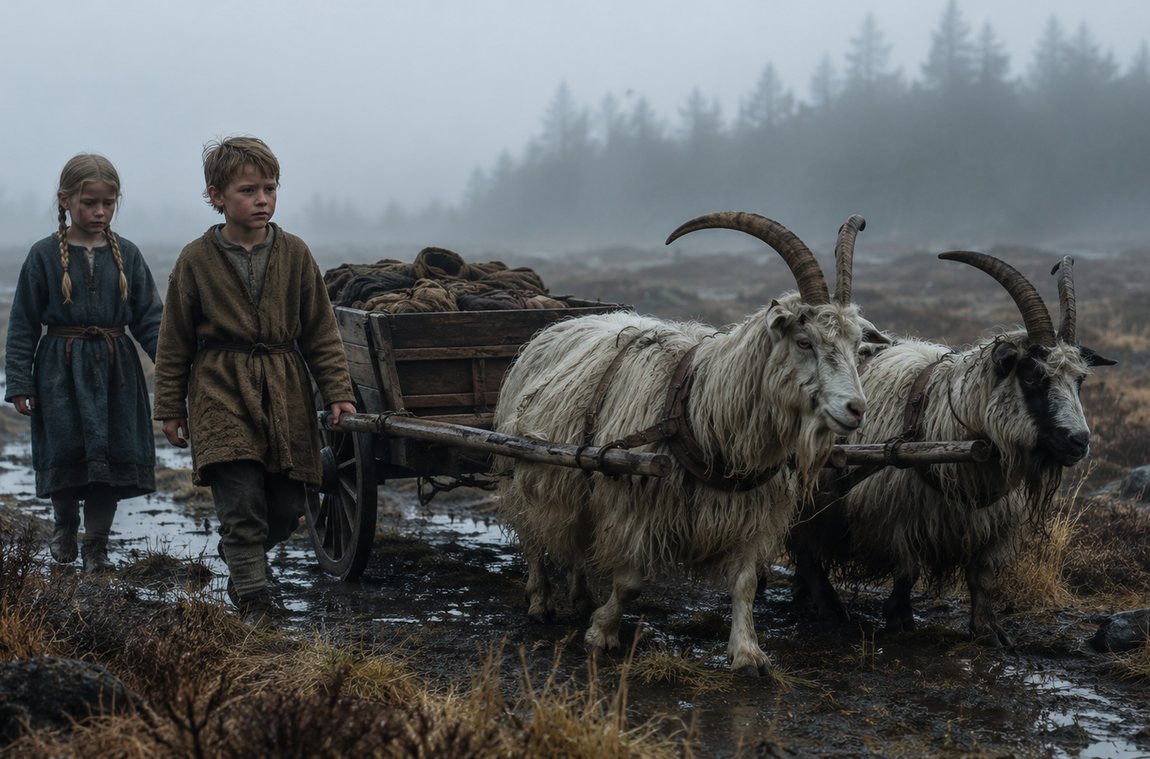
Tanngrisnir ("teeth-barer") and Tanngnjóstr ("teeth-grinder") are the two billy goats that pull Thor's chariot – which is why Snorri calls him Ökuþórr, "Driving Thor". Their fame rests on one night at a farmer's house: Thor slaughters them, shares the meat, has the bones laid on the hides and raises the goats again at dawn with Mjölnir. Because one bone was broken, one goat limps. Here is what the sources actually say, where the bone miracle may come from, and how much truth there is in the Yule goat link.
Picture a small farmhouse at nightfall. The hearth is burning, and at the table sits a red-bearded guest who has just butchered his own draught animals. He invites the whole family to share the meat and sets a single rule: every bone goes onto the hides, unbroken. At dawn he raises his hammer – and the goats get back on their feet. One of them, though, is limping.
Few scenes in Norse myth mix the divine and the farmyard quite like this one. It also has a scholarly afterlife: for more than a century researchers have argued over it, because an almost identical miracle turns up in Christian saints' lives. Here we look closely at the two animals themselves – their names, the chariot, the sources, the bone taboo, the St Germanus debate – and at whether the Scandinavian Yule goat really descends from Thor's team.
The names describe the animals. Tanngnjóstr combines tönn (tooth) with a word for grinding or gnashing: "teeth-grinder". Tanngrisnir also contains the tooth; the second element is usually read as "baring" or "snarling", while some translators prefer "gap-toothed". Either fits a billy goat. Anyone who has watched one chewing the cud knows the grinding sound, and the curled lip when he catches a scent.
The sources call them hafrar, he-goats, not geitr, nannies. That matters. A billy is strong, stubborn, pungent in the rutting season and only grudgingly harnessed to anything. That Thor drives such animals rather than horses says something about how the storytellers saw him: not an elegant rider but a god at home among farmsteads, byres and mountain pastures.
The names themselves survive only in the Prose Edda, written by the Icelandic scholar and politician Snorri Sturluson around 1220 – some two centuries after Iceland converted to Christianity. You can read more about him in Snorri Sturluson – the man we owe Norse mythology to. The goats appear in older poetry; their names do not. Whether Snorri took them from a lost poem, from a versified name list (a þula), or coined them himself cannot be determined.
In chapter 21 of Gylfaginning, the first major part of Snorri's Edda (chapter numbers vary between editions), we read: "Þórr á hafra tvá, er svá heita: Tanngnjóstr ok Tanngrisnir" – Thor owns two goats with these names. He also has a chariot that the goats pull, and that, says Snorri, is why he is called Öku-Þórr, "Driving Thor" or "Chariot Thor". The word belongs to the Old Norse verb aka, "to drive". An alternative derivation from the Finnish sky god Ukko ("Ukko-Thor") has been proposed, but it remains a fringe view. The by-name itself is attested only in Snorri.
The poets knew that Thor drives long before Snorri, though. In Þrymskviða, the lay of the stolen hammer, Thor sets off in bridal disguise to the giants. In Henry Adams Bellows' 1923 translation:
"Then home the goats | to the hall were driven, / They wrenched at the halters, | swift were they to run; / The mountains burst, | earth burned with fire, / And Othin's son | sought Jotunheim."Þrymskviða, st. 21, transl. H. A. Bellows (1923)
Where the team runs, rock splits. Older still is Haustlöng by the Norwegian skald Þjóðólfr of Hvinir, usually dated to around 900. It describes Thor's drive to his duel with the stone giant – in paraphrase: the moon's road thunders beneath him and the earth is lashed with hail. We tell the whole story in Thor versus Hrungnir: the duel with the stone giant.
An echo survives in Swedish. Etymological dictionaries (Elof Hellquist's among them) derive åska, "thunderstorm", from a compound of ás (god) and a word for driving or a draught team: "the god's drive". Whether medieval Swedes pictured Thor's goats when they used the word is something etymology cannot tell us. For the thunder god himself, start with Thor – thunder over Midgard.
Hymiskviða is especially rich. It tells how Thor and Tyr fetch a giant brewing cauldron from the giant Hymir for a feast of the gods. Early on (st. 7) they drive as far as a man called Egil, who looks after the goats while they continue on foot. Twice (st. 20 and 31) the poem calls Thor simply hafra dróttinn, "lord of the goats" – an honorific that shows how firmly the team belonged to his image.
In Snorri's own version of the fishing trip to Hymir, by contrast, Thor sets out like a young lad, with no chariot and no goats. Snorri clearly expects his readers to picture the god on his goat-cart, so he points out that this time Thor is travelling incognito. The best-known goat episode comes in chapters 44 and 45, as the prelude to the journey we follow in Thor at Utgard-Loki's.
Ökuþórr is travelling with his goats and chariot, and Loki is with him. In the evening they find lodging with a farmer. Then comes the line that still startles readers: "En um kveldit tók Þórr hafra sína ok skar báða" – in the evening Thor took his goats and slaughtered both.
The animals are skinned and put into the pot, and the household is invited to eat. Thor spreads the goatskins, the hafrstökur, away from the fire and tells everyone to throw the bones onto them. A noble guest providing his own dinner – on four legs.
But Þjálfi, the farmer's son, takes a thighbone, splits it with his knife and breaks it open to get at the marrow. Marrow was rich, fatty and prized; a hungry boy reaching for it is easy to understand.
Before daybreak Thor takes Mjölnir, raises it and hallows the hides: "tók hamarinn Mjöllni ok brá upp ok vígði hafrstökurnar". The goats stand up. But one is haltr eftra fæti, lame in a hind leg.
What follows is one of the most vivid scenes of divine anger in the Edda. Thor's brows sink over his eyes and he grips the hammer shaft so hard that his knuckles turn white – "svá at hvítnuðu knúarnir". The family cries out and offers everything they own. Seeing their terror, Thor's rage subsides. As settlement, sætt, he takes the children Þjálfi and Röskva into his service. He leaves the goats behind and continues on foot.
Snorri never tells us what became of the animals. The story of the two children – Þjálfi's race at Utgard-Loki's hall among other things – has its own page: Thjalfi & Röskva. Here we stay with the goats, and with the question of why one broken bone matters so much.
The logic is strict. The animal can only be restored whole if its skeleton stays whole. The meat may be eaten, the hide serves as the shell, and the bones are the framework from which the goat is rebuilt. Break one, and the damage carries over into the revived body.
Look at the verb. Snorri does not say that Thor healed the goats; he says Thor hallowed the hides with the hammer: vígja. We know that exact verb from tenth-century runestones. The Glavendrup stone on Funen reads "Þórr vígi þessar rúnar" – may Thor hallow these runes; the Virring stone in Jutland has "Þórr vígi þessi kuml" – may Thor hallow this monument. In Þrymskviða the hammer is to be laid in the bride's lap to hallow the marriage. Mjölnir, in other words, is a tool of blessing as well as a weapon. More in Thor's hammer Mjölnir – meaning, myth and what the finds really show.
Whether a real ritual lay behind the episode – a sacrificial meal with carefully handled bones, say – is speculation. No find can be tied unambiguously to this story. We read it as a narrative with a religious core rather than a description of a rite.
Hymiskviða closes, after Thor's escape with Hymir's cauldron, with two puzzling stanzas. Bellows renders the first (his st. 38, st. 37 in most Old Norse editions) like this:
"Not long had they fared | ere one there lay / Of Hlorrithi's goats | half-dead on the ground; / In his leg the pole-horse | there was lame; / The deed the evil | Loki had done."Hymiskviða, transl. H. A. Bellows (1923)
The final stanza reminds the audience that they already know what compensation Thor received from a dweller among the rocks: two children. The poem assumes the story we know from Snorri – but names a different culprit.
In Snorri the fault is Þjálfi's alone. Bellows himself noted in 1923 that Snorri does not blame Loki at all. That is typical of orally transmitted myth: there was no single correct version, only variants. Loki as the guilty party fits his role as troublemaker (more in Loki – helper and destroyer); Snorri's hungry farm boy makes the scene more human and explains why Þjálfi of all people ends up in Thor's service. Which version is older cannot be settled; many scholars regard Hymiskviða as a comparatively late eddic poem.
The Historia Brittonum, a Latin history of Britain compiled in Wales in the first half of the ninth century, contains a legend about St Germanus of Auxerre (chapter 32). Germanus tries to preach to a tyrannical king named Benli but is turned away at the gate. One of the king's servants takes the strangers in. He owns just one cow and her calf; he slaughters the calf and serves it to his guests. Germanus orders that none of its bones be broken. Next morning the calf is standing alive beside its mother.
Powerful guest, poor household, slaughtered animal, intact bones, revival at dawn – and the legend is roughly four hundred years older than Snorri's text.
In 1910 the Swedish folklorist Carl Wilhelm von Sydow, writing in Danske Studier, gathered several dozen such saints' legends, from the British Isles and France to the Alps, Transylvania and Rome. He concluded that the motif was Celtic and had travelled north in the Viking Age. Norse settlers, after all, lived for centuries in Ireland, Scotland and the isles.
Matthias Egeler re-examined the parallel in 2013. He criticises von Sydow for assuming a uniform "Celtic mythology" and for leaning on late folklore. Yet because the match is so close and the Historia so early, he still treats a direct link as a serious possibility. He is clear about the differences: in the Germanus story the calf belongs to the host, while Thor's goats belong to the guest; Germanus only forbids breaking the bones, whereas in Snorri the ban is actually broken.
Egeler's reading of the context is the intriguing part. For Germanus the miracle is a power play: the saint shows an unbelieving king whose god is stronger. If Norse storytellers transferred such a miracle to Thor, that would signal not a fading paganism but a confident reply – much like the tenth-century hammer pendants often read as an answer to the cross.
The strongest counter-position came in 2022 from the Danish scholar of religion Karen Bek-Pedersen, in an article with the memorable title "The Damaged Bone and the Lone Mushroom". Her point: the crucial element of Thor's story, the damaged bone and the limping animal, is missing from the Germanus legends. They can hardly be its direct source.
Instead she gathers parallels from an enormous area. Irish and Gaelic saints' legends include versions with a damaged bone. In Tyrolean hunting legends a supernatural master of animals feeds a human on chamois meat; if a bone goes missing, the revived animal limps. Witch trials in Milan (1390) and Modena (1519) record statements about animals eaten and then raised from their bones – in Milan even with wooden replacement bones. Armenian tales feature a rib made of walnut wood.
And then there are the Sámi. In the Sámi bear ceremony the bones of a slain bear were collected and buried so that the animal could return; such bear graves are known archaeologically. If a bone was damaged, by a dog for example, amends had to be made. For how the Norse saw their Sámi neighbours, read The Sámi in the Norse sources.
Bek-Pedersen concludes that the motif probably springs from very old thinking among northern hunting peoples: animals give themselves as food, provided humans respect their bones so they can come back. Thor's story would be one visible "mushroom" of a vast underground mycelium. She openly admits that in the end this is a matter of conviction. The two models need not exclude each other, either: an old motif could have been given a fresh edge after someone heard a saint's tale.
For all the comparative scholarship, this is a down-to-earth story. Goats were ordinary farm animals in medieval Scandinavia. In bone assemblages they usually appear together with sheep, because the skeletons of the two are hard to tell apart – specialists simply record "sheep/goat". Sheep tend to dominate clearly. For the wider picture, see Viking agriculture – the real backbone of the North.
A goat climbs and browses leaves, twigs and thin mountain grass. In Norway, with its steep slopes and summer pastures of the seter system, it was particularly useful: milk for cheese, meat, hide, leather, horn. A billy pulling a light cart is plausible enough, but we have no concrete Viking Age evidence for it.
Goats reached Iceland with the first settlers in the late ninth century. The Icelandic goat is regarded as descending from that early stock and has survived largely in isolation – but in the twentieth century it came close to extinction, with fewer than a hundred animals at times in the 1960s. Today the breed is actively conserved, though still considered endangered.
The farmhouse scene is everyday life too: slaughtering, skinning, boiling in the cauldron, long bones cracked open, as settlement excavations show by the thousand. Every listener knew exactly what Þjálfi was doing – what you do with a thighbone. And goats are not alone in the myths: on Valhalla's roof stands Heiðrún, whose udder streams with mead (see Heidrun and Eikthyrnir: mead and rivers on Valhalla's roof). Thor's goats pull; Odin's goat feeds.
The sources never explain it. Modern interpretations exist – and should be labelled as such. First, sound: a cart over rock rumbles like thunder, and gnashing billies are not quiet beasts. Second, the farming world: in Hárbarðsljóð Odin taunts, in paraphrase, that the nobles who fall in battle are his, while Thor gets the race of thralls. A goat team suits that image better than a steed like Sleipnir. Third, comparison: in ancient India the god Pūṣan, guardian of roads and herds, drives a chariot drawn by goats, and some see an Indo-European inheritance here – though the bridge is thin. For the wider bestiary, see our guide to the animals of the Norse world.
Does the Scandinavian Yule goat descend from Tanngrisnir and Tanngnjóstr? The honest answer: possibly, but it is unproven – and specialists disagree.
The facts first. In Sweden the julbock is known today mainly as a straw goat. The most famous one has been built in Gävle every year since 1966 and falls victim to arsonists almost as regularly. In Norway, people in disguise went julebukking from house to house at Christmas, receiving food and drink; emigrants took the custom to the American Midwest. In Finland, Father Christmas is still called joulupukki, literally "Yule goat".
According to the Nordiska museet in Stockholm, the Yule goat was once a wild figure: someone in disguise with a goat's head on a pole, playing pranks, butting the maids with its horns and only calming down once given food and spirits. Later it brought presents for a time, until the jultomte took over that job.
And Thor? The romantic derivation says: goats, midwinter, thunder god – they must belong together. Folklorists point to other roots: medieval processions in which St Nicholas led a chained devil in goat form; harvest customs in which the last sheaf was shaped into a "goat"; and winter mumming of the kind found all over Europe. Written evidence for the Yule goat begins centuries after the Viking Age.
None of that spoils a good straw goat. For what the midwinter feast really looked like in the sources, see Yule – the festival of the long nights. And in our workshop in Alsdorf the goats turn up now and then on wood and slate – because they show Thor from a rare angle: a guest at a poor farmer's fire who shares, flares up, and then shows mercy after all.
What are the names of Thor's goats? Tanngrisnir ("teeth-barer") and Tanngnjóstr ("teeth-grinder"). The names survive only in Snorri's thirteenth-century Prose Edda.
What does Ökuþórr mean? "Driving Thor" or "Chariot Thor". Snorri explains the by-name by the chariot the goats pull.
Why is one of Thor's goats lame? According to Snorri, the farmer's son Þjálfi split a thighbone for its marrow, so when Thor revived the goats with Mjölnir one was lame. Hymiskviða blames Loki instead.
Is the Yule goat related to Thor's goats? That is unproven and disputed. Christian St Nicholas processions and harvest customs are also discussed as possible origins.
Are there similar stories in other cultures? Yes: the Germanus legend in the ninth-century Historia Brittonum, Irish saints' lives, Tyrolean hunting legends and the Sámi bear ceremony.
For courage. For remembrance. For legends that live on.
Thor · Thjálfi & Röskva · Mjöllnir · Thor and Utgard-Loki.
All Beings & Creatures articles →
Almost everything that makes the gods mighty comes from a single set of hands: those of the dwarves. Thor’s hammer …
Read more →Between gods and humans dwells a third, half-hidden race: the elves (Old Norse álfar). They are bright and beautiful …
Read more →At the feet of the father of the gods lie two wolves: Geri and Freki – both names mean „the greedy one". In the hall of …
Read more →The end of the world does not begin with thunder but with a rooster's crow — and it sounds three times over. Three …
Read more →