Almost everything we think we know about Odin, Thor and the end of the world runs through a single figure: an Icelandic chieftain named Snorri Sturluson. He was a politician, a prolific writer, the richest man on the island – and a storyteller who ordered, interpreted and wrote down the gods of his heathen ancestors roughly two hundred years after Iceland had converted to Christianity. Without him we would know alarmingly little. With him we have to look very closely.
Snorri was born in 1179 into a family that would shape Iceland for generations – the Sturlungar, named after his father Sturla Þórðarson of Hvammur. As a small boy Snorri was sent to one of the most powerful households on the island: he was raised at Oddi, in the care of Jón Loftsson, a grandson of the scholar Sæmundr fróði. Oddi was no ordinary farm but a centre of learning, where old genealogies, kings' histories and the art of poetry were cultivated. Here Snorri learned to read and write and – perhaps most importantly – mastered the craft of skaldic verse, with its intricate kennings and demanding metres.
That upbringing explains a great deal. Snorri was not a cloistered monk in a writing cell but a man who lived from childhood in the world of chieftains, inheritance claims and orally transmitted stories. When Jón Loftsson died in 1197 Snorri had almost no inheritance of his own – yet he married shrewdly, acquired land and wealth, and began a meteoric rise that would carry him to the very top of Icelandic society.
Medieval Iceland had no king. It was a Free State governed by a handful of chieftains (goðar) who competed for power, followers and farms. In that game Snorri was a master. Through clever marriages, inheritances and alliances he amassed a fortune that few on the island could match. For a time he was simply regarded as the most powerful and wealthy man in Iceland.
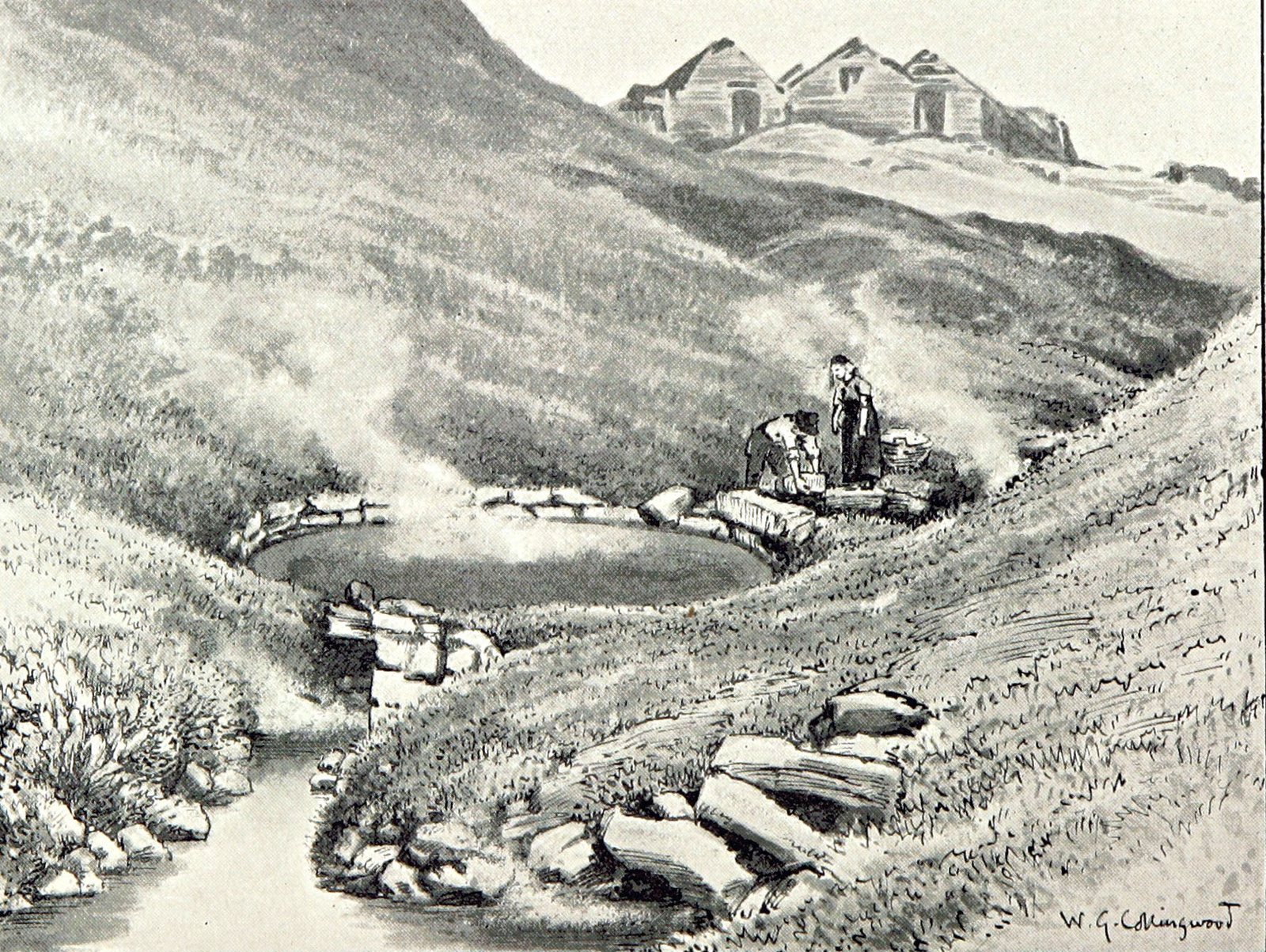
His main residence became Reykholt in the west of the island. There he had a fortified farm built, complete with an underground passage – and a stone bathing pool fed by a hot spring: the famous Snorralaug, which still exists today and ranks among the best-preserved structures of medieval Iceland. Picture it: a chieftain who, after a day of lawsuits and verses, sits in his own warm bath and muses about the gods. Reykholt became the centre of his work – and later the place of his violent death.
The highest office an Icelander could reach in the Free State was that of Lawspeaker (lögsögumaðr) at the Althing, the annual assembly on the plains of Þingvellir. The Lawspeaker had to know the entire body of law by heart and, year after year, recite portions of it from the Law Rock – in an age when the laws had not yet been fully written down. Snorri held this office twice, from 1215 to 1218 and again from 1222 to 1231.
This is more than a footnote. It shows that the author of the Edda was a man of the spoken, ordered word – someone accustomed to holding vast amounts of inherited knowledge in his head, systematising it and passing it on. Precisely this ability shapes his books: they are the attempt to bring a scattered oral heritage into a clear, teachable order.
Snorri's most famous work is the Prose Edda (also the Snorra Edda or Younger Edda), written around 1220. It is important to grasp why he wrote it: not as a pious devotional book, and not as a history of religion, but as a manual for aspiring skalds. The old court poetry was in danger of dying out because hardly anyone still understood the mythological allusions on which its imagery depended. Anyone who wanted to decode „the fire of Ægir's hall" (gold) or „Grani's burden" (also gold, after Sigurd's horse) had to know the stories behind them.
So Snorri structured his work cleverly. The Gylfaginning („The Deluding of Gylfi") tells the myths from creation to Ragnarök in the form of a framed dialogue – the Swedish king Gylfi questions three mysterious figures. The Skáldskaparmál („The Language of Poetry") explains the kennings and supplies the stories needed to interpret them. And the Háttatal („List of Verse Forms") is a praise poem of 102 stanzas for King Hákon and Jarl Skúli that simultaneously demonstrates a hundred different metres. Without the Gylfaginning we would know almost nothing about the structure of the nine worlds, about Yggdrasil, or about the ordered sequence of Ragnarök.
Snorri's second great work is the corpus of kings' sagas gathered under the name Heimskringla. The name comes from the very first words of the text – kringla heimsins, „the orb of the world that mankind inhabits". It is a history of the Norwegian kings from the legendary past, through the Ynglingar and Harald Fairhair, down to the twelfth century, with the saga of Saint Olaf as its monumental centrepiece.
What is remarkable is how methodically Snorri proceeds. In his preface he explains what he relies on and why: the testimony of old, learned men, genealogies – and above all the poems of the skalds, which were recited before the princes themselves while they still lived. His reasoning is strikingly sober.
With Snorri himself we rely most on what is said in those poems that were recited before the princes themselves, or before their sons. We take everything to be true that is told in such poems about their journeys and battles. For although it is the way of skalds to praise most highly the one before whom they stand, none would dare to recount to his face deeds that all the listeners, and he himself, would recognise as lies and empty boasting – that would be mockery rather than praise.Snorri Sturluson, Heimskringla, preface (rendered from the Old Norse)
This is source criticism in the thirteenth century: a contemporary praise poem may exaggerate, but it cannot invent wholly fictitious battles without disgracing the poet before everyone present. That cool line of argument shows a Snorri who reflects on the truth-value of his sources – and it makes him one of Europe's early historians to lay his method bare.
Beyond the Edda and Heimskringla, Snorri is also, with high probability, credited with Egils saga Skalla-Grímssonar, the story of the battle-hardened poet-Viking Egill Skallagrímsson. No medieval manuscript names an author, however; the attribution to Snorri rests on internal grounds – Egill belonged to Snorri's own ancestral line, the saga is set in his region, and its style and its interest in skaldic verse fit conspicuously well. There is no certainty. It is a reasoned but open attribution – a good example of how much in saga scholarship remains argument rather than proof.
To understand why Snorri wrote at all, you have to know the skaldic poetry he wanted to save. Skaldic verse almost never calls things by their plain names. Instead of „gold" it says „Ægir's fire" or „Sif's hair"; instead of „battle", „the storm of spears"; instead of „warrior", „the tree of the sword". Such circumlocutions are called kennings, and many of them presuppose mythological knowledge: if you do not know that the dwarf Andvari cursed his gold, or that Loki cut off Sif's hair, you simply cannot understand the poem.
This is precisely where Snorri's real purpose lies. The Skáldskaparmál is not a story collection for its own sake but a kind of dictionary of poetic images: Snorri lists the kennings systematically, assigns them to the gods and heroes, and tells the underlying stories along the way. That we know myths today such as the theft of Idun's apples or Thor's cauldron-quest to Ægir is a by-product of this textbook. Snorri set out to train poets – and in doing so preserved an entire world of gods.
It does Snorri an injustice to see him only as a collector of northern sagas. He was a European-educated author of the High Middle Ages, familiar with Latin learning, with the idea of universal history, and with the euhemeristic interpretation of ancient gods that Christian scholars had long applied to Jupiter and Saturn. His Troy prologue is no slip but a deliberate attempt to fit the northern past into the grand narrative of world history – the Æsir as descendants of Trojan heroes, Thor as a distant kinsman of Priam.
At the same time he stayed deeply rooted in native material. The Heimskringla combines both: sober source-criticism of skaldic verse with a narrative breath that turns individual kings into unforgettable figures. This mixture – learned method and gripping storytelling – is rare, and it explains why Snorri's works have outlasted the centuries while many drier chronicles are forgotten.
Snorri was never only a scholar. Twice he travelled to Norway, to the court of the young king Hákon Hákonarson and the powerful Jarl Skúli. The Háttatal, the metrical tour de force at the end of the Edda, is addressed precisely to these two – poetry as a diplomatic gift. Hákon granted Snorri rank at court, but that also made him a piece in the Norwegian power game: the king wanted to bring Iceland under his crown, and Snorri found himself caught between the fronts.
In Iceland, meanwhile, raged the so-called Age of the Sturlungs, an era of bloody feuds between the great families in which the old Free State gradually disintegrated. Snorri became deeply entangled in alliances, inheritance disputes and the conflict with the Norwegian king. When he returned to Iceland without royal permission and lost Hákon's trust, it proved his undoing.
On the night of 23 September 1241, armed men acting on behalf of his former son-in-law Gizurr Þorvaldsson – who in turn was acting in King Hákon's interest – broke into Snorri's farm at Reykholt. The old chieftain fled into the cellar. According to tradition he called out to his killers the words „Eigi skal höggva!" – „You shall not strike!" They struck all the same.
So ended the man to whom we owe the greater part of our knowledge of the Norse gods – not on the battlefield and not with honour, but as a victim of exactly the power struggles he had played along with all his life. Barely two decades later, in 1262–1264, Iceland finally submitted to the Norwegian crown. The Free State, whose law Snorri had once recited from the Law Rock, was history.
And here comes the decisive point, without which Snorri is thoroughly misunderstood: he wrote around 1220–1230 – roughly two hundred years after Iceland had accepted Christianity in the year 1000. Snorri was himself a Christian. He did not worship the old gods; he wrote about them, with the distance of an educated man who wished to preserve a dying heritage without professing himself a heathen.
That colours everything. Snorri systematises where the old sources are contradictory. He orders the nine worlds, divides the gods neatly into families, gives Ragnarök a clear sequence. Much of this is probably his ordering achievement, not the wording of heathen belief. It shows most clearly in the prologue to the Edda: there Snorri simply declares the gods to be immigrant human beings – the Æsir, he says, came from Asia, from the region of Troy, and were only later mistaken for gods. This interpretation is called euhemerism, and it is a neatly Christian device: it lets one tell the old stories without betraying the one God.
For all the caution: Snorri must not be belittled. Without the Prose Edda, Norse mythology would be a field of rubble made of allusions. We would have the Poetic Edda, a handful of skaldic verses, scattered runestones and picture stones – but scarcely a connected narrative. It was Snorri who handed down to us Odin's self-sacrifice on the world tree, Thor's journey to Utgarda-Loki, the death of Baldr and the doom of the gods as tellable stories. He rescued a dying body of knowledge into the future – and inevitably left his own signature on it.
Therein lies exactly the honest stance that suits a brand like Glanz & Gravur, which sees the North not as kitsch but as real history: Snorri is our most precious source and an author with intent. You may love him – you just have to read him critically. Do that, and behind the ordered myths you can still hear the roar of a far older, far wilder world.
The Edda · Ragnarök · The Norse pantheon · Odin · What comes after Ragnarök.
Some heroes set out with a sword. Svipdagr sets out with the protective charms of his dead mother – and with a task he …
Read more →Among all the gods, giants and dwarves there are two who are different: Thjálfi and Röskva, a pair of farmer's children …
Read more →This is the tale in which the immortal gods turn grey for the first and only time. An eagle on an ox, an extorted oath …
Read more →Before Thor is humbled in the stronghold of Utgard, he meets on the road a giant so vast that the gods spend the night …
Read more →