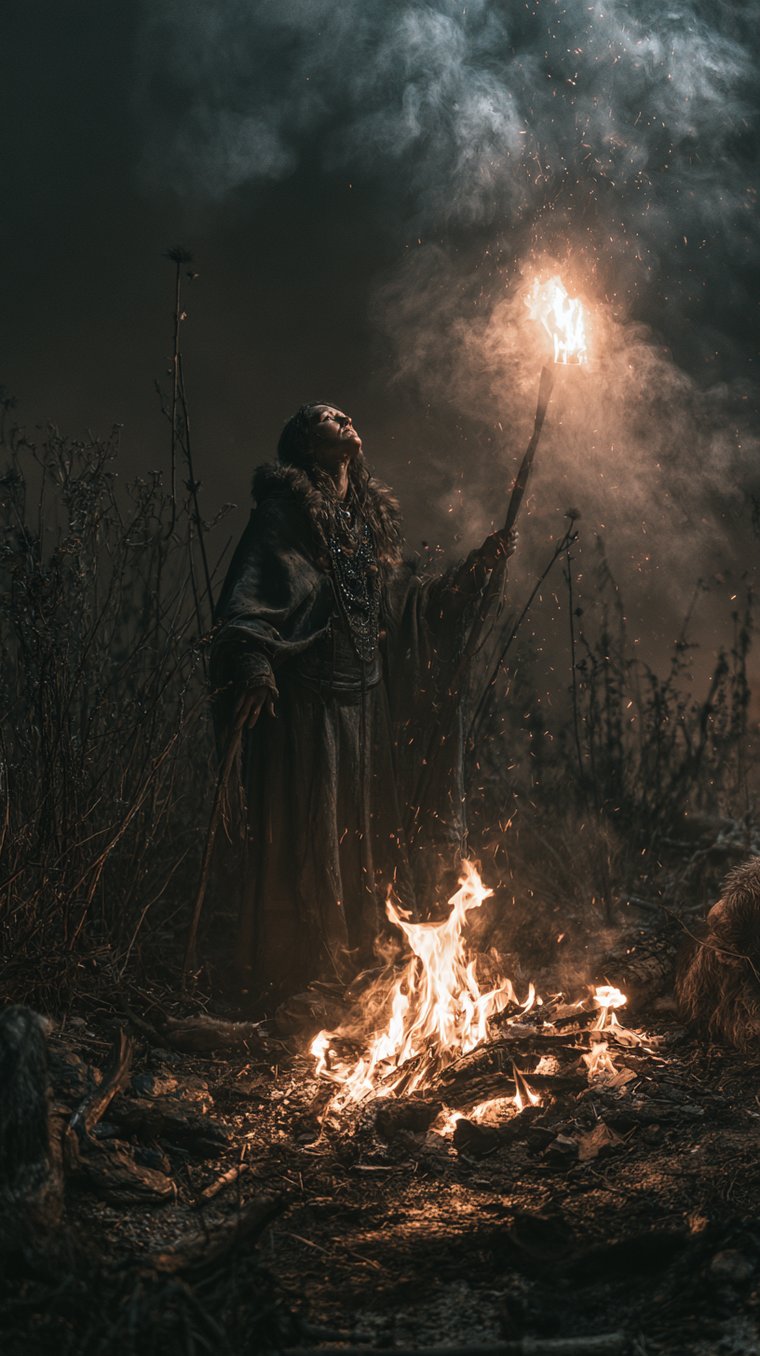
Some heroes set out with a sword. Svipdagr sets out with the protective charms of his dead mother – and with a task he did not choose.
Most heroic tales of the North begin with weapons, feuds and blood. The Svipdagsmál begins at a grave. Young Svipdagr has been set a seemingly impossible task by his stepmother: he is to win the far, unattainable Menglöd. Instead of charging off, he does the wisest thing a son in this world can do – he goes to the grave-mound of his dead mother Gróa and asks her for help. That opening sets the tone of the whole poem: here it is not the strength of the arm that counts, but the knowledge and blessing of the ancestors.
The lay falls into two parts, which only 19th-century scholarship grouped under the name Svipdagsmál: the „Grógaldr" (Gróa’s spell) and the „Fjölsvinnsmál" (the lay of Fjölsviðr). Both belong together through the figure of Svipdagr and the goal of Menglöd, telling a single quest – from the plea at the grave to the arrival behind the flames.
Svipdagr wakes his mother from death. Gróa, a knowing sorceress, rises once more and sings him nine mighty protective charms for the road – against slipping on a smooth path, against foes, against tearing water, against cold in the mountains, against fetters on hands and mind, against the storm on the high sea. Each charm covers a danger of the journey; together they are a mother’s shield that works beyond death.
„Awake, Gróa! Awake, good woman! At the doors of the dead I call thee." — Grógaldr, after Thorpe
It is one of the tenderest and at the same time most uncanny scenes of Norse magic. Tender, because a mother still cares for her child from the grave; uncanny, because the hero must cross the border between the living and the dead to reach her. The nine charms recall the spell-songs Odin claims for himself in the Hávamál – protective words that keep travellers and fighters safe. Care and magic are one here.
Armed with Gróa’s charms, Svipdagr reaches a mighty castle ringed with licking fire. At its gate stands the warden Fjölsviðr („the very wise"), who turns every stranger away. Now comes what makes the poem so Eddic: no sword-fight, but a contest of knowledge. Question by question Svipdagr draws from the warden the lore of the castle, the tree that overshadows it, the cock on its crown, the hounds that guard the entrance, and the name of the lady within: Menglöd.
Only when Svipdagr at last names his true name does everything turn. The gates open, Menglöd rises and greets him – not as a stranger, but as the long-awaited one. The quest ends not in blood but in a reunion that lay in fate from the start. The wall of fire, the warden, the questions: all were tests that only the one for whom the bride was destined could pass.
As lovely as the poem is, honesty requires placing it: the Svipdagsmál stands in no medieval main manuscript of the Edda. It survives only in paper manuscripts of the late 17th century, and its language and verse count as comparatively young. It is thus more a late echo of the old lay-poetry than a witness from the Viking Age. The popular reading that Menglöd is none other than the goddess Freyja and Svipdagr her husband Óðr is attractive, but speculation.
And yet the lay carries a genuine old core: the idea that the dead can still help the living, that knowledge is the true key, and that some paths are not won by force but opened by name and fate. For us that is one of the finest messages of the North – and a reason we so gladly bind runes and old motifs into lasting material: that, too, is a passing-on across time.
Seiðr & Magic · Sacred Horses & Cults · Hervör Wakes the Dead · Sigurd & Brynhild.
Grógaldr & Fjölsvinnsmál; Karl Simrock, Die Edda (1851); Benjamin Thorpe (1866). Rudolf Simek, Dictionary of Northern Mythology.
Among all the gods, giants and dwarves there are two who are different: Thjálfi and Röskva, a pair of farmer's children …
Read more →This is the tale in which the immortal gods turn grey for the first and only time. An eagle on an ox, an extorted oath …
Read more →Before Thor is humbled in the stronghold of Utgard, he meets on the road a giant so vast that the gods spend the night …
Read more →Her name is Þrúðr („strength, power") and she is the daughter of Thor and Sif. Around her turns one of the craftiest …
Read more →