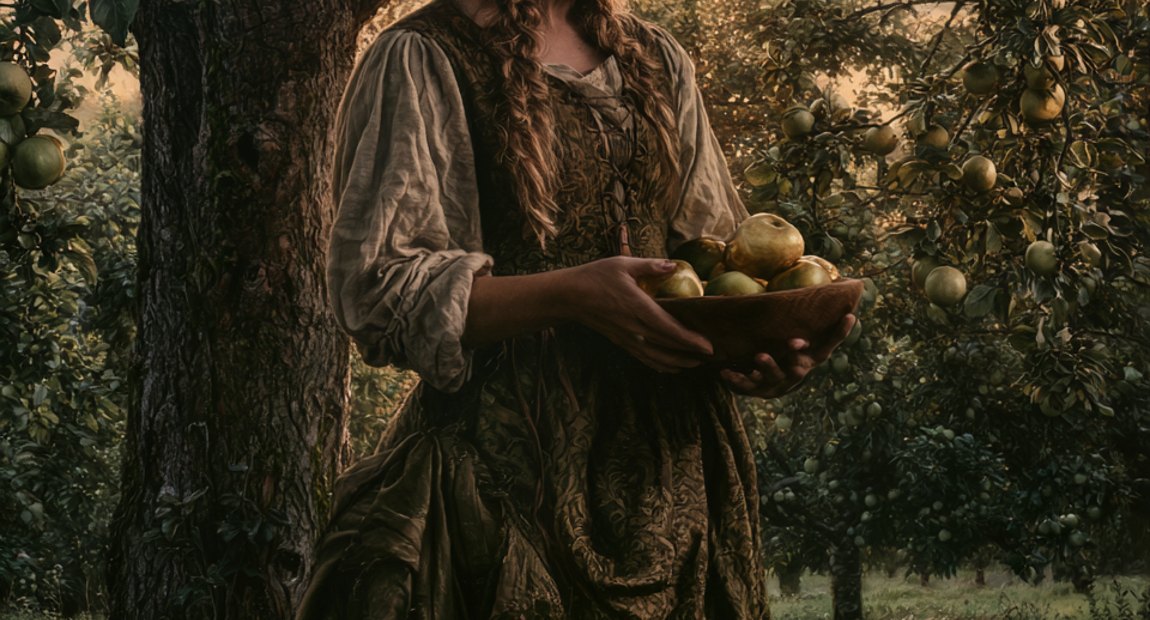
This is the tale in which the immortal gods turn grey for the first and only time. An eagle on an ox, an extorted oath, a goddess turned into a nut, and a fire on the wall of Asgard that scorches a giant's feathers. The theft of Idun is one of the loveliest sagas of the Edda, and out of it grows, along the way, the story of a giant's daughter later called Skadi. Let us sit down and listen.
Three gods are travelling: Odin, Hœnir and Loki. The road is long, the land barren, the hunger great. At last they drive an ox out of a herd, slaughter it and lay it in the fire. But however long they wait, the meat will not cook. They stoke the fire anew, test it, wait, and again the ox is raw. Then they hear a voice from the oak above them: a huge eagle sits there and declares that it is he who prevents the cooking. If they give him a share of the ox, the meat will soon grow tender. The hungry gods agree.
The eagle swoops down and at once seizes the best pieces for himself, two haunches and both shoulders. That is too much for Loki. He grabs a great pole and strikes at the greedy bird. But the pole sticks fast to the eagle, and Loki's hands stick to the pole. The eagle rises and drags Loki over rock and root, low above the ground, so that his arms are nearly torn from their sockets. Loki begs for mercy. The eagle, however, who is in truth the giant Thjazi in eagle form, names his price: Loki must lure the goddess Idun with her apples out of Asgard. In his pain Loki swears the oath and is set free.
Idun keeps the golden apples that the gods taste when age begins to touch them, and which make them young again. Without these apples there is no eternal youth in Asgard. At the appointed time Loki lures the unsuspecting Idun beyond the walls. He has found, he says, apples in the wood quite like hers; she should bring her own along to compare. Idun follows him out. Then Thjazi comes flying in eagle guise, seizes Idun together with her apples, and carries her off to his mountain home Þrymheimr.
Þrymheim the seventh is called, / where Thjazi dwelt, / that giant of terrible strength.after the Prose Edda / Grímnismál (Henry Adams Bellows, translation tradition 1923)
Now begins for the gods what they have never known. Without Idun's apples they age. Their hair turns grey, their skin withers, their limbs stiffen. Bewildered and greyed, they hold council and search for the guilt. Soon it is clear that Idun was last seen with Loki. They seize the cunning one, and under threats he confesses everything. Then he receives what every good saga needs: the chance to make amends, but only under compulsion. Anyone wishing to know this healing keeper of youth more closely will find her in the portrait of Idun and the apples of youth.
Loki borrows Freyja's falcon cloak and flies to Þrymheim. Thjazi happens to be out at sea, rowing, and the hall stands open. Loki finds Idun alone, swiftly turns her into a nut, takes her in his claws, and flies, as fast as the falcon wings will carry him, back towards Asgard. Soon Thjazi returns, discovers the empty hall, dons his eagle cloak and gives chase. An eagle behind a falcon, over sea and land, and the eagle is faster.
But the gods see the two coming. They heap wood shavings and brushwood upon the wall of Asgard. No sooner has Loki swept over the wall with the nut than they light the fire. The eagle Thjazi, in full flight and too close, can no longer check himself. His feathers catch fire, he crashes to the ground within the walls, and there the gods slay him. So ends the giant who had meant to steal youth itself.
That is not the end of the matter. Thjazi's daughter Skadi arms herself with helmet, mail and weapons and rides to Asgard to avenge her father's death. But the gods offer her reconciliation. In compensation she may choose a husband from among them, yet only by their feet, without seeing the men. She spies a pair of especially beautiful feet and believes it is Baldr the radiant. But it is Njörd, the god of the sea. So the goddess of mountains and winter gains a husband from the salty deep, a marriage between two worlds that does not last long. Secondly, Skadi demands that they make her laugh, which in her grief seems impossible. Then Loki ties a cord to the beard of a goat and to his own body and stages a tug-of-war, until both bleat and shriek and Loki finally tumbles into the goat's lap. Skadi has to laugh. Last of all, Odin comforts her: he takes Thjazi's eyes and casts them into the sky, where from then on they shine as two stars. So the North reconciles vengeance and law, grief and laughter, in a single story.
The narrative appears in Snorri's Skáldskaparmál and there draws on the Haustlöng of the skald Þjóðólfr ór Hvíni from the ninth or early tenth century, a shield poem that renders the scenes explicitly as the description of painted images. The giant Thjazi and his dwelling Þrymheimr are named independently in the eddic Grímnismál, as is the connection to Skadi. The main outlines of the saga are thus secured by more than one source and belong to the old mythological stock.
Idun's apples are today often read as a symbol of Norse nature magic or as evidence of a Viking-Age apple cult. A word of caution: the Old Norse word epli denoted fruit or tree-produce in general, not necessarily the apple of our imagination, and the only fully worked-out narrative comes from Snorri, a good two hundred years after conversion. That the Vikings actually venerated apples as youth-giving cult objects is not attested. The apples are a powerful literary image of youth and ageing; the sources yield no more certain knowledge than that.
Idun & the apples of youth · Loki · Skaði – goddess of the mountains · The treasures of the gods · The Norse pantheon.
Before Thor is humbled in the stronghold of Utgard, he meets on the road a giant so vast that the gods spend the night …
Read more →Her name is Þrúðr („strength, power") and she is the daughter of Thor and Sif. Around her turns one of the craftiest …
Read more →The funniest and at the same time most profound Thor story is a string of defeats – that are none at all. On his …
Read more →A poet who fears for his reward, and a lord who lets himself be celebrated: the Vellekla („gold-lack“) by the skald …
Read more →