Idun (Old Norse Iðunn) is the Norse goddess who keeps the gods young: according to Snorri Sturluson she guards apples in a wooden box, and the Æsir bite them whenever old age creeps up. When the giant Þjazi abducts her with Loki's help, the gods turn grey and old. Here is what the oldest source, the skaldic poem Haustlöng, actually says, what Snorri added, what Lokasenna reveals about her – and why scholars ask whether the apples were apples at all.
Odin has his spear, Thor his hammer, Freyja her magic. And underneath all that power sits a quiet woman with a box. Take the box away and the lords of the world start going grey.
That woman is Iðunn, usually anglicised as Idun, Idunn or Ithun. She is one of the oddest figures in Norse myth: she barely acts, barely speaks, and yet the gods' freedom from age depends on her. Follow her trail and you arrive at one of the best stories in the whole tradition – the theft by the giant Þjazi – and at a lively scholarly argument over a single word: epli, apple.
As always, we keep the layers apart: what a skald composed around 900, what Snorri made of it in the thirteenth century, and what was added later still.
Iðunn is one of the ásynjur, the goddesses of the Æsir. Her husband is Bragi, god of poetry. Beyond that the medieval texts tell us almost nothing about her background: no parents, no children, no hall of her own.
The record is thin, but it goes back a long way. For Iðunn we have a poem roughly three centuries older than Snorri's Edda – a luxury many goddesses do not enjoy.
On top of that, the Icelandic Landnámabók (Book of Settlements) records two women called Iðunn. The name was therefore in use as a personal name during the settlement of Iceland in the tenth century.
The usual explanation splits Iðunn into two parts. The first is ið-, an Old Norse prefix meaning "again, anew, repeatedly". You meet it in iðgrœnn, "evergreen, greening again". In Völuspá, after the end of the world, an earth rises from the sea that is called iðjagrœna – the "ever-greening" one. The second element, -unn, is a common ending in women's names whose meaning is less clear.
Hence the translation found in most handbooks: "the rejuvenating one", "the renewer", sometimes "ever young". Rudolf Simek follows this line in his Dictionary of Northern Mythology. It is not certain in every detail, but it is linguistically sound and fits the myths remarkably well.
John Lindow makes a sharp observation here. If the name already means "ever young", the goddess hardly needs apples to grant youth – she would be the power of renewal herself. The apples might then be a later, more tangible way of telling it. Keep that thought; we will need it.
The most important witness to Iðunn is not an Eddic lay but a skaldic poem. Skalds were court poets who composed in strict, intricate metres for kings and chieftains. Their verse is often considered comparatively well preserved, because the rigid form made changes difficult.
The poem is called Haustlöng, "Autumn-long" – perhaps because it took the poet an autumn to compose. Its author was the Norwegian Þjóðólfr of Hvinir, generally dated to around 900. The occasion is wonderfully practical: a man named Þorleifr had given the poet a painted shield, and Þjóðólfr thanks him by describing its pictures in verse. Stanzas 1–13 tell of Iðunn's abduction; stanzas 14–20 of Thor's duel with the giant Hrungnir. The poem survives only because Snorri quotes it in Skáldskaparmál.
What does Haustlöng tell us? Three gods – Odin, Loki and Hœnir – are on the road; an eagle appears; Loki gets stuck to it; and the goddess is carried off to the giants. In stanza 9, Iðunn is the one who knew the ellilyf ása, literally the "old-age medicine of the Æsir". In stanza 10 the gods become hárar ok gamlar: grey-haired and old.
Here is the point most popular retellings miss: Haustlöng never mentions apples. There is a remedy against age, and Iðunn knows it. What it consists of, the skald does not say. The goddess is even named only once, her name artfully split across two lines, as skaldic style loved to do. Otherwise Þjóðólfr refers to her through kennings – poetic circumlocutions – such as "lady of the gods" or "girl-friend of the Æsir".
The familiar, detailed story opens Snorri's Skáldskaparmál, his handbook of poetic diction. The frame: the sea-giant Ægir is feasting in Asgard, seated beside Bragi, and Bragi tells him old tales – the first chapters of the work, depending on the edition. Snorri clearly has Haustlöng in front of him and spins its terse hints into a full narrative.
Odin, Loki and Hœnir are crossing mountains and wasteland. Hungry, they spot a herd of oxen in a valley, slaughter one and put it in an earth oven. But the meat will not cook – not the first time, not the second. Then a voice speaks from the oak above them: a great eagle sits there and says he is the cause. Give him his share, and the meat will cook.
The gods agree. The eagle swoops down and grabs both thighs and both shoulders of the ox. Loki, furious, seizes a long pole and strikes at the bird. Mistake: the pole sticks fast to the eagle, Loki's hands stick fast to the pole, and the eagle takes off – flying just low enough for Loki's feet to drag over rocks, scree and trees. Loki begs for mercy. The eagle, who is really the giant Þjazi, will release him on one condition: Loki must bring Iðunn and her apples out of Asgard.
Loki swears, returns to his companions and says nothing. At the agreed time he lures Iðunn out into a forest. His bait is clever: he has found apples there that she will think precious, and she should bring her own to compare. The moment they are outside, Þjazi arrives in eagle form, seizes Iðunn and carries her off to Þrymheimr, his home in the mountains.
Now we see how fragile the world of the gods really is. Without Iðunn, Snorri says, the Æsir quickly grow grey and old. They hold an assembly and ask who saw her last. The answer: she was seen leaving Asgard with Loki. So they seize Loki and threaten him with death or torture. Loki promptly promises to fetch her back – if Freyja lends him her falcon shape.
As a falcon, Loki flies north to giant-land. He is lucky: Þjazi has rowed out to sea, and Iðunn is alone. Loki turns her into a nut, takes her in his claws and flies off. But Þjazi returns, notices the loss, puts on his eagle shape and gives chase. The eagle is fast, and the gap closes.
From the stronghold the Æsir see the falcon coming with the nut, the eagle close behind. They carry loads of wood shavings to the wall. The falcon slips over the wall and drops down behind it. At that moment the gods set the shavings alight. The eagle cannot stop, its feathers catch fire, it falls – and the Æsir kill Þjazi inside their gates. Snorri adds drily that this killing is very famous.
Famous indeed – so famous that several gods claim the credit. In Lokasenna Loki boasts to Skaði that he was first and foremost at her father's death. In Hárbarðsljóð (st. 19) Thor claims he killed Þjazi and threw his eyes into the sky. The myths contradict one another here. The North never had a single authorised scripture.
Þjazi's death does not end the story. His daughter Skaði puts on helmet and mail, takes up her weapons and marches on Asgard to avenge her father. The gods offer her settlement and compensation – exactly how a killing was resolved in Norse law. She may choose a husband from among the gods, but she may see only their feet. Skaði picks the most beautiful feet, hoping they belong to Baldr. They belong to the sea-god Njörðr.
The second condition: the gods must make her laugh, which she thinks impossible. Loki solves it in the crudest way the Edda knows – a cord tied between a goat's beard and his own genitals. Both shriek, Loki tumbles into Skaði's lap, and she laughs. As further compensation Odin throws Þjazi's eyes into the sky, where they shine as two stars.
So Iðunn's abduction is no isolated fairy tale. It is one link in a chain that binds giants and gods together through theft, killing, compensation and marriage.
The famous one-line summary of Iðunn comes from Gylfaginning, the first main part of Snorri's Edda, in the passage on Bragi. In our own rendering:
"His wife is Iðunn. She keeps in her box the apples which the gods must bite when they grow old, and then they all become young again, and so it shall be until Ragnarök."— Snorri Sturluson, Gylfaginning 26 (our own translation)
The word for the box is eski. It comes from askr, ash tree, and means a small box or casket of ash wood, used for keeping personal belongings. Not a golden shrine, then – an everyday object. As woodworkers, we love that detail: the most precious thing the gods own sits in a plain wooden box.
The questioner, Gangleri, remarks that the gods depend a great deal on Iðunn's care and good faith. The narrator laughs and says it nearly went wrong once – Snorri's own pointer to the Þjazi story he tells later in Skáldskaparmál.
In Skáldskaparmál Snorri also lists ways to refer to Iðunn in verse: as Bragi's wife, as keeper of the apples – the apples themselves may be called the "old-age remedy of the Æsir" – and as the giant Þjazi's plunder. Here Snorri explicitly ties the old skaldic word ellilyf from Haustlöng to his apples.
Iðunn's only appearance in the Poetic Edda is brief but telling. In Lokasenna, the great flyting, Loki bursts into the feast at the sea-giant Ægir's hall and insults one god after another. Bragi has just gone for him when Iðunn speaks up.
In stanza 16 she asks Bragi to remember kinship: Loki is Odin's adopted "wish-son", family of a sort, and Bragi should not abuse him in Ægir's hall. In stanza 17 Loki strikes back as he does at every goddess: he calls her the most man-mad of women, because she wrapped her arms around her own brother's killer. In stanza 18 Iðunn refuses the bait. She will not answer with abuse, she says; she only wants to calm Bragi, who is hot with beer, so that the two do not fight.
Who is this murdered brother? Nobody knows. No other surviving source mentions a brother of Iðunn or a killing that concerns her. Bellows noted this in his 1923 translation, and John Lindow stresses it still. A lost story may lie behind it – or simply Loki's delight in slander. Lokasenna is a mocking poem; its accusations are not family records.
What the stanzas do show is Iðunn's role: she calms things down. Where Bragi flares up, she soothes – fitting for a figure whose whole mythic job is to keep the divine world intact.
Another text about Iðunn turns up often in books and online: Hrafnagaldr Óðins, "Odin's Raven-Magic", also known as Forspjallsljóð. In it a goddess – usually identified as Iðunn – falls from the world tree into the depths and is given a wolfskin. Odin, alarmed, sends messengers led by Heimdallr to question her about the beginning and end of things, but she answers only with tears. The poem also calls her a kinswoman of the elves and counts her among the children of Ivaldi – details found nowhere else.
Treat all of that with great caution. The poem survives only in paper manuscripts from the late seventeenth century onwards. Sophus Bugge already judged it a seventeenth-century work in 1867, and Annette Lassen reaches the same conclusion in her 2011 critical edition: a post-medieval poem, probably composed soon after the Codex Regius resurfaced in 1643. It tells us nothing about Viking Age religion – but a good deal about early learned enthusiasm for the Edda.
Now for the question people search for most. Snorri's Old Norse word is epli, which first of all simply means "apple". In several Germanic languages, though, the apple word was used early on for other round fruits too. Scholars have therefore repeatedly suggested that epli in such contexts might mean "fruit" more generally. For Iðunn's apples this cannot be proven – it is a possibility, not a fact.
Botany adds a further twist. The apple native to Scandinavia was the small, sour wild crab apple. Large cultivated varieties spread in the North on any scale only during the Middle Ages, not least through monasteries. A skald around 900 would have pictured crab apples rather than the glossy fruit in your supermarket.
An argument often cited concerns the Oseberg ship burial in Norway, where two women were laid to rest in 834. Among the plant remains of the grave goods were wild apples, a point Hilda Ellis Davidson in particular emphasised. Do not read more into it than that: apples placed in a grave prove neither an Iðunn cult nor a particular belief about the afterlife. They show only that apples had a place in one of the richest burials of the Viking Age.
Then there is Snorri's learning. The golden apples of the Hesperides from Greek myth are an obvious comparison, and some scholars suspect classical influence. Others take an Indo-European view: the historian of religion David Knipe saw in the motif "an eagle steals the means of immortality" an ancient inheritance. Both are interpretations, not proof.
Even if Iðunn's apples are hard to pin down, the apple does not stand alone in Old Norse literature. Three passages come up again and again.
In Skírnismál, Freyr's servant Skírnir woos the giantess Gerðr on his master's behalf and offers her eleven apples of pure gold (st. 19). Gerðr refuses. The scene shows apples serving as a precious gift in a courtship myth – and in the orbit of the Vanir, the gods of fertility and plenty.
In Völsunga saga, King Rerir and his wife long for a child in vain. Frigg hears their plea, and Odin sends a wish-maiden with an apple, which she drops into Rerir's lap. The queen eats it, conceives, and after a very long pregnancy gives birth to Völsungr, ancestor of the line that later produces Sigurd. Here the apple is plainly a fertility token.
From such passages – together with apples and nuts found in graves – Hilda Ellis Davidson suggested that Iðunn might be a faint reflection of a guardian goddess of the life-giving fruit of the otherworld. A stimulating hypothesis, no more. Richard North, for his part, regarded Iðunn as probably an aspect of Freyja. That cannot be proven either.
And the nut? For a goddess of renewal it is a fitting disguise – hard shell outside, living kernel within. Whether Snorri meant it that way, we cannot know.
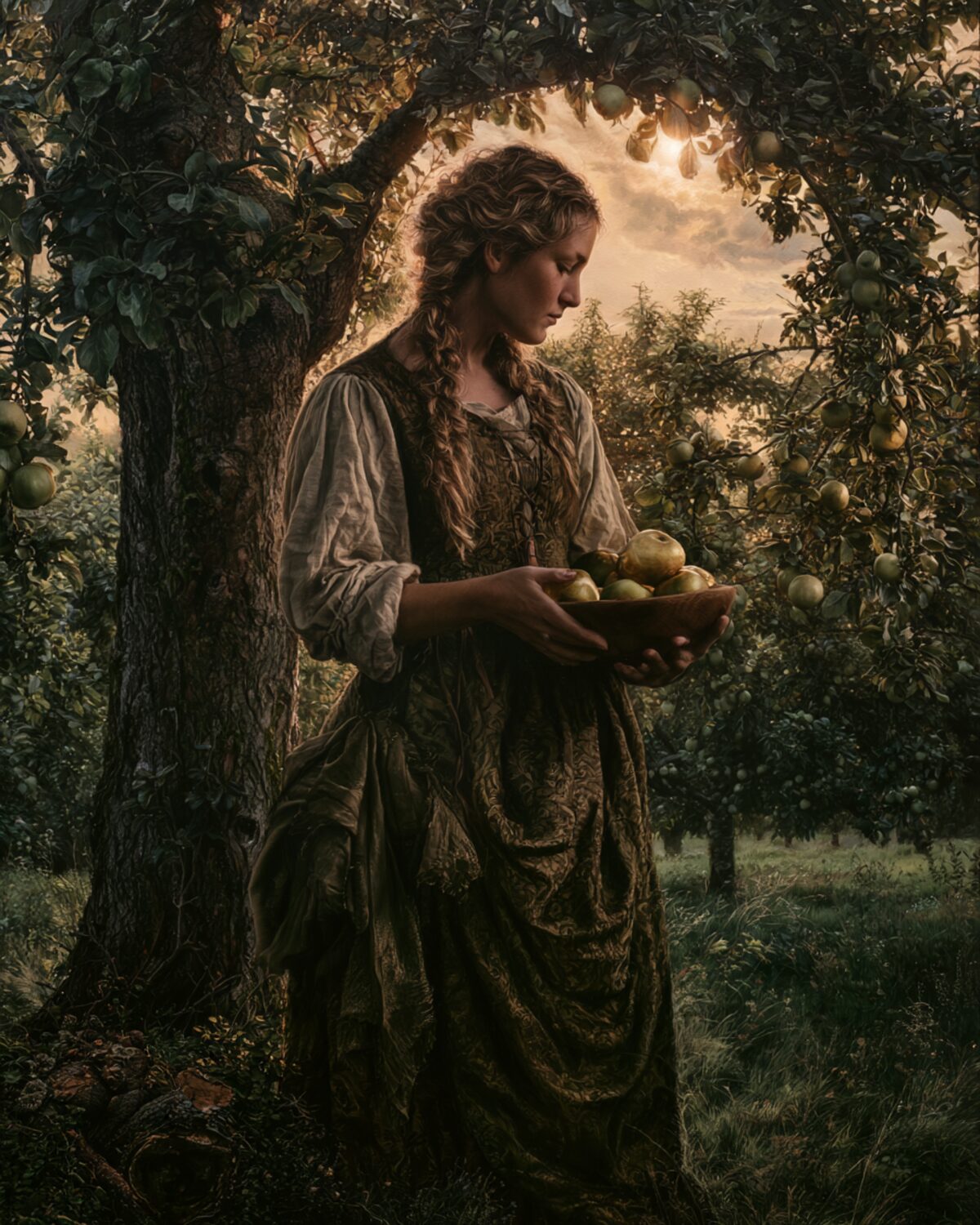
Since the Romantic era Iðunn has enjoyed a remarkable second career. The form Iduna became popular in the nineteenth century as a name for journals, societies and girls. In Sweden, for instance, the Geatish Society (Götiska förbundet) published a journal called Iduna from 1811. Painters showed her with a basket of apples, young, fair-haired and in flowing robes – far more nineteenth century than Viking Age.
She is also often declared the "real spring goddess", sometimes even equated with Ostara or Eostre. There is no source for this. No medieval text links Iðunn with spring or Easter, and Ostara herself is largely Jacob Grimm's reconstruction from a single sentence by the Anglo-Saxon scholar Bede. We have written that story up in full: Ostara – the goddess born from a single sentence.
What remains is honest enough: Iðunn stands for renewal. Name and myth both support that. She needs nothing more to be one of the loveliest figures in the Norse tradition.
And the lesson underneath it all is a very Norse one: nothing lasts on its own. Youth, strength and order have to be guarded, and won back if need be – with cunning, a borrowed feather cloak and a pile of wood shavings. That we know Iðunn at all we owe to her husband's art, poetry: to a skald who praised a painted shield, and to an Icelander who wrote his verses down three hundred years later.
In our workshop in Alsdorf, Iðunn is a motif made for personal gifts – especially where a new beginning is being celebrated: a wedding, a birth, a milestone birthday, a new home. When we design her, we follow the sources rather than nineteenth-century romance.
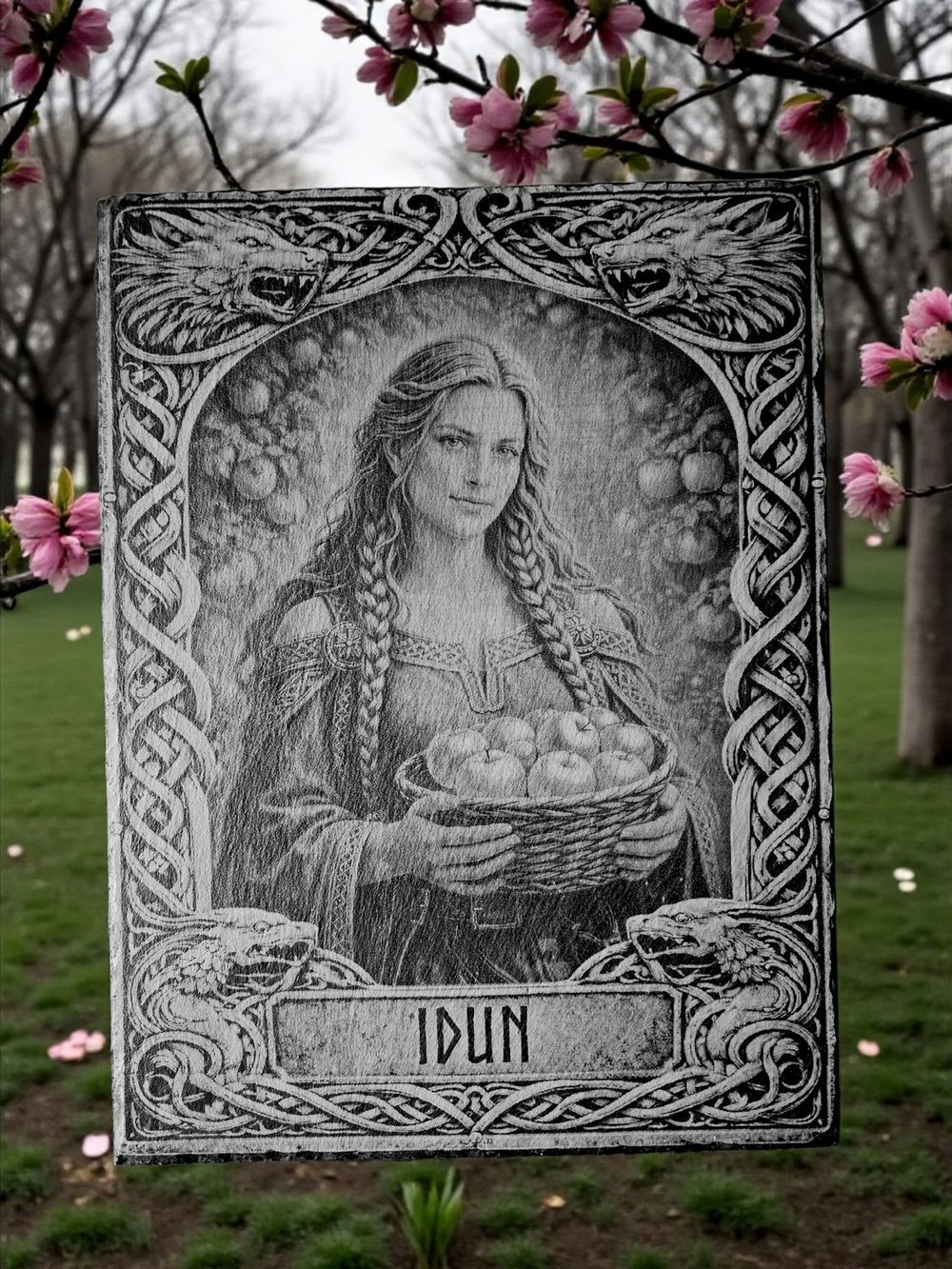
Our idea for a slate plaque: Iðunn not with a golden basket but with a plain wooden box, the eski. Beside her, a branch with small, round crab apples. Above, as a counterpoint, the silhouette of an eagle with outspread wings – Þjazi, the threat. Around the edge, her name in runes. In the Younger Futhark of the Viking Age you write Iðunn as ᛁᚦᚢᚾ, because the ð sound is rendered with the þ rune there. In the Elder Futhark it would be ᛁᛞᚢᚾ. Try it in our rune translator.
For a couple, pair Iðunn with Bragi: renewal and the word, side by side on one plaque, perhaps with a line of your own beneath. Engraved on ash wood, the motif carries a little joke for those in the know – Iðunn's box was made of ash.
Who is Idun in Norse mythology? Idun (Iðunn) is a goddess of the Æsir and the wife of Bragi, god of poetry. According to Snorri she keeps the apples that keep the gods young until Ragnarök.
What does the name Iðunn mean? The usual interpretation is "the renewing one" or "the rejuvenating one", from the prefix ið- ("again, anew"). It is well founded but not certain in every detail.
Who kidnapped Idun? The giant Þjazi, in the form of an eagle, after forcing Loki to lure her out of Asgard. Loki brought her back as a falcon, and Þjazi burned at Asgard's wall.
Were Idun's apples really apples? Snorri writes epli, apples. The older poem Haustlöng speaks only of an "old-age medicine of the Æsir" and mentions no apples. Whether another fruit was originally meant remains open.
Were Idun's apples golden? No medieval source says so. Golden apples appear in the Edda only in Skírnismál, as a wooing gift to Gerðr.
Is Idun a spring goddess or the same as Ostara? There is no evidence for either. The identification is a modern guess.
For courage. For remembrance. For legends that live on.
She is so vast that she encircles the whole world and bites her own tail: Jörmungandr, the Midgard Serpent. Between her …
Read more →No god of the North is without his treasure: Thor without his hammer would be only an angry giant, Odin without spear …
Read more →Where does poetry come from? The North had an uncannily beautiful answer to this: from the blood of a wise being …
Read more →A feast of the gods, ale in plenty – and a guest who exposes every single one of them. The Lokasenna („Loki’s flyting") …
Read more →