 He stands on the shore at the creation of humankind, he survives the world's fire, and still almost nobody knows him. Hœnir is the quiet, half-forgotten god – and that is exactly what makes him fascinating. Let us look at what the sources actually give us and where interpretation begins.
In the great tales of Norse mythology, Odin, Thor and Loki act loudly and clearly. Hœnir, by contrast, remains in the half-light. He belongs to the Æsir, he is present at some of the most important events of all – the creation of humankind, the war of the gods, the new beginning after Ragnarök – and yet he owns not a single story of his own in which he truly acts. The skalds called him in kennings "Odin's companion", "Odin's sitting- and travelling-partner", "the swift god", "the long-legged one" and "the mud-king". Such by-names sound weighty, but they explain nothing. Hœnir is a figure about whom we have more questions than answers.
That is precisely his appeal. Anyone who studies the North quickly meets gods who can be summed up in a few sentences. Hœnir cannot be summed up – because the material is missing. He is a good example of how patchy the tradition really is, and how much later systematising went into what we today call "Norse mythology".
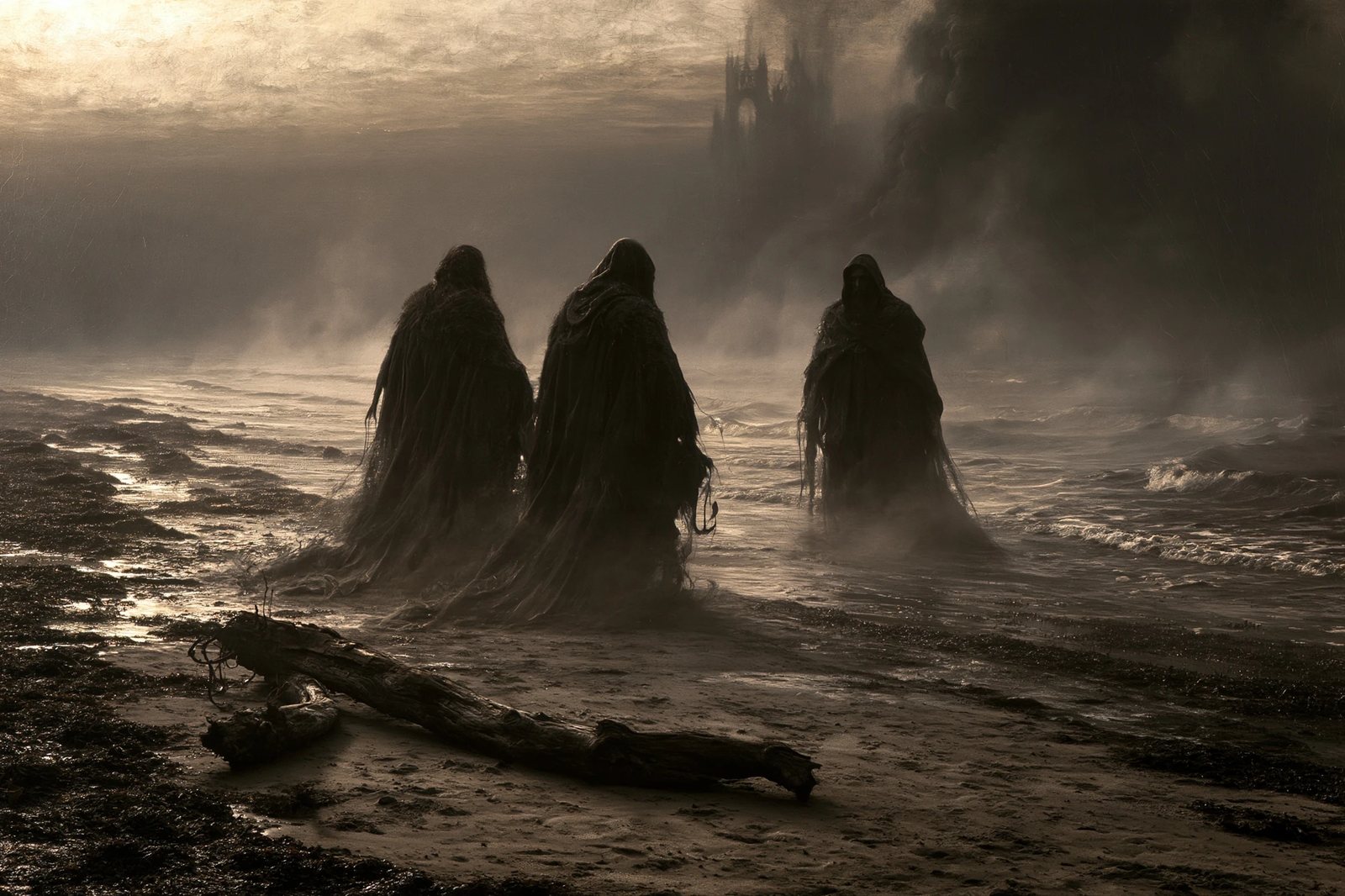
His most important appearance stands in the Völuspá, the most famous poem of the Poetic Edda. Three gods find two lifeless shapes of wood on the sea-shore – Ask (ash) and Embla – and give them what makes a human being. Odin grants breath or soul, Hœnir grants sense, Lóðurr grants blood and good colour. In Henry Adams Bellows's public-domain translation the passage reads:
Soul they had not, sense they had not, / Heat nor motion, nor goodly hue; / Soul gave Othin, sense gave Hönir, / Heat gave Lothur and goodly hue.Völuspá, stanza 18, transl. Henry Adams Bellows (1923)
Here Hœnir stands on the same level as Odin himself – he is one of the three creators who make the human being. That is remarkable: a god almost nobody knows gives us, of all things, the mind. In this single stanza his whole mythological dignity is concentrated. But that is all the Völuspá says about him. We learn nothing of who he is, where he comes from, how he is related to the others. He appears, gives his gift and vanishes again.
It is precisely at this gift that things become complicated – and instructive. The Old Norse original says óð gaf Hœnir. The word óðr does not simply mean "reason". It means rather spirit, sense, inspiration, ecstatic excitement, inner drive – the same word-field from which Odin's own name (Óðinn) is formed. Bellows chooses "sense"; other translators write "wit" or "mind"; Simrock's German gives "Sinn". Each of these decisions shifts the meaning a little.
This is not a detail for language geeks, but reveals a basic problem: what Hœnir gave to humankind depends on how one reads a single Old Norse word. Some scholars therefore stress that the exact division of roles among the three gods in the Völuspá stays blurred, and is told differently again in other, later sources. Whoever claims Hœnir is "the god of reason" collapses an open question into a formula.
The second story in which Hœnir appears takes place after the war between the two families of gods – the Æsir and the Vanir. Snorri Sturluson tells it in his Ynglinga saga in the thirteenth century. To seal the peace, both sides exchange hostages. The Vanir send Njörðr and Freyr to the Æsir; in return the Æsir send Hœnir – and with him the wise Mímir.
To place the story, one must know the background: the war of the Æsir and Vanir counts as the first war in the world, fought between the Æsir around Odin and the Vanir, the gods of fertility and wealth. After long struggle with no clear victor, both sides make peace and seal it – as humans later did too – by an exchange of hostages. Such hostages were not prisoners but high-ranking trusted figures who stood as living pledges for the peace. That of all the Æsir it is Hœnir who is chosen says something about his rank: one does not send a minor figure as the pledge of a world-peace.
At first the Vanir are delighted. Hœnir is tall, stately, looks every inch a leader, and so they make him a chieftain. Mímir, the clever counsellor, stands at his side and whispers him the right answer on every important question. As long as the two appear together, everything goes splendidly. Hœnir seems a wise, sovereign leader.
The problem shows itself the moment Mímir is not there. At the council and at the Thing, without his adviser beside him, Hœnir gives the same answer to every question: ráði aðrir – "let others decide". The Vanir soon realise that their splendid chieftain is incapable of a judgement of his own without Mímir. They feel cheated in the hostage exchange.
The revenge does not strike Hœnir but his counsellor. The Vanir seize Mímir, cut off his head and send it back to the Æsir. Odin takes the head, preserves it with herbs and spells, and from then on consults it as a source of secret knowledge – the famous talking head at the well. Hœnir himself remains strangely passive in this tale. He is the trigger of a catastrophe without doing anything himself. His only "contribution" is a sentence that captures weak leadership perfectly.
As pale as Hœnir seems in his appearances, his final role is that significant. At the end of the Völuspá, after the world's fire and the fall of most of the gods, a new, green earth rises from the sea. The surviving gods return, find again in the grass the golden game-pieces of the old time – and in this new beginning Hœnir is expressly named. He is one of the few to survive the last battle, and in the new world he "chooses the lot-twigs" or "reads the future" – the old phrasing is not entirely clear.
This is the true core of his meaning. A god who is present at the first creation of humankind and experiences the new start after the end spans an arc across the whole age of the world. Hœnir marks beginning and re-beginning. Perhaps this is precisely why he was preserved although hardly any stories are told of him: he is less a character than a bracket around time.
It is striking that the old poems name Hœnir of all gods for this future, and not one of the famous ones. Odin, Thor and Loki fall in the world's fire; Hœnir, however, lives on and takes up a task that enjoyed high standing in the old North – the reading of what is to come. Whether one reads the passage as "choosing the lot-twigs" or as "prophesying", in both cases the silent god becomes at the end the one who knows what is not yet. Of all of them, the quiet one gets the last, soft word.
Because the sources give so little, scholarship has speculated a great deal. A popular approach ties in with the skaldic by-names. Hœnir is called "the long-legged one" and "the mud-king" (aurkonungr), and the sound of his name reminded some scholars of a word for "hen" or of a wading bird. From this arose the idea that Hœnir was originally connected with the stork – a long-legged bird in the mud, perhaps a symbol of fertility or creation.
It is a pretty notion, but it stays interpretation. No Old Norse source calls Hœnir a stork or connects him with a bird in a strict sense. The stork theory rests on etymology, sound-similarity and the wish to shape a rounded picture out of little material. Other scholars, because of the creation triad, have identified him with Vili and Vé – those brothers of Odin who in Snorri's version create humankind. That too is not attested but the understandable attempt to think different groups of three together. Honestly, only this remains: we do not know.
Hœnir is a model case of how the Norse tradition works. Much of what looks today like a fixed system was only ordered in the thirteenth century by Christian scholars such as Snorri, more than two hundred years after the official conversion. Where the old poems are silent, later systematising filled the gaps. With Hœnir these gaps are especially large – and that is why he is so instructive. He shows where secure tradition ends and conjecture begins.
The Völuspá names Hœnir as one of the three gods who animate Ask and Embla; he gives them the gift called óðr in Old Norse (spirit/sense). Snorri's Ynglinga saga reports the hostage exchange with the Vanir, Hœnir's answer "let others decide" and the beheading of Mímir. The Völuspá also counts Hœnir among the survivors after Ragnarök. Skaldic kennings attest him as Odin's companion and supply the by-names "the long-legged one" and "mud-king".
The source situation is extremely thin – Hœnir has not a single independent story of action. What he gave to humankind depends on the translation of a single word (óðr as "sense", "spirit" or "reason"). The reading as a stork or bird-god rests on etymology and sound alone, not on any source. The equation with Vili and Vé is likewise reconstruction. Much of Hœnir's "character" stems from Snorri's ordering pen in the thirteenth century, not from the Viking Age itself. Anyone who speaks of Hœnir should keep evidence and conjecture cleanly apart.
Mímir – the counselling head · The Norse pantheon · Aesir & Vanir · The war of the Aesir and Vanir · Ask & Embla.
All Gods & Goddesses articles →
Loki fits no box. Now he saves the gods with a trick, now he plunges them into ruin. It is exactly this doubleness that …
Read more →The strongest god has two sons: Magni („the mighty") and Modi („the brave / wrathful"). They are more than minor …
Read more →In the North, the moon is a man. Máni, brother of the sun, steers his heavenly body across the sky night after night …
Read more →