 The Norse gods fall into two kindreds: the Æsir around Odin and the Vanir around Freyr and Freyja. Between them lies the first war of the world – and a reading that goes far beyond what the sources actually support.
The world of the Norse gods is no single family. It consists of two kindreds: the Æsir and the Vanir. The Æsir are the larger and, in the surviving tradition, dominant group – Odin, Thor, Tyr, Baldr, Frigg and many more. The Vanir are a smaller, more mysterious kindred connected with the sea, fertility, wealth and prosperity: above all Njörd and his children Freyr and Freyja.
What this division means is one of the most hotly debated questions in the field. For the Vanir almost never appear as an independent, acting group. We meet them chiefly in a single event – the war with the Æsir – and thereafter as members of the shared divine household. Whether there ever was a separate „realm of the Vanir" with its own worship is anything but certain.
The Æsir dwell in Asgard and form the centre of the recorded myths. Odin is their leader, god of wisdom, ecstasy and war; Thor, his son, defends gods and humans with the hammer Mjöllnir against the giants; Tyr stands for law and the courage to sacrifice for the whole; Baldr for light and purity, Frigg as lady and seeress. In the Gylfaginning Snorri lists twelve Æsir and as many goddesses, though the number varies and should not be read as a closed register.
The Æsir are the gods of sovereignty, war and cosmic order – those around whom the great narratives from creation to Ragnarök revolve. It is no accident that it is almost always Æsir whose names are most densely attested in place-names, weekdays and traces of cult.
The word Áss (plural Æsir) means simply „god" and probably connects with a root for „breath of life" or „divine power". In the runic inscriptions and place-names of the continent we meet the same group under other sound-shapes – Wodan, Donar, Ziu – showing that the Æsir are no purely Icelandic phenomenon but go back to common Germanic deities. The Vanir, by contrast, are almost entirely absent from the continental record, which makes their special status all the more puzzling.
The three securely attested Vanir are Njörd, god of the sea, seafaring and fishing, and his twin children Freyr and Freyja. Freyr stands for fertility, a good year and peace – „ár ok friðr" – for harvest and procreative power; Adam of Bremen describes his image at Uppsala with an enormous phallus. Freyja is goddess of love and beauty, but also of the magic art of seiðr and, as we have seen, the receiver of half the slain. Njörd brings prosperity across sea and coast.
Striking is what is ascribed to the Vanir: wealth, fertility, peace, magic – and a hint of the scandalous. Snorri reports that among the Vanir marriage between siblings was permitted; Njörd is said to have taken his own sister to wife, and Freyr and Freyja count as siblings. Among the Æsir this was taboo. Such differences have tempted scholars to see in the Vanir the legacy of an older fertility cult.
Njörd, in turn, points linguistically to a Germanic goddess named Nerthus, whom the Roman historian Tacitus in the 1st century describes as „Mother Earth", worshipped in a sacred grove on an island. Between the female Nerthus and the male Njörd lies a change of gender that no one can quite explain – a further sign that the Vanir carry a very old heritage, preserved only in fragments.
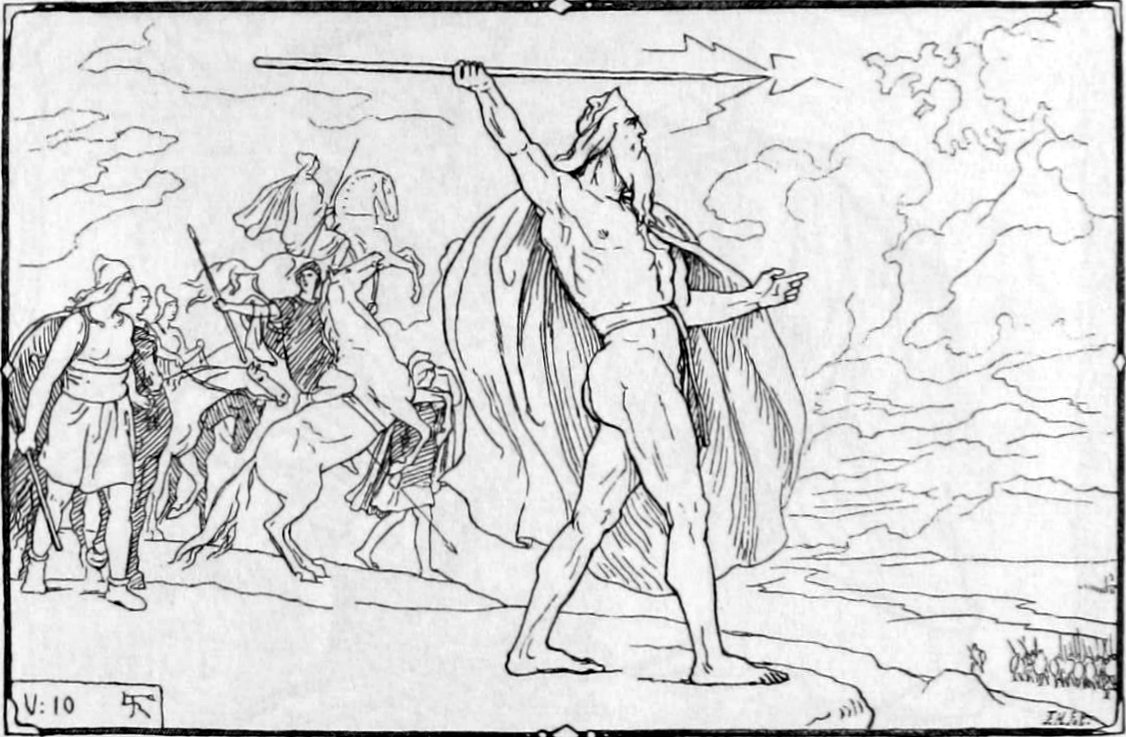
The turning point of the relationship is the Æsir–Vanir War – the very first war in the world. The Völuspá tells how a figure named Gullveig („gold-draught" or „gold-power") comes to the Æsir and is thrice pierced with spears and burned, yet each time rises anew. Some scholars equate Gullveig with Freyja; this is not certain. Out of this outrage – or the quarrel over her – grows the war between the two kindreds of gods.
On the host his spear did Othin hurl,
Then in the world did war first come;
The wall that girdled the gods was broken,
And the field by the warlike Wanes was trodden.Völuspá 24, transl. Henry Adams Bellows (1923)
The spear Odin hurls not only opens this war but founds a ritual: casting the spear over the enemy host dedicates the foe to Odin. Remarkable is the outcome: the war-skilled Vanir break the Æsir's rampart – the supposed war-gods do not win.
Because neither side wins, the war ends in peace and a hostage exchange – the oldest way to seal an alliance. The Vanir send Njörd, Freyr and Freyja to the Æsir; the Æsir give Hönir and the wise Mimir to the Vanir. The Vanir soon make the silent Hönir – useful only with Mimir's counsel – their chieftain, feel deceived, behead Mimir and send the head back. Odin embalms it and thereafter questions Mimir's severed head for wisdom.
The most important effect of this exchange: from now on Njörd, Freyr and Freyja live among the Æsir and are barely distinguished from them in the myths. This is precisely why the Vanir remain so pale as an independent group – they are graspable almost only as integrated members of the Æsir household.
The hostage exchange is more than a footnote: it is the mythic founding act of the united pantheon. Without it there would be no shared Asgard, no Freyja receiving the dead beside Odin, no Freyr worshipped as an honoured god at Uppsala. The Norse divine world as we know it is the result of a reconciliation after an undecided war – a remarkably diplomatic motif for a mythology so often reduced to battle and doom.
A small, often overlooked detail seals the peace. To confirm it, both parties spit into a vessel, and from this shared spittle the gods form a being: Kvasir, wisest of all, able to answer any question. Kvasir is later slain by dwarves, his blood fermented into the mead of poetry – the source of all skaldic art. Thus the reconciliation of the two kindreds is bound up with the origin of poetry itself: from the end of the first war grows the language of verse.
That shared spittle should stand at the origin of poetry is typical of the Norse tradition: the sublime and the earthy lie close together. And it underlines the point of the whole myth – not the victory of one side, but the union of both, creates something new and lasting.
Sum up what the sources actually say, and less remains than the catchphrase „war versus fertility" suggests. Attested are: the membership of Njörd, Freyr and Freyja among the Vanir; the war and the hostage exchange; differing marriage rules; an association of the Vanir with wealth, sea and fertility, of the Æsir with sovereignty, war and order. Not attested is a strict division of labour – Odin is himself a master of seiðr, Freyr fights and falls at Ragnarök, Freyja receives warriors. The boundaries are porous.
The sharp reading „Æsir = first and second function (sovereignty and war), Vanir = third function (fertility and wealth)" comes from the French scholar of religion Georges Dumézil, who fitted the Norse division into his Indo-European model of three basic functions. This theory is influential, but it is an interpretation, not a source – and it is criticised for tending toward circular reasoning: one finds in the myths the order one brings to them.
There is also a source problem: almost everything we know about the Æsir–Vanir War, the hostage exchange and the division of roles we owe to two texts – the Völuspá, whose hints are terse and dark, and Snorri's Prose Edda, written roughly 200 years after the conversion. Where Snorri orders and interprets, we should be cautious: he was a Christian scholar treating heathenism as history, not as lived belief.
More fundamentally, Rudolf Simek objects. In a much-noted essay („The Vanir: An Obituary", 2010) he argues that „the Vanir" as an independent kindred of gods may largely be a construction of Snorri's; the term is thinly attested in the older sources, and Freyr and Freyja may never have belonged to a clearly bounded group. Whether or not one follows Simek, his objection reminds us that we know most about the Vanir only through Snorri's ordering gaze – and that behind the tidy scheme lies more uncertainty than the popular story admits.
The Æsir–Vanir War and Odin's spear-cast stand in the Völuspá (stanzas 21–24); the hostage exchange with Njörd, Freyr, Freyja on one side and Hönir and Mimir on the other, and Kvasir's origin from the shared spittle, are described in Snorri's Prose Edda (Ynglinga saga and Skáldskaparmál). What is attested is thus the twofold division, the war and the subsequent merging – but not a fixed distribution of responsibilities between the kindreds.
The neat formula „Æsir = war, Vanir = fertility" is a modern reading, shaped above all by Georges Dumézil's theory of functions. The sources show porous boundaries: Odin masters the Vanir magic seiðr, Freyr fights at Ragnarök. Rudolf Simek goes further and asks in „The Vanir: An Obituary" (2010) whether the Vanir were ever a distinct kindred at all, or only became one through Snorri's systematising gaze. Much of what we think we know about the Vanir we know only second-hand – from the 13th century.
The war of the Aesir and Vanir · The Vanir · The Norse pantheon · Njörðr – god of the sea · Freyja.
All Gods & Goddesses articles →
He was the fairest, the gentlest, the purest – and yet it was he whom death struck. The legend of Balder is the most …
Read more →In the halls of the gods sits one who would rather turn a fine phrase than swing an axe: Bragi, the long-bearded lord …
Read more →