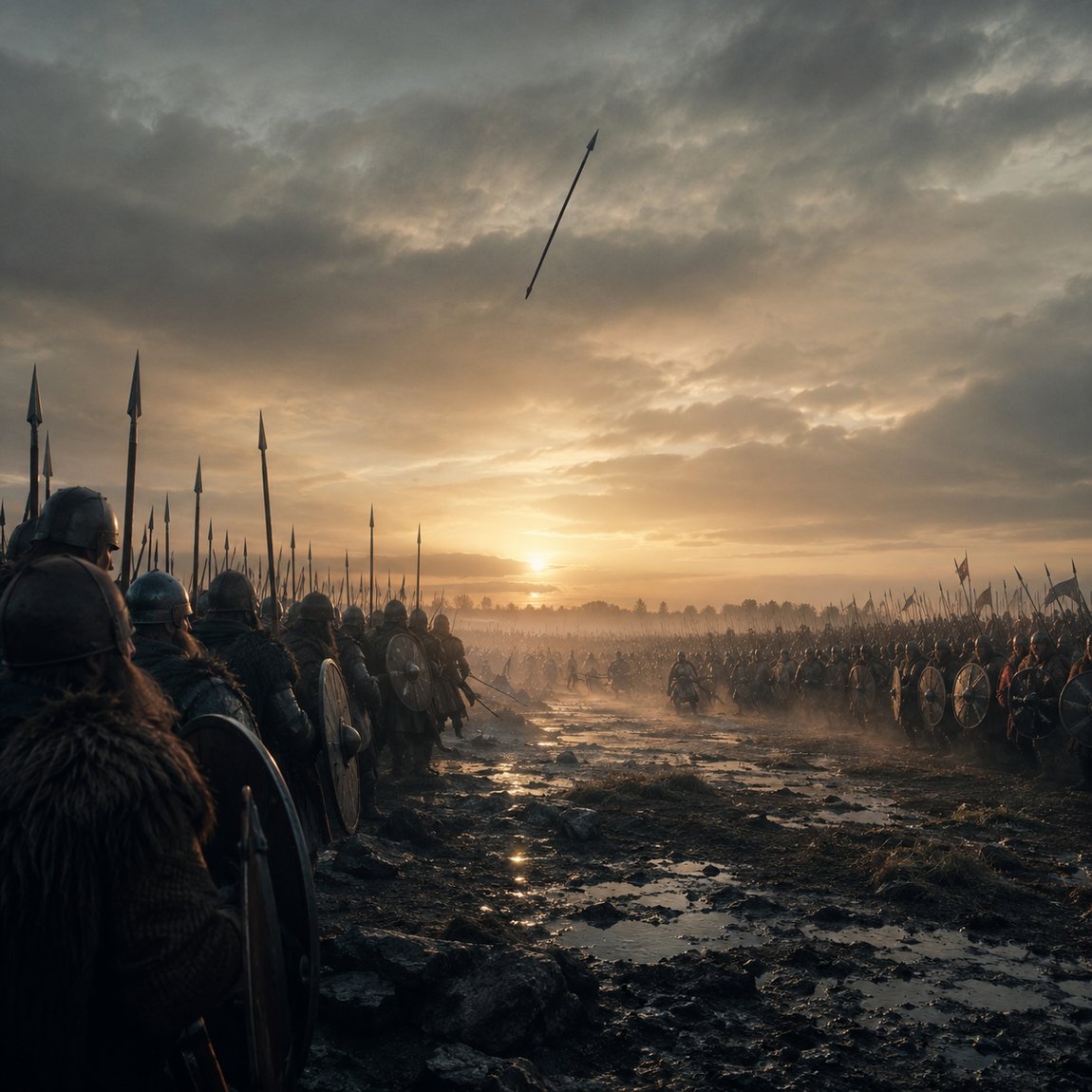
The Æsir–Vanir war is the first war in the world according to Norse mythology: Odin's gods, the Æsir, fight the second family of gods, the Vanir, until neither side can win and both agree to peace. The story survives only in fragments – four cryptic stanzas of the Völuspá, a sober account in Snorri's Ynglinga saga and a single sentence in his Skáldskaparmál. We put the sources side by side, show where they disagree, and sort out what scholars have made of them.
It does not begin with a dragon or a giant. It begins with a woman who refuses to die. The gods pierce her with spears and burn her in Odin's hall – three times. Three times she comes back. After that, nothing is the same: Odin hurls his spear, the wall of the gods' stronghold breaks, and the world has its first war.
The Norse divine family, you see, is a merger. Njörðr, Freyr and Freyja are not really Æsir (Old Norse æsir, singular áss). They belong to the Vanir (vanir), a second group of gods usually linked with fertility, wealth, the sea and magic. How two hostile camps became one pantheon is the subject of this myth. For the bigger picture, see our articles on the Æsir and the Vanir and on the Vanir themselves.
There is no single, continuous account of the war. There are three texts, each showing a different piece – and they do not fit together perfectly:
Scattered hints fill the gaps. Gylfaginning and the eddic poems Vafþrúðnismál and Lokasenna explicitly call Njörðr a hostage – which shows that the hostage exchange was not simply Snorri's invention.
In the Völuspá, the seeress opens with a memory. In stanza 21 of the standard edition (Neckel/Kuhn), she says, in our own translation from the Old Norse:
She remembers the first great war in the world, when they propped up Gullveig with spears and burned her in Hár's hall; three times they burned the three-times-born, often, not seldom – yet she still lives.Völuspá 21, our own translation ("þrisvar brenndu, þrisvar borna")
Hár, "the High One", is a name of Odin, so the deed happens at the very heart of Æsir power. The name Gullveig combines gull, "gold", with veig, which means roughly "(intoxicating) drink" but has also been linked with "strength". Hence the usual renderings "gold-drink", "gold-intoxication" or "gold-might" – Bellows chose "Gold-Might". None is certain.
The next stanza gives her a second name: Heiðr. That is what she was called wherever she went – a far-seeing völva who practised seiðr, the kind of magic the sources associate with trance, prophecy and influencing minds. Whether Gullveig and Heiðr really are the same figure is debated; some scholars even apply the name to the seeress who speaks the poem.
Why do the gods burn Gullveig, and why does war follow? The poem does not say. The link exists only through the order of the stanzas: Gullveig, Heiðr, then the gods' council, then the war. Many readers conclude that Gullveig was one of the Vanir and that her mistreatment caused the war. That is plausible – but it is an inference, not a line of text. We look at her in detail in our article on Gullveig.
One of the oldest and most stubborn theories identifies Gullveig with Freyja. Karl Müllenhoff argued for it in the nineteenth century, and it still appears in modern scholarship. The arguments are not weak. Freyja is the Vanir goddess par excellence; Snorri's Ynglinga saga says she taught seiðr to the Æsir, the very art Heiðr practises in the Völuspá; and Freyja is closely tied to gold in poetry – skalds call gold "Freyja's tears", and her daughter is named Hnoss, "treasure".
The counter-arguments are just as clear. The Völuspá does not name Freyja here, and Snorri, who knew Freyja well, never equates her with Gullveig. The identification is a modern combination of scattered motifs. It may be right; it cannot be proven. Meet the goddess on her own terms in our portrait of Freyja.
After the Gullveig stanzas, the gods gather on their judgement seats. The stanza (Völuspá 23 in Neckel/Kuhn) asks a strikingly political question: should the Æsir afráð gjalda – pay a tribute – or should "all the gods" gildi eiga, share equally in sacrifices and feasts?
Read closely, this is not about victory or defeat but about cult and status: who gets worshipped, who receives offerings, who sits at the table? The poem gives no direct answer, but the ending is well known: the Vanir become part of the divine world. It is tempting to read the stanza as a hint that their claim to equal rank succeeded.
Then comes the stanza that gives the myth its most famous moment:
Fleygði Óðinn ok í fólk of skaut, þat var enn fólkvíg fyrst í heimi; brotinn var borðveggr borgar ása, knáttu vanir vígspá völlu sporna.Völuspá 24 – our own translation: "Odin hurled, and shot into the host; that was still the first great war in the world. Broken was the plank-wall of the Æsir's stronghold; the Vanir, with war-magic, trampled the fields."
Three things stand out. First, throwing a spear over the enemy host is an act of war with a ritual flavour. In the sagas, casting a spear over one's opponents appears as an old custom, probably meant to dedicate them to Odin. The gods do here what humans later imitated.
Second, the Völuspá does not name the spear. The idea that it was Gungnir is added by modern retellings, simply because Gungnir is Odin's spear. The stanza says nothing of the kind.
Third, the Æsir's wall breaks – in the Vanir's favour. The word vígspá is hard to translate: literally "battle-prophecy", it most likely means war-magic. So the Vanir win this round not only with weapons but with magical power, which fits their image as masters of spells and seiðr. Whether the broken wall connects to the story of the giant builder who offers to build Asgard a new wall is a popular but unproven link; Snorri does not make it explicit. We tell that tale in the building of Asgard's wall.
In the Ynglinga saga everything sounds different. Snorri is not writing about gods here but about humans: Odin is a powerful ruler from Asia, the Æsir one people, the Vanir another. In the first chapter he places the land of the Vanir, Vanaland or Vanaheimr, on a river called Vanakvísl, formerly Tanakvísl – the Don, which classical writers called the Tanais. That is learned medieval etymology, not ancient tradition. The method of explaining gods as famous humans who were later worshipped is called euhemerism.
In chapter 4, Odin leads a great army against the Vanir. They defend themselves well; neither side gains the upper hand, and each lays waste to the other's land. When both grow tired of it, they arrange a meeting, make peace and exchange hostages. Gullveig, the spear-cast and the broken wall do not appear. Snorri probably knew the Völuspá but chose to write a sober, almost political version.
In the early Middle Ages, hostages were a standard way to secure a treaty: a side that leaves members of its own elite with the former enemy will not break the peace lightly. That is exactly how Snorri frames the gods' agreement.
The Vanir send their best: Njörðr the Rich and his son Freyr. The Æsir send Hœnir, a tall and very handsome man whom they thought fit to be a chieftain, and Mímir, the wisest of all. According to Snorri the Vanir also hand over Kvasir, the cleverest among them – more on him below.
Freyja, by the way, is not named as a hostage in the Ynglinga saga. She appears in the same chapter as Njörðr's daughter and as a sacrificial priestess (blótgyðja) who first taught the Æsir the magic customary among the Vanir. That she came to the Æsir with her father and brother follows from the context; the familiar formula "Njörðr, Freyr and Freyja as hostages" is a simplification.
Snorri adds a spicy detail. Among the Vanir, Njörðr had been married to his own sister, as their law allowed, and Freyr and Freyja were their children. Among the Æsir, marriage between such close kin was forbidden. Once again Snorri marks the Vanir as outsiders with different customs.
Odin makes Njörðr and Freyr priests of the sacrifices, and among the Æsir they become díar, gods. Read more in our articles on Njörðr, god of the sea and on Freyr and the Vanir.
The peace holds – almost. Among the Vanir, Hœnir is promptly made a chieftain, with Mímir to advise him. With Mímir at his side, Hœnir gives wise answers. Whenever Mímir is absent and Hœnir must decide alone, he says only: let others decide. The Vanir feel cheated in the exchange. They cut off Mímir's head and send it to the Æsir. Samuel Laing's 1844 translation continues:
Odin took the head, smeared it with herbs so that it should not rot, and sang incantations over it. Thereby he gave it the power that it spoke to him, and discovered to him many secrets.Ynglinga saga, ch. 4, trans. Samuel Laing (1844), public domain
Note the irony: the Vanir kill not the useless hostage Hœnir but the wise Mímir – and his head becomes Odin's most valuable counsellor. The Völuspá knows this talking head too: before Ragnarök, "Odin speaks with Mím's head" (st. 46 in Neckel/Kuhn). Alongside it runs a second, quite different Mímir tradition – the well beneath Yggdrasil, for whose drink Odin pledged an eye. How the two fit together is a story in itself, told in Mímir – the head that keeps advising. Silent Hœnir has his own portrait: Hœnir – the silent god.
The third source adds an image that is hard to forget. In Skáldskaparmál, the god Bragi explains where poetry comes from. Arthur Gilchrist Brodeur's public-domain translation of 1916 opens:
The gods had a dispute with the folk which are called Vanir, and they appointed a peace-meeting between them …Skáldskaparmál, trans. A. G. Brodeur (1916), public domain
At this meeting both sides go to a vessel and spit into it. When they part, the gods do not want this token of peace to be lost, so they shape it into a man: Kvasir. He is so wise that nobody can ask him a question he cannot answer. Later the dwarves Fjalarr and Galarr kill him, drain his blood into the vessels Són and Boðn and the kettle Óðrerir, and mix it with honey. The result is the mead that makes anyone who drinks it a poet or a scholar. How Odin later steals it from the giant Suttungr is told in Kvasir and the mead of poetry.
Spitting together into a pot strikes us as strange; as a peace ritual, it makes sense. What both sides put in belongs to neither alone. Rudolf Simek points to the practice, known among various peoples, of chewing fruit together and spitting it out to make a fermented drink. The name Kvasir is often connected with Slavic kvas, a fermented beverage; others derive it from a Germanic root meaning "to squeeze, crush". The etymology is not certain.
That Snorri did not simply make Kvasir up is shown by skaldic verse. As early as the tenth century, the skald Einarr skálaglamm calls poetry "Kvasir's blood" in his poem Vellekla. The figure was known long before Snorri.
Snorri tells Kvasir's origin differently in two works. In Skáldskaparmál, Kvasir is created from the shared spittle of both divine families. In the Ynglinga saga, he is one of the Vanir, "the wisest among them", sent as an extra hostage.
Both versions come from the same author, written a few years apart. One explanation: Snorri knew several traditions and chose the one that suited each work – in the euhemerized Ynglinga saga, a human envoy is more believable than a man made of spit. Another: the spittle story is the older, mythic form, and the hostage version a rationalized rewrite. We cannot decide. But the contradiction shows that Snorri was not an archivist; he was an author shaping his material.
After the treaty, Njörðr, Freyr and Freyja appear in the eddic poems as natural members of the divine company at feasts. Yet a trace of foreignness remains. Vafþrúðnismál has Njörðr return "to the wise Vanir" at the end of the world – a hostage to the last. The Völuspá, for its part, has Hœnir cast the lots of fate after Ragnarök: the god who failed among the Vanir belongs to the gods of the new world. So both hostages of the ancient war reach to the end of time. Where the world goes after that, we explore in What comes after Ragnarök?
Three lines of interpretation have shaped the debate. All three are hypotheses, not settled results.
1. Memory of a religious conflict. The oldest reading sees the war as the echo of a real clash between two religions: an agrarian fertility cult with gods like Njörðr, Freyr and Freyja, and a younger, warlike cult of Odin that – so the theory goes – spread from the south. In the end the two merged. John Lindow mentions this view in his handbook, noting that it has even been read as an image of Indo-European expansion. The trouble is that archaeology cannot pin down any such religious conflict, and the split into "farming" and "warrior" gods is crude – Freyja, after all, receives half of the slain according to the eddic poem Grímnismál.
2. Dumézil's three functions. The French scholar Georges Dumézil (1898–1986) argued that Indo-European societies organized their world in three functions: sovereignty and the sacred, war, and fertility and prosperity. For him the Æsir around Odin and Týr embody the first two, the Vanir the third. The war is then not history but a founding myth: a complete society arises only when the functions unite after a struggle. Dumézil saw parallels in Rome and India. In Roman legend, Romulus's men fight the wealthy Sabines until the two peoples merge and share rule (Livy, book 1). In Indian tradition, as Dumézil read it, the healing twin gods, the Aśvins, are admitted to the soma sacrifice only after a conflict with Indra, and he compared the intoxication monster Mada who appears in that story with Kvasir. The model was hugely influential, but critics find it too neat.
3. Social and political readings. Others read the myth less as a memory of religions than as a picture of what people knew: feud, negotiation, hostages, alliance through marriage and exchange. The war of the gods would then model how powerful families settled conflicts. Terry Gunnell has asked whether Snorri's details – priestesses, sibling marriage, foreign magic – preserve oral memories of regional differences in pre-Christian religion. That too is a hypothesis.
Set the big models aside and a surprisingly modern story remains. The first war in the world ends not in victory but in stalemate, and the peace rests on people entrusted to the other side and on something both sides make together.
Out of the spit of two enemies comes the wisest being in the world, and out of his blood comes poetry. Anyone in the North who recited a poem was, figuratively, drinking from the peace between Æsir and Vanir. It is an idea we like in the workshop: lasting things are rarely made by one hand alone. And the gods themselves? They burn a woman they cannot kill, lose their wall, get the worse end of a trade – and negotiate. Meet the god who threw the first spear in Odin – wisdom at any price, and the seeress's poem in Völuspá – the prophecy of the seeress.
What was the Æsir–Vanir war? In Norse mythology it is the first war in the world, fought between Odin's Æsir and the Vanir around Njörðr. It ends in a draw, a peace treaty and an exchange of hostages.
Where is the Æsir–Vanir war in the Poetic Edda? In the Völuspá, stanzas 21–24 in the standard Neckel/Kuhn edition (other editions number them differently). Snorri tells it at more length in the Ynglinga saga, chapter 4, and briefly in Skáldskaparmál.
Who won the war between the Æsir and the Vanir? Nobody. The Völuspá shows the Vanir briefly on top when the Æsir's wall breaks; according to Snorri neither side could prevail.
Which gods were exchanged as hostages? The Vanir gave Njörðr and Freyr (and, in the Ynglinga saga, Kvasir); the Æsir gave Hœnir and Mímir. Freyja came to the Æsir with her father but is not explicitly called a hostage.
Who is Gullveig? A mysterious woman in the Völuspá whom the gods burn three times and who is reborn three times; she is also called Heiðr. Whether she is Freyja is a disputed theory.
How is Kvasir connected to the war? According to Skáldskaparmál, the Æsir and Vanir spat into a vessel to seal the peace, and the gods shaped Kvasir from it. The dwarves later brewed the mead of poetry from his blood.
For courage. For remembrance. For legends that live on.
Æsir & Vanir – the pantheon · Njörd, Freyr & Freyja · Kvasir & the mead of poetry · Gungnir · Asgard.
When in deepest winter the storm howls, so people believed, a spectral host rides through the night: the Wild Hunt. At …
Read more →At the centre of the Norse picture of the world stands a tree. At its roots fate is decided, in its crown an eagle …
Read more →The world of the Vikings is, quite literally, built from a corpse. From the slain primal giant Ymir the first gods …
Read more →Once a year the gods brewed not mischief but beer. The sea-giant Ægir welcomed them into his hall on the sea-floor …
Read more →