Kvasir is the wisest being in Norse mythology, shaped by the gods from the spit that the Æsir and Vanir shared in a vat to seal their peace. Two dwarves, Fjalarr and Galarr, murdered him, mixed his blood with honey and created the mead of poetry: whoever drinks it becomes a poet or a scholar. Here you will find what Snorri's Edda, the Hávamál and Ynglinga saga actually say, where the name probably comes from, and why skalds called their verses "Kvasir's blood".
Picture a peace conference where nobody signs anything. Two families of gods, who have just spent a war trying to destroy each other, step up to a vat one by one and spit into it. No oath, no sacrifice, no handshake. Spit. And from that spit the gods shape a man who turns out to be wiser than every one of them.
That is how one of the strangest stories of the Norse tradition begins. Murder, extortion, a god as farmhand, snake and eagle. At its end lies the answer to a question every culture asks: where does the gift of words come from?
The North's answer: from a kettle of blood and honey. We will tell you the story the way the sources tell it, and we will flag clearly where the sources stop and interpretation starts.
Kvasir is not really a god. Snorri Sturluson calls him a maðr, a "man", though one made by gods and so wise that nobody could ask him a question he could not answer. Almost everything we know about him comes from a single writer: the Icelandic scholar and chieftain Snorri Sturluson (1179–1241).
The basic myth of the poetic mead is older than Snorri, because skalds were alluding to it centuries before him. But the complete, joined-up narrative with all its details survives only from his pen, and Snorri was a thirteenth-century Christian writing a handbook for young poets. For more on the texts themselves, see our article on the Edda.
In Skáldskaparmál the sea giant Ægir is a guest at a feast in Asgard, seated beside Bragi, the god of poetry. Ægir asks where the art called poetry came from, and Bragi begins.
The gods, Bragi says, had a quarrel with the people called the Vanir. This is the war between Æsir and Vanir. The two sides met to make peace and sealed it in this way: they went up to a vat (ker) and spat into it. When they parted, the gods did not want this token of peace to be lost, so they made a man out of it. His name was Kvasir, and he was so wise that no one could ask him anything he could not answer. He travelled far and wide across the world, teaching people.
To modern ears this sounds disgusting. In many cultures, though, it was a technique: chewed fruit or grain starts to ferment thanks to the enzymes in saliva, and a shared mass becomes a shared drink. Rudolf Simek points exactly in this direction in his dictionary: the myth may echo customs in which a jointly prepared intoxicating drink binds a group together or seals a peace. Whether Norse people ever did this themselves is not documented. It is an interpretation, not a fact.
Kvasir is a child of peace, belonging wholly to neither side. Not a bad punchline for a culture usually reduced to axes and battle cries.
One day the wandering sage comes to two dwarves, Fjalarr and Galarr. They invite him to a private conversation and kill him. They let his blood run into three vessels: a kettle (ketill) named Óðrerir and two vats (ker) named Són and Boðn. Then they mix honey into the blood, and it becomes mead. Whoever drinks from it, says Snorri, becomes skáld eða fræðamaðr, "a poet or a scholar".
To the Æsir the killers tell a brazen lie: Kvasir had "choked on his own intelligence" (kafnat í mannviti), because nobody was learned enough to question him. It is an excuse so absurd that it almost loops back round to wisdom.
Elsewhere in the myths the dwarves are the great craftsmen, forgers of Mjölnir, Gungnir and Draupnir. It fits that they make the mead; only here their craft is murder.
The names of the vessels say something too, although not all can be interpreted with confidence. Óðrerir (also spelled Óðrørir or Óðrœrir) contains óðr, a word for mind, frenzy and poetic inspiration, which is linked to Odin's own name. It is usually rendered "stirrer of inspiration". For Són and Boðn, meanings such as "atonement, reconciliation" and "vessel" or "offering" have been suggested; both are disputed. Notably, in the Hávamál Óðrerir seems to be the name of the mead itself rather than of a kettle. Snorri may have made it a vessel.
The dwarves are not finished. Snorri tells how they invited a giant called Gillingr and his wife to visit. They took Gillingr out rowing, ran the boat onto a rock and capsized it, and Gillingr, who could not swim, drowned. His wife wept loudly. Fjalarr offered to show her the spot at sea where her husband had died; that would comfort her. As she stepped out of the door, Galarr dropped a millstone on her head. Her wailing had got on his nerves.
These dwarves are pitiless killers, and they get what is coming to them. Gillingr's son Suttungr hears of it, seizes both and leaves them on a skerry that is covered at high tide. With the sea rising around them, they beg for their lives and offer as compensation for his father (föðurgjöld) the most precious thing they own: the mead.
Suttungr accepts, takes the mead home and hides it inside the mountain Hnitbjörg, with his daughter Gunnlöð to guard it. Snorri immediately adds the poetic names that come from this episode: poetry is called "Kvasir's blood", "the dwarves' drink", the liquid of Óðrerir, Boðn or Són, "Suttungr's mead" and "Hnitbjörg's liquor". Elsewhere in Skáldskaparmál he also lists "dwarves' ship" (dverga skip), presumably because the mead carried the dwarves off the skerry like a boat.
Typically Norse legal logic: the most precious drink in the world started its career as a blood-price.
Only now does Odin enter the story. Snorri tells it briskly. Odin left home and came to a place where nine thralls were mowing hay. He offered to sharpen their scythes, pulled a whetstone from his belt, and afterwards the blades cut better than ever. Every one of them wanted to buy the stone. Odin threw it into the air. The thralls scrambled for it, and in the struggle they cut each other's throats with their scythes.
A small, nasty scene: Odin stirs up desire and lets others do the rest. The nine thralls belonged to Baugi, Suttungr's brother. Odin asks him for lodging that evening, calls himself Bölverkr, "evil-doer" or "bale-worker", and listens to Baugi's complaint: his workers have killed one another and he has no idea how to get his harvest in.
Bölverkr offers to do the work of all nine men himself. His price is a single drink of Suttungr's mead. Baugi has no say over the mead but promises to try. All summer the stranger does the work of nine; in winter Suttungr flatly refuses.
Bölverkr does not give up. He suggests they try trickery and produces an auger called Rati. Baugi is to bore into the mountain. After a while Baugi claims he is through. Bölverkr blows into the hole and the chips fly back into his face, so the giant was lying. Baugi has to keep going. The second time the chips blow inwards. Bölverkr turns into a snake and slips into the hole. Baugi stabs after him with the auger and misses.
Inside, Odin finds Gunnlöð. He sleeps with her for three nights, and in return she lets him have three drinks of the mead. With the first he empties Óðrerir, with the second Boðn, with the third Són.
In Snorri Gunnlöð barely speaks: guard, lover, dupe. In the Hávamál, by contrast, there is something like remorse when Odin admits he repaid her loyal heart badly. Our own article on Gunnlöð and the theft of the mead looks at her in more depth. Her name probably means something like "invitation to battle", an oddly martial name for the keeper of poetry.
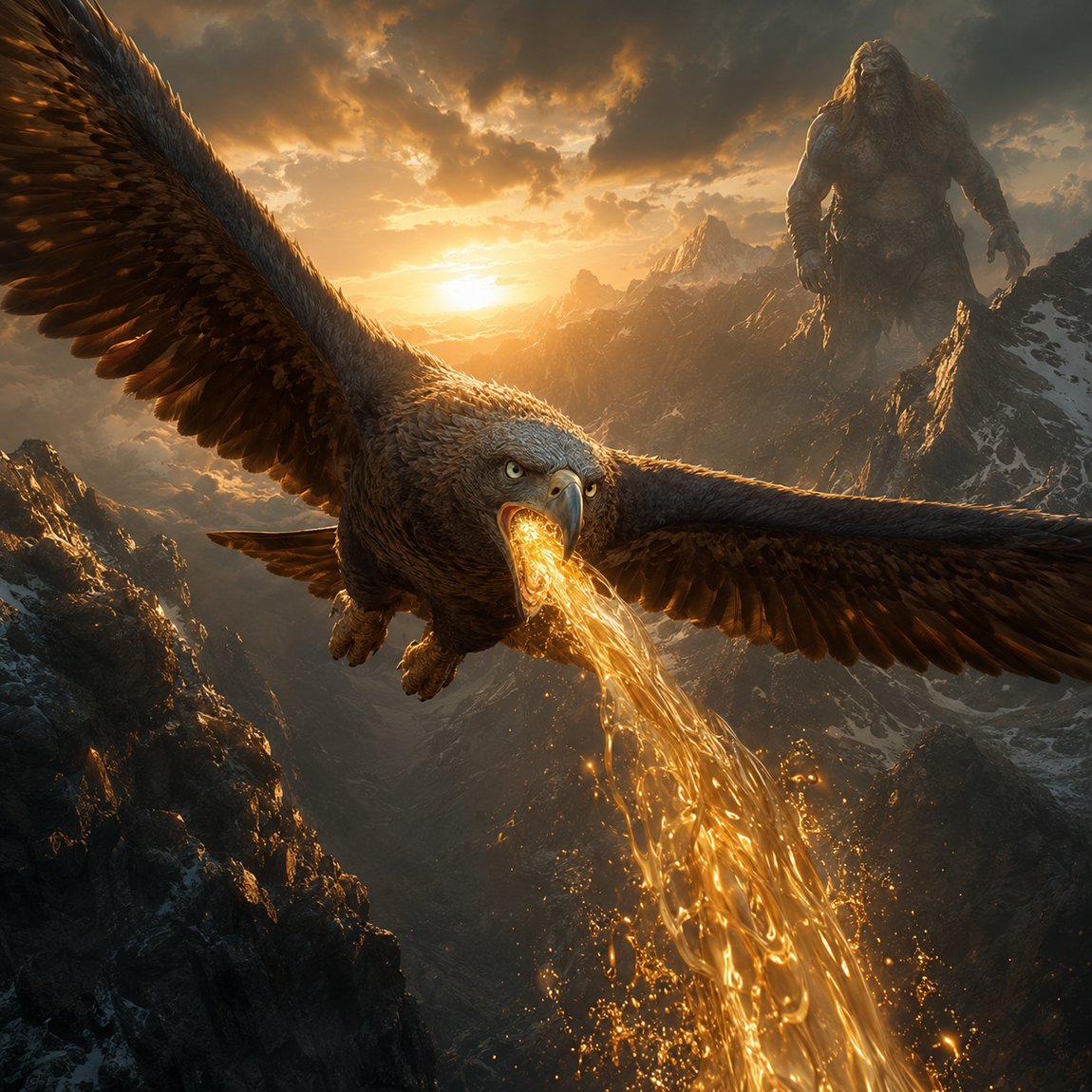
After the third swallow Odin turns into an eagle and flies as fast as he can. Snorri's sentence is short and breathless: Þá brásk hann í arnarham ok flaug sem ákafast, "Then he changed into eagle shape and flew as fast as he could." Suttungr sees him, takes eagle shape as well and gives chase.
In Asgard the Æsir see Odin coming and set out vessels in the courtyard. Odin spits the mead into them. But Suttungr is so close behind that Odin lets some of the mead go out the back, and yes, it means exactly what you think. Nobody bothered with that portion. Anyone who wants it may have it, and it is called the skáldfífla hlutr, "the share of the poetasters" or "the rhymesters' portion".
This may be the best joke in the whole Edda. Snorri writes a textbook for aspiring skalds and casually informs them that bad verse comes, quite literally, out of Odin's rear end. The good mead, on the other hand, Odin gave to the Æsir and to those humans who know how to compose. That is why, Snorri says, poetry is also called "Odin's catch", "Odin's find", "Odin's drink", "Odin's gift" and "the drink of the Æsir".
The older telling is not Snorri's but the one in the Hávamál, the "Sayings of the High One" in the Poetic Edda. Here Odin speaks himself, about the value of speech, cunning and, rather honestly, his own untrustworthiness. We give the stanzas in our own paraphrase.
In stanza 104 Odin says he sought out the old giant and has now come back; silence got him little there, but many words brought him profit in Suttungr's halls. In stanza 105 Gunnlöð gives him a drink of the precious mead on a golden chair, and he admits he left her a poor reward for her loyal heart and heavy spirit. Stanza 106 names the auger: he let "Rati's mouth" clear a way and gnaw the rock; above and below ran the giants' roads, and so he risked his head.
The well-bought shape I put to good use;
little is lacking to the wise.
For Óðrerir has now come up
to the rim of the sanctuary of men.
— Hávamál, st. 107 (our own translation)
In stanza 108 Odin concedes he would hardly have escaped from the giants' courts had he not made use of Gunnlöð, the good woman he had held in his arms. In stanza 109 the frost giants come asking after Bölverkr. And stanza 110 ends with a line you would not expect about a chief god: Odin, the speaker thinks, swore an oath on a ring, so how can his good faith be trusted? He cheated Suttungr of his drink and left Gunnlöð weeping.
Two things stand out. First, Kvasir is not here at all: no dwarves, no Gillingr, no Baugi and his whetstone. Second, Óðrerir is used more like a name for the mead itself. Snorri apparently combined older, scattered motifs into one plot.
In stanzas 13–14 Odin says he was very drunk "in Gunnlöð's courts" and "at wise Fjalarr's"; this Fjalarr is evidently not the dwarf but probably a giant. In stanza 140, after his self-sacrifice on the tree, he gets "a drink of the precious mead, poured from Óðrerir". Whether that is the same story is open.
If you assume Snorri told one consistent Kvasir story, his own works will correct you. In Ynglinga saga in Heimskringla he tells the gods' story as if they were human. After their war they make a truce and exchange hostages. The Vanir hand over their noblest men, Njörðr the Rich and his son Freyr. The Æsir send Hœnir and with him the shrewd Mímir. And in return the Vanir give the wisest man in their company: Kvasir.
Here, then, Kvasir is not made from spit but is one of the Vanir, sent to the Æsir as a hostage. The saga does not say what becomes of him. Both versions share a core: Kvasir belongs to the peace between the two families of gods. In one he is its pledge, in the other its fruit.
The third passage is stranger still. In Gylfaginning ch. 50 Snorri tells how Loki flees from the gods after Baldr's death. He hides in a waterfall in the shape of a salmon and, at home, knots a net, according to Snorri the first net ever made. When the gods arrive, he throws it into the fire. But the first to enter the house is Kvasir, "the wisest of all". He recognises the net's shape in the ash, and the gods make one of their own to catch Loki.
According to Skáldskaparmál, Kvasir is long dead by this point. Snorri evidently let different traditions stand side by side: Norse mythology was not a dogma with a fixed timeline, but a stock of stories.
Jan de Vries, in his Altnordisches etymologisches Wörterbuch, links the name to a root meaning "to squeeze, crush". The Slavic languages offer a close counterpart: kvass (Russian kvas), the mildly fermented drink made from bread or grain that is still popular today.
Since the nineteenth century, scholars have concluded from this that Kvasir was originally the personification of a fermented drink, a juice of crushed fruit or berries set to ferment with the help of saliva. Rudolf Simek follows this reading in his dictionary. Georges Dumézil, the great comparativist of Indo-European myth, went further. He set the story beside an episode in the Indian epic Mahābhārata, in which the sage Cyavana creates a monster named Mada ("intoxication") to force the god Indra to admit two other gods, the Aśvins, to the soma sacrifice. Once peace is made, Mada is cut into pieces. Like Kvasir, an intoxicating being born of peace between two groups of gods, then destroyed.
A second comparison is even closer. In the Rigveda an eagle steals soma, the Indian drink of the gods, and brings it to them. Many scholars consider a shared Indo-European background possible.
Why did Snorri tell this story at such length? Because his young readers needed it. Skaldic poetry worked with kennings, compressed images that replace a thing with an allusion. A ship is a "sea-steed", gold is "fire of the sea", and poetry itself is "Kvasir's blood", "Suttungr's mead", "Odin's theft" or "the dwarves' ship". If you did not know the story, you could not follow the verse.
These kennings are not Snorri's invention. The Icelandic skald Einarr skálaglamm opens his Vellekla, a praise poem for the Norwegian Jarl Hákon from the late tenth century, by asking the jarl to listen to "Kvasir's blood", meaning the poem itself. And Egill Skallagrímsson, in the first stanza of Sonatorrek, his lament for his drowned sons, complains how hard it is to move his tongue; it is no easy thing now to bring forth "Viðurr's theft". Viðurr is a name of Odin, and the theft is the mead of poetry. Even in the depths of grief, the poet reaches for this myth to say: I have no words.
The court poet Eyvindr skáldaspillir and many others worked with the same imagery. For the skalds, the story of the mead was a kind of professional origin myth. Their art was precious, dangerously won and divine.
From here on we are interpreting, not reporting. Knowledge alone is not yet poetry: Kvasir knows everything, but only death, the dwarves' craft and the honey turn his wisdom into something drinkable. Poetry is contested: the mead changes hands through murder, compensation, theft and seduction, which suits a world in which skalds competed for the favour of kings and a good poem could be rewarded with gold. And the road to poetry crosses boundaries: down into the mountain as a snake, up to Asgard as an eagle, fitting for a god who also owns the ravens Huginn and Muninn, "Thought" and "Memory". Which leaves the scraps for everyone else. Anyone can rhyme. Not everyone has tasted the good mead.
An honest word first: there is no secure Viking-age image of Kvasir. No rune stone, pendant or picture stone demonstrably shows his death or Odin's eagle flight with the mead. A Kvasir design therefore works with symbols taken from the text, which is more honest than inventing a "historical" picture.
In our workshop we see three good routes. An eagle with three vessels, Óðrerir, Boðn and Són, is a clear and readable motif that engraves with strong contrast on slate. A mead horn or drinking cup inscribed Kvasis blóð in runes makes a fine gift for anyone who writes, sings or teaches. And a line from the Hávamál, such as Óðrerir rising "to the rim of the sanctuary of men", works as well on a wooden slice as on glass.
For runes we recommend the Younger Futhark, the script actually in use in the age of the skalds. We are happy to help with transliteration.
Who was Kvasir in Norse mythology? According to Snorri Sturluson, Kvasir was the wisest of all beings, made from the spit the Æsir and Vanir shared in a vat when they made peace. Dwarves killed him and brewed the mead of poetry from his blood and honey.
What is the mead of poetry? In the myth it is a drink made of Kvasir's blood and honey that turns anyone who drinks it into a poet or a scholar. Odin stole it from the giant Suttungr, which is why poetry counts as Odin's gift.
How did Odin steal the mead of poetry? Calling himself Bölverkr, he worked for Suttungr's brother Baugi, had the auger Rati bore into the mountain Hnitbjörg, slipped in as a snake, won Gunnlöð over and, after three swallows, escaped to Asgard as an eagle.
What does the name Kvasir mean? It is usually connected with a root meaning "to crush" and with the Slavic fermented drink kvass. That interpretation is widely accepted but not proven.
Why is poetry called "Kvasir's blood"? Because the mead of poetry was brewed from his blood. Skalds used this kenning as early as the tenth century, for example Einarr skálaglamm in Vellekla.
For courage. For remembrance. For legends that live on.
Odin – god of poetry · The war of the Æsir and Vanir & the pantheon · The Treasures of the Gods · Ægir – ale-brewer of the gods.
A feast of the gods, ale in plenty – and a guest who exposes every single one of them. The Lokasenna („Loki’s flyting") …
Read more →Every misdeed has its price, and Loki’s bill is settled all at once. After the death of Baldr and his merciless mockery …
Read more →A stranger offers the gods an unbreachable wall around their stronghold - in a single winter. His price is outrageous …
Read more →Most people know Ragnarök only as a world-fire: gods die, the sun goes out, the earth sinks. Yet the great world-poem …
Read more →