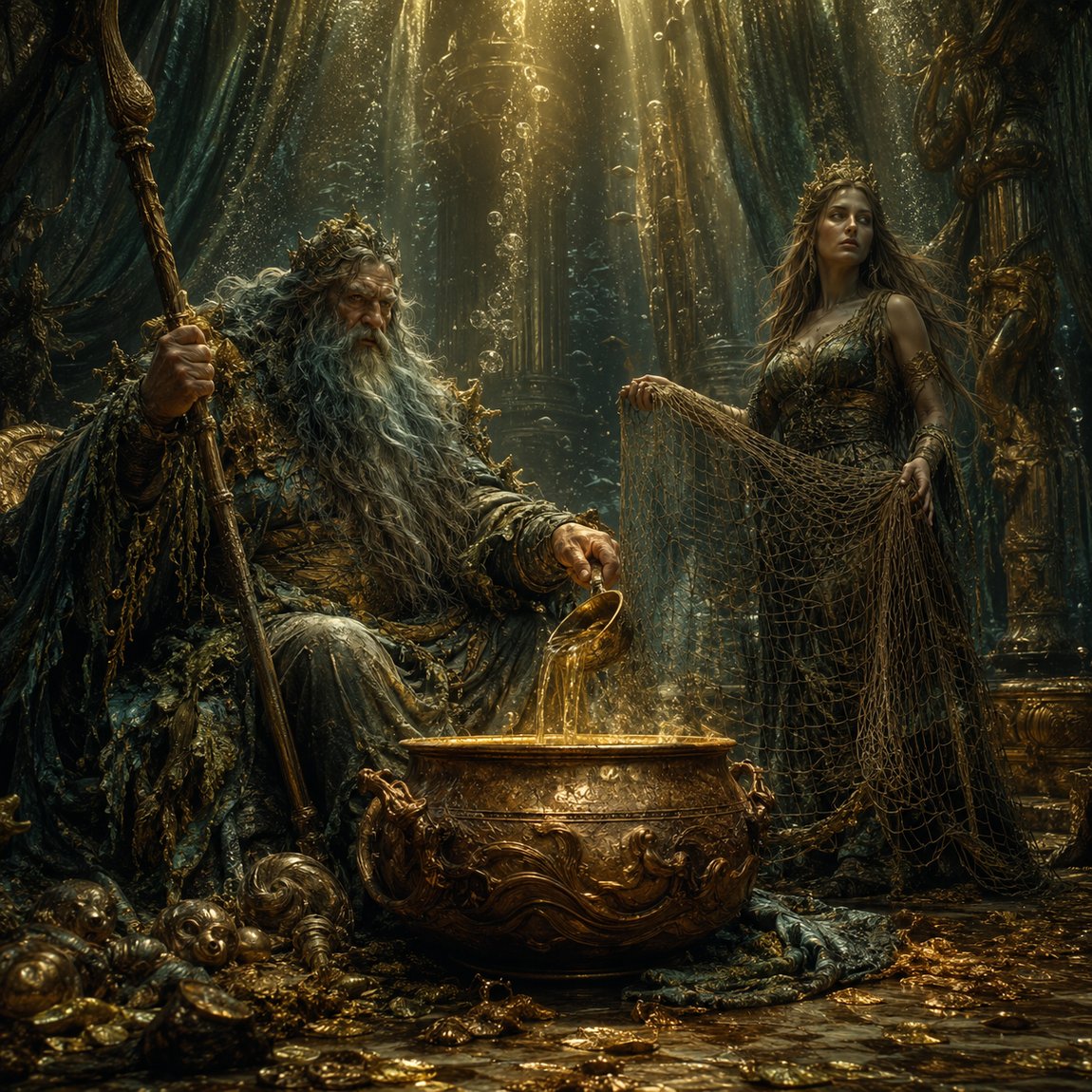
Aegir (Old Norse Ægir, also called Hlér and Gymir) is the sea itself in the shape of a giant: the great host of Norse mythology, who brews ale for the gods in his hall and lights it with shining gold instead of fire. His wife Rán catches the drowned in her net, and their nine daughters are the waves. Whether Aegir is a god or a giant is a question the medieval sources leave open and scholars still argue about. Here is what the Eddas, the skalds and the sagas actually say.
Stand on a North Sea beach in a force-seven north-westerly and watch the water come in. No two waves are alike. One rears up steep and glassy, the next collapses in foam, the one after that drags the sand out from under your boots. A Viking-Age sailor could have told you their names. They had names, they had parents, and they lived in a hall that smelled of freshly brewed ale.
Aegir is one of the strangest figures in the whole Norse tradition. He fights no wars, he has no temple, and not a single place name points to anyone ever worshipping him. Yet he turns up in several Eddic poems, in skaldic verse and at the very heart of Snorri Sturluson's Prose Edda. He is the North's great host. And his wife is the one figure in the mythology who could put real fear into a man about to set sail.
In Old Norse, ægir is first of all an ordinary poetic word for the sea. Philologists usually trace it to a Proto-Germanic form along the lines of *āgwi-jaz, "the one belonging to the water", built on the stem *ahwō-, "river, water". Its relatives include Gothic aƕa (body of water), Old High German aha (river) and Old English ēa (stream). The derivation is the standard one, though not beyond doubt. When the skalds said "Ægir", they were saying "the sea" – and meaning a person.
He has two other names. Hlér also means "sea". The Danish island of Læsø in the Kattegat was called Hlésey in Old Norse, "Hlér's island", and Snorri has Aegir live there. Whether the island was named after the giant or the giant took a by-name from the island cannot be settled. Rudolf Simek suggests Hlér may have been seen as a kind of ancestor figure for the island.
The third name, Gymir, causes trouble. The prose introduction to Lokasenna states outright that Ægir was "also called Gymir". But in Skírnismál, Gymir is the father of the beautiful giantess Gerðr, whom Freyr woos – and her mother there is Aurboða, not Rán. One giant with two different wives? Simek thinks the identification grew out of kennings in which giant names were swapped freely for one another. Most likely there were two Gymirs, merged by a later writer. That remains a hypothesis.
Aegir only acquires a family tree in late texts. Orkneyinga saga and the short piece Hversu Noregr byggðist ("How Norway Was Settled") name a giant king, Fornjótr, with three sons: Hlér, "whom we call Ægir", Logi (fire) and Kári (wind). Sea, fire and wind sorted into one pedigree looks less like ancient myth than like the tidy learning of the twelfth and thirteenth centuries.
Almost every popular book calls Aegir "the Norse god of the sea". The sources are more careful. Anthony Faulkes, the modern editor of Snorri's Edda, points out that Snorri never calls him a god. In the name lists (þulur) at the end of Skáldskaparmál, Ægir is filed among the giants. Hymiskviða calls him a bergbúi, a "mountain-dweller" – a stock term for giants, and an odd one for a lord of the sea.
On the other hand, Aegir deals with the Æsir as an equal. He visits them in Ásgarðr, they feast at his hall, and no god ever raises a hammer against him. His wife Rán even appears among the goddesses, the ásynjur, in those same lists. John Lindow therefore finds the label "giant" questionable. Andy Orchard argues the other way: Aegir's closeness to the gods is a later development, and his daughters are clearly giantesses. Simek settles for a middle formula: a giant with the features of a sea god.
What this means for you as a reader: the hard front line of "gods versus giants" that films and games love does not hold in the sources. Many gods have giantesses as mothers or wives. Aegir is simply the clearest case of a giant who is not an enemy but a host – rather as the Vanir refuse to fit the simple scheme of a single divine family.
However genial Aegir seems, his wife is the opposite. The Old Norse common noun rán means "robbery, plunder". Simek notes that the name's meaning is not fully settled, but it was evidently understood as "the robber". And that is what she does. She takes.
Her tool is a net. In Skáldskaparmál, Snorri says that when the Æsir visited Aegir's hall they discovered that Rán owned a net in which she caught everyone who went out to sea. The same net turns up in another famous story. When the gods have to pay compensation to the farmer Hreiðmarr for killing his son, Loki borrows Rán's net and uses it to catch the dwarf Andvari, who lives as a pike in a waterfall. So says the prose to the Eddic poem Reginsmál, and Völsunga saga tells it the same way. From that catch comes the cursed treasure that drives the whole Sigurd and Nibelung legend. The disaster begins with a fishing net borrowed from the bottom of the sea.
Simek sees the couple as two sides of one element: Aegir as the sea in its friendly aspect, bringing food and trade, and Rán as its sinister side. With her, on the sea floor, lies a realm of the dead of its own. Those who drown do not go to Hel and not to Valhalla. They "go to Rán".
Aegir and Rán have nine daughters, and they are, quite simply, the waves. Snorri lists them twice in Skáldskaparmál, once in the section on ways to name the sea and once in the name lists. The two lists are almost identical, except that one has Bára where the other has Dröfn:
The translations are approximate, and several of the names are plain words for a wave: bylgja and bára still mean "wave" in modern Icelandic. Blóðughadda is the puzzle. Lindow thinks of reddish foam in evening light; Simek finds the name an odd fit for a wave. Anyone who has watched spray at sunset will see Lindow's point at once.
These daughters have no stories, no personalities, no adventures. They are poets' vocabulary. In Helgakviða Hundingsbana I, a huge wave slamming against Helgi's ships is called "Ægir's terrible daughter" – and every listener knew exactly what was meant.
The Eddic poem Hymiskviða opens with a catering problem. The gods have been hunting, they are thirsty, they have shaken divining twigs and examined blood – and the answer is that Aegir's hall has plenty. Bellows' 1923 translation renders the opening scene like this:
"The mountain-dweller sat merry as boyhood"Hymiskviða 2, trans. Henry Adams Bellows (1923)
Thor looks him in the eye and orders him to brew for the gods. Aegir complies, but not without a counter-demand: he needs a cauldron big enough for everyone. Nobody has one. Týr knows where to look. East of the Élivágar rivers, at the edge of heaven, lives the giant Hymir, who owns a kettle, in Bellows' words, "a mile in depth". Týr calls Hymir his father – a detail found nowhere else, which already puzzled nineteenth-century editors.
What follows is one of the best-known scenes in all of Norse myth. Thor rows out with Hymir, baits his hook with an ox's head and hauls the Midgard Serpent to the surface before it sinks back into the deep. Back at the house he must pass a strength test: he smashes an unbreakable cup, first in vain against a stone pillar, then successfully against Hymir's skull. Finally he jams the cauldron over his own head – its handles ringing at his heels – and kills the giants who come after him.
At the end comes the line the whole poem was building towards. The kettle arrives at the assembly of the gods, and from then on they can drink at Aegir's. The last word of that stanza is hard to interpret; it is usually taken to mean "at every flax harvest", which is to say once a year, in autumn. Bellows himself admitted his rendering of these lines was largely guesswork. An annual autumn feast at the sea giant's hall – at exactly the time of year when ships were drawn up on land and the sailing season ended. Whether that was intended, we cannot know. It fits remarkably well.
Carolyne Larrington has noted another layer. Thor staring Aegir down and demanding a feast behaves like a king exacting hospitality from a subordinate. Aegir's generosity, in other words, is not entirely voluntary. We tell more of this story in our piece on Aegir's feast.
Aegir's second great appearance is Lokasenna, "Loki's flyting". The prose introduction sets the scene. Aegir, also called Gymir, had brewed ale for the Æsir once he had obtained the great cauldron. Thor was away in the east, but nearly every other god and goddess was there.
Three details make the hall unforgettable. First, shining gold was used for light instead of fire. Second, the ale served itself; nobody had to pour. Third, the hall was a griðastaðr mikill, a great place of sanctuary where no violence was allowed.
Aegir had two servants, Fimafengr ("the quick one") and Eldir ("fire-man"). The gods praised how well they did their work, and Loki could not stand it. He killed Fimafengr on the spot, inside the sanctuary. The gods shook their shields, shouted at him and drove him out into the forest. But Loki came back, confronted Eldir at the door and talked his way in. What follows is a feast of insults. One by one he accuses every god and goddess of cowardice, adultery, sorcery or unmanliness, until Thor returns, raises his hammer and drives him off.
Aegir himself says nothing in the entire poem. He is the venue, not a party to the quarrel. But he catches Loki's last blow. In the closing stanza, Loki curses his host:
"Ale hast thou brewed, but, Ægir, now / Such feasts shalt thou make no more"Lokasenna 65, trans. Henry Adams Bellows (1923)
Flames, Loki goes on, shall play over everything Aegir owns and burn his back. For a host whose hall is lit by gold rather than fire, that is a nasty parting shot.
For Snorri Sturluson, the Icelandic scholar who wrote the Prose Edda around 1220, Aegir is more than a host. He is the figure for whose benefit a whole section of the book is told. Skáldskaparmál, Snorri's handbook of poetic language, opens like this: a man called Ægir or Hlér, who lived on Hlésey and was well versed in magic, travelled to Ásgarðr. The gods welcomed him with a feast. In the evening Odin had swords brought into the hall that gleamed so brightly no other light was needed.
Next to Aegir sits Bragi, god of poetry. Aegir asks, Bragi answers: how Iðunn and her apples were stolen, how the giant Þjazi died, where the mead of poetry came from. Out of these conversations Snorri develops his explanation of kennings. Here Aegir is the audience – the curious outsider to whom the world of the gods is explained, just as Gylfi is in the first part of the Edda. Andy Orchard finds it a nice touch that the eternal host is, for once, the one being entertained.
Later in the same book Snorri turns the scene round. The Æsir visit Aegir, and he has glowing gold brought onto the floor of his hall, lighting it like fire – just as swords lit Valhalla. That, Snorri explains, is why gold is called "Ægir's fire" in poetry. It is also on this visit that the gods discover Rán's net.
A kenning is a poetic circumlocution made of at least two parts: "whale-road" for the sea, "wound-sea" for blood. Norse skalds built elaborate riddles out of them, and Aegir's family gave them a whole arsenal. Snorri lists ways to name the sea: "Ymir's blood", "visitor of the gods", "husband of Rán", "father of Ægir's daughters", "land of Rán and of Ægir's daughters and of Ægir".
Skaldic poems and the dictionaries supply more: Ránar vegr, "Rán's road", for the sea; Ránar salr, "Rán's hall", for the seabed; "Rán's bed" for the resting place of the drowned. Waves are "Ægir's daughters", gold is "Ægir's fire", and elsewhere Egill Skallagrímsson calls gold "Hlér's fire". The eleventh-century skald Hofgarða-Refr calls Rán "Gymir's völva", Gymir's seeress – which for Snorri proved that Ægir, Hlér and Gymir were one and the same.
This shows how the poetry worked. To understand a stanza, you had to know the stories: the gold in Aegir's hall, Rán's net, the nine daughters. That was common knowledge for an audience listening on long winter evenings in the longhouse. The myths lived on in the language long after anyone believed in Aegir.
The most moving passage about the couple comes not from a poem about gods but from a grieving father. Around 960 the Icelandic poet Egill Skallagrímsson lost his son Böðvarr, drowned in a storm in Borgarfjörður. Egill shut himself away, refused food and meant to die. His daughter coaxed him into composing a poem instead: Sonatorrek, "The Loss of Sons".
In it Egill addresses Rán directly. In paraphrase: Rán has dealt harshly with me, I am stripped of dear friends; the sea has torn the bonds of my kin. In a famously difficult stanza he wishes he could settle the matter with the sword – then he would go to war against the "ale-smith", meaning Aegir, and against "Ægir's wife". A father who wants to declare war on the sea for taking his son: this is not theology, it is grief in verse. And that is exactly why it rings true. Here we see how a tenth-century man actually related to these figures.
The heroic poems know Rán as a threat too. In Helgakviða Hjörvarðssonar, Atli taunts the giantess Hrímgerðr that she would have given the king's men to Rán if a spear had not stopped her. To "give someone to Rán" means to drown them.
A remarkable piece of evidence comes from Eyrbyggja saga, chapter 54. The farmer Þóroddr drowns with his crew off the Snæfellsnes peninsula. At their funeral feast the whole crew walks in dripping wet and sits down by the fire. At first people take this as a good sign: in William Morris's translation, the drowned "should have good cheer of Ran" if they came to their own burial-ale. The saga adds that the old belief still held sway, although people were baptised. It is a thirteenth-century text and part of the famous Fróðá hauntings – but it shows that Rán kept her place in Icelandic thinking well after the conversion.
Search for "Norse god of the sea" and two names come up: Aegir and Njörðr, father of Freyr and Freyja and one of the Vanir. They are often confused or treated as a double booking. They are something fundamentally different.
Njörðr is a god people called on. In Gylfaginning, Snorri says he governs the course of the wind, calms sea and fire, and should be invoked for seafaring and fishing. He lives in Nóatún, "ship-enclosure" – the harbour, not the deep. He is rich enough to grant land and goods to those who worship him. Numerous Scandinavian place names preserve his cult, and his name is generally linked with the goddess Nerthus described by Tacitus in the first century.
Aegir is never invoked. No prayer, no offering, no sanctuary is recorded for him. He is the sea as a force of nature, not a patron of sailors. Put simply: Njörðr is the sea as a fisherman hopes it will be – the sheltered bay, the fair wind, the full net. Aegir and Rán are the sea as it is – generous on good days and merciless on bad ones.
Sober numbers show how dangerous that sea was. According to Landnámabók, the Icelandic Book of Settlements, 25 ships set out with Erik the Red for Greenland. Only 14 arrived; the rest turned back or were lost. A runestone from Vallentuna north of Stockholm (U 214) records how the husband of a woman named Ingibjörg drowned in "Holmr's sea": his cargo ship, a knarr, went to the bottom, and only three men came out alive. Then there was hafvilla, the dreaded state of being lost at sea in fog, with neither sun nor stars to steer by.
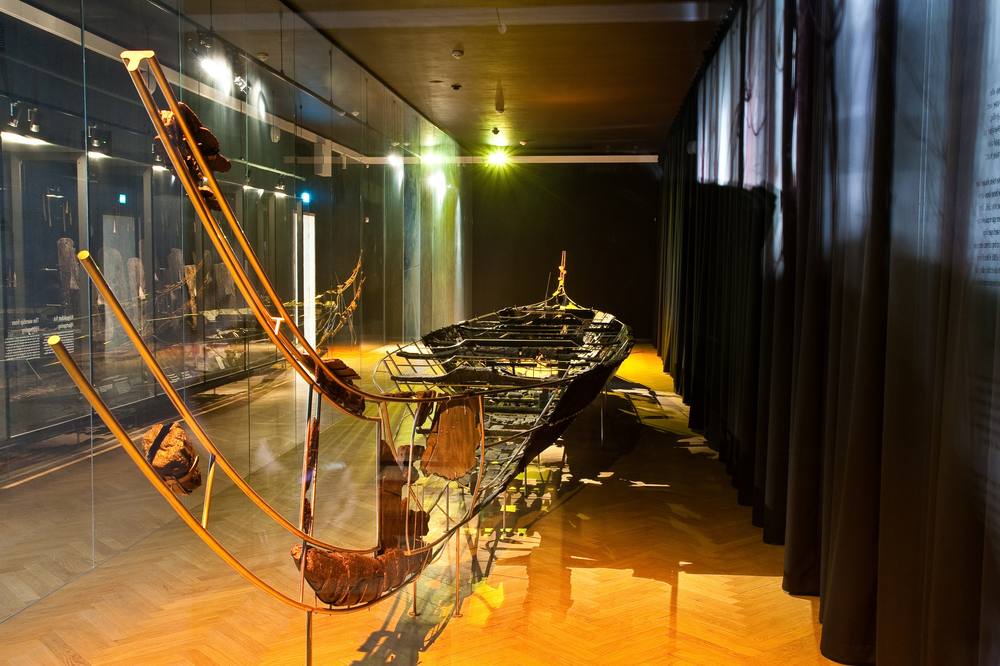
Did the Vikings make offerings to the sea to survive such voyages? Here we have to separate carefully. No offering to Aegir or Rán is attested. What we do have is something else. The Gallo-Roman bishop Sidonius Apollinaris reports that fifth-century Saxon sea raiders killed every tenth captive before sailing home – a hostile source about Saxons, not Vikings. In Scandinavia itself there are massive deposits in lakes and bogs: the Hjortspring boat from the pre-Roman Iron Age, the Nydam boats, the third-century weapon offerings of Illerup Ådal. They show that water was treated for centuries as a recipient of gifts. Who those gifts were meant for, no find tells us.
From Iceland's settlement period, Landnámabók and Eyrbyggja saga tell how settlers such as Ingólfr Arnarson and Þórólfr Mostrarskegg threw their high-seat pillars overboard and settled where they washed ashore. According to the saga, Þórólfr's pillars bore an image of Thor. The sea was the messenger here, but the god invoked was Thor, not Aegir – one more sign that Aegir belonged to poetry rather than to cult.
Navies quickly realised that a sea giant makes a good ship's name. In 1895 the Imperial German Navy commissioned the coastal defence ship SMS Aegir of the Odin class. The Icelandic Coast Guard has operated ships named Ægir for decades, the best known launched in 1968 and active in the Cod Wars with Britain. Norway, too, had a corvette of that name.
In the sky Aegir appears twice: one of Saturn's small moons bears his name, and since 2015 the exoplanet Epsilon Eridani b has officially been called Ægir. Mineralogists named the dark green mineral aegirine after him, first described from Norway. And in England the tidal bore that runs up the River Trent at spring tides is known as the "Trent Aegir" – whether that name really comes from the Norse Ægir or from the old English dialect word eagre for such a bore is disputed.
The bearded sea giants with tridents you see today go back to nineteenth-century art – Emil Doepler's Ægir of 1901, for instance – and to Poseidon. The Edda says not one word about what Aegir looked like.
In our workshop in Alsdorf, Aegir is a gift of a motif precisely because he has no fixed appearance. Rather than an invented face with a trident, we prefer to engrave what the sources actually give us: nine wave lines stacked one above the other, each curving a little differently, with his name in Younger Futhark runes beneath. On dark natural slate it looks like spray at night.
For something more personal, take a kenning as your inscription: "Ægis eldr", Aegir's fire – for someone who is worth their weight in gold. And because Aegir's hall was lit by gold rather than flame, the motif works especially well on an engraved glass lantern: the light falls through the wave lines as if the sea giant's hall lay on the seabed below.
Aegir and Rán are neither good nor evil powers. They are the most honest description of the sea a seafaring people could give: a hall full of gold and ale, and a net that makes no exceptions. Anyone who lives by the coast knows both are true.
Is Aegir a god or a giant? The sources class him as a giant (jötunn), and Snorri never calls him a god. Because he is on friendly terms with the Æsir, many modern books call him a sea god; Simek describes him as a giant with the features of a sea god.
Who is Rán in Norse mythology? Rán is Aegir's wife. Her name means "robbery"; she catches those who drown at sea in her net and keeps them in her realm on the seabed.
What are the names of Aegir's nine daughters? According to Snorri: Himinglæva, Dúfa, Blóðughadda, Hefring, Uðr, Hrönn, Bylgja, Dröfn (Bára in a second list) and Kólga. Every name describes a kind of wave.
What is the difference between Aegir and Njord? Njörðr is one of the Vanir, a god invoked for seafaring, wind and fishing, with a documented cult. Aegir is the personified sea and host of the gods, with no attested worship.
Why is gold called "Aegir's fire"? Because, according to Snorri and the prose introduction to Lokasenna, Aegir's hall was lit not by fire but by shining gold.
Is the Ægishjálmr related to Aegir? No. The symbol's name comes from agi, "terror", and means "helm of awe"; the similarity to the sea giant's name is a coincidence.
For courage. For remembrance. For legends that live on.
All Gods & Goddesses articles →
She appears rarely and never speaks a single recorded word – yet the greatest catastrophe of Norse myth springs from …
Read more →He was the fairest, the gentlest, the purest – and yet it was he whom death struck. The legend of Balder is the most …
Read more →In the halls of the gods sits one who would rather turn a fine phrase than swing an axe: Bragi, the long-bearded lord …
Read more →Every great deity of the North has a dwelling. That of Frigg, the highest of the goddesses, is called Fensalir – „the …
Read more →