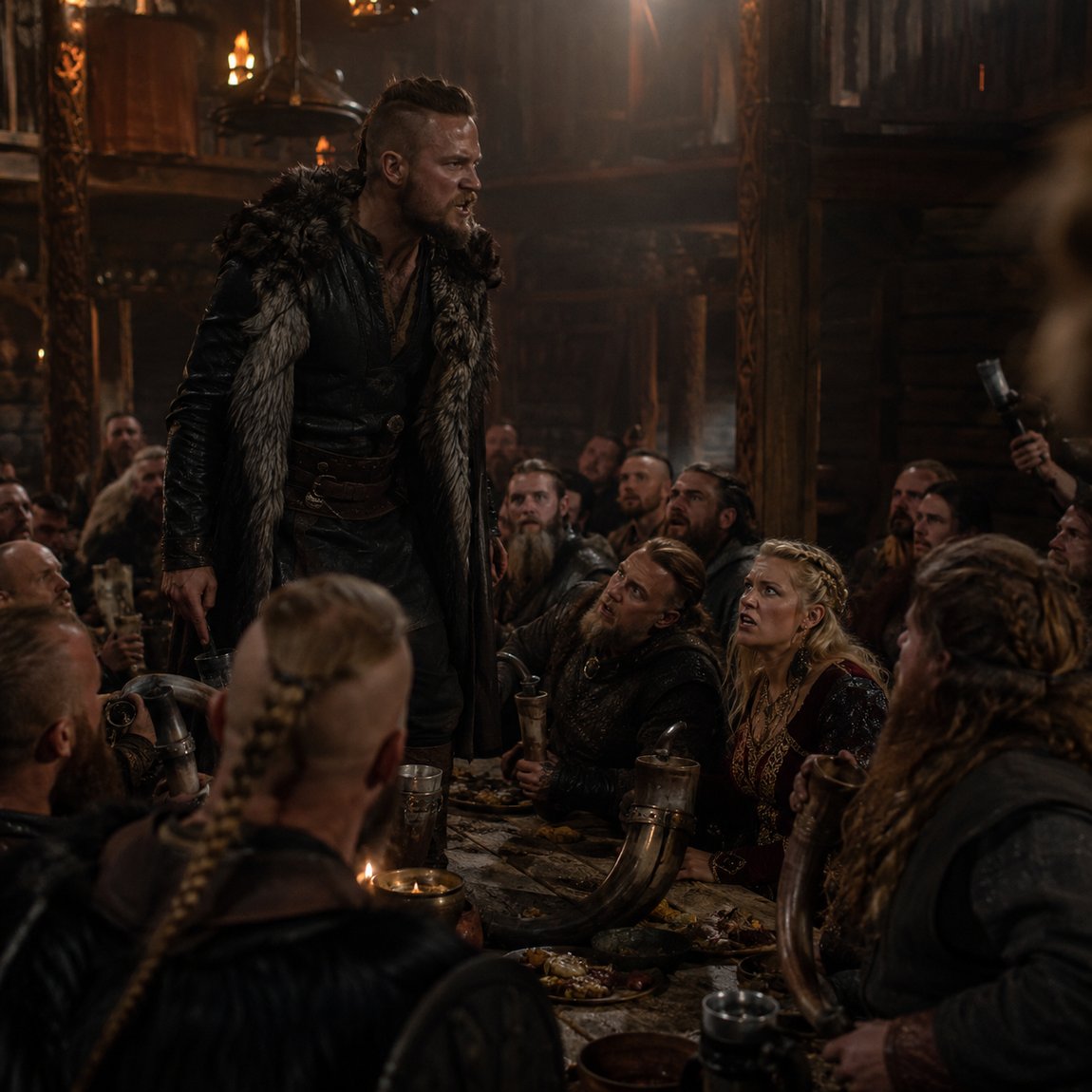
Lokasenna („Loki's quarrel“ or „Loki's flyting“) is a poem of the Poetic Edda in which Loki gatecrashes a feast in the hall of the sea-giant Ægir and insults the gods one by one: cowardice, adultery, incest, unmanly magic. Only Thor's hammer silences him, and a closing prose passage tells how the gods then bind him. The poem survives in a single manuscript, the thirteenth-century Codex Regius. We walk through it stanza group by stanza group, decode the allusions and keep a clear line between what the source says and what scholars read into it.
Picture a party where every guest has a secret. The ale pours itself, the hall shines, everyone is toasting the host. Then the door opens and in walks the one person who knows all of those secrets. He sits down, raises his cup and starts talking. That, in short, is Lokasenna: sixty-five stanzas in which Loki takes the assembled gods apart, one after another, until the Thunderer is standing in the doorway.
Read it closely and you get a cross-section of half of Norse mythology for free. Almost every insult points to a story told somewhere else, sometimes at length, sometimes nowhere at all. Those gaps are part of the fascination: Loki mentions things no other source knows anything about.
The poem is preserved in exactly one medieval manuscript, the Codex Regius of the Poetic Edda (GKS 2365 4to), written in Iceland around 1270 and now back in Reykjavík. Later paper copies all descend from it. For the collection as a whole, see our article on the Edda.
In the Codex Regius, Lokasenna sits between Hymiskviða and Þrymskviða, two Thor poems. The opening prose explicitly picks up from Hymiskviða, in which Thor fetches the giant brewing cauldron for Ægir, and at the end it is Thor again who breaks up the feast. The scribe seems to have read it as part of a small Thor cycle, even though Loki does nearly all the talking. The poem is also known as Ægisdrekka, „Ægir's drinking party“; Karl Simrock's German translation used that title.
The metre is ljóðaháttr, „song metre“, the verse form of dialogue and wisdom poetry also used in Hávamál. Four stanzas, all spoken by Loki, carry an extra line in the expanded form called galdralag, „spell metre“. At key moments Loki literally says more than the metre allows.
Before a single stanza, a short prose passage sets the scene. Ægir, the sea-giant „who was also called Gymir“, has brewed ale for the gods now that he has the great cauldron. Nearly everyone is there: Odin and Frigg, Sif, Bragi and Iðunn, Týr, „who was one-handed, because Fenrir had bitten off his hand“, Njörðr and Skaði, Freyr and Freyja, Víðarr, Loki, and Freyr's servants Byggvir and Beyla, along with „many Æsir and elves“. Thor is missing. He is off on the eastern road killing trolls.
Two details stand out. First, Ægir has shining gold (lýsigull) carried into the hall to light it in place of fire. Snorri knows the motif too and uses it to explain why gold can be called „Ægir's fire“ in skaldic poetry. Second, the hall is a griðastaðr mikill, „a great place of sanctuary“, where no violence may be done. The ale serves itself.
The guests praise Ægir's servants Fimafengr and Eldir for how well they wait at table. Loki cannot stand it and kills Fimafengr: a murder in a sanctuary, right at the start. The gods shake their shields, shout at him and chase him out into the woods. Then they go back to their drinking. Big mistake. Interestingly, the stanzas themselves never mention the killing; the prose probably draws on older narrative material that Snorri also knew.
Loki comes back and meets the other servant, Eldir, outside. The first five stanzas are a warm-up. Loki wants to know what the gods are talking about. Weapons and battle-glory, says Eldir, and not one of them in there has a kind word for you. Loki announces that he will go in and mix strife and hatred into their mead. Eldir warns him that every insult will rebound on him. Loki shrugs: when it comes to a war of words, he has plenty of answers.
Inside, the room goes quiet as he enters. Loki demands what every guest is owed: a seat and a drink. Bragi, the god of poetry, refuses. So Loki plays his strongest card and turns straight to Odin:
Remember, Othin, in olden days / That we both our blood have mixed;Lokasenna 9, trans. Henry Adams Bellows (1923, public domain)
In paraphrase, he goes on: back then, Odin swore never to drink ale unless it was brought to both of them. Odin and Loki are blood-brothers. Lokasenna is our main source for that bond, and it ties Odin's hands. He orders his son Víðarr to stand up and make room for „the wolf's father“, so that Loki will not speak abuse in Ægir's hall. The irony could hardly be thicker: Odin lets Loki in to prevent exactly what then happens.
Loki drinks and toasts every god and goddess, „except that one god who sits further in, Bragi, on the bench“. The gauntlet is down.
Old Norse senna means „quarrel, wrangling“; scholars use it for a fixed form of verbal combat, called flyting in English after the Scots tradition of elaborate insult contests. In 1980 Carol J. Clover showed that such duels in Germanic poetry follow a recognisable pattern. The opponents often meet at a threshold, a door or across water, accuse each other of cowardice, sexual disgrace and failure, counter, top each other and finish with a threat. Related scenes include Thor's slanging match with the disguised Odin across a sound in Hárbarðsljóð, and the exchange between Beowulf and Unferth in the Old English epic.
This was not harmless banter. The medieval law codes of Norway and Iceland punished certain kinds of verbal abuse severely, above all accusations of unmanliness, such as claiming that a man had given birth to children. That is precisely the kind of charge Loki and Odin throw at each other. The key Old Norse term is ergi (adjective argr or ragr): sexual passivity and „effeminacy“ in a man, the most damaging thing you could say about him.
Bragi tries bribery first: a horse, a sword and a ring if Loki will just keep the peace. Loki laughs at him. Bragi is always short of horses and rings himself, he says, and of all the gods he is the most wary of battle. Bragi says that if they were outside, he would be holding Loki's head in his hand. Loki retorts that Bragi is a hero only when sitting on a bench.
Iðunn, Bragi's wife, pleads for calm. Loki's reply: she is the most man-hungry of women, because she wrapped her freshly washed arms around her brother's killer. Who that brother was, and whom she embraced, no other source tells us. It is one of the charges that exists only here. Iðunn refuses to take the bait and tries to calm Bragi.
Next comes Gefjun, a goddess Snorri connects with ploughing the island of Zealand out of Sweden. Loki reminds her of „the white boy“ who gave her a jewel, and of how she laid her thigh over him in return. Again, we know this story from nowhere else. Some scholars suspect that motifs belonging to Freyja have been shifted onto Gefjun here, since a later tale has Freyja buy her necklace with nights of love. That remains a guess.
Now Odin himself steps in: Loki must be mad to provoke Gefjun, who knows the fates of the world as well as Odin does. With that, Odin is in the ring, and Loki goes straight for his role as god of victory. Odin never knew how to share out battle fairly, he says, and often gave victory to the less brave. The charge has support elsewhere, in poems and sagas where Odin withdraws his favour on a whim and lets heroes fall whom he once backed.
Odin hits back hard. Loki spent eight winters under the earth as a milch-cow and a woman, and bore children there; Odin calls that args aðal, the nature of an unmanly creature. Loki's motherhood turns up elsewhere too: in Snorri, Loki as a mare gives birth to the eight-legged horse Sleipnir, and the Short Völuspá in Hyndluljóð says he became pregnant after eating a half-burnt woman's heart. The eight winters as a milch-cow are found only in Lokasenna.
Loki's answer is famous. On the island of Samsey, he says, Odin practised seiðr, „beat on the drum as seeresses do“ and wandered through the world of men in the shape of a sorcerer. That too, Loki says, is unmanly. Seiðr was a form of magic that the sources link mainly with women, with prophecy and with steering fate. In Ynglinga saga Snorri writes that men shunned this art because of the ergi attached to it. Odin practised it anyway. We dig into that paradox in our articles on seiðr and on Odin.
Frigg, Odin's wife, urges everyone to let old stories lie. Loki pounces at once: she has always been man-mad and, while Odin was away, took both of his brothers, Vé and Vili, into her arms. That fits a note in Ynglinga saga, where Odin's brothers rule his realm and share Frigg during a long absence. Lokasenna and Snorri may be drawing on the same tradition here.
Frigg answers with grief and anger: if she had a son like Baldr sitting here, Loki would not get out alive. Loki's response may be the coldest line in the whole poem. He is the reason, he says, that she will never again see Baldr ride home to the halls. Loki openly admits his guilt for Baldr's death, which matches Snorri's account of Loki guiding blind Höðr's hand with the mistletoe. How old that link is depends on the date of the poem, and that date is uncertain.
Now Freyja joins in: Frigg knows all fates, even if she does not speak them. Loki's answer: every god and every elf in the hall has been her lover. Freyja predicts he will go home unhappy. Loki doubles down: she is a malicious witch, the gods caught her in bed with her brother Freyr, and at that moment she broke wind. The poem drops into crude comedy here, quite deliberately. The incest charge is not plucked from thin air, though: according to Snorri's Ynglinga saga, sibling marriage was the custom among the Vanir.
Njörðr defends Freyja with a remarkable argument. Women having lovers is no great harm, he says; the real outrage is that an unmanly god who has borne children is sitting here. Loki answers with one of the rudest stanzas in the Edda: Njörðr was sent east to the gods as a hostage, and the daughters of the giant Hymir used him as a chamber-pot and pissed in his mouth. The background is the war between the Æsir and the Vanir, after which Njörðr went to the Æsir as a hostage. Some commentators have read Hymir's daughters as rivers running into the sea, a natural fit for a god of coasts and seafaring, but that is a modern explanation, not something the source says. Njörðr takes comfort in his son Freyr; Loki replies that Njörðr fathered him on his own sister.
Then Týr speaks up for Freyr, who frees every captive from his bonds. Loki hits Týr where it hurts. Týr could never bring two parties to a fair settlement, and Fenrir tore off his right hand. Týr's reply is bitter and sharp: he lacks a hand, but Loki lacks his wolf, and the wolf must wait in fetters until the end of the world. Loki's punchline: Týr's wife had a son by Loki, and Týr never got a penny of compensation. No other source mentions a wife of Týr.
Freyr himself now threatens that Loki will be bound like his wolf-son unless he keeps quiet. Loki aims at Freyr's courtship: he bought Gymir's daughter Gerðr with gold and gave away his sword for her, so when the sons of Muspell come he will not know what to fight with. The story behind this is told in the Eddic poem Skírnismál, and Snorri adds that at Ragnarök Freyr falls to Surtr for lack of his sword.
In the middle of all this divine mud-slinging, a servant jumps up: Byggvir. If he had Freyr's lineage and such a fine seat, he would grind Loki smaller than marrow. Loki mocks him as a little wagging thing that always hangs at Freyr's ear and chatters under the millstones. Byggvir is proud that everyone is drinking the ale he helped make. Loki says that when men fight, Byggvir hides in the straw.
The name Byggvir is very probably related to Old Norse bygg, „barley“. A servant of the fertility god who helps with grinding and brewing and hides in the straw fits rather too well to be coincidence. Whether he was a minor deity or a poetic personification is open; Joseph Harris devoted a study to him in 1999. The name of his wife Beyla has no secure explanation.
Then Heimdall speaks: Loki is drunk and does not know what he is saying. Loki's answer: from the beginning of time, Heimdall has been stuck with the ugly lot of standing watch forever with a „muddy back“. What the muddy or wet back means is unclear; perhaps simply the sentry who stays outside in all weathers. According to Snorri, Loki and Heimdall kill each other at Ragnarök.
Now things turn serious. Skaði, daughter of the giant Thjazi, is the first to say aloud what awaits Loki. He will not be playing with his tail free for much longer, because the gods will bind him on a sharp rock with the guts of his ice-cold son. Loki is unmoved: if so, he was still first and last when her father Thjazi was killed. Skaði swears that only cold counsel will ever come to him from her shrines and fields. Loki answers that she was friendlier when she invited him into her bed.
This exchange knots several myths together. Snorri tells how the gods killed Thjazi, how Skaði came for revenge, and how Loki helped reconcile her by making her laugh. Snorri knows nothing of a night together. The key point: Skaði names the very punishment that the closing prose will carry out. Lokasenna knows how Loki's story ends.
Then Sif, Thor's wife, steps forward and hands Loki a rime-cold cup of old mead, hoping he will spare at least her. Loki drinks and says she would be the one blameless woman, if he did not know of one man who made a cuckold of Thor: himself. Sif's peace offering becomes the worst humiliation for her absent husband. Beyla calls out that the mountains are shaking and Thor is coming home. Loki has a parting insult for her too, calling her a filthy dairymaid.
Then Thor is in the hall: shut up, or Mjöllnir will stop your mouth. Loki retorts that Thor will not be so bold when he has to fight the wolf and it swallows the „Father of Victory“ whole, meaning Odin. Some retellings turn this into the wolf swallowing the sun; that is not what the text says. In fact Thor fights the Midgard Serpent at Ragnarök, not the wolf, so Loki is needling him with Odin's death.
Thor threatens a second time: he will hurl Loki into the east where no one will ever see him again. Loki reminds him of his eastern journeys and of the time Thor cowered in the thumb of a glove and hardly seemed like Thor at all. That is the story of the giant Skrýmir, whose glove Thor and his companions mistook for a hall. Snorri tells it in full in the episode of Útgarða-Loki.
Thor threatens a third time to break every bone in Loki's body. Loki: Thor could not even untie Skrýmir's food-bag and nearly starved. The fourth time, Thor promises to send him down to Hel, below the corpse-gates. Only now does Loki give way. He has said to the gods what his heart told him, he says; for Thor alone he will leave, because he knows Thor will strike. Notice what Thor does not do: he does not answer a single charge. He does not argue, he threatens, and in doing so steps outside the rules of the senna. You can read that as brute force beating words, or as an admission that Loki's arrows hit home. The poem leaves both readings open.
The last stanza belongs to Loki, and it is a curse on the host:
Ale hast thou brewed, but, Ægir, now / Such feasts shalt thou make no more;Lokasenna 65, trans. Henry Adams Bellows (1923, public domain)
In paraphrase: flames shall play over everything Ægir owns and burn his back. Many readers see a glimpse of Ragnarök here, when Surtr's fire consumes the world. The circle closes: the feast in the sanctuary becomes the last party of a world already heading for its end.
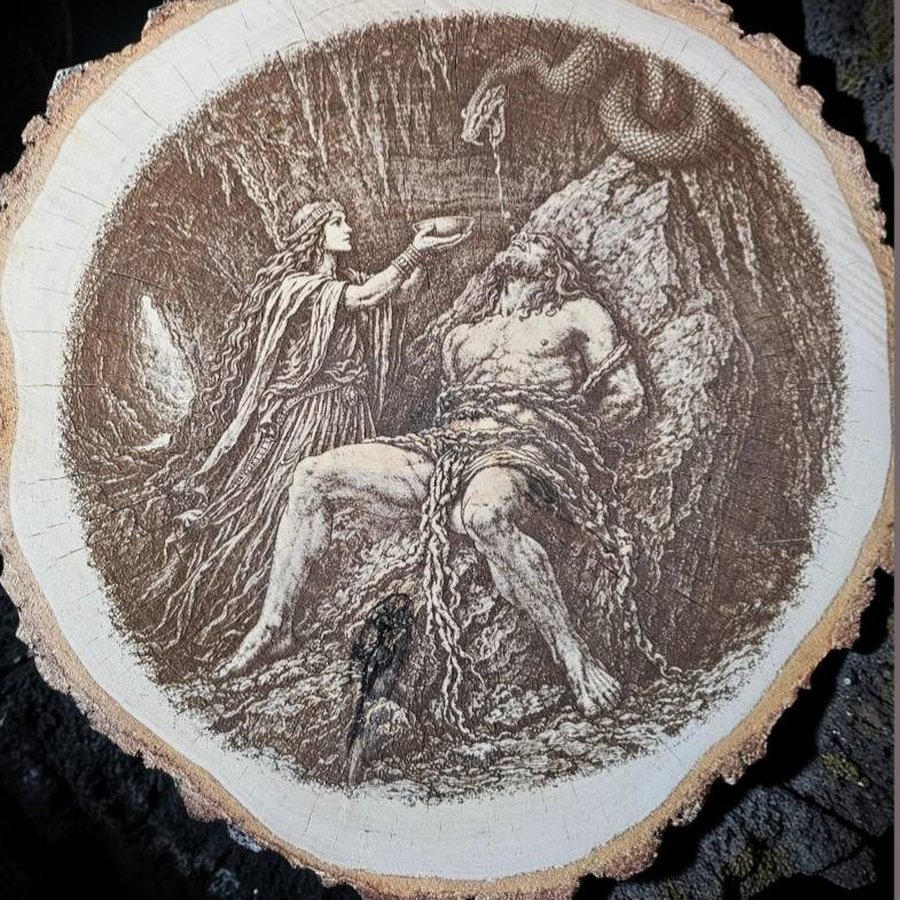
A short prose passage follows. Loki hides in the shape of a salmon in the waterfall Fránangrsfoss, but the gods catch him. He is bound with the entrails of his son Nari, while his son Narfi is turned into a wolf. Skaði fastens a venomous snake above Loki's face. His wife Sigyn holds a bowl beneath the dripping venom. When she goes to empty it, the venom falls on Loki and he writhes so violently that the whole earth shakes. „That is now called an earthquake“, the text concludes.
Snorri tells the same punishment at greater length in Gylfaginning, but in a different context. For him the binding follows Baldr's death, not the feast, and the gods turn Váli into a wolf who tears apart his brother Narfi, whose guts then bind Loki. We cannot say which version is closer to an older tale. We tell the full story in Loki's punishment.
What was the poet after? None of the following positions is proven.
Pagan tragicomedy. On this view the poet was firmly rooted in the old faith and could still mock his gods: comic on the surface, tragic at the core, because Ragnarök stands behind every insult. Preben Meulengracht Sørensen emphasised in 1988 that Loki is exposing the guilt of the gods that leads to their downfall. A related reading sees disillusionment in the twilight of paganism, around the time Iceland accepted Christianity in 999 or 1000.
Christian critique. Another position reads Lokasenna as a deliberate attempt by a Christian author to discredit the old gods: show them as cowardly, lecherous and unmanly, and you strip them of all dignity. Critics object that the poem takes the gods seriously enough to keep their whole story, right up to Ragnarök, in view, and that Loki makes an unlikely mouthpiece for the poet.
Thirteenth-century learned play. It is also conceivable that an educated Icelander of Snorri's generation gathered old myths and rearranged them with irony. One argument for a later date is that Lokasenna seems to allude to and twist many other stories, which makes it more likely the borrower than the source.
Cultic background. Another strand of research asks whether a real ritual stands behind the scene: the formal drinking feast (sumbl) with toasts, vows and boasting, where mockery had its place. Byggvir and Beyla, the brewing cauldron and the central role of ale are cited as hints. None of this can be proven; Lokasenna is not the transcript of a rite but carefully built poetry.
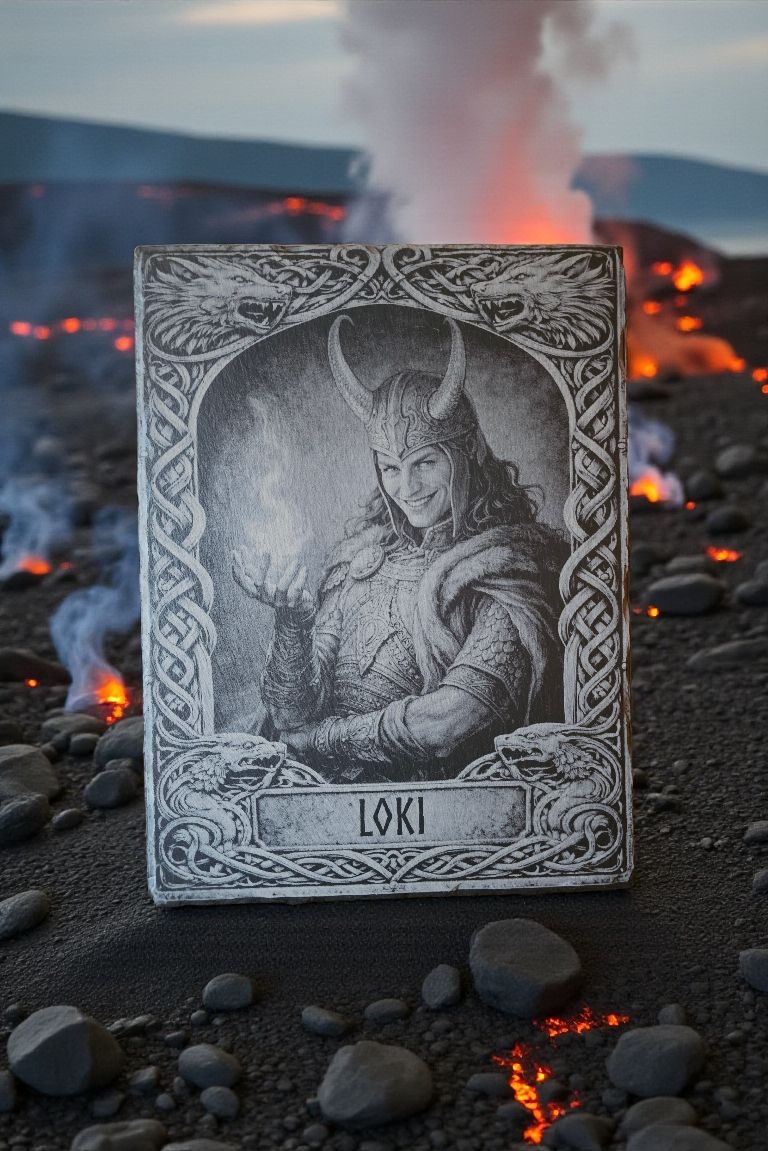
What does Lokasenna mean? Roughly „Loki's quarrel“ or „Loki's flyting“; Old Norse senna is a verbal duel of mutual insults. The poem is also known as Ægisdrekka, „Ægir's drinking party“.
Where is Lokasenna preserved? Only in the Codex Regius of the Poetic Edda, an Icelandic manuscript of about 1270. Later paper manuscripts are copies of it.
Why does Loki kill Fimafengr? According to the opening prose, because the gods praise Ægir's servant Fimafengr for his good service and Loki cannot bear it. The source gives no further reason.
Which gods does Loki insult in Lokasenna? Bragi, Iðunn, Gefjun, Odin, Frigg, Freyja, Njörðr, Týr, Freyr, Byggvir, Heimdall, Skaði, Sif, Beyla and finally Thor. Ægir himself only gets the curse in the last stanza.
How does Lokasenna end? Thor threatens Loki four times with his hammer, Loki leaves and curses Ægir's hall. A closing prose passage tells how Loki is caught as a salmon and bound with his son's entrails.
Is Lokasenna Christian satire? That is one of several scholarly positions. Others see pagan tragicomedy or thirteenth-century learned play in it; the question cannot be settled.
For courage. For remembrance. For legends that live on.
Loki · Seiðr – the magic · Thor · Freyja · The Norse pantheon.
Every misdeed has its price, and Loki’s bill is settled all at once. After the death of Baldr and his merciless mockery …
Read more →A stranger offers the gods an unbreachable wall around their stronghold - in a single winter. His price is outrageous …
Read more →Most people know Ragnarök only as a world-fire: gods die, the sun goes out, the earth sinks. Yet the great world-poem …
Read more →Norse cosmology knows not heaven and earth but nine worlds – strung along the world tree Yggdrasil, which runs through …
Read more →