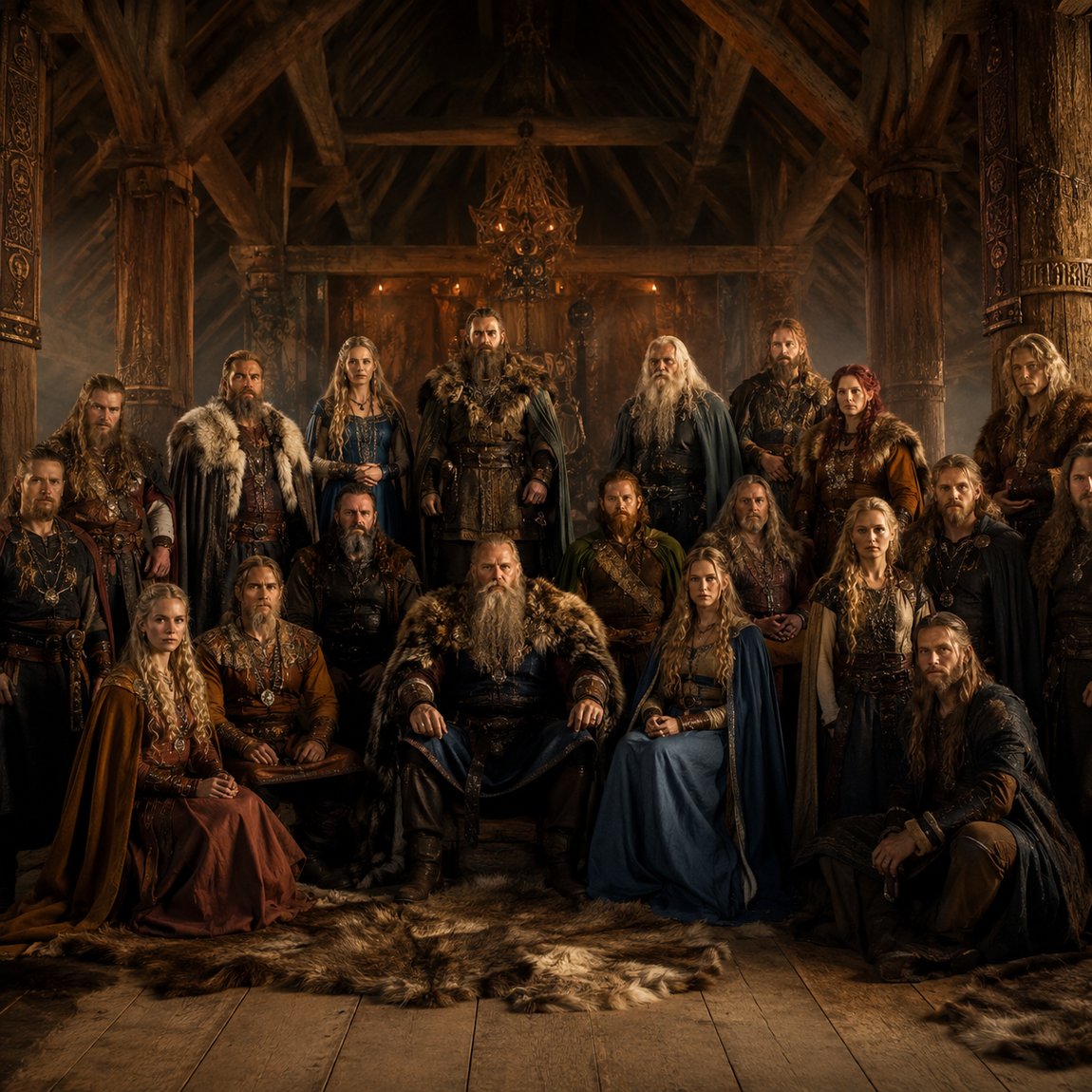
Norse religion has no distant, all-powerful deity on a throne. It has a family – quarrelsome, cunning, loving, mortal. And it has not one but two races of gods, who once went to war and then merged: the Æsir and the Vanir. This piece introduces them both, god by god, with sources, Edda quotes and an honest boundary between what is attested and what remains later interpretation.
When we say ‘the Norse gods’ we usually mean a dozen names: Odin, Thor, Freyja, Loki. But Snorri Sturluson, the Icelandic scholar who wrote our most important handbook of mythology around 1220, lists far more – ‘twelve Æsir and as many goddesses’, plus the Vanir, countless giants, dwarves and beings in between. All told there are over fifty named figures. Many are now only names in a list; others carry whole sagas. This text sorts them – but it begins with a warning.
The Æsir are the gods of sovereignty, war, law and the word: Odin, Thor, Tyr, Frigg, Baldr, Heimdall and their kin. They dwell in Asgard, high above the human world of Midgard, joined to it by the rainbow bridge Bifröst. The Vanir are the gods of fertility, wealth, the sea and magic: Njörd, his son Freyr and his daughter Freyja. They come from Vanaheim.
In the beginning there was war. The Völuspá, the great world-poem of the seeress, tells of the first war of the world – sparked by a figure called Gullveig (‘gold-draught’, ‘gold-power’), who comes to Odin’s hall and is pierced with spears and burned three times, yet three times returns. Then Odin hurls his spear over the enemy host – the ritual war-hallowing – and Æsir and Vanir fall upon one another. Neither side wins. The war ends in a stalemate and a peace, sealed by an exchange of hostages: the Vanir send Njörd, Freyr and Freyja to Asgard; the Æsir send Hœnir and the wise Mímir to the Vanir. As a token of reconciliation all the gods spit into a vat – and from it is born the wisest of beings, Kvasir, from whose blood the mead of poetry will later be made.
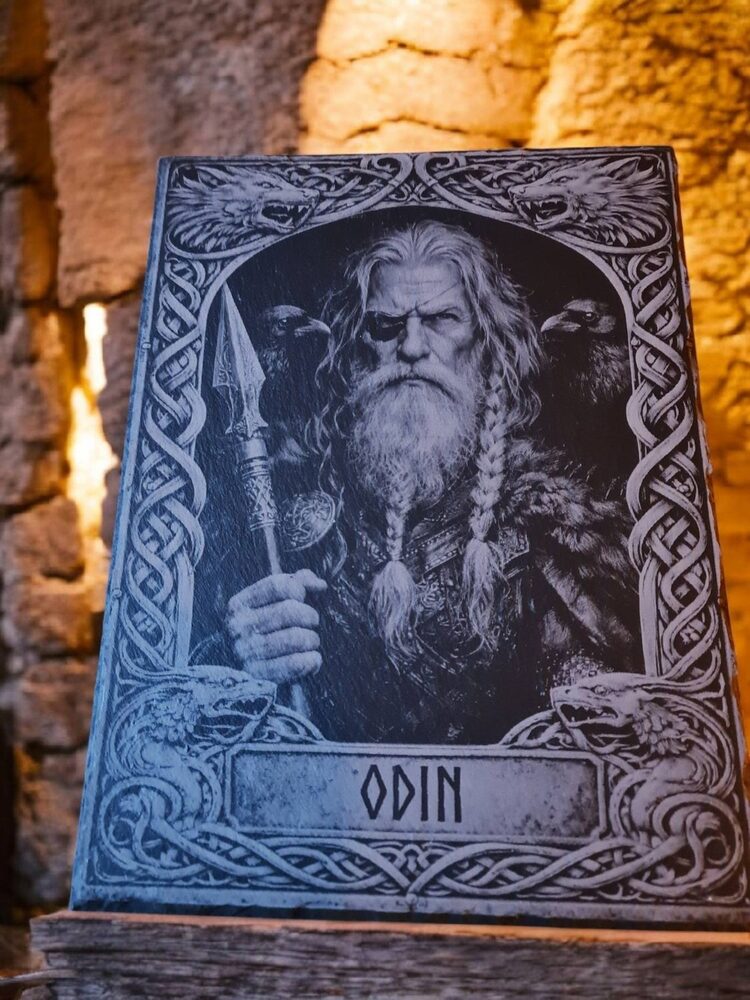
Odin (Old Norse Óðinn) heads the Æsir, yet is anything but a kindly sky-father. He is the god of ecstasy and poetry, of war and the dead, of wisdom and magic. For a drink from Mímir’s well he gave an eye; to win the runes he hanged himself, self-sacrificed, nine nights on the world tree. Two ravens, Huginn (‘thought’) and Muninn (‘memory’), fly over the world each day and report to him; on the eight-legged Sleipnir he rides between the worlds. He gathers the slain in Valhalla – not out of kindness, but for the last battle.
“Cattle die, and kinsmen die, / and so one dies one’s self; / but a noble name will never die, / if good renown one gets.”Hávamál 77, translation after Henry Adams Bellows (public domain)
This verse from the Hávamál (‘Sayings of the High One’), Odin’s great poem of counsel, is the core of the Norse ethic: fame and good repute outlast death. More on the most many-sided of the gods in our Odin portrait.
Frigg, Odin’s wife and highest of the goddesses, knows the fate of all things – and keeps silent about it. When she dreams of the death of her son Baldr, she takes an oath from all things not to harm him – overlooking only the young mistletoe. Frigg is goddess of marriage, motherhood and hidden knowledge; her name survives in ‘Friday’.
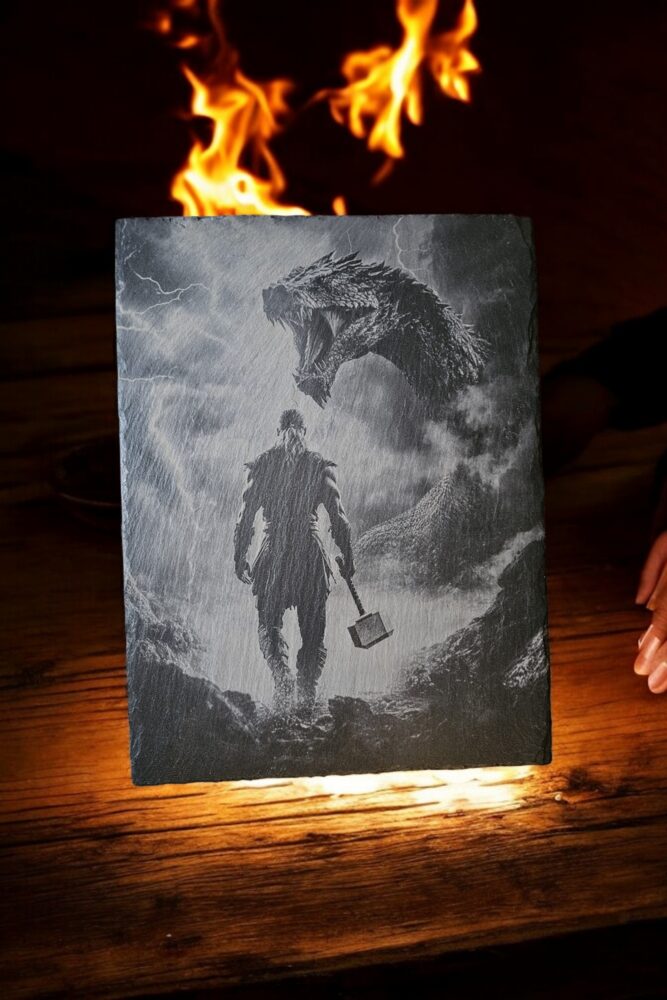
Thor (Old Norse Þórr), Odin’s son, is the most popular god of the North: lord of thunder, foe of the giants, guardian of gods and men. His hammer Mjölnir returns to his hand when thrown; his goat-drawn chariot makes the thunder. Archaeologically he is the most tangible god of all: over a thousand Thor’s-hammer amulets have been found, many as a heathen answer to the Christian cross. More in our Thor portrait and the big piece on the hammer Mjölnir.
Tyr (Old Norse Týr) is the old god of law, of the assembly (thing) and of honourable war – perhaps once a sky-god of even higher rank than Odin (his name is cognate with Latin deus and Greek Zeus). His great deed is a sacrifice: when the gods want to bind the wolf Fenrir with the magic fetter Gleipnir, the beast demands a pledge of good faith – a hand in its jaws. Only Tyr lays his in. When Fenrir realises he is tricked, he bites down. More in our Tyr portrait.
Baldr, son of Odin and Frigg, is the fairest and best of the Æsir – and the first to die. Through Loki’s cunning, the blind brother Höðr sends a sprig of mistletoe at the seemingly invulnerable Baldr; he falls. His death sets the beginning of the end in motion. Yet Baldr is also the sign of hope: after Ragnarök he returns from the realm of the dead and is reconciled with Höðr. More in our piece ‘What comes after Ragnarök?’.
Heimdall stands at Bifröst, the rainbow bridge, and guards the way into Asgard. He hears grass grow and wool on the sheep, needs less sleep than a bird and sees a hundred miles. His horn Gjallarhorn will sound Ragnarök. In the Rígsþula he appears as the ancestor of the human classes. More in our Heimdall portrait.
Loki is the borderline case of the pantheon: a giant by birth, counted among the Æsir through blood-brotherhood with Odin. He is problem-solver and troublemaker in one, a shape-shifter, father of monsters (Fenrir, the Midgard Serpent and the death-goddess Hel) and – as a mare – mother of Odin’s steed Sleipnir. He wins the gods their greatest treasures and causes Baldr’s death. In the end he leads the powers of chaos against the gods. More in our Loki portrait.
Idun keeps the apples that preserve the gods’ youth – her abduction by the giant Thjazi shows how mortal the ‘immortal’ gods really are (see our Idun portrait). Sif, Thor’s golden-haired wife, stands for harvest and fertility; the golden hair forged for her after Loki cut it off is the occasion for the making of the gods’ greatest treasures. Bragi is the god of poetry, Nanna Baldr’s faithful wife, who dies of grief and goes with him onto the pyre.
Snorri names a whole series of further goddesses, of whom often only the name and a sphere survive: Eir (healing), Gefjon (who ploughs the island of Zealand out of Sweden with her ox-sons), Fulla (Frigg’s confidante), Sjöfn and Lofn (love), Vár (oaths), Syn (defence), Hlín (protection), Snotra (prudence), Gná (Frigg’s messenger). Whether independent cults once stood behind them, or whether Snorri here fanned out aspects of Frigg and Freyja, is debated. Alongside them stand the quieter younger Æsir, almost all conceived with Ragnarök in mind: Vidar the silent avenger, Vali the born avenger of Baldr, Ullr god of the bow and skis, Forseti the reconciler, Hermod who rides to Hel to ransom Baldr.
Njörd heads the Vanir in Asgard: god of the sea, wind, fishing and wealth, invoked by seafarers and traders. Famous is his unhappy marriage to the giantess and huntress Skadi: she loves the mountains, he the sea, and so they live apart. In Njörd an even older deity may echo: the Roman writer Tacitus describes among the 1st-century Germanic peoples an earth-goddess Nerthus – the name is the exact linguistic counterpart of Njörd, only feminine. A goddess became, over the centuries, a god.
Freyr (‘lord’), Njörd’s son, is the god of peace, good harvest, sunshine and fertility – one of the most widely worshipped gods of the North, especially at Swedish Uppsala. His are the ship Skidbladnir, which always has fair wind and folds up small, and the boar Gullinborsti. His great story is a love story with consequences: for the giantess Gerd he gives away his self-fighting sword – which is why at Ragnarök he faces the fire giant Surt weaponless and lost. More in our piece ‘Freyr & the Vanir’.
“At Uppsala … stands a temple entirely decked in gold … Thor in the middle, Wodan and Fricco at his sides.”Adam of Bremen, c. 1075 (‘Fricco’ = Freyr)
Freyja (‘lady’), Freyr’s sister, is the most many-sided goddess of the North: mistress of love, desire and beauty – and at the same time of war, death and sorcery. She rides in a cart drawn by two cats, wears the falcon cloak and the dwarf-forged necklace Brísingamen. Above all she is the mistress of seiðr, the ecstatic magic she – says Snorri – brought to the Æsir and even to Odin. And she is no mere love-goddess: half of those who fall in battle are hers and come to her hall Fólkvangr, only the other half to Odin. More in our Freyja portrait.
Not every important figure sorts neatly into ‘Ás’ or ‘Vanir’. Mímir, wisest of beings, is beheaded in the hostage exchange; Odin preserves his head and consults it to the end of time. Kvasir, born of the spittle of all the gods, is killed by dwarves – from his blood comes the mead of poetry. Hœnir, the silent Ás, goes to the Vanir and returns in the new world after Ragnarök. They show that the pantheon is no rigid chart but a web of kinship, betrayal and reconciliation.
The Norse gods are not omniscient, not omnipotent, not immortal. They deceive and are deceived, they love and lose, and they know their end is coming – and face it anyway. Perhaps that is the lasting appeal: a world of gods closer to us than any distant perfection. Whoever engraves one of these figures on the wall or wears it as a pendant brings home less an ‘idol’ than an attitude – courage, loyalty, a name that outlasts death.
Individual portraits: Odin · Thor · Freyja · Freyr & the Vanir · Loki · Tyr · Heimdall · Idun. Around the pantheon: Yggdrasil · The Norns · Valhalla · The Valkyries · The Edda. And the great cosmology: Ginnungagap · Ymir & the making of the world · Ragnarök · What comes after.
Poetic Edda (Codex Regius): Völuspá, Hávamál, Grímnismál, Lokasenna, Vafþrúðnismál. Snorri Sturluson, Prose Edda (Gylfaginning, Skáldskaparmál), c. 1220; Ynglinga saga. Antiquity: Tacitus, Germania (98 AD); Adam of Bremen, Gesta Hammaburgensis (c. 1075). English public-domain translation: Henry Adams Bellows, The Poetic Edda (1923). Scholarship: Rudolf Simek, Dictionary of Northern Mythology; R. Simek, ‘The Vanir: An Obituary’, RMN Newsletter 1 (2010) and Clive Tolley’s reply, ‘In Defence of the Vanir’ (2011); John Lindow, Norse Mythology (2001); Georges Dumézil, Gods of the Ancient Northmen. Evidence and interpretation are kept apart.
Few names sound as thoroughly Viking as Ragnar Lodbrok. Television has made him the face of the entire North – the …
Read more →Norse mythology is the only great tradition in which the gods themselves are doomed – and in which they know it …
Read more →Ragnar Lodbrok, so the saga goes, died in a pit of snakes – laughing, we are told, and with a threat on his lips. His …
Read more →A dwarf's curse, a re-forged sword and a thrust from below: how young Sigurd slew the gold-greedy dragon Fafnir …
Read more →