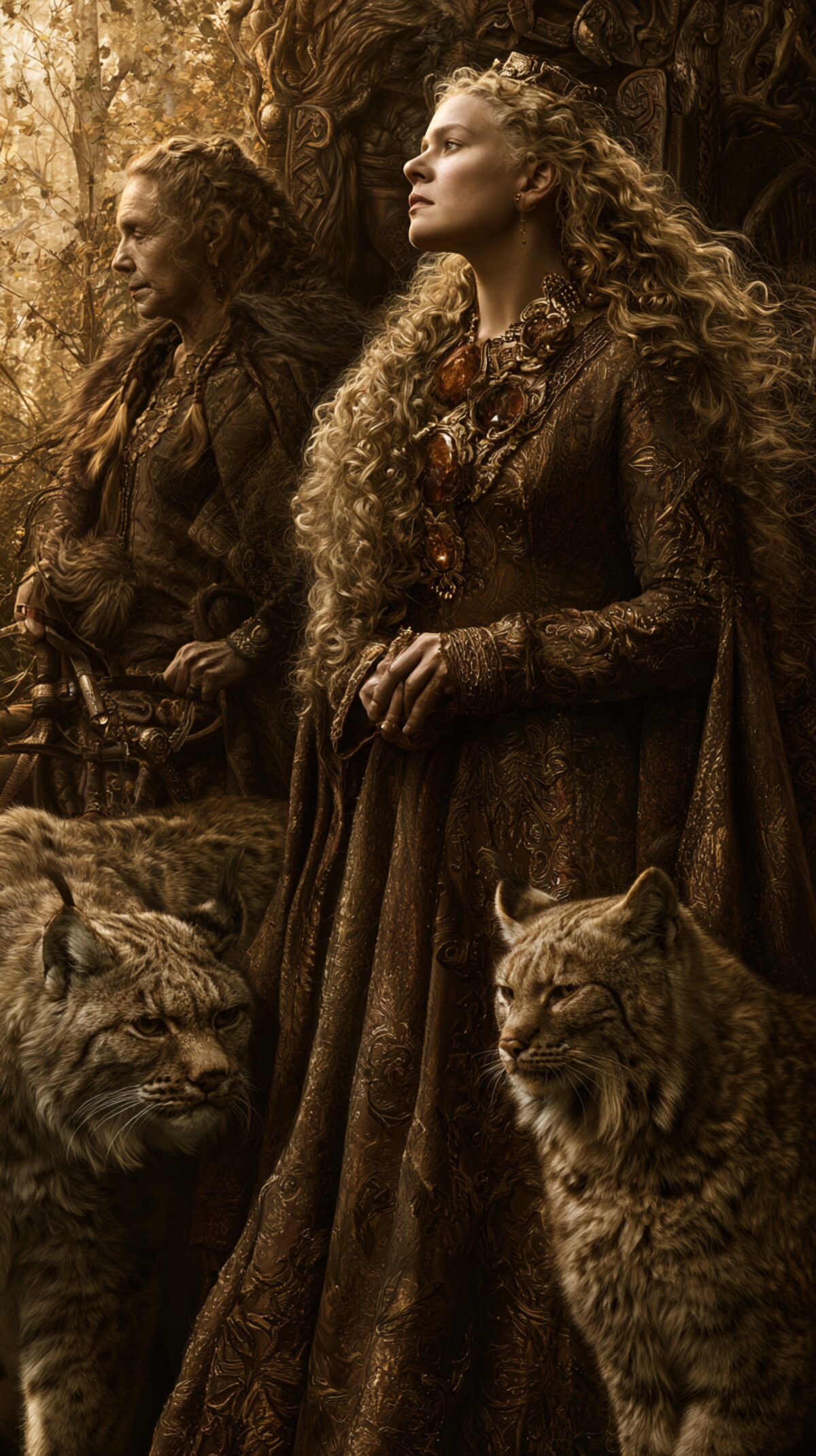
Freyja is the most prominent goddess of Norse mythology: one of the Vanir, daughter of the sea god Njörðr and sister of Freyr, a goddess of love and desire who also rules over war, death and the magic called seiðr. Her name simply means “the Lady”. According to the Edda she claims half of the slain, drives a chariot drawn by cats, owns the necklace Brísingamen and weeps tears of red gold. Here is what the sources actually say about her – and where the legend takes over.
Giants want to marry her. Dwarves forge her gold. Loki insults her in front of the assembled gods, and Odin shares the dead with her. No other goddess of the North turns up in as many stories, and none gets squeezed into a single label as often. “Freya, goddess of love” is printed on candles, mugs and tattoo flash. That is true as far as it goes, which is about as far as calling Odin “the god of ravens”. Read the sources and you meet a goddess who takes what she wants, decides over life and death, and commands a kind of magic that even the All-Father had to learn from her.
Nearly everything we know about Freyja comes from Icelandic texts of the 13th and 14th centuries: the Poetic Edda, Snorri Sturluson's Prose Edda and the sagas. By then Iceland had been Christian for more than two centuries. That does not make it all invention. It does mean that for every statement we have to ask who wrote it down, and when.
Old Norse Freyja goes back to Proto-Germanic *frawjōn, “lady, mistress”. It is the feminine of the word hidden in the name of her brother Freyr: “lord”. German still has the same word family in Frau (Old High German frouwa, originally “lady” in the noble sense), and Old English had the masculine cousin in frēa, “lord”.
Snorri knew about the link and explained it his own way. From Freyja's name, he says, comes the title of honour frú used for noblewomen (Gylfaginning, ch. 24). In Ynglinga saga (ch. 10) he adds that a woman who rules over her property is therefore called húsfreyja, “lady of the house”. Linguistically the arrow points the other way: the word for “lady” came first, the goddess who bore it as a name came after. That is why many scholars suspect Freyja began as a reverent title that pushed an older personal name out of use. What that name was, nobody knows.
It fits that Freyja has an unusual number of names. In Gylfaginning ch. 35 Snorri lists Mardöll, Hörn, Gefn and Sýr, plus Vanadís, “the dís of the Vanir”. Some meanings are transparent, others are not. Gefn is related to “give”: the giver. Sýr means “sow” – not an insult but a nod to the pig as an animal of fertility, an association shared with Freyr. Hörn is often linked to hörr, “flax”, and Mardöll perhaps to marr, “sea”, and a word for shining. Neither of the last two has a secure explanation.
Freyja belongs to the Vanir, the second family of gods alongside the Æsir. Her father is the sea god Njörðr, her brother is Freyr. Her mother has no name. In Ynglinga saga (ch. 4) Snorri remarks that among the Vanir Njörðr had been married to his own sister, as was their custom, and that Freyr and Freyja were the children of that union.
How the Vanir came to live among the Æsir is told in the myth of the war between the Æsir and Vanir. When peace was made, the two sides exchanged hostages. According to Ynglinga saga, Njörðr and Freyr went over to the Æsir, and Freyja is singled out: she was a sacrificial priestess (blótgyðja) and was the first to teach the Æsir seiðr, which had been customary among the Vanir. In Gylfaginning she is simply one of the goddesses of Asgard, and in ch. 35 Snorri ranks her alongside Frigg as the two highest goddesses of all.
One caveat. Ynglinga saga is written in a euhemerist mode: Snorri treats the gods as human rulers from Asia who were worshipped only after their deaths. He has Freyja keep up the sacrifices after Freyr dies because she was the last of the gods still alive (ch. 10). That is the historical reconstruction of a Christian scholar. Her role as a priestess, though, may preserve an older memory.
Here is the detail that surprises most readers. When people think of the glorious dead, they think of Odin and the einherjar in Valhalla. Yet the Edda says plainly that Odin only gets half. The other half belongs to Freyja. In Grímnismál, the poem in which Odin, disguised as Grímnir, lists the dwellings of the gods, stanza 14 reads in Henry Adams Bellows' public-domain translation:
The ninth is Folkvang, where Freyja decrees
Who shall have seats in the hall;
The half of the dead each day does she choose,
And half does Othin have.– Grímnismál 14, trans. Henry Adams Bellows (1923, public domain)
Fólkvangr can be rendered “field of the people” or “field of the host”; Old Norse fólk can also mean a war band. Snorri picks up the stanza in Gylfaginning ch. 24: Freyja is the most renowned of the goddesses, her home is called Fólkvangr, and wherever she rides to battle she has half of the slain and Odin half. Her hall, Sessrúmnir – “roomy-seated” – is great and fair.
Who goes to whom, no source tells us. The fact that she chooses the dead places her close to the valkyries, the “choosers of the slain”. Either way the ranking is remarkable: a goddess filed away as a love goddess stands on equal footing with the All-Father when the bravest dead are divided.
A second witness suggests that her hall was not reserved for warriors. In Egils saga (ch. 78) the poet Egill, devastated by the death of his son, shuts himself away to starve. His daughter Þorgerðr lies down beside him and says she has had no evening meal and will have none until she is with Freyja. The ruse works: instead of dying, Egill composes his great lament Sonatorrek. For a 13th-century storyteller, then, it made sense that a woman would go “to Freyja” after death. Whether that reflects old belief or a literary turn of phrase cannot be settled.
Freyja is married – something people tend to forget. Her husband is called Óðr. Snorri gives him a handful of sentences in Gylfaginning ch. 35. In Arthur Brodeur's public-domain translation:
Ódr went away on long journeys, and Freyja weeps for him, and her tears are red gold.– Gylfaginning 35, trans. Arthur G. Brodeur (1916, public domain)
Searching for him among foreign peoples, Snorri adds, she gave herself a different name in each place – which is why she has so many. Their daughter is Hnoss, “treasure”, so beautiful that precious things are called hnossir after her. Ynglinga saga (ch. 10) gives her a second daughter, Gersemi, another word for “treasure”.
In skaldic diction gold can be called “Freyja's tears”, and in Skáldskaparmál Snorri lists “the fair-weeping goddess” among the ways to refer to her. Völuspá knows the name too: when Asgard's wall is being built, the gods ask who had given “Óðr's maid” (Óðs mey) to the race of giants – meaning Freyja.
So who is Óðr? His name means “frenzy, inspiration, poetic fury” – the same word from which Óðinn is formed. That has fuelled one of the big debates about Freyja, which we come back to below: was Óðr originally Odin, and was Freyja originally Frigg? Within the stories themselves Óðr is an empty space. The goddess everyone wants weeps for the one who left.
“When she goes forth, she drives her cats and sits in a chariot,” Snorri writes in ch. 24, and at Baldr's funeral (ch. 49) she arrives exactly that way. No source describes what the team looked like, and no source explains why cats. In the Viking Age the cat was known above all as a fur animal and a mouser; we cover that in our article on cats in the Norse world.
Besides the cats there is a boar. In Hyndluljóð (st. 7) Freyja rides Hildisvíni, the “battle-swine”, with golden bristles, made by the dwarves Dáinn and Nabbi. It recalls Freyr's golden-bristled boar Gullinbursti, and it fits her by-name Sýr.
And Freyja can fly – or at least she owns the means. In Þrymskviða, the poem of Thor's stolen hammer, Loki borrows her feather cloak (fjaðrhamr, st. 3) to fly to the land of the giants and find the thief. In Skáldskaparmál he borrows her falcon cloak (valshamr) to rescue the abducted Iðunn. Frigg owns one too: in the story of Thor's journey to Geirröðr, Loki flies in Frigg's falcon cloak – a small detail that is regularly cited in the Freyja-Frigg debate.
Freyja's most famous possession is the necklace or collar Brísingamen. Snorri mentions it only briefly in ch. 35. How she got it is told only in Sörla þáttr, a tale preserved in the late 14th-century Flateyjarbók: four dwarves forge the jewel, and Freyja obtains it by spending a night with each of them. Loki steals it on Odin's orders, and she gets it back only by agreeing to stir up an endless war between two kings. The text is late, Christian in outlook and treats the gods as humans. As evidence for pagan belief it has to be handled with care.
An older trace runs elsewhere. Around 985 the skald Úlfr Uggason described, in his Húsdrápa, a fight between Loki and Heimdall in the shape of seals; Snorri understood it as a struggle over Brísingamen. The Old English Beowulf mentions a precious Brosinga mene. Whether it is the same object is debated, but the echo of the name is hard to ignore.
The most memorable scene comes in Þrymskviða. The giant Þrymr has stolen Thor's hammer and will return it only if Freyja becomes his bride. When Loki brings her the message she flies into such a rage that the halls of the gods shake and Brísingamen bursts (st. 13). Her answer, in paraphrase: people would think her the most man-crazy of women if she drove to the giants with them. In the end Thor himself goes, wearing the bridal veil – and Brísingamen.
The motif runs through the whole mythology. The builder of Asgard's wall demands Freyja, the sun and the moon as his fee (Gylfaginning ch. 42). The drunken giant Hrungnir boasts that he will carry off Freyja and Sif; tellingly, in this scene from Skáldskaparmál, Freyja is the only one who dares to pour his drink. She is the object of desire par excellence, yet never mere loot: the stories are about the gods refusing to hand her over.
Where there is that much desire, there is gossip. In Lokasenna, the flyting at the feast of the sea giant Ægir, Loki works his way through the gods one by one. Freyja steps in at stanza 29: Loki must be mad to list his own misdeeds; Frigg knows all fates, even if she keeps silent.
Loki answers in stanza 30, roughly: be quiet, Freyja, I know you well – every one of the Æsir and elves in this hall has been your lover. Freyja retorts in stanza 31 that his tongue is false and will bring him misfortune; gods and goddesses alike are angry with him. In stanza 32 Loki goes further: she is a witch (fordæða) steeped in malice, the gods caught her with her brother, and at that moment – a crude joke – she broke wind. Her father Njörðr defends her in stanza 33: it is no great harm if a woman has a lover besides her husband; worse is a god like Loki, who has borne children himself.
Lokasenna is a poem of abuse, and every charge aims for the punchline. Still, the incest jibe fits what Snorri says about the Vanir marriage of Njörðr and his sister. And the word fordæða, a worker of harmful magic, targets Freyja's reputation as a sorceress. The insult only lands because the audience knew the image.
Hyndluljóð is the poem in which Freyja does the most herself. It survives only in the Flateyjarbók, a compilation made around 1400, and is usually considered relatively late; Bellows placed it not much before the 12th century, while allowing for older material inside.
The plot: Freyja wakes the giantess Hyndla in her cave and asks her to ride with her to Valhalla. Freyja sits on Hildisvíni, and Hyndla immediately sees that the boar is really Freyja's favourite, Óttarr. Óttarr is caught in an inheritance dispute and has to prove his ancestry in full. Freyja wants to help, and the poem says why: he built her a hörgr, a shrine of piled stones, and reddened it so often with sacrificial blood that the stones turned to glass (st. 10); he has always put his faith in the goddesses.
Hyndla then recites long lines of descent, with an inserted section known as the “Short Völuspá” in the middle. Finally Freyja asks for a draught of memory-ale so that Óttarr will keep the whole genealogy in his head. Hyndla refuses and insults her: Freyja ran after Óðr, many others have crept under her apron, and she leaps about at night like the goat Heiðrún among the bucks. Freyja threatens to ring Hyndla with fire, and gets her way.
The poem shows a side that disappears in Snorri's handbook tone: Freyja as the patron of a single man, fighting his corner because he sacrifices to her. It is the pattern of personal devotion that also appears in stories of Freyr and his worshippers.
That leaves the role that sets Freyja apart from every other goddess: the sorceress. According to Ynglinga saga (ch. 4) she brought seiðr to the Æsir. Seiðr was a form of magic and divination concerned with fate, spirits and uncovering hidden things. In ch. 7 Snorri writes that Odin mastered it, but that it carried so much ergi – unmanliness, shame – that men were ashamed to practise it, and so it was taught to priestesses.
If the highest god learns from Freyja a technique regarded as typically female, that says a lot about her standing. It also ties her to the völur, the seeresses who travel from farm to farm in the sagas. The most famous description is in Eiríks saga rauða (ch. 4): the seeress Þorbjörg wears a black lambskin hood lined with white catskin, and gloves of catskin. Cats with Freyja, catskin on the seeress – not proof of a connection, but a resonance many scholars have noticed.
Loki's insult fordæða belongs here too. Some scholars also identify Freyja with Gullveig, the woman in Völuspá who is burned three times, comes back three times and, as Heiðr, practises seiðr. That is an interpretation, not a finding: no source says Gullveig is Freyja.
Now for the big question. In the surviving sources Freyja and Frigg are clearly separate. Frigg is Odin's wife, Baldr's mother, mistress of Fensalir; Freyja is the Vanir goddess, daughter of Njörðr. And yet the parallels are striking:
From this grew the hypothesis that both derive from a single Germanic goddess who split into two figures only in the North. Stephan Grundy argued for it, and Hilda Ellis Davidson considered it more cautiously. One strong argument in its favour: no Freyja is attested on the Continent. There we only meet Frija – in the Second Merseburg Charm and, as Frea, in the origin legend of the Lombards, where she is Wodan's cunning wife.
There are counter-arguments as well. The names are not etymologically related: Frigg goes back to *Frijjō, “beloved”, Freyja to *frawjōn, “lady”. Freyja has a fixed place in a family of her own, with father, brother and a cult history. And overlapping motifs between goddesses are common in many religions. Most specialists therefore still treat them as two figures while regarding the question as open.
Was Freyja actually worshipped, or is she a creature of poetry? Place-name research offers some clues. In Sweden, names such as Frövi (from Freyjuvé, “Freyja's sanctuary”) are discussed as candidates, and names like Härnevi in Uppland are traced back to Hörn, one of her by-names. In Norway, Frøihov is interpreted as Freyjuhof, “Freyja's temple farm”. Individual cases are often disputed, because Frö- can just as well belong to Freyr and early spellings are frequently missing.
A second strand is the dísir, female guardian spirits who received a sacrifice, the dísablót, in autumn or winter. Ynglinga saga (ch. 29) has the Swedish king Aðils fall from his horse and die during a dísablót at Uppsala, and Víga-Glúms saga also knows a dísablót at the start of winter. Freyja's by-name Vanadís has led many scholars to suggest she was the dís par excellence and that such sacrifices were also meant for her. That is not attested: no source names Freyja as the recipient of a dísablót.
Archaeologically Freyja is hard to pin down, because images of gods do not come with name tags. One object that keeps being mentioned is a small Viking Age silver pendant from a woman's grave at Aska (Hagebyhöga, Östergötland, Sweden): a female figure wearing a conspicuously large neck ornament. Reading it as Freyja with Brísingamen is tempting, but it remains an interpretation.
The best-known modern trace is not one at all.
There is genuine afterlife all the same. Denmark's national anthem, Der er et yndigt land by Adam Oehlenschläger (1819), calls the country “Freja's hall” in its first verse. Richard Wagner turned her into Freia in Das Rheingold, the goddess promised to the giants as payment for building Valhalla – a blend of Freyja and the wall-builder myth, with Iðunn's golden apples mixed in. Wagner's Freia is helpless; the Freyja of the Edda is not. And names like Freya, Freja and Frøya are popular girls' names today, in Scandinavia and well beyond.
In our workshop in Alsdorf, Freyja is one of the motifs people ask for most often. We like to show more than a pretty woman with long hair, because the sources offer plenty: the cat-drawn chariot, falcon feathers, the necklace, the golden-bristled boar, tears of gold. On slate, clean lines and bold surfaces work best; on glass, finer details like feathers or the neck ornament come into their own. For something simpler, one of her names in runes – Freyja, Vanadís or Gefn – or the Grímnismál lines about Fólkvangr. She suits a wedding as well as a memorial to someone you loved, because that is Freyja too: the goddess people hoped to join after death.
What does the name Freyja mean? Freyja means “the Lady”. It is the feminine of Freyr (“the Lord”) and related to German Frau; it was probably a title before it became a name.
What is Freyja the goddess of? Love, desire and fertility, but also war and death – she claims half of the slain – and seiðr, the magic she taught to the Æsir.
Is Freya the same as Freyja? Yes. Freya, Freia and Freja are modern spellings of the same goddess; the Old Norse form is Freyja.
Are Freyja and Frigg the same goddess? Not in the surviving sources: Frigg is Odin's wife, Freyja one of the Vanir. Whether both descend from one older goddess is still debated.
Who is Freyja's husband? Óðr, who went away on long journeys and never returned. Freyja weeps tears of red gold for him; her daughters are Hnoss and Gersemi.
What are the names of Freyja's cats? The sources never name them. “Bygul” and “Trjegul” are modern inventions.
For courage. For remembrance. For legends that live on.
Hel · Valkyries · Freyr · The Vanir · Valhalla · The Norse pantheon.
All Gods & Goddesses articles →
Freyr is the god the Vikings offered to for good weather, rich harvest and peace – the „foremost of the Æsir", as …
Read more →Above all the goddesses of the Æsir stands one: Frigg, Odin’s wife and queen of Asgard. She knows the fate of all …
Read more →Heimdall is the watchman who never sleeps – the god who hears the grass grow and the wool sprout on the sheep. Born of …
Read more →Not every dead man came to Valhalla. Most people – all who died of sickness and age – went to Hel. She is the mistress …
Read more →