Vanaheim (Old Norse Vanaheimr) is the home of the Vanir in Norse mythology – the land from which Njörðr came to the Æsir as a hostage. Beyond that, the sources say remarkably little: the Poetic Edda names Vanaheim exactly once, Snorri mentions it in Gylfaginning and twice in Ynglinga saga, where he places it on the river Don. Here is every passage, with evidence kept apart from modern additions – and why games make Vanaheim lush while the Eddas leave it almost empty.
Picture a map of the Norse cosmos. Asgard has walls, halls and a giant builder who almost finished them. Jötunheim has mountains, iron woods and giants with names. Hel has a gate, a river and a bridge roofed with gold. And Vanaheim? Vanaheim has a name – and very little else. No hall is described, no river, no tree, no ruler. The homeland of the gods the North credited with harvests, wealth and love is, in the medieval sources, a blank space on the map.
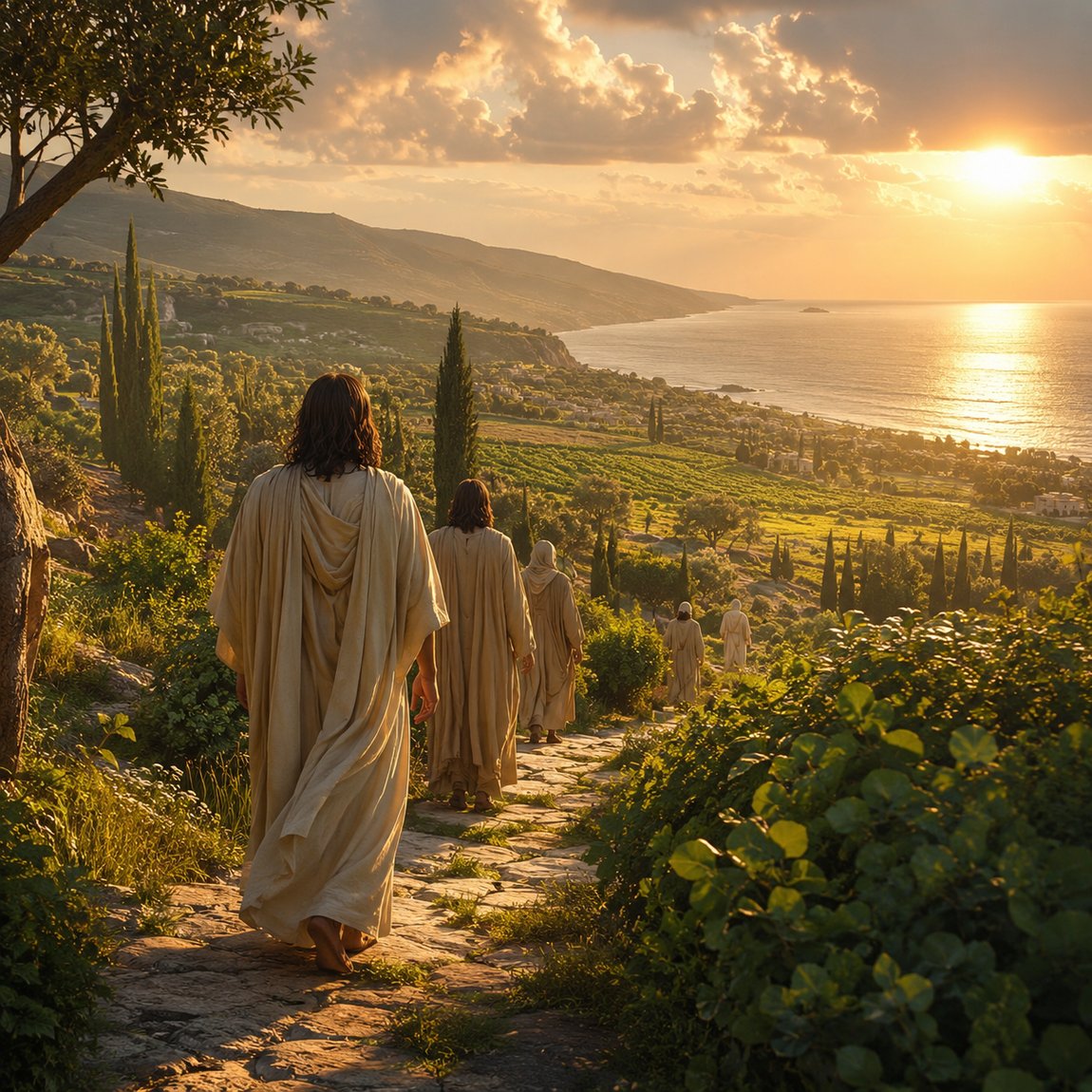
Search for Vanaheim online and you will find lush valleys, eternal spring and enchanted forests. Those come from video games, fantasy novels and comics, not from the Eddas. So we are taking a different route: we lay out every single medieval passage that actually names Vanaheim – there are surprisingly few – and then ask what can honestly be built on them.
One note before we start: the Vanir as a family of gods – their name, their cult, and the debate over whether they were ever a separate group at all – get their own article. Here the focus is the place.
In Old Norse the world is called Vanaheimr. The compound is transparent: Vana- is the genitive plural of vanr, "one of the Vanir", and heimr means "world, abode, home" – the same element found in Jötunheimr, Álfheimr and Niflheimr, and a cousin of English "home". Vanaheimr is literally "the world of the Vanir". In English you will usually see Vanaheim; older translators such as Bellows rendered the Vanir as "Wanes".
Where vanr itself comes from is not settled. It is often linked to an Indo-European root meaning "to wish, to love, to delight", the same root proposed for Latin Venus and Old Norse vinr, "friend". That is a common suggestion, not a proven etymology. For the place, it means this: the name tells you whose world it is, not what it looks like or where it lies.
In the entire Poetic Edda, Vanaheimr appears exactly once. The passage sits in Vafþrúðnismál, the deadly wisdom contest between Odin and the giant Vafþrúðnir, in which the loser forfeits his head. In stanza 38 Odin asks how Njörðr came to the gods – a god who rules over countless temples and shrines, yet was not born among the Æsir. The giant answers in stanza 39. Here it is in Old Norse and in Henry Adams Bellows' public-domain translation of 1923:
Í Vanaheimi skópu hann vís regin
ok seldu at gíslingu goðum;
í aldar rök hann mun aftr koma
heim með vísum vǫnum.
In the home of the Wanes did the wise ones create him,
And gave him as pledge to the gods;
At the fall of the world shall he fare once more
Home to the Wanes so wise.
— Vafþrúðnismál 39, Old Norse; translation Henry Adams Bellows, The Poetic Edda (1923)
These four lines are the oldest and most important witness to Vanaheim. They contain three claims worth holding on to.
First: Njörðr was "created" or "shaped" in Vanaheim (skópu, from skapa). The poem does not say "born" and names no parents. Vanaheim is the point of origin of a god, not the setting for a family saga.
Second: Njörðr was handed to the gods as a hostage. That presupposes a conflict and a peace settlement – the Æsir–Vanir war that Völuspá hints at in its darkest stanzas.
Third, and this is the real surprise: at aldar rök, the "fate" or "doom of the age", Njörðr goes home to the Vanir. No other text says anything about how Njörðr ends. Odin is swallowed by the wolf, Freyr falls to Surtr – and Njörðr, according to this poem, simply returns home. Vanaheim thus appears as a place that, on this one point, outlasts Ragnarök, or lies beyond its reach. That is all the stanza gives us; anything more is speculation.
The earlier version of this article quoted a line saying Njörðr "was born in Nóatún". That is not what the stanza says, and we have corrected it. Nóatún is Njörðr's residence among the Æsir, not his place of origin.
A second Eddic poem does not name Vanaheim but touches the same story. In Lokasenna, Loki crashes the feast of the sea giant Ægir and insults the gods one by one. To Njörðr he says in stanza 34, roughly: be silent, Njörðr, you were sent east from here (austr heðan) as a hostage to the gods – followed by a crude jibe about the daughters of the giant Hymir. Njörðr replies calmly that this is his comfort: sent far away as a hostage, he fathered a son whom no one hates – Freyr. In stanza 36 Loki strikes again: Njörðr fathered that son on his own sister.
"East from here" is the only directional hint anywhere in the Eddas connected with the Vanir's origin, and it is frustratingly ambiguous. Is the speaker at Ægir's hall by the sea, with the gods living to the east of it? Or is "here" simply wherever Njörðr came from? The stanza cannot be read in a way that fixes a compass point for Vanaheim.
The incest charge, on the other hand, matters, because Snorri picks it up and turns it into a custom of the land of Vanaheim. More on that shortly.
Yes, the Prose Edda names Vanaheim explicitly. This is sometimes denied, so we checked the text. In chapter 23 of Gylfaginning, written around 1220, Snorri Sturluson introduces Njörðr. He lives in heaven at a place called Nóatún, rules wind and sea, and is so wealthy that he can grant land and goods to anyone who asks. Then:
Njǫrðr er eigi ása ættar. Hann var upp fœddr í Vanaheimi, en Vanir gísluðu hann goðunum ok tóku í mót at gíslingu þann er Hœnir heitir.
— Snorri, Gylfaginning 23, Old Norse. In our own rendering: Njörðr is not of the race of the Æsir. He was brought up in Vanaheim, but the Vanir gave him to the gods as a hostage and took in exchange the one called Hœnir.
Snorri is clearly following the Vafþrúðnismál stanza, which he quotes elsewhere in his work. But he shifts the emphasis. "Created" becomes "brought up" (upp fœddr), and the exchange acquires a counterweight: Hœnir goes to the Vanir in return. Snorri drops the homecoming at Ragnarök entirely; in his great account of the end of the world, Njörðr plays no part.
What Snorri does not do is just as telling: he describes Vanaheim not at all. For Asgard he lists halls, for Hel he even names the goddess's dish and knife – Vanaheim remains a bare note of origin.
Snorri's other great work, Heimskringla, a history of the kings of Norway, sounds very different. Its opening section, Ynglinga saga, tells the prehistory of the Swedish Yngling dynasty, and here Snorri turns the gods into humans. Scholars call this method euhemerism, after the Greek writer Euhemerus: gods are explained as early kings and heroes who were worshipped after death.
In chapter 1 Snorri describes the world in the manner of medieval learning. A river flowing from the north into the Black Sea divides Europe from Asia. Its proper name is Tanais – the classical name of the Don – but it was once called Tanakvísl or Vanakvísl. Then comes the key sentence:
Í Vanakvíslum var þá kallat Vanaland eða Vanaheimr.
— Snorri, Ynglinga saga 1, Old Norse. In our own rendering: the land by the Vana-forks was then called Vanaland or Vanaheimr.
East of the river, in Asia, lies Ásaland or Ásaheimr with its chief city Ásgarðr (chapter 2), where Odin is a mighty chieftain. Snorri has built a neat learned combination: Æsir sounds like Asia, Tana- like Vana-, and out of the echo comes geography. The word kvísl means "fork, branch of a river" – so in Snorri's mental map, Vanaheim lies in a river delta.
In chapter 4 Snorri tells the war. Odin leads an army against the Vanir; they stand firm and defend their land, and each side lays waste the other's territory. Eventually they make peace and exchange hostages. The Vanir send their noblest men, Njörðr the Wealthy and his son Freyr; the Æsir send Hœnir and wise Mímir. Because Hœnir has nothing to say without Mímir at his side, the Vanir feel cheated, cut off Mímir's head and send it back to the Æsir. Snorri also places Kvasir, the wisest of the Vanir, in this exchange.
The same chapter holds the two sentences that give Vanaheim something like a culture for the first time. Of Njörðr: while he was among the Vanir he had his sister as his wife, "for that was the law there" (því at þat váru þar lǫg); among the Æsir, marriage between such close kin was forbidden. Of Freyja: she was the first to teach the Æsir seiðr, a form of sorcery, "as was customary among the Vanir" (sem Vǫnum var títt).
Vanaheimr turns up once more in Ynglinga saga, in chapter 15. The legendary king Svegðir, a descendant of Freyr, sets out to find "Godheimr" and Odin the Old. He spends five years travelling through "Sweden the Great", Snorri's name for the vast lands north of the Black Sea. Along the way, we are told, he took a wife named Vana in Vanaheim; their son was Vanlandi.
Snorri's method shows clearly here. Vanlandi is a name from the old poem Ynglingatal, which Snorri quotes. The name can be read as "man from the land of the Vanir", and Snorri supplies a mother from Vanaheim to match. Whether he knew a tradition behind this or embroidered an explanation for the name, we cannot tell. For the history of the place, the passage is still valuable: it shows that for Snorri, Vanaheim was imagined as a real country at the edge of the known world – somewhere you could travel to and marry from.
Almost every modern guide lists Vanaheim among the nine worlds hanging on the world tree Yggdrasil. The Eddas neither confirm nor contradict this. The number nine is well attested: the seeress of Völuspá remembers "nine worlds" in stanza 2; Vafþrúðnir boasts in stanza 43 that he has travelled through nine worlds down to Niflhel; in Alvíssmál the dwarf Alvíss has journeyed through "all nine worlds"; and according to Snorri, Hel was given power over nine worlds. But not one medieval source supplies a list of those nine.
The familiar line-up – Asgard, Vanaheim, Álfheim, Midgard, Jötunheim, Svartálfheim, Niflheim, Muspelheim, Hel – is a modern construction. The Icelandic scholar Finnur Magnússon led the way in 1825; Gustav Legis followed in 1829, and Karl Simrock included a list in his handbook of German mythology. All these early lists include Vanaheim, which makes sense: it is one of the few heimr-names that genuinely occurs in the Eddas. Simrock, incidentally, put Vanaheim in the west – a choice with no source behind it.
Scholars also disagree on whether Vanaheim was ever thought of as a distinct world in a cosmological sense. Rudolf Simek treats the name essentially as a counterpart to Asgard. The British historian of religion Hilda Ellis Davidson suggested instead that the Vanir may have been linked with the earth, with hills and waters, so that their world might rather lie below than above. Both are interpretations, not evidence.
Asgard lies in the sky, Jötunheim to the east, Hel to the north and below, Muspelheim to the south – such placements can be read out of the Eddas with more or less effort. For Vanaheim there is nothing comparable. The only concrete location comes from Ynglinga saga, and it is learned geography: a river delta on the Don, between Europe and Asia, where medieval world maps placed the edge of the familiar world.
Modern books and diagrams often put Vanaheim on an "upper level" beside Asgard and Álfheim, sometimes in the west, sometimes somewhere among the roots. These are organising proposals by authors trying to fill gaps in the sources. If someone tells you Vanaheim lies "at the second root of Yggdrasil" or "in the west beyond the sea", they are quoting a diagram, not an Edda.
We rather like that gap. In the texts, Vanaheim is not scenery but origin: the place the good things come from, though nobody ever goes there. In no surviving story does any god travel to Vanaheim. Only the hostages come from it – and, if Vafþrúðnismál is right, Njörðr will one day go back.
Many readers mix up Vanaheim with the places where the Vanir gods actually live in the Eddas. Those all lie among the Æsir. Grímnismál, the poem in which Odin lists the dwellings of the gods, and Snorri's Gylfaginning name three.
Nóatún, "ship-enclosure" or "harbour", is Njörðr's home (Grímnismál 16). Snorri says plainly that he lives in heaven at a place called Nóatún. There, by the sea, Njörðr is content; he cannot bear the mountains of his wife Skaði in Þrymheimr, and she cannot stand the gulls' screaming. Nóatún is the hostage's residence, not his homeland.
Fólkvangr, "field of the people" or "field of the war-host", is Freyja's home (Grímnismál 14). According to Grímnismál, Freyja chooses half of the slain there each day, while the other half belong to Odin. Snorri says her estate is in heaven and her hall is called Sessrúmnir. More in our article Valhalla, Hel, Fólkvangr.
Álfheimr, the world of the light elves, was given to Freyr by the gods as a tooth-gift, a present for cutting his first tooth (Grímnismál 5). So a Vanir god does receive a world of his own – not Vanaheim, but the land of the elves. Whether elves and Vanir were originally connected is debated; the Eddas often pair "Æsir and elves" as a fixed formula, with the Vanir sometimes added to such lists.
The striking point: all three places stand among the Æsir. In the Eddas the Vanir are integrated. They get estates in the gods' world, and their homeland drops out of the story. Vanaheim is the place one has left behind.
The question is natural: if the Vanir were gods of fertility, were there earthly places associated with "their" land? Nothing proves it. What we do have are place names in Scandinavia containing Njörðr and Freyr – many Swedish and Norwegian names with Frö- and Njärd-/Nerd- – and Adam of Bremen's report of an image of Freyr (whom he calls Fricco) in the temple at Uppsala. In Snorri's Ynglinga saga Freyr himself builds the temple at Uppsala. No place called Vanaheim is recorded anywhere on the human map.
Whether the Æsir–Vanir war reflects a historical clash of two cults or, following Georges Dumézil, an ordering of divine functions, is something we discuss in our article on the Vanir. None of these theories tells us where Vanaheim lay.
Most people today meet Vanaheim not in the Eddas but on a screen. That is perfectly fine, as long as you know what you are looking at.
In the video game God of War Ragnarök (2022), Vanaheim is a large explorable realm of dense jungle, swamps, plains and a vast crater, where Freyr leads a Vanir resistance against the Æsir. That is a bold, original invention by the developers: the landscape, the conflict and Freyr's role as a rebel leader have no model in the medieval texts. Our God of War fact check separates game and source in more detail.
In the Marvel universe, Vanaheim is one of the "Nine Realms". Thor: The Dark World (2013) opens with Thor and his companions fighting on Vanaheim, the home of the warrior Hogun. Marvel's realms derive from the modern nine-worlds list, not from any Eddic stanza. More in our Marvel Thor fact check.
Precisely because Vanaheim is empty in the sources, every age can reinvent it. That is reception – lively and sometimes brilliant, but not knowledge about the Viking Age.
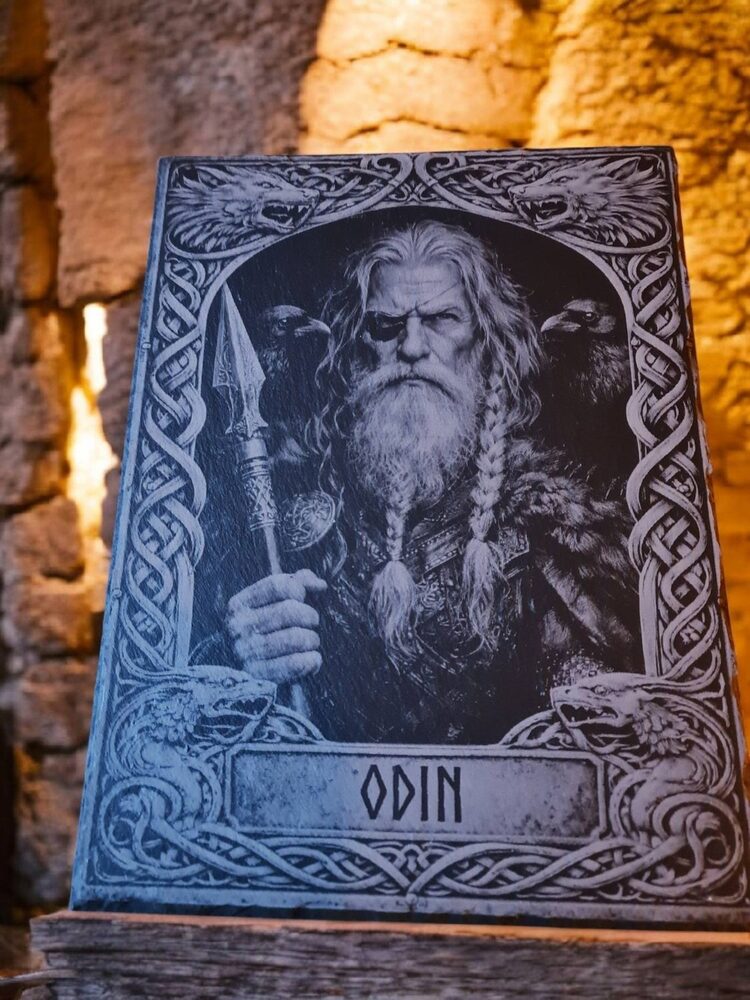
How do you engrave a place nobody ever described? In our workshop in Alsdorf, near Aachen, we usually take one of two routes, and both stay honest.
The verse. The loveliest trace of Vanaheim is a single phrase: aftr koma heim með vísum vǫnum – "come home again to the wise Vanir". On a slate plaque, in a clean roman letter or a historical uncial, it becomes a homecoming line. It suits a front door, a house-warming gift, or someone returning after a long time away. Old Norse with a small English rendering beneath keeps the source readable.
The gifts instead of the landscape. Rather than an invented view of Vanaheim, we prefer to engrave what the sources say came from there: the ship for Njörðr and Nóatún, the ear of grain and the boar for Freyr, the cat or a simple necklace ornament for Freyja. Three motifs, one plaque, one story – the Vanir who went to Asgard. It works just as well on wood or glass.
If you would rather have your own Vanaheim fantasy, we will engrave that too. We just won't write "according to the Edda" underneath.
What is Vanaheim in Norse mythology? Vanaheim (Old Norse Vanaheimr) is the home of the Vanir, the second family of gods alongside the Æsir. Njörðr came from there as a hostage to the Æsir.
Where is Vanaheim mentioned in the Eddas? In the Poetic Edda only in Vafþrúðnismál 39, in the Prose Edda in Gylfaginning 23. Snorri's Ynglinga saga adds two more passages (chapters 1 and 15).
Who lives in Vanaheim? The Vanir. The best known are Njörðr, Freyr and Freyja – but after the hostage exchange they live among the Æsir. The sources name no other inhabitants.
Is Vanaheim one of the nine realms? In modern lists, yes. The Eddas mention "nine worlds" but never list them; the familiar list dates from 1825 onwards.
What does Vanaheim look like? No medieval source describes it. Green hills, jungles and craters come from modern games, films and fantasy.
What happens to Vanaheim at Ragnarök? According to Vafþrúðnismál 39, Njörðr returns home to the Vanir at the end of the age. The sources say nothing about the fate of Vanaheim itself.
For courage. For remembrance. For legends that live on.
Freyr · Æsir & Vanir – the pantheon · The Nine Worlds · Midgard · Helheim.
All The Nine Worlds articles →
The world was ordered, the sun ran its course – but the shore lay empty. Then three gods found on the sea-strand two …
Read more →Before there were gods, before the world was formed, there were two beings in the frost: the primal giant Ymir and a …
Read more →Deep below, beyond a dark river and a gold-roofed bridge, lies Helheim – the realm of the dead. Not the shining hall of …
Read more →Beyond the wall, beyond the roaring rivers, lies Jötunheim – the land of the giants. It is the world of the untamed …
Read more →