 „All warriors to Valhalla, everyone else to the hell of Hel" – that is how the story is usually told. Yet the old sources know at least five paths into the afterlife, and the tidiest part of it all is a late invention.
Anyone approaching Norse mythology with Christian assumptions instinctively looks for two places: a heaven for the good, a hell for the wicked. That is precisely what you will not find. The Old Norse sources paint no moral binary but a web of destinations for the dead – and who went where depended less on how you lived than on how you died, which deity claimed you, and simply which source you happen to read.
At least five destinations can be named: Odin's warrior hall Valhalla, Freyja's field Folkvangr, the realm of the death-goddess Hel, Rán's watery domain on the sea floor, and living on in the burial mound or a sacred mountain. These places do not sit neatly side by side; they overlap, contradict one another, and were only pressed into a system in the 13th century by one man whose scheme has shaped most people's picture ever since.
Valhalla (Old Norse Valhǫll, „hall of the slain") is the best-known realm and also the most heavily embellished. Here Odin gathers those who fell in battle – the Einherjar – carried from the field by the valkyries. According to Grímnismál the hall has five hundred and forty doors, from each of which eight hundred warriors will march at the end of days; its roof is thatched with shields, its rafters made of spears. The dead fight each other by day, fall, rise again, and feast by night on the flesh of the boar Sæhrímnir and the mead of the goat Heiðrún.
The purpose of this training camp is unmistakable: Odin is raising an army for Ragnarök, the final battle. Valhalla is therefore no paradise of rest but a restless waystation – a place of honour for those the one-eyed god needs for his own ends. This also explains its dominance in popular culture: no other death realm supplies such a vivid, martial image.
Yet not every fallen warrior is taken up. The valkyries – Odin's „choosers of the slain" – make a selection on the battlefield, and what reads like an honour has a cool purpose: the god gathers not the most pious but the most useful fighters. Whoever dies in bed has no claim to this path, however brave their life may have been. The „good death", in this logic, is death with a weapon in hand – an idea one can read as an ideal for a warrior society, but equally as consolation for the harshness of everyday life.
Here comes the first great surprise. Odin does not receive the fallen alone. Grímnismál names a second place, to which just as many of the dead go: Folkvangr, the „people's field" or „army field" of the goddess Freyja.
The ninth is Folkvang, where Freyja decrees
Who shall have seats in the hall;
The half of the dead each day does she choose,
And half does Othin have.Grímnismál 14, transl. Henry Adams Bellows (1923)
Freyja chooses first, another passage says, and she takes half of all the slain into her hall Sessrúmnir. This is striking: the most famous notion of a warrior's death – Valhalla – applies to only one half. The other belongs to a goddess we usually associate with love and fertility. Why a Vanir goddess should receive fallen warriors, the sources do not say. That very gap makes Folkvangr the most frequently omitted death realm: it does not fit the standard picture and so is quietly passed over.
Sessrúmnir, Freyja's hall, bears a name meaning „with many seats" – room, then, for a great following. Some scholars have speculated whether Folkvangr preserves an older, independent notion of a powerful goddess's death realm, later outshone by Valhalla. It cannot be proven. What is certain is only this: anyone claiming that all fallen Vikings went to Odin has overlooked half the testimony of their own source.
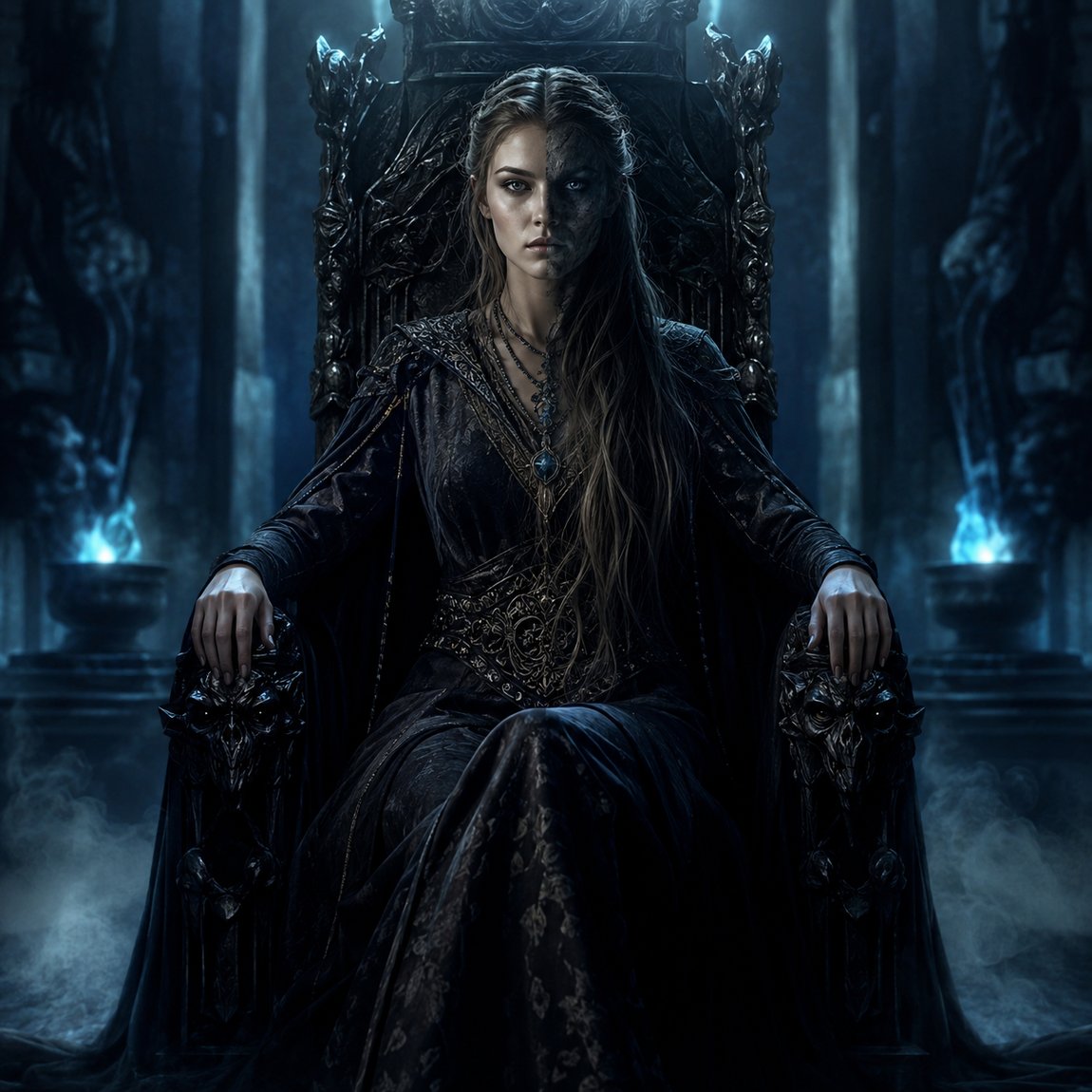
The name Hel means two things: the giant's daughter Hel, a child of Loki and the giantess Angrboða, and her realm, called Helheim. Snorri describes the goddess as half black, half flesh-coloured – an image later read as a symbol of decay. To her realm, deep down and to the north, comes whoever dies of illness or old age: the „straw death" in bed, the ordinary passing of the great majority.
What matters is what Hel is not: a place of punishment. There is no catalogue of sins, no torment for wrongdoers in the Christian sense – apart from the grim corpse-shore Náströnd, where oath-breakers and murderers suffer and the dragon Níðhǫggr gnaws the dead. But the normal case is a shadowy continued existence, cold and quiet, yet without torture. Baldr, the purest of the gods, ends up in Hel after his death – clear proof that this place was not reserved for the wicked.
The road to Hel is moreover far and perilous: over nine nights the messenger Hermod rides down on Odin's steed Sleipnir, crosses the river Gjöll on the golden bridge and reaches the gate Helgrind. That is no description of a place of punishment but of a journey into the distance – death as a change of place, not a judgement.
A fourth destination is rarely mentioned and yet, for a seafaring people, was of the greatest importance: whoever drowned at sea came to Rán, the wife of the sea-giant Ægir. She catches the drowning in a net and drags them down into her hall on the sea floor. In the Icelandic sagas it counts as a comforting sign if a drowned man appears at his own funeral ale – then, it was believed, Rán has received him well. For people whose daily life was a struggle with the sea, Rán's realm was no abstract thought-game but a real expectation.
Rán and Ægir have nine daughters, the waves, whose names the skalds used as kennings for the sea. This too shows how tightly this death realm was woven into lived experience: the sea that fed and killed had a face, a mistress and a net.
Alongside the mythic halls stands an older, more down-to-earth notion: the dead remain near the living. One lives on in one's burial mound, eats and drinks there, guards one's grave-goods – sometimes kindly, sometimes as a revenant draugr haunting the farms. The Eyrbyggja saga tells of the sacred mountain Helgafell, into which deceased members of the family pass; a passer-by once saw fires burning inside the hill and the ancestors seated at their drinking feast.
This mound-and-mountain idea is the most tangible archaeologically: it lies behind the richly furnished burials, the boat graves, the memorial stones. The dead were not simply gone; they were neighbours with a residence of their own.
The attempt to bring all of this into a tidy order fails – and that is not a weakness of the tradition but its true character. The same fallen can belong to Odin and to Freyja. Baldr, not fallen in battle, nonetheless goes to Hel. Some texts place the drowned with Rán, ancestors in the mound. There was no fixed doctrine of the afterlife, no catechism that regulated which death led to which place. What we have are notions grown over centuries and regions that coexisted without resolving into a system.
This ambiguity has a simple reason: the notions come from different centuries, landscapes and poems. A skald at a king's court sang of the warrior's death in Valhalla because it matched his lords' self-image. A farmer in Iceland thought of the ancestor in the nearby mound. Both pictures were true, because there was no authority to decide which was the right one.
If everyone today knows the scheme „warriors to Valhalla, the rest to Hel", we owe it above all to one author: Snorri Sturluson, who around 1220 in his Prose Edda ordered the scattered material into a retellable system. He was a brilliant collector – but he wrote roughly two centuries after the Christianisation of Iceland, as an educated Christian for whom a tidy afterlife was more natural than the contradictory coexistence of his sources. His order makes a good story. It is simply not the whole picture.
This is no reproach to Snorri – without him we would know far less. It is only an invitation to look behind the tidy picture and rediscover the many voices of the old notions: five paths, no judgement, and a goddess who shares the honour of the dead with the All-Father.
Valhalla and Folkvangr stand directly side by side in Grímnismál (stanzas 8–14) of the Poetic Edda: Odin and Freyja each take half of the slain. Hel as the place of the „straw death" and Baldr's road there is described in Snorri's Gylfaginning. Rán's net and the drowned are attested in several Icelandic sagas, living on in the mountain in the Eyrbyggja saga (Helgafell). What is attested, then, is the plurality of death realms – precisely not a single, morally sorting afterlife.
The clear scheme „the brave → Valhalla, everyone else → Hel as a place of punishment" is largely Snorri's systematisation (c. 1220) and carries a Christian tint: only with him does Hel take on the flavour of a hell. The older Eddic poems do not sort so strictly, let Baldr go to Hel and never omit Folkvangr. Take the plurality of death realms seriously and you see: the tidy afterlife is a work of high-medieval ordering, not the faith of the Viking Age.
Valhalla · Hel – goddess and realm of the dead · What comes after Ragnarök · Ragnarök · Viking burials.
All Festivals & Belief articles →
When the nights are longest and the fire in the house is warmest, the departed draw nearer. Yule, the midwinter feast …
Read more →For our ancestors the year was no sheet on the wall but hard, beautiful work: to sow, to tend, to harvest, to store …
Read more →The old faith of our ancestors has not died out – it is being lived again. “Ásatrú”, literally “true to the Æsir”, is …
Read more →