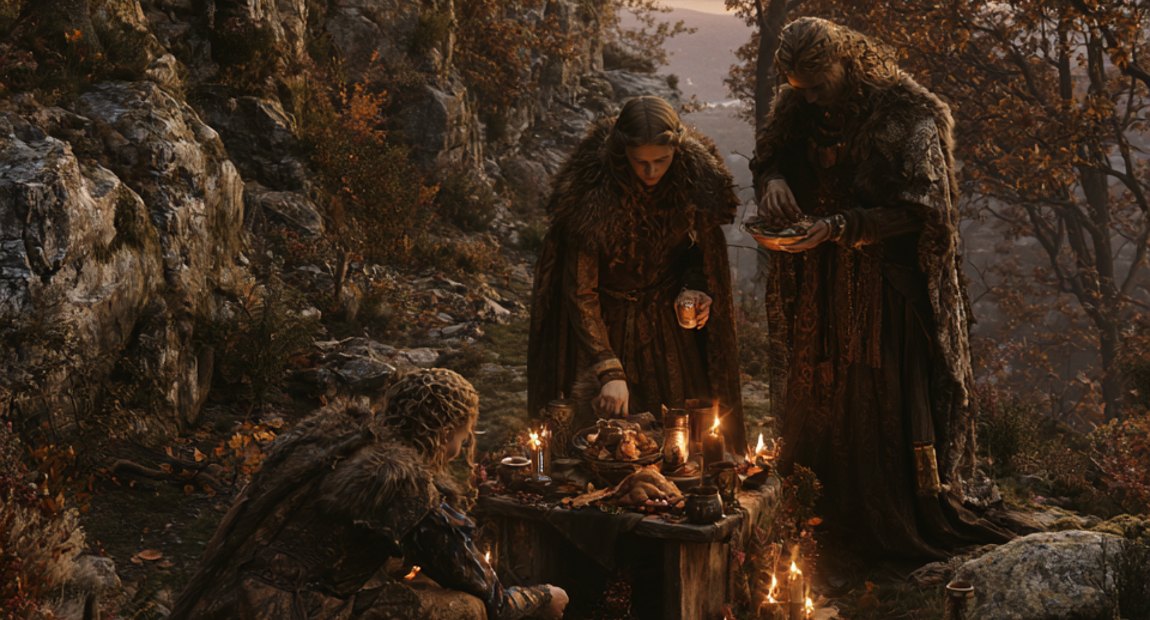
The old faith of our ancestors has not died out – it is being lived again. “Ásatrú”, literally “true to the Æsir”, is today the common name for modern Germanic heathenry. It is no dusty niche, but well organised: with registered societies, magazines, ritual books, regular gatherings and feasts across the German-speaking world. A look at what that looks like today.
Ásatrú is the modern revival of the pre-Christian Germanic religion. The name comes from the Norse, because heathenry survived longest there and is therefore best transmitted – but it is now used for Germanic heathenry across Europe. At its core stands a polytheism without a fixed hierarchy: many gods and goddesses, together with veneration of the ancestors and an awareness of the powers of nature.
Important is how these communities place themselves: they do not claim to continue an unbroken, ancient religion. They understand themselves as reconstruction – a serious, source-based attempt to make something livable again out of what has been handed down.
Two examples show the range. The Heidnische Gemeinschaft e.V. in Berlin has existed since 1985; it celebrates the feasts of the year's cycle outdoors, has published the magazine “Der Runenstein” for decades and keeps up hands-on folk custom. The Eldaring e.V., founded in 2000 on the model of the American “The Troth”, today numbers around 600 members and is thus one of the largest German-speaking societies.
The structure is deliberately lean and decentralised. Local groups – often called “hearths” or regular tables – organise meetings and feasts on their own responsibility. The groups shape their rituals themselves; fixed priestly offices usually do not exist. Whoever wants to celebrate finds a way in through regional groups, society gatherings and, today, Discord servers and online celebrations.
Perhaps the most important mark of serious modern heathenry is its stance towards the sources. Edda, sagas and archaeological finds are read not as a holy, infallible book, but critically – in the light of scholarship. The large communities expressly stress that the tradition is fragmentary, late and regionally shaped.
“Offerings to the gods are not an act of sacrifice that we suffer, but an act of sharing and of gratitude for our well-being.” Eldaring e.V., statement of self-understanding (2024)
This is exactly the stance we share at Glanz & Gravur: we cleanly separate what is historically attested from what is later romance or modern invention. For us a motif is strong when its story holds up.
Ásatrú today is above all practice. People celebrate the feasts of the year, drink at the Blót to gods and ancestors, sing old and new songs, gather herbs, visit cult sites, sew garb, publish magazines and ritual books. Much of it happens outdoors, among friends. It is a faith that embraces the whole of life – and one that, unlike the cliché, often feels very down-to-earth and glad of life.
Whoever wants to go deeper will find a good start in the reckoning of the old feasts by the moon or in our Blót calendar – and, in the societies themselves, people glad to share what they know.
The societies named and their key facts are publicly documented: the Heidnische Gemeinschaft e.V. (Berlin, founded 1985, the magazine “Der Runenstein” in around 100 issues) and the Eldaring e.V. (founded 2000 after The Troth, around 600 members in 2024, the magazine “Herdfeuer”, the ritual book “Eldariten” 2022). The decentralised structure of local groups without fixed priestly offices, and the emphatically source-critical stance, follow from these communities' own self-descriptions. The term “Ásatrú” (true to the Æsir) as a modern umbrella term is well established.
Ásatrú is not an unbroken religion that secretly outlasted the whole Middle Ages. Germanic heathenry was displaced in the course of Christianisation; what we see today is a conscious revival of the 20th and 21st centuries, grounded in sources and scholarship. The often-cited “eight feasts of the year”, too, are a modern scheme and not identical with the historically attested Germanic feast calendar. This does not diminish what is lived – it only makes it honest.
How do heathens celebrate today? · The Germanic feasts · Seiðr – the magic · The Merseburg Charms · The Norse pantheon.
All Festivals & Belief articles →
“Under all roots is rest.” More and more people wish, at the end, not for a cool stone but for a tree – a living place …
Read more →Scarcely an image is so bound up with the Vikings as the burning ship drifting out to sea with the dead. The ship was …
Read more →They appear almost in passing in the old texts, yet they are everywhere: the disir, female spirits who watch over a …
Read more →Forget the translucent veil-ghost. The draugr of the Old Norse sagas comes back in the flesh – heavy as an ox, darkly …
Read more →