The market is full of "Norse" symbols: on pendants, T-shirts, tattoos and wall art. Many are sold as ancient and Viking-age — yet quite a few are barely 200 years old or belong to entirely different contexts. Let us sort this out honestly: what is archaeologically attested, what is a modern invention, and what is even problematic? And how, in the end, do you recognise a historically correct motif?
Search the web for "Viking symbols" and you get a colourful jumble: runic wheels, interlaced knots, geometric suns, plus flowery meanings from "protection on all paths" to "power of the ancestors". It sounds coherent — but it is a mix of genuine finds, medieval manuscripts, 19th-century esotericism and pure fantasy. The problem: everything is thrown into the same pot and labelled "Old Norse".
We do it differently here. Instead of uncritically calling every pretty sign "Viking-age", we separate cleanly: what lies in the ground or on a stone as a find? What only appears centuries later? And what has nothing to do with the Vikings at all? This overview bundles our detailed individual checks — the linked articles go deeper on each.
"Cattle die, kinsmen die, you yourself die as they do; one thing I know that never dies: the fame of a dead man's deeds." Hávamál 77, after the translation by Henry Adams Bellows (public domain)
Let us begin with what you can rely on — motifs that really come from the Viking Age (or demonstrably before it) and are backed by finds, stones or manuscripts.
Thor's hammer (Mjölnir). This is the rock in the surf. From Scandinavia to England and into the Baltic, hundreds of small hammer amulets of silver, bronze and iron have been found, many from the 9th to 11th centuries. Some casting moulds even show a cross and a hammer side by side — one craftsman serving both markets. Thor's hammer is thus one of the few symbols you can call "genuinely Viking-age" without hesitation. More in the Thor's hammer article.
Valknut. The triangular knot of three interlocking triangles appears on Gotland picture stones, on the Oseberg ship burial and on a few mounts — usually near warriors, riders and death scenes. The find is genuine, but the modern name "valknut" and the popular reading "knot of the slain" are modern attributions. The sign is attested; its precise meaning remains open. Details in the valknut article.
Runes. Not a fantasy alphabet but a real script. The Elder Futhark (24 signs, from around the 2nd century) and the Younger Futhark (16 signs, Viking Age) are attested on thousands of runestones, amulets and everyday objects. Just be careful with interpretation: runes were first and foremost writing for names, ownership and memorial — the notion that every rune is a secret magic key is heavily overstated. More in the runes article.
Sun wheel and sun cross. A circle with a cross or spokes is one of the oldest symbols there is — just much older than the Vikings. It belongs to the Nordic Bronze Age (think of the Trundholm sun chariot, around 1400 BC). As a general sun and season sign it is real, but it is not a specifically "Viking" motif. Anyone using it should know this deep antiquity — and consciously distance themselves from modern appropriations.
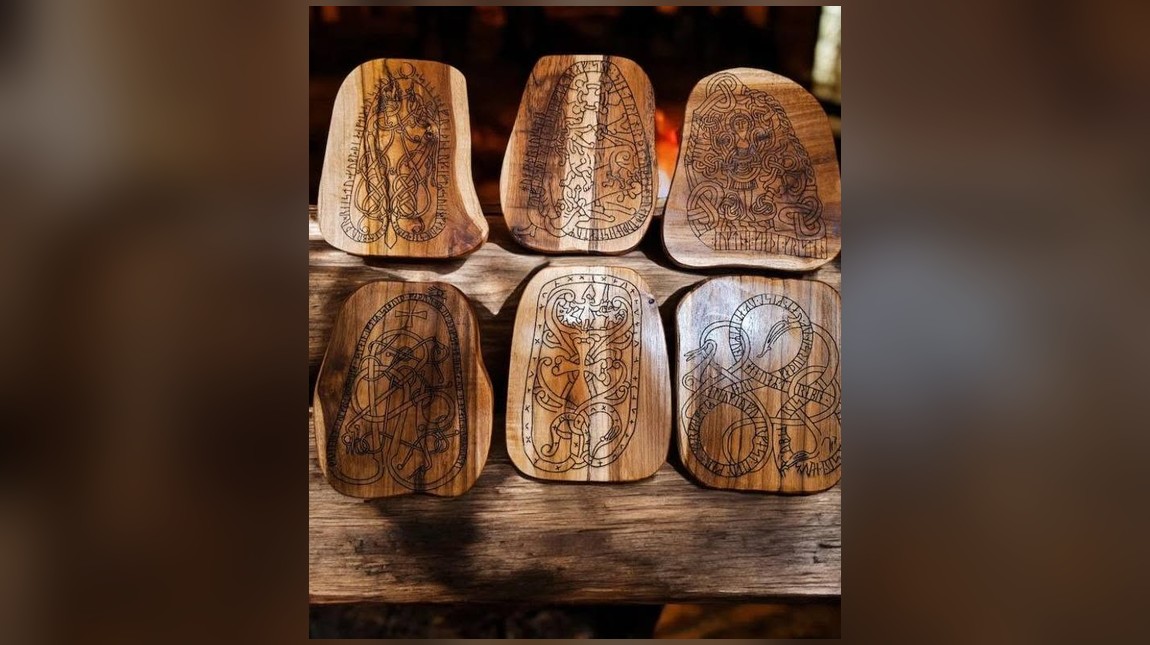
Animal-style motifs (Borre, Jelling, Urnes). The interlaced gripping beasts, bands and serpent bodies of Viking art are extremely well attested — on brooches, runestones, wood carvings and stave churches. This ornamentation is perhaps the most authentic "look" of the era and can be dated precisely. Anyone drawing their motif from this vocabulary stands on firm historical ground.
Yggdrasil imagery. The world tree is described at length in the Poetic and Prose Edda — so as text it is clearly transmitted. A fixed, recognisable "Yggdrasil image-symbol" of the Viking Age, however, does not exist; today's tree depictions are modern illustrations of a genuine literary source. Honestly put: idea real, concrete pictorial sign young.
Now the group most often mislabelled. Some of these signs are beautiful, some meaningful — but they are not Viking-age, however universally they are sold as such.
Vegvísir and Ægishjálmr. The two "Viking compass" and "helm of awe" stars are the perennial favourites of misattribution. They come from Icelandic books of magic (galdrabækur) of the early modern period, roughly 1600 to 1900 — the well-known Vegvísir, for example, from the Huld manuscript of 1860. The word Ægishjálmr is indeed old (it already appears in the Edda), but the drawn symbol is centuries younger. Neither has anything to do with seafaring Vikings. In detail in the Vegvísir and Ægishjálmr article.
"Viking compass". Strictly speaking just a marketing name for the Vegvísir. There is no Viking-age compass symbol. (The real Uunartoq sun-compass find is a navigation device, not a written sign.)
Many "wish bindrunes". Bindrunes — runes merged together — really did exist, usually as a space-saving abbreviation of names. The modern practice, however, of crafting a personal "power sign" for love, success or protection out of runes goes back largely to the runic esotericism of around 1900, for instance Guido von List and his invented "Armanen runes". A prettily designed wish bindrune can be a lovely personal sign — it is simply modern, not Old Norse.
"Web of Wyrd" (net of fate). The nine-line grid said to combine "all the runes" is often sold as ancient Norse — yet it has no Viking-age source. Even the term misleads: wyrd is Old English (Anglo-Saxon), while the Old Norse cognate is urðr (also the name of the fate-Norn Urðr). As a word, "wyrd" was popularised above all by Brian Bates’s book title The Way of Wyrd (1983); the drawn geometric symbol, by contrast, is documented only from the 1990s (earliest geometric form 1993, a related "web" form 1995) before spreading in modern use. A lovely sign — but modern, not Old Norse. A carefully documented timeline is kept by Mythic Harmonies.
Horned helmet. The classic among the inventions. Not a single Viking-age horned helmet has ever been found; the image arose only in 1876 through the costumes for Wagner's "Ring of the Nibelung" at Bayreuth. A pure stage prop. The whole story in the horned helmet article.
One symbol deserves a serious, clear paragraph here. The so-called black sun — a wheel of twelve spokes or Sig-runes — is sometimes passed off as "ancient Germanic" or "Norse". That is false, and it is no harmless mix-up. The motif was designed in this form by the SS and set into the floor of the Wewelsburg; it has no attestation whatsoever in Germanic or Viking-age tradition. Today it serves in far-right circles as a substitute and recognition sign.
For us the matter is unequivocal: the black sun is not a historical symbol but a 20th-century invention with a tainted, inhuman origin. We do not engrave it — under no circumstances. Why the sign comes across as so dangerously inconspicuous, and how to recognise it, we cover in the black sun article.
Genuinely attested for the Viking Age are Thor's hammer (hundreds of amulet finds, 9th–11th centuries), the runic rows (Elder and Younger Futhark, thousands of inscriptions), the valknut (Gotland picture stones, Oseberg) and animal-style ornament (Borre, Jelling, Urnes). Sun wheel/sun cross are real but Bronze Age and thus older than the Vikings. Yggdrasil is transmitted as text (Edda), not as a fixed pictorial sign of the era.
Modern, but often sold as "ancient": Vegvísir and Ægishjálmr (Icelandic books of magic, ~1600–1900; Vegvísir from the Huld manuscript 1860), the "Viking compass" (merely a marketing name for the Vegvísir), many "wish bindrunes" (runic esotericism around 1900, Guido von List) and the horned helmet (Wagner costume 1876). Clearly to be set apart, and historically unattested, is the black sun – a 20th-century invention of SS origin, not a Germanic symbol. We do not engrave it.
You need not be an archaeologist to choose responsibly. A few rules of thumb go a long way:
We are an engraving workshop, not a costume box. Our aim is to show Norse motifs as they really were — or, where that is not possible, to say honestly where a sign comes from. Thor's hammer, runes, animal-style ornament: gladly, with a clear conscience. Vegvísir and the rest: possible too, but we label them as what they are — beautiful modern signs of Icelandic magic-book origin, not "genuine Viking magic". The black sun we do not engrave, on principle.
Anyone who wants a motif that does justice to history will find, on our laser-engraved slate plates, historically grounded designs — from Thor's hammer through runic signs to animal-style ornament. And anyone looking for their own personal sign can approach us through Individual Engraving: we then say openly what is attested and what is a modern reading — so that in the end you get a piece you can stand behind with knowledge.
Yes. Thor's hammer (Mjölnir) is among the best-attested symbols of the Viking Age. Hundreds of small hammer amulets from the 9th to 11th centuries have been found across northern Europe, some in casting moulds alongside the Christian cross.
No. The Vegvísir comes from Icelandic books of magic of the early modern period; the well-known version is found in the Huld manuscript of 1860. It thus postdates the height of the Viking Age by roughly 800 years and has nothing to do with seafaring Vikings.
Because it is not a historical symbol. The black sun was designed in the 20th century by the SS (the floor mosaic of the Wewelsburg) and is used today in far-right circles as a recognition sign. It has no attestation in Germanic or Norse tradition. We do not engrave it.
Partly. Bindrunes as a space-saving merging of runes (for example in names) really existed. The modern "wish bindrune" as a personal power sign, by contrast, goes back largely to the runic esotericism of around 1900 and is therefore modern, not Viking-age.
Vegvísir & Ægishjálmr · The horned-helmet myth · Thor's Hammer · The Valknut · Runes & their meaning.
Every Easter she makes the rounds again: „Ostara, the Germanic spring goddess". Only – she is largely an invention of …
Read more →It is one of the most stubborn images of the „wild Viking“: the bearded warrior sipping his mead from the hollowed-out …
Read more →The sun wheel is one of humanity's oldest signs – around the world, since the Stone Age. Precisely for that reason …
Read more →It is the most mysterious and most feared art of the North: seiðr, the magic with which one does not merely see fate …
Read more →