No ancient source mentions a Germanic goddess called "Ostara". That name was worked out by Jacob Grimm in 1835. What we do have is her Anglo-Saxon counterpart: around 725 the monk Bede mentions a goddess named Eostre, after whom the month of April was supposedly named – in exactly one sentence. Here we look at what that sentence says, what Grimm built on it, why a cache of Roman altar stones from the Rhineland keeps the debate alive, and why the Easter bunny and Easter eggs have nothing to do with any of it.
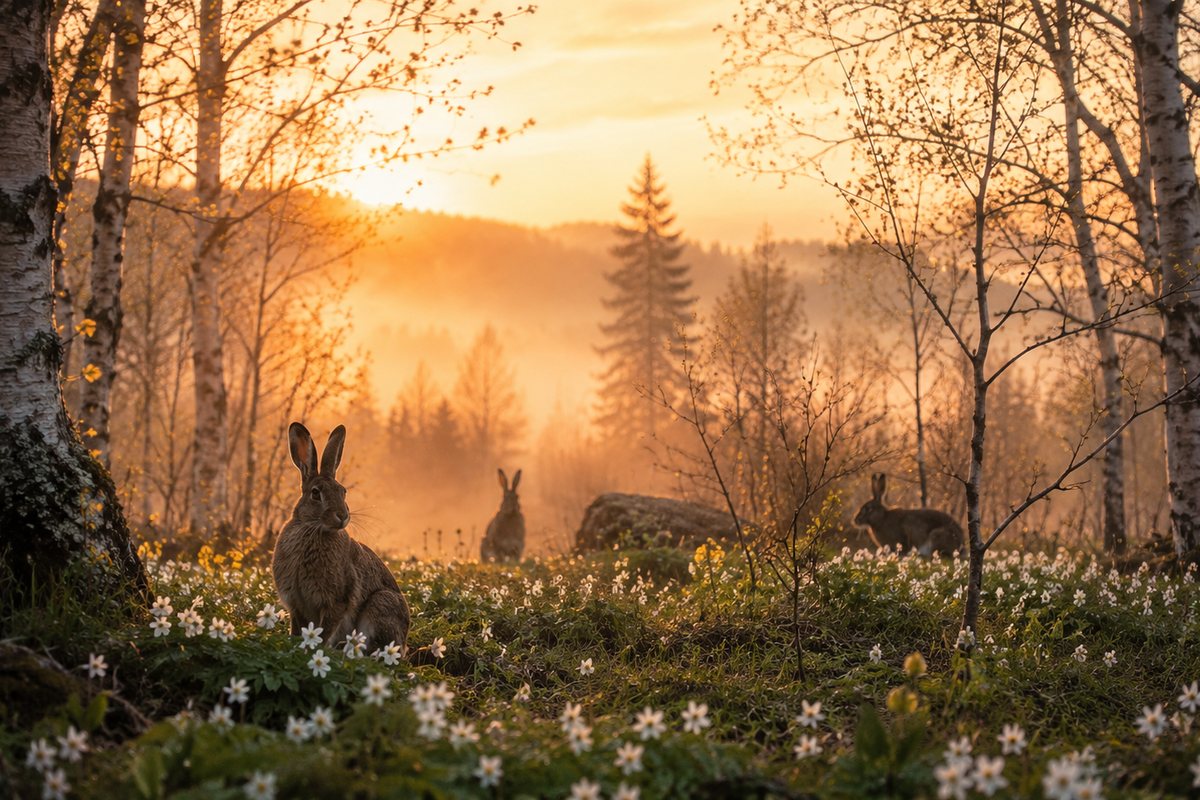
Every spring the same post goes round: a fair-haired goddess with a crown of blossoms, a hare in her arms, and a caption telling you that "Easter was really the pagan festival of Ostara". In our workshop we spend our days engraving motifs from the old North into slate, wood and glass. That is exactly why we want to know what the sources actually say. With Ostara the answer is sobering and fascinating at once: the whole goddess hangs on a single Latin sentence written by an English monk, and on the ingenuity of a German collector of fairy tales.
Bede, known as "the Venerable", lived from about 672 to 735 at the twin monastery of Wearmouth-Jarrow in north-east England. He was the most learned man of his age in the Anglo-Saxon world: theologian, historian, natural philosopher and, above all, an expert in time-reckoning. Around 725 he wrote De temporum ratione ("The Reckoning of Time"), a textbook with one overriding purpose: working out the correct date of Easter. And it is in this thoroughly Christian technical manual that we find the only early mention of a goddess whose name echoes Easter.
In chapter 15, titled De mensibus Anglorum ("On the months of the English"), Bede lists the old English month names and explains them. Of April he writes, in essence:
"Eosturmonath, which is now rendered 'Paschal month', once took its name from a goddess of theirs called Eostre, to whom they held feasts in that month. Now they call the Paschal season by that name, giving the joys of the new rite the time-honoured name of the old observance."Bede, De temporum ratione, ch. 15 (our own translation)
The Latin core runs: Eosturmonath, qui nunc paschalis mensis interpretatur, quondam a dea illorum quae Eostre vocabatur, et cui in illo festa celebrabant nomen habuit. That is all there is. No description, no sacrifices, no myth, no sacred animal, no statue. Only this: there was a goddess, her name was Eostre, feasts were held for her in this month, and the name stuck to the Christian festival.
One detail is still argued over. The clause a cuius nomine ("from whose name" or "from its name") can grammatically refer either to the goddess or to the month and its name. On the second reading Bede is only saying that the feast is named after the month, and the month was once named after the goddess. That changes little about the facts, but it does affect how direct the line from goddess to the word "Easter" really is.
Context matters. Bede was writing some 130 years after the Christian mission to England began in 597. He was describing a past he had not witnessed, but which could still be heard in the month names. For the background to the Angles and their move to Britain, see our article on the Angles.
On the continent we find no goddess, but we do find a word. Einhard, Charlemagne's biographer, reports in his Life of Charlemagne (chapter 29, around 830) that the emperor gave the months names in his own tongue. January became wintarmanoth, February hornung, March lenzinmanoth and April ostarmanoth. Then there is the Old High German word for the feast itself, ôstarûn, a plural form that became modern German Ostern.
This is striking. In English and German the festival is named from a root related to "east" and "dawn". Almost everywhere else in Europe, Scandinavia included, its name goes back via Greek and Latin pascha to Hebrew Pesach: Danish and Norwegian påske, Swedish påsk, Dutch Pasen, French Pâques. For more on the old month names and how much of them can be verified, read our article on the Germanic month names.
A month name, however, is not a goddess. Ostarmanoth may simply mean "the month in which Easter falls", once the feast had brought its name over from England. Anglo-Saxon missionaries such as Boniface and Willibrord played a decisive part in shaping the Church east of the Rhine in the eighth century. Many linguists think it likely that they brought their word for the festival with them, which would explain why English and German share it.
The next step came over a thousand years later, from a man you probably know from your childhood bookshelf. Jacob Grimm, the elder of the two fairy-tale brothers and a founder of German philology, published his Deutsche Mythologie ("Teutonic Mythology") in 1835. It was a colossal attempt to reconstruct the religion of the pre-Christian Germans from language, folk custom, legend and the handful of early sources. We explore how he worked, and what survives of his methods, in our piece on the Brothers Grimm and mythology.
Grimm's reasoning on Ostara is easy to follow. First: Bede names an Anglo-Saxon goddess Eostre. Second: Old High German has ôstarûn and ostarmanoth. Third: so the continental Germans must also have had a corresponding goddess, whose name, by the regular sound laws, would have been "Ostara". Grimm saw her as a goddess of the radiant dawn and of rising light, a joyful figure whose meaning the Church was happy to borrow for the feast of the Resurrection. He then attached a whole series of customs to her: Easter fires, Easter eggs, Easter water and tales of white ladies who appear around Easter.
The crucial point: the form "Ostara" does not appear in a single early manuscript. It is a linguistic back-formation, a reconstructed word. Grimm knew this and presented his idea as an inference, not a discovery. It was his successors, and even more so popular writers, who turned "must have existed" into "existed".
Scholars were already quarrelling about this in the nineteenth century. Some followed Grimm; others thought Eostre a phantom. The mythologist Adalbert Kuhn called her an invention of Bede's, and Wilhelm Mannhardt mocked her as an etymological "goddess from the machine", wheeled on solely to explain a word. Karl Weinhold rejected her on linguistic grounds.
The sceptics' case: Bede was a learned etymologist in the tradition of Isidore of Seville, and scholars of his day loved to explain words through persons. Perhaps Bede only had an old word for the season, something like "time of the rising sun", and, true to his era, turned it into a goddess. In favour of this, nobody but Bede knows anything about her: no English place-names, no personal names, no inscription, no poem.
The counter-argument: Bede was generally a careful writer who drew on the oral tradition of his own people. He lived only a few generations after the end of paganism in Northumbria. And why would a monk writing a manual on calculating Easter link the holiest feast of the year to a pagan goddess he had simply invented? The Viennese scholar of Germanic studies Rudolf Simek therefore takes Bede's statement seriously without stretching it. The English philologist Philip A. Shaw concluded in his 2011 study Pagan Goddesses in the Early Germanic World that Eostre was probably a genuine but locally rooted goddess, bound to a community and a territory rather than a grand goddess of spring or light for all Germanic peoples.
The question is still not settled. Most specialists now lean towards believing Bede that an Eostre existed. What she was, what she stood for and how she was worshipped, nobody knows. Anyone who tells you about her myths, her sacred animals or her rites is telling you modern poetry.
Then came 1958. At Morken-Harff, now part of Bedburg in the Rhein-Erft district and barely an hour's drive from our workshop in Alsdorf, the remains of many Roman-era votive stones came to light. They had been reused as building material at a later date and mostly survive only as fragments. The literature speaks of more than 150 inscriptions or inscription fragments. Many are dedicated to goddesses called the Matronae Austriahenae. Hans-Georg Kolbe published the find in 1960 in the Bonner Jahrbücher.
The Matronae are a characteristically Lower Rhenish phenomenon: triads of mother goddesses, often shown as three seated women, the outer two wearing large, round bonnets. Hundreds of such stones from the second and third centuries survive in the Rhineland, set up by locals, soldiers and veterans. The goddesses' epithets are usually local, derived from places, rivers, kin groups or communities. We describe how this cult worked in our article on the Matronae and in our overview of the Germanic peoples of the Rhineland.
The name Austriahenae contains a stem austri- that sounds tantalisingly like Eostre and the word for "east". For some scholars this was the longed-for second witness: goddesses with an Ostara-like name, almost a thousand years before Grimm, on the continent, carved in stone. It is not quite that simple.
The ground is firmer when it comes to language. Eostre, ôstarûn and Easter all go back to a Germanic word reconstructed as *austrō (the asterisk marks a reconstructed, unattested form). It belongs to an ancient Indo-European root *h₂ews-, meaning "to shine, to glow reddish". From the same root come "east", German Osten, Lithuanian aušra ("dawn") – and the names of three famous dawn goddesses: Greek Eos, Roman Aurora and Vedic Ushas, to whom many hymns of the Rigveda are addressed.
This is the strongest point in Eostre's favour. An Indo-European goddess of the dawn is well attested in several daughter cultures. That the Germanic peoples also knew a figure by that name is linguistically plausible. Dawn in the east, the spring season when the sun rises due east at the equinox: it all hangs together. For the role of the sun in the year and the customs actually attested around its turning points, see our article on the solstice.
There is, however, a serious rival theory. In his 1999 book Ostern. Geschichte eines Wortes ("Easter: the history of a word") the onomastics scholar Jürgen Udolph suggested that the word is linked to a North Germanic root meaning "to pour, to sprinkle" (Old Norse ausa), in other words to baptism. In the early Church, baptisms were preferably performed during the Easter Vigil. This view is disputed and has not won general acceptance, but it shows that even for the word "Easter" a goddess is not the only explanation. A derivation from "east" as the direction from which the light of the Resurrection comes is also conceivable, with no deity involved at all.
Many Ostara texts, including an earlier version of this very article, quote a supposed charm: "Eostar, Eostar, eordhan modor" – Ostara as "mother of earth". That sounds like the longed-for proof. It is not. The genuine Old English field blessing, the Æcerbot (literally "field remedy", a ritual to restore barren land), survives in an eleventh-century manuscript in the British Library. There the figure invoked is called Erce: "Erce, Erce, Erce, eorþan modor". Who or what Erce was is itself unclear. No manuscript contains an "Eostar" version. We are correcting that here explicitly.
If Ostara is this thinly attested, were there any pagan spring festivals at all? The honest answer is: probably yes, but we know very few details. Bede himself confirms that feasts were held in Eosturmonath. What they looked like, he does not say.
For the North we have a late report. Writing around 1230 in Ynglinga saga (chapter 8), Snorri Sturluson says Odin established three great sacrifices. In Samuel Laing's 1844 translation: "On winter day there should be blood-sacrifice for a good year, and in the middle of winter for a good crop; and the third sacrifice should be on summer day, for victory in battle." The Old Norse calls this last one sigrblót, the victory sacrifice. Snorri wrote as a Christian, two centuries after Iceland's conversion, and credited the cult to a deified primeval king. A festival at the start of summer in spring is therefore likely for Scandinavia, but the details remain obscure.
A word on a term that haunts many Ostara texts: a "Varblot" at the equinox with a fixed programme honouring Freyr, Freyja, Njörðr, Nerthus and Idun is unknown to the medieval sources. It is a modern festival design by heathen groups, not a transmitted tradition. That deities such as Freyr, Freyja and Nerthus were linked with fertility is well attested; a spring date does not follow from that. Nor is Idun with her apples a traditional spring goddess, however often she is read that way today.
Even the idea that the Germanic peoples marked the exact equinox is uncertain. The North Germanic peoples divided the year into two halves, summer and winter, and reckoned by lunar months and weeks. Astronomically precise dates tied to the equinoxes are not attested for the pre-Christian period. For an overview of which festivals are well evidenced and which are not, read our article on Germanic festivals and our hands-on old cycle of the year. If you want the dates for your own year, the Blót calendar has them.
Now for the stars of every Easter basket. The hare, we are told everywhere, was Ostara's sacred animal and the egg her symbol of fertility. The sources tell a different story.
The earliest secure written evidence for the egg-bringing Easter hare dates from 1682. That year a medical dissertation titled De ovis paschalibus. Von Oster-Eyern ("On Easter eggs") appeared in Heidelberg, presided over by the physician and botanist Georg Franck von Franckenau, with a certain Johannes Richier named as author or respondent. It describes a folk custom from Alsace, the Palatinate and neighbouring areas: children were told that the Easter hare laid the eggs and hid them in the garden. Some accounts give a slightly earlier date (1678); either way, we are firmly in the early modern period, not the Iron Age.
With the egg, the Christian background is easy to see. Under medieval Lenten rules, eggs were forbidden too. The hens carried on laying regardless, so by Easter the stock was large. Eggs were blessed, given as gifts and paid as dues to landlords and parish priests. Christian writers read the egg, new life breaking out of a seemingly dead shell, as an image of the Resurrection. That eggs are fertility symbols in many cultures around the world is true enough, but that does not make them the cult object of one particular Germanic goddess.
The Easter fire is very often labelled "ancient pagan". Here, too, a closer look pays off. In the Church, kindling a new fire during the Easter Vigil is a fixed part of the liturgy: the Paschal candle is lit from it, and its light is carried into the dark church as an image of the risen Christ. A papal letter to Boniface from the year 751 is regarded as an early, indirect reference to fire customs connected with Easter.
The great bonfires on hills and fields that you find today especially in northern Germany, Westphalia and the Netherlands are attested as an established folk custom from the fifteenth and sixteenth centuries. That older, pre-Christian fire customs might lie behind them cannot be ruled out. Church prohibitions against pagan fires, the so-called nodfyr ("need-fire"), already appear in the early Middle Ages. But no documented path can be traced from a Germanic spring fire to the village Easter bonfire. Grimm saw one; scholars today are more cautious.
The reason you trip over Ostara in every other New Age shop each March is quite specific, and it lies in the twentieth century. Wicca, the modern witchcraft religion spread in England from the 1950s by Gerald Gardner and his circle, developed a "Wheel of the Year" with eight festivals: the four solar points plus four festivals modelled on Irish seasonal feasts. At first the solar festivals simply had descriptive names.
In 1974 the American pagan Aidan Kelly proposed names for the festivals that still lacked them: Litha for midsummer, Mabon for the autumn equinox and, yes, Ostara for the spring equinox. The names spread through the magazines of the US pagan scene and became so familiar within a few decades that many people now take them to be ancient. The festival "Ostara" on 20 or 21 March is barely fifty years old.
That is not a criticism. Modern religions are free to shape their festivals as they wish, and many heathen communities in the German-speaking world handle this very thoughtfully, as we describe in our articles on Asatru today and on modern blót and sumbel celebrations. What matters is honesty: if you celebrate Ostara at the equinox, you are celebrating a modern festival with a name from 1835 and a goddess hidden in one sentence from 725.
After all this you might think Ostara is finished. We see it differently. The story of this goddess is a lesson in how tradition works. A monk jots down, almost in passing, a name that would otherwise have vanished without trace. A philologist hears an echo in a word and builds a figure from it. In the Rhineland, stones with a similar name turn up and reignite the debate. And behind it all stands the dawn, which really was one of the oldest goddesses of the Indo-European world.
Perhaps this is the loveliest version, because it is the truest: somewhere in early medieval England there was a goddess whose name may have meant "the shining one" or "she of the east". Her month lay where light begins to win against darkness. That is all we know. And sometimes "that is all we know" is more honest than any fairy tale with a hare and a crown of flowers.
Was Ostara a real Germanic goddess? The form "Ostara" appears in no ancient source; Jacob Grimm reconstructed it in 1835. Only the Anglo-Saxon Eostre is attested, in a single sentence by Bede (around 725).
Is Easter a pagan holiday? No. Easter is the Christian feast of the Resurrection and grew out of the Jewish Passover. Only its name in English and German may, via Bede, go back to a pagan goddess or to an old word for dawn or the east.
Where does the word Easter come from? Most likely from Germanic *austrō, "dawn", related to "east", Eos and Aurora. A minority theory by Jürgen Udolph derives it from a word meaning "to pour", that is, baptism.
What does the Easter bunny have to do with Ostara? Nothing that can be documented. The egg-bringing Easter hare is first attested in 1682 in a Heidelberg dissertation under Georg Franck von Franckenau. The link to Ostara dates from the nineteenth century.
When is Ostara celebrated today? On the modern Wheel of the Year used by Wiccans and other neopagans, at the spring equinox on 20 or 21 March. The name for this festival was introduced in 1974.
What are the Matronae Austriahenae? Roman-era mother goddesses whose altar stones were found in 1958 at Morken-Harff near Bedburg in Germany. Their name recalls Eostre, but a connection has not been proven.
For courage. For remembrance. For legends that live on.
Nerthus · Idun · Kolovrat or Black Sun?.
It is one of the most stubborn images of the „wild Viking“: the bearded warrior sipping his mead from the hollowed-out …
Read more →The sun wheel is one of humanity's oldest signs – around the world, since the Stone Age. Precisely for that reason …
Read more →It is the most mysterious and most feared art of the North: seiðr, the magic with which one does not merely see fate …
Read more →A single thorn – and even a valkyrie sleeps for years: the svefnþorn, the „sleep thorn," is one of the eeriest motifs …
Read more →