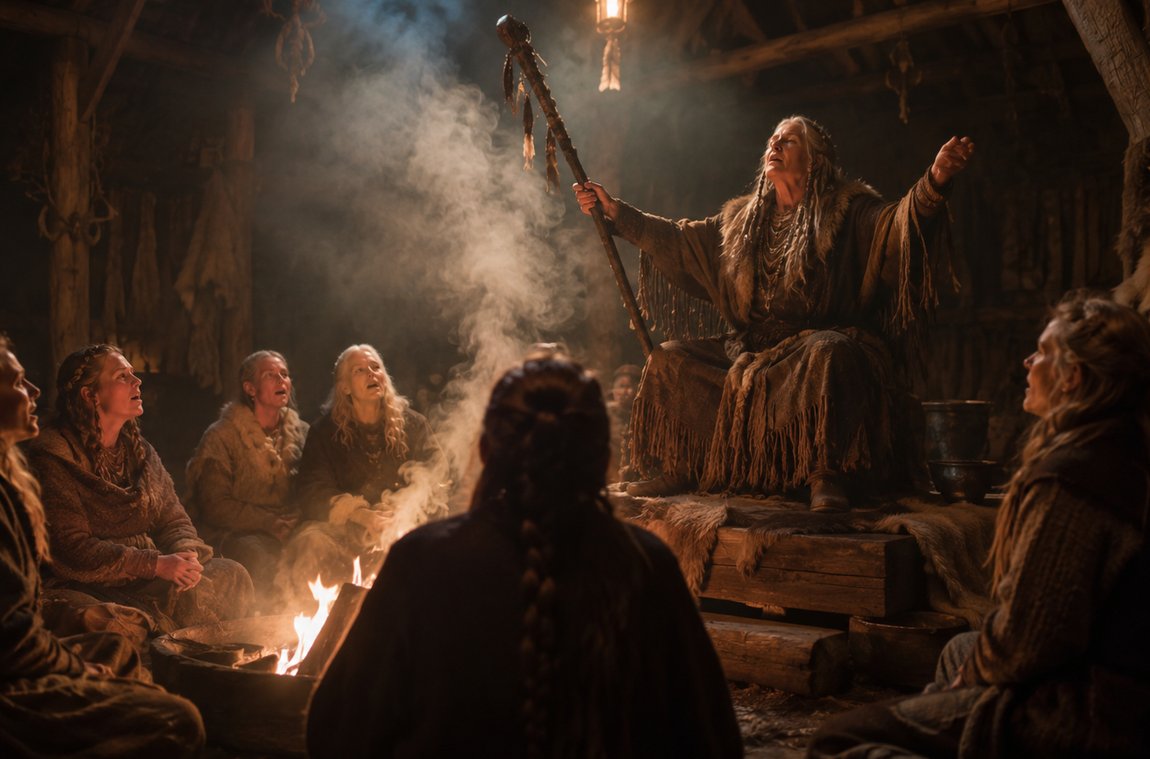
Seiðr is the ritual magic of the Old Norse world, used by a seeress – the völva – to learn hidden things in trance and to reach into fate itself. According to Snorri, Freyja brought it to the gods, and Odin practised it even though it was shameful for men. We follow the seeress Þorbjörg through her night in Greenland as the Saga of Erik the Red tells it, read the Völuspá as a völva's speech, open the staff graves from Fyrkat to Gnezdovo and weigh the shamanism theory – keeping sources, finds and interpretation clearly apart.
Seiðr (roughly “SAY-thr”, with the soft th of “this”) is the Old Norse name for a particular kind of magic – not a catch-all word for “witchcraft”. A woman who practised it was a seiðkona, a man a seiðmaðr, and the verb for doing it was síða. Nobody knows for certain where the word comes from. It is often linked to a Germanic root meaning “cord, string, binding” (Old English sāda, “halter, cord”). That makes for a lovely image – seiðr as the art of binding and drawing threads – but it is a hypothesis, not a fact.
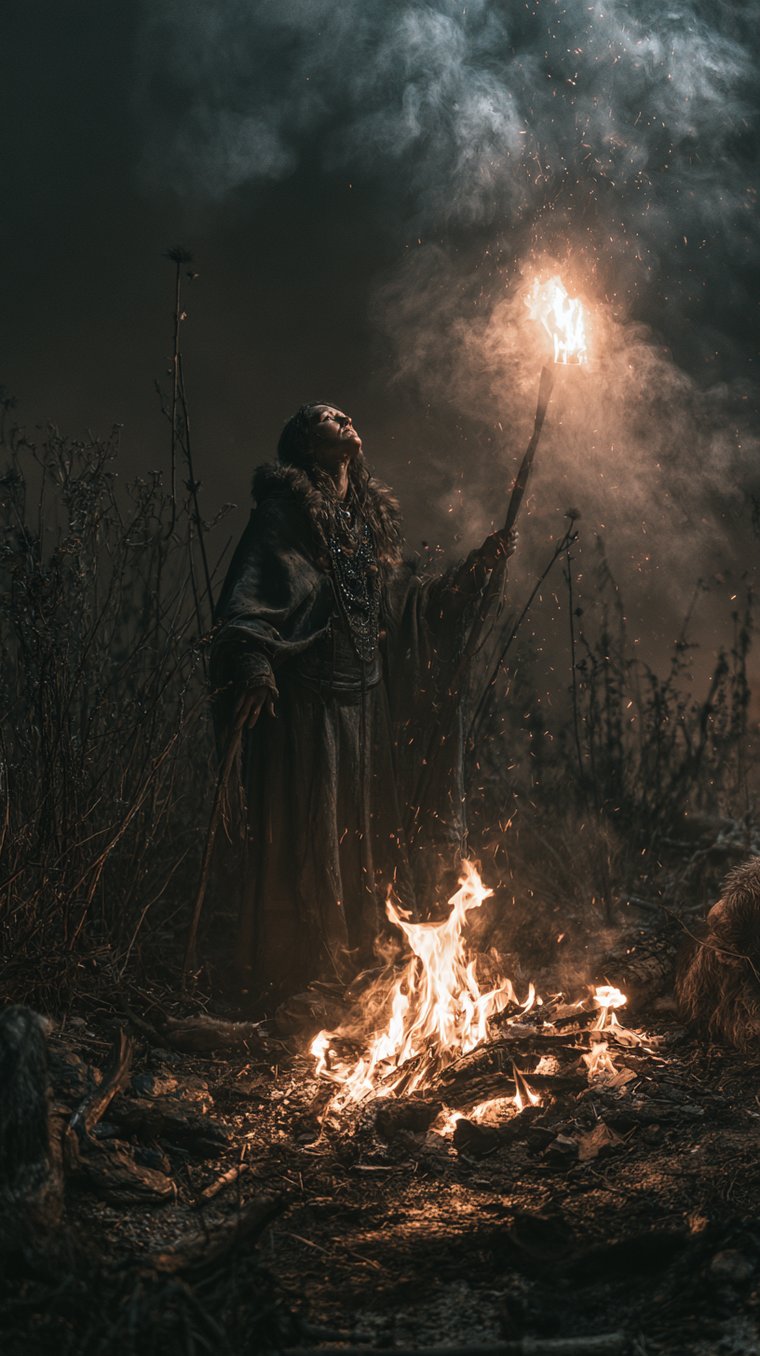
What the texts say is clearer. Seiðr is used to learn what is hidden: the future, a person's fate, the weather of the coming season. It is also used to act on the world – to sicken or kill, to rob people of wits or strength, to raise storms. And it tends to happen in public, almost as theatre: a raised seat, a song, an audience, one person slipping into an altered state and then speaking. Knowledge and power in one package – which is exactly why seiðr was both sought after and distrusted.
Three terms get thrown together constantly in books and online. They overlap, but the medieval sources do not use them at random.
Spá is prophecy. A spákona is a prophetess, and the most famous poem of the Edda is the Völuspá – “the prophecy of the völva”. Spá names the result, a glimpse of what is coming, not the method used to get there.
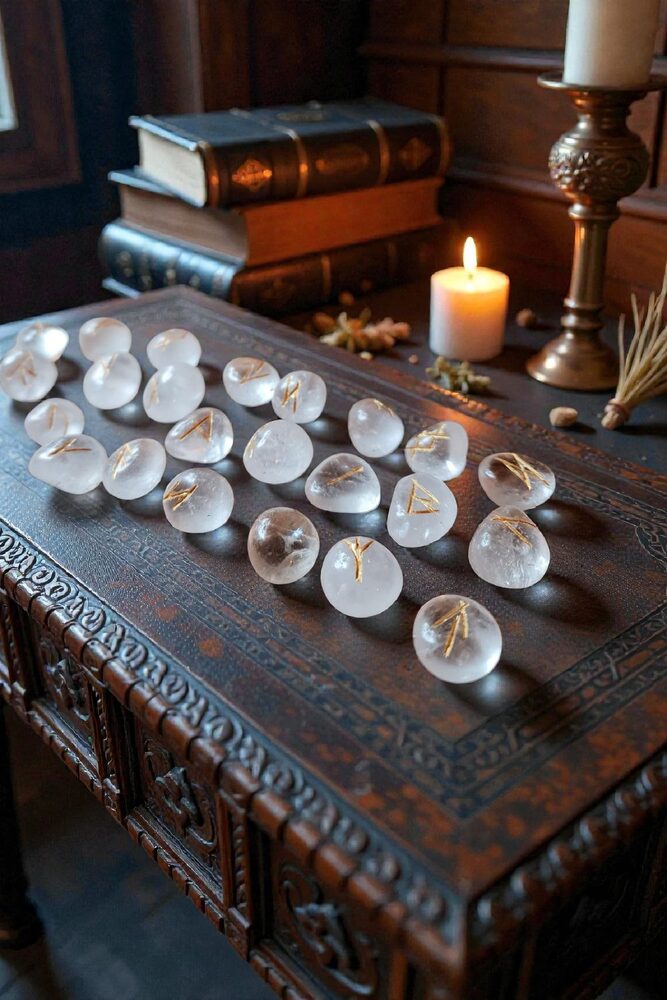
Galdr is sung or spoken magic. It comes from the verb gala, “to sing, to crow” – the same root sits in English “nightingale”. Galdr is tied to formulas and often to runes. In the Hávamál, Odin lists eighteen spell-songs he knows: against fetters, against arrows in flight, against fire, to calm the sea. That is galdr in its purest form, and in the sources it carries no stigma – respected men could master it. Our article on rune magic goes deeper.
Seiðr is the practice involving trance, a platform and ritual – and a specific reputation. It can lead to spá, and songs are sung during it, so galdr is never far away. Yet the texts treat seiðr as its own thing, with its own social label. Add to that the útiseta, “sitting out”: spending a night alone outdoors, often on a burial mound, to gain knowledge from the dead. Rule of thumb: spá is seeing, galdr is singing, seiðr is the whole ritual performance.
The clearest origin story comes from Snorri Sturluson in the thirteenth century – not in his Edda, but in the Ynglinga saga, the opening of his history of the Norwegian kings, Heimskringla. There he presents the gods as early rulers of Sweden, a learned retelling that treats them as human beings.
In chapter 4, after the war between the Æsir and the Vanir, Njörðr and his children come to the Æsir as hostages. Of the daughter, Snorri writes: “hon kenndi fyrst með Ásum seið, sem Vönum var títt” – she was the first to teach seiðr among the Æsir, as it was customary among the Vanir. Samuel Laing's 1844 translation puts it as Freyja having “first taught the Asaland people the magic art, as it was in use and fashion among the Vanaland people.”
Two things follow. Seiðr is originally an art of the Vanir, the family of gods tied to fertility, wealth and sensuality. And its teacher is Freyja – not a pupil but the mistress of the craft. That fits her wider profile, where love, gold, death and magic sit uncomfortably close together.
A caution, though: this is a Christian scholar writing roughly two centuries after Iceland's conversion. Whether “Freyja as teacher of seiðr” goes back to old tradition or is Snorri tidying up his material, we cannot say for sure. The casual way he states it suggests his audience found it plausible.
In chapter 7, Snorri turns to Odin. He can change shape while his body lies as if asleep, quench fire and calm the sea with words, and he carries Mímir's head, which brings him news from other worlds. Then comes the passage that matters. In paraphrase: Odin knew and himself practised the art that carries the greatest power, called seiðr. Through it he could know people's fates and things not yet come to pass, bring death, misfortune or sickness, and take wits or strength from some and give them to others. But so much ergi follows this sorcery that men could not practise it without shame, and so it was taught to the goddesses.
“But after such witchcraft followed such weakness and anxiety, that it was not thought respectable for men to practise it …”— Ynglinga saga 7, translated by Samuel Laing (1844, public domain)
Laing is being polite. The Norse word ergi (adjective argr) means unmanliness in the harshest sense: cowardice, softness and, above all, a man taking the passive, “female” role sexually. Under Grágás, the Icelandic law collection, merely calling a man argr in this way could be punished with outlawry. This was not a schoolyard taunt.
Why seiðr in particular brought ergi is debated. Perhaps because it was women's work and a man doing it stepped into a woman's role; perhaps because trance meant opening oneself up, receiving rather than acting; perhaps because of ritual elements we can no longer reconstruct. Only the outcome is certain. And that is what makes Odin's choice so telling. The god who gave an eye for wisdom and hanged himself on the tree for the runes pays this price too: his reputation as a man.
That this was not just Snorri's invention is shown by an eddic poem probably older than his saga: the Lokasenna, “Loki's Quarrel”. At the sea giant Ægir's feast, Loki insults the gods one by one. Odin has just accused him of spending eight winters under the earth as a woman, milking cows and bearing children. Loki fires back:
“They say that with spells in Samsey once / Like witches with charms didst thou work; / And in witch's guise among men didst thou go; / Unmanly thy soul must seem.”— Lokasenna 24, translated by Henry Adams Bellows (1923, public domain)
The Norse original says Odin “did seiðr” (síða) on Samsey and beat on a vétt “like the völur”. What a vétt was is uncertain – some readers think of a lid or a kind of drum. He went among men in a sorcerer's likeness, “and I took that for the nature of an argr”. The exact word from the Ynglinga saga, aimed at the All-father. Where Samsey was is unclear; Bellows suggested the Danish island of Samsø, and noted that no other source tells of Odin disguising himself as a witch. The poem assumes its audience knew a story we have lost.
The most detailed description of a seiðr session in all of medieval literature is not in a myth at all but in a saga about people: Eiríks saga rauða, the Saga of Erik the Red. It was probably written in the thirteenth century and survives in Hauksbók (early fourteenth century) and the later Skálholtsbók. The story is set around the year 1000 among the Greenland Norse. We retell the chapter closely here, in our own rendering.
Greenland is in the grip of famine. Hunting parties come back with little, some not at all. In the settlement lives a woman called Þorbjörg, known as the lítilvölva, “the little völva”. She had had nine sisters, all seeresses, and she alone is still alive. In winter she goes from feast to feast, invited by those curious about their fate or the coming year. Þorkell, a wealthy farmer at Herjólfsnes, asks her to come and say when the hard times will end. He sends a man to meet her and has a high seat prepared, with a cushion stuffed with hen feathers.
She arrives in the evening, and the saga stops to paint her portrait:
Þorkell takes her by the hand and leads her to her seat. She says little. She is served a porridge of goat's milk and a dish made from the hearts of every kind of animal on the farm, and she eats with a brass spoon and a knife with a tooth or ivory handle whose point is broken off. Asked what she thinks of the household and the year ahead, she says she will answer in the morning, after a night there.
The next day she is given what she needs to perform the seiðr. She asks for women who know the song required: the varðlokkur, usually interpreted as “spirit-calling songs”, though the exact meaning is uncertain. Nobody on the farm knows it. Then Guðríðr speaks up, a young Icelandic woman wintering there with her father Þorbjörn. She is, she says, neither skilled in magic nor a wise-woman, but her foster-mother Halldís taught her such songs in Iceland. And she is a Christian and does not want to take part. Þorbjörg answers drily that Guðríðr could help people here and would be no worse a woman for it. Þorkell presses her, and she agrees.
The women form a ring around the platform on which Þorbjörg sits – the saga calls it a seiðhjallr. Guðríðr sings so beautifully that everyone agrees they have never heard a finer voice. The seeress thanks her: many náttúrur – powers, beings – have come who had turned away from her before and would not obey; now much is revealed to her that was hidden. The famine will last no longer than this winter, things will improve with spring, and the sickness will lift sooner than expected.
Guðríðr receives her own prophecy as payment: an honourable marriage in Greenland that will not last long; her path leads to Iceland, where a great and worthy family will descend from her, and over her descendants a bright ray will shine. After that, people come up one by one to ask what they most want to know, and little of what she says fails to come true. Guðríðr's father, by the way, had not stayed in the house at all – he wanted no part of such heathen goings-on. In the saga, the prophecy is fulfilled: Guðríðr marries Erik's son Þorsteinn, who soon dies, and later Þorfinnr karlsefni, with whom she sails to Vinland. At the end of the saga bishops are named among her descendants – the “bright ray” is a Christian one.
This chapter is both a gift and a trap. A gift, because it gives details no poem offers: clothing, food, seat, song, sequence, payment in hospitality. The catskins point to Freyja, whose chariot, according to Snorri, is drawn by cats. The staff is the defining tool: the word völva is usually derived from vǫlr, “staff” – the staff-bearer.
A trap, because it was written down a good two centuries after the events by a Christian author. Much of it is clearly crafted: the pious singer who joins in against her will, the father who walks out on principle, a prophecy that ends in bishops. Some scholars therefore read the scene as a learned reconstruction of what thirteenth-century Icelanders imagined heathen sorceresses to be like. Others see genuine memory in its oddly specific details – hen feathers, a broken knife point, a touchwood belt. Both positions are defensible. What does come through clearly is that the völva is no outcast. She is invited, seated in the place of honour and fed – a respected professional with an edge of the uncanny. For more on these women, see our portrait of the völva.
The most striking witness is an entire poem: the Völuspá, first in the Codex Regius of the Poetic Edda (written down around 1270, but probably considerably older). The whole poem is framed as the speech of a seeress. It opens, in our own translation:
“Hearing I ask of all the holy kindreds, greater and lesser sons of Heimdallr; you wish, Father of the Slain, that I tell well the ancient tales of men, the earliest I remember.”— Völuspá 1, own translation
Odin himself has made her speak. Later we hear that she sat out alone when the old god came and looked into her eyes: “What do you ask of me? Why do you test me? I know it all, Odin, where you hid your eye.” Sitting out recalls the útiseta, and her refrain – “Do you know yet more, or what?” – throws the challenge back at her listeners.
The same poem introduces Gullveig, whom the gods pierce with spears and burn three times, and who three times lives again. The next stanza reads:
“Heiðr they called her, wherever she came to a house, the far-seeing völva; she enchanted wands. Seiðr she worked where she could, seiðr she worked, her mind in a trance; ever was she the delight of wicked women.”— Völuspá 22 (Codex Regius), own translation
Several words are uncertain: ganda (“wands”) is also read as “spirits”, and hugleikin (“her mind in a trance”) is ambiguous. Whether Gullveig/Heiðr is a form of Freyja is a popular theory that cannot be proven. What stands out is the next event: the first war in the world, between Æsir and Vanir, breaks out.
Seeresses appear elsewhere too. In Baldrs draumar, Odin wakes a dead seeress with a valgaldr, a corpse-raising chant, to learn what threatens Baldr – galdr forcing a völva into spá. In Örvar-Odds saga a völva named Heiðr foretells that the hero will die because of his own horse.
In the sagas of Icelanders, seiðr is rarely harmless. In Laxdæla saga (chapters 35–37), the immigrant family of Kotkell – he, his wife Gríma and their sons Hallbjörn and Stígandi – are known as sorcerers. When young Þórðr Ingunnarson sues them for theft and witchcraft, Kotkell has a great seiðr platform built. The family climbs up and chants; a storm rises, Þórðr's ship capsizes, and he and all his men drown. Later they work seiðr by night against the farm of Hrútr. Hrútr sees through it and orders everyone to stay awake, but his twelve-year-old son Kári walks out towards the enchantment and drops dead. Kotkell and Gríma are stoned to death; Hallbjörn is drowned with a stone tied around his neck. In Gísla saga, Börkr pays a man called Þorgrímr nef to work seiðr so that nobody will be able to help the outlawed Gísli.
Saga seiðr is the weapon of outsiders, and often lethal. Again, these are Christian authors writing about a pagan past – but the fear of such magic was real enough.
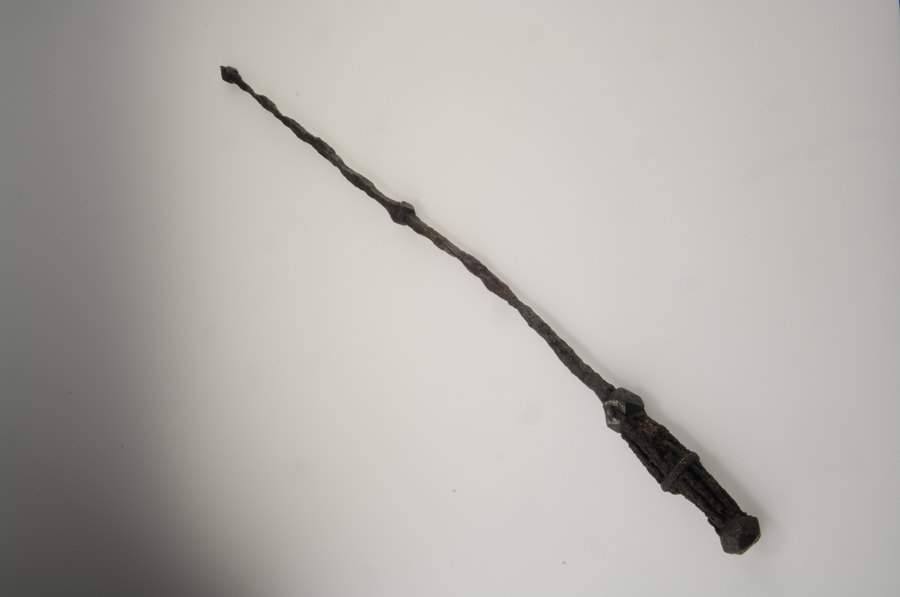
Up to now we have had texts. Now come objects. In a number of Viking Age graves, mostly women's, archaeologists have found staffs – usually iron, sometimes with bronze fittings, often with a basket-like cage of iron rods near the top. For a long time they were catalogued as roasting spits or measuring rods. Today many are read as völva staffs. Neil Price gathered and interpreted them in The Viking Way (2002; much-expanded second edition 2019), and Leszek Gardeła devoted a monograph to them in 2016.
Fyrkat (northern Jutland): next to the late tenth-century ring fortress lies a cemetery of around 30 graves. One of them – usually cited as grave 4 – stands out completely. The woman was buried in the body of a horse-drawn wagon, as the richest women were, in blue and red clothing with gold thread, wearing silver toe rings unknown elsewhere in Scandinavia. With her: a partly decayed iron staff with bronze fittings, a small silver amulet shaped like a chair – perhaps the seiðr seat –, a box with owl pellets and bones of small birds and mammals, bronze bowls possibly from Central Asia, and a small pouch of henbane seeds.
Klinta (near Köpingsvik, Öland): a tenth-century cremation in which the dead woman was laid on a bearskin in a boat. Set into the grave was an iron staff with bronze inlays, now in the Swedish History Museum in Stockholm. It is broken at the bottom, so it was once longer. Its tip is crowned by a tiny house, originally surrounded by four animals with their heads turned to the roof. The museum lists several readings: Valhalla, Freyja's hall Fólkvangr, the world tree – or a spinning tool that recalls the Norns and the thread of fate.
Birka (Lake Mälaren): in the trading town, several women's chamber graves contained such staffs; Price and Gardeła cite grave Bj 845 among them. Ingrid Gustin revisited three of these Birka women in 2010, and the discussion now includes more down-to-earth readings such as measuring rods or distaffs.
Gnezdovo (near Smolensk, Russia): the great Scandinavian-influenced cemetery on the Dnieper has also produced a knobbed iron staff that is placed in the same series. The tradition, or the women who carried it, travelled far east.
Add to these Oseberg in Norway, with a wooden staff and cannabis seeds in a pouch, and Hagebyhöga in Östergötland, where a woman was buried with a staff, horses, a wagon and a small silver figure of a woman with a great neck-ring, often read as Freyja. Many staffs, with their basket tops, look strikingly like a distaff, the tool that holds fibre for spinning – a neat match for the Norse image of fate as something spun and woven. Still, not every iron rod in a grave was a magic wand.
Was seiðr a form of shamanism? Few questions have occupied research on the topic more. The Swedish folklorist Dag Strömbäck laid the groundwork in 1935 with his dissertation Sejd. He collected the textual evidence and pointed to parallels with the trance practices of the Sámi, the Norse neighbours whose ritual specialists (noaidi) worked with drum and song. In the sagas, sorcerers are strikingly often called “Finns” – meaning Sámi.
Neil Price went much further in The Viking Way. He combined the texts with archaeology – staffs, graves, amulets, psychoactive plants – and with comparisons from the circumpolar world. His picture: seiðr belongs to a wide field of consciousness-altering rituals, deeply embedded in Viking Age warfare and society. He speaks of “shamanic” traits and stresses how varied the practices were.
The pushback is real. Clive Tolley's two-volume Shamanism in Norse Myth and Magic (2009) tests the label critically: much that looks shamanic, he argues, is literary motif, learned construction or a reflection of how the Norse imagined the Sámi, and a term coined for Siberia cannot simply be transplanted to Scandinavia. François-Xavier Dillmann has likewise studied the Icelandic portrayals of sorcerers with strict source criticism.
Since the 1980s and 1990s, groups within modern Heathenry have tried to revive seiðr. Best known is the “oracular seiðr” of the American author Diana Paxson and her group Hrafnar: a seeress sits on a raised seat, the group sings, and she then answers questions from those present – clearly modelled on chapter 4 of Eiríks saga. The anthropologist Jenny Blain studied this practice in Nine Worlds of Seid-Magic (2002). It is a modern religious practice that draws on the sources and fills the gaps with its own forms, not an unbroken tradition from the Viking Age. Neither diminishes the other; they just should not be confused. See also Asatru today.
Seiðr was an art meant to reveal the hidden and reach into fate, shaped as women's work, with Freyja as its teacher. A man who used it lost his honour – and Odin used it anyway. The völva travelled from farm to farm with staff, catskin and glass beads, and from Jutland to the Dnieper the staffs of such women still lie in the ground. In our workshop in Alsdorf this sometimes becomes a Völuspá line engraved in slate – with an honest note on what is attested and what remains interpretation.
What does seiðr mean? Seiðr is the Old Norse word for a ritual form of magic used to see the future and to intervene in fate, weather and health. Its etymology (perhaps “cord, binding”) is not settled.
What is the difference between seiðr and galdr? Galdr is sung formula magic, often linked with runes, and carried no stigma. Seiðr was a ritual with trance, platform and song, regarded as women's craft and bringing men the charge of ergi.
What is a völva? A seeress who, like Þorbjörg in the Saga of Erik the Red, travelled from farm to farm and foretold the future in return for hospitality. The name is usually explained as “staff-bearer”.
Did Odin practise seiðr? Yes, according to Snorri's Ynglinga saga (chapter 7) and Lokasenna 24. Both sources treat it as unmanly.
Is there archaeological evidence for seiðr? There are staffs in rich women's graves at Fyrkat, Klinta, Birka and Gnezdovo, plus henbane seeds at Fyrkat. They fit the texts well, but not every staff is proven to be a magic staff.
Was seiðr shamanism? That is a scholarly debate: Strömbäck and Price stress the closeness to shamanic practice, while Tolley warns against simply transferring a Siberian concept.
For courage. For remembrance. For legends that live on.
Freyja – mistress of seiðr · Odin · Freya or Frigg? · The Norns & fate · Runes & galdr · The Merseburg Charms.
A single thorn – and even a valkyrie sleeps for years: the svefnþorn, the „sleep thorn," is one of the eeriest motifs …
Read more →They appear on T-shirts, tattoos, jewellery and in every second Viking TV series: the Vegvísir, the supposed „Viking …
Read more →Few images from the Viking Age are as disturbing as the „blood eagle": a ritual killing in which the victim's ribs were …
Read more →To some an ancient Germanic sun-sanctuary, to others a Christian place of pilgrimage – the Externsteine in the …
Read more →