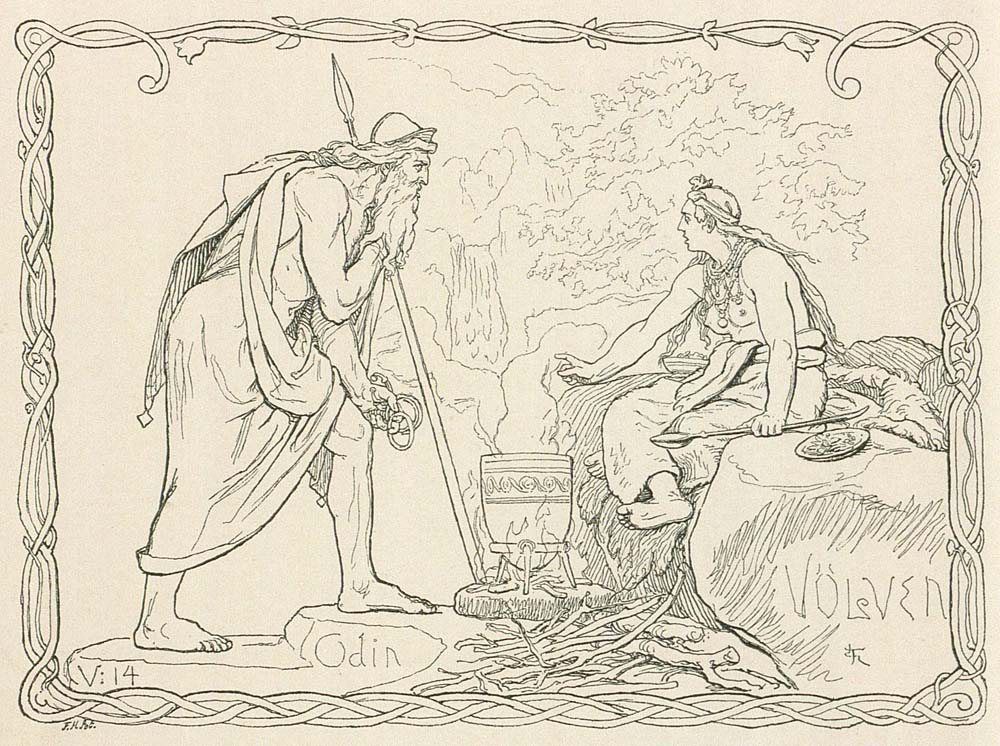
She came from farm to farm in a blue cloak, a staff in her hand. They seated her on the highest place, gave her the finest food, and waited – because what the völva said could decide the coming year. No figure of the North is as fascinating, or as often misunderstood, as the seeress. Here we separate cleanly what the sources attest, what is interpretation, and what only the modern age invented.
The völva was a seeress and worker of magic in the Norse world. She rarely belonged to a single farm; instead she travelled, summoned when a winter turned harsh, an illness baffling, or the future dark. People received her with respect mixed with unease: whoever could look into the threads of fate stood outside the ordinary order. In the sagas the völva is no minor character but an authority whose word carried weight – farmers, chieftains and even kings sought her counsel.
Her craft was twofold and yet one: to see what is hidden, and to work what an ordinary person cannot. She was prophet and ritual leader in one. Just as important is what she was not: no wicked fairy-tale witch, no priestess of a fixed church, no uniform office with training and title. The role was personal, tied to a special gift – and to tools, songs and a reputation that arrived before she did.
Two Old Norse terms outline her ability. Spá means prophecy, foreseeing – related to English "to spy". A spákona was literally a "seeing woman". Seiðr, by contrast, denotes an active magic: a ritual working by which fate could be influenced, hidden things traced, wind and weather, luck and misfortune guided. Both lay in the hands of the völva, though the line between them was fluid.
Seiðr was bound to ritual: to a raised platform, the seiðhjallr, to song, to a distinctive costume, and often to helpers. It was not about reciting formulas but about entering a state – the seeress's soul was to travel, the protective spirits to be called. This is exactly where the most famous account we possess begins.
The word völva (Old Norse vǫlva, plural vǫlur) most likely derives from vǫlr, the word for "staff" or "wand". The völva is therefore, quite literally, "the bearer of the staff" or "the one with the staff". The staff belongs inseparably to her image – not as a walking aid, but as the sign and instrument of her craft.
Alongside völva the sources use other terms: spákona (seeing woman), vísendakona (woman of knowledge), seiðkona (magic-woman). They overlap, each stressing one aspect. The name itself already tells a small story: no staff, no völva.
The fullest description of a völva stands in the Icelandic Eiríks saga rauða, the Saga of Erik the Red. In famine-stricken Greenland the seeress Þorbjörg – called lítilvölva, "the little völva" – is invited to a farm to prophesy about the coming year and the end of the hunger. The saga describes her arrival with unusual precision.
She wears a blue cloak set with stones down to the hem, glass beads about her neck, on her head a hood of black lambskin lined with white cat fur. She carries a staff with a knob, mounted with brass and set with stones; at her belt hangs a pouch in which she keeps her charms. On her hands are gloves of cat skin, white and furry within. They seat her on a high seat with a cushion of hens' feathers and feed her with the hearts of every animal to be found on the farm. This wealth of detail makes the scene the single most important source we have for the equipment of a seeress.
For the magic to succeed, Þorbjörg needs help: women who can sing the Varðlokur, the "luring of the spirits" or "warding chants". But no one on the farm knows it – until Guðríðr Þorbjarnardóttir steps forward, a young, Christian-raised woman. She hesitates, because she does not want to be a sorceress, yet she sings it in the end, because she once learned it from her foster-mother. She sings so beautifully that the summoned spirits appear and Þorbjörg sees more than ever before.
The seeress then declares that the hardship will soon end, and foretells a great future for Guðríðr. The scene is telling for another reason: it shows the crossing of worlds – a Christian woman reluctantly singing the old song – an honest picture of an age in transition, written down centuries after the events.
The most famous poem of the Poetic Edda carries the völva even in its name: Völuspá means "the prophecy of the seeress". In it Odin rouses a seeress who unfolds for him – and for us – the whole history of the world: from the primeval Ginnungagap through the creation of the cosmos to Ragnarök and the new, green earth beyond. It is the great cosmic vision, placed in the mouth of a völva.
Hearing I ask / from the holy races, / From Heimdall's sons, / both high and low; / Thou wilt, Valfather, / that well I relate / Old tales I remember / of men long ago.Völuspá, stanza 1 (translation Henry Adams Bellows, 1923, public domain)
That a seeress of all figures speaks the highest wisdom of the cosmos – and that Odin, the All-Father, listens and asks her questions – says a great deal about the rank granted to this figure.
Seiðr was not the affair of mortal women alone. The Prose Edda and the Ynglinga saga relate that Freyja, goddess of the Vanir, mastered seiðr and first taught it to the Æsir. She counts as its divine mistress. And even Odin, god of wisdom, learned seiðr – a remarkable trait, for he thereby joined the highest power to a practice regarded as feminine.
The völva thus stands in a line with the gods themselves: what she did, Freyja and Odin also did in their way. The seeress was no curiosity at the margins but part of a worldview in which seeing and fateful working reached all the way into the world of the gods.
Precisely because Odin mastered seiðr, a delicate point comes into view. The Ynglinga saga notes that with this magic came so great an ergi that it was held shameful for men to practise it – which is why it was left to the priestesses. Ergi is a word hard to translate: it means unmanliness, softness, a conduct that offended the honour-code of the male world. In the Lokasenna, the poem of flyting, Loki throws exactly this at Odin: that he had worked "in the manner of witches".
Seiðr, then, carried feminine connotations. Men who practised it – called seiðmenn – did exist, but they moved at the edge of social honour. This underscores how closely the craft was bound to the role of women.
Beside the texts, the finds speak. In several richly furnished women's graves of the Viking Age, archaeologists have found elongated iron staffs, often with a knobbed or basket-like end, sometimes worked with bronze details. Because the word völva means "staff-bearer" and the Eiríks saga describes just such a staff, scholarship – led above all by the archaeologist Neil Price in his study of seiðr – interprets these objects as the wands of seeresses.
Three find-spots are named again and again. In grave 4 of the Danish ring-fortress Fyrkat lay a richly furnished woman with a metal staff, amulets, henbane seeds (a psychoactive plant) and goods from distant lands – a grave that broke the mould and is often linked with a seeress. At Birka, the great Swedish trading place, several women's graves held similar staff-shaped objects. And in the grave at Klinta on the island of Öland lay a particularly elaborate staff beside a woman whose furnishings set her clearly apart.
These finds give the völva a face beyond the sagas. They show women of rank whose grave goods point to wealth, far-reaching contacts and an elevated position. Whether each of them truly was a seeress remains a matter of interpretation – yet the recurrence of staff, amulet and foreign treasures is striking.
One trait makes the völva unique: in a certain sense she stands above the gods, because she sees what even they do not know. In the Völuspá it is Odin who questions the seeress. In the Baldrs draumar, "Baldr's Dreams", Odin even rides down into the world of the dead and wakes a long-dead völva from her grave to question her about Baldr's fate. The mightiest god must go to the seeress, not the other way round.
This is more than a narrative flourish. It reflects a belief in which fate – the ørlög laid down by the Norns – lies above all things, even above the gods. The völva is the mediator to that knowledge. Whoever questioned her was, in the end, questioning the powers to which even Odin was subject.
Not every act of seeing needed a great hall. The sources know the útiseta, the "sitting out": one sat outside alone at night, often at a crossroads or upon a burial mound, to gain knowledge, question spirits, or ask the dead for answers. The grave mound was no accident – the ancestors were held to be a source of wisdom, and nearness to the dead could open the sight into what is hidden.
This very motif lies behind Odin's ride to the dead seeress in the Baldrs draumar: the waking of the dead to learn what the living do not know. For the völva, the boundary between the worlds was permeable. That also explains the unease with which she was met: to speak with the dead and the spirits was to move in a place most people avoided. Christian laws of the later period expressly forbade the útiseta – indirect proof that the practice was alive enough to be fought.
The völva is easily confused with the Norns, yet they are two different things. The Norns – above all Urðr, Verðandi and Skuld – are powers of fate who lay down the ørlög of every person at birth; they belong to the fabric of the world itself. The völva, by contrast, is a human being (or, in the myths, a woken corpse) who can see, and sometimes influence, this fate already laid. The Norns weave; the völva reads.
This distinction matters, because it sharpens the seeress's role: she does not create fate, she reveals it. Her power lies in access to knowledge, not in command over the threads. That is exactly what made her a sought-after mediator – and explains why even the gods had to come to her rather than command her. Between fear and honour the völva stood at the threshold: respected for her sight, feared for the powers she dealt with.
Precisely because the völva is so fascinating, misunderstandings cling to her. Three should be named plainly.
Seen honestly, the völva loses nothing by this – she becomes, if anything, more impressive: a real figure with real authority, not a fantasy cliché.
The seeress of the North was a woman of rank who stood between worlds – between humans and spirits, between present and future, and in the end even between the old faith and the new. Her staff, her blue cloak and her song belong to the most striking images the Viking Age has left us. She reminds us that in this world not only warriors counted, but also the knowledge of the hidden – and that a single woman upon the high seat could silence an entire hall.
When we portray the völva today, we do so with respect for what is attested and with honesty where the sources fall silent. That is the North as it truly was: rich, mysterious and larger than any legend later fastened onto it.
Seiðr – the magic · The Norns · The Dísir – guardian spirits of the kin · Draumar – dreams as omens · Freyja.
All Festivals & Belief articles →
When the nights are longest and the fire in the house is warmest, the departed draw nearer. Yule, the midwinter feast …
Read more →For our ancestors the year was no sheet on the wall but hard, beautiful work: to sow, to tend, to harvest, to store …
Read more →