 Not every dead person went to Odin's gleaming hall. For most, the road led down and to the north, across a roaring river, past a watchful gatekeeper, into a silent realm beneath the roots of the world. What the sources tell of this last journey – and how much of it Snorri first tidied into order.
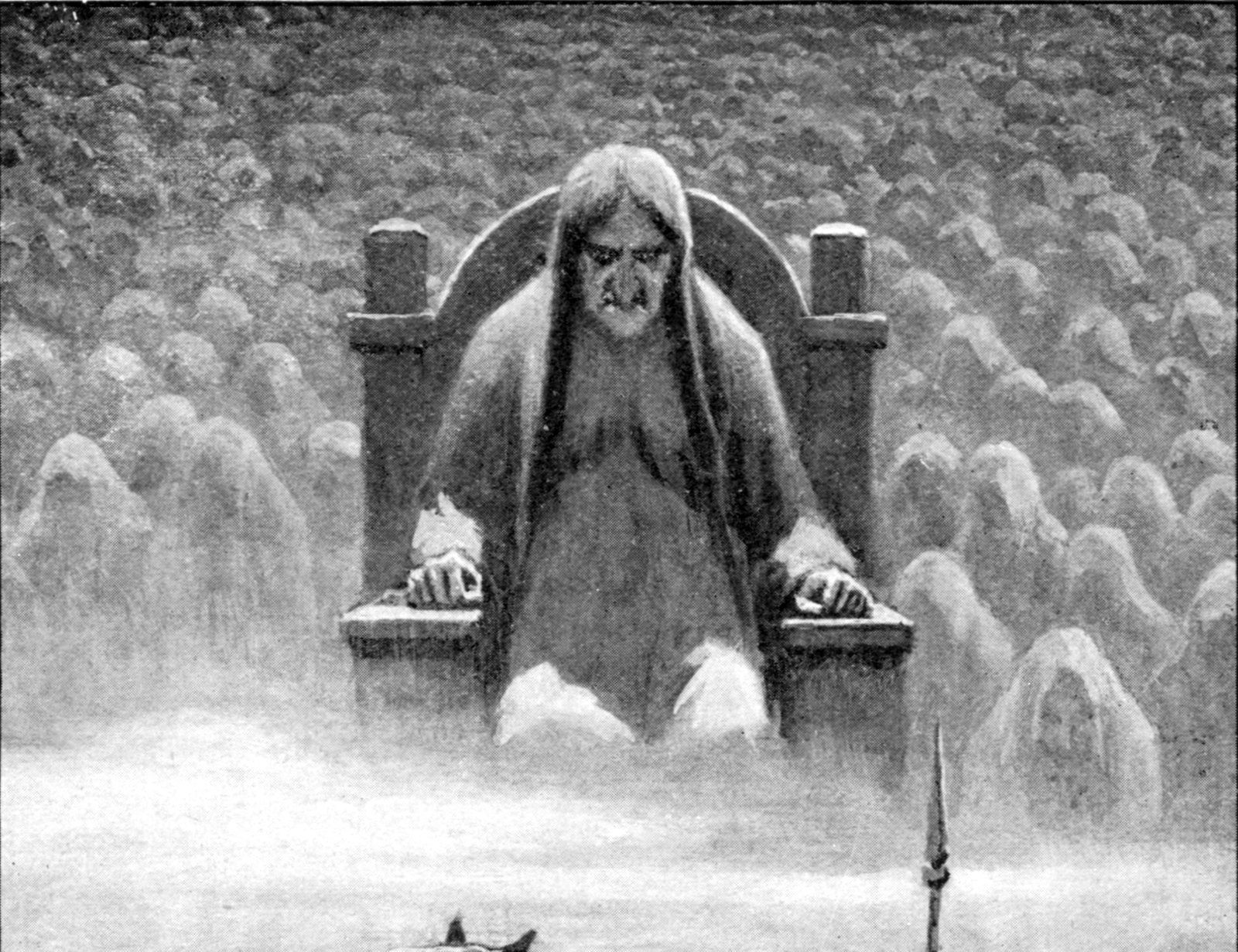
When we hear "Hel" today we quickly think of fire and damnation. Yet the Norse realm of the dead was originally something else: not a place of punishment, but simply the dwelling of most of the departed – cold, distant and still. Hel is at once the name of the mistress of that realm, Loki's daughter, half living and half corpse-pale. The road there, though, is one of the most striking images in all the Edda.
The journey to the realm of the dead is called Helvegr in the sources, the "Hel-road". It leads not into the sky but down and to the north – the direction that in the North always stood for cold, darkness and the alien. Snorri Sturluson describes the ride most vividly in the Gylfaginning: after Baldr has died, his brother Hermóðr rides Odin's steed Sleipnir to bring him back. "For nine nights he rode through valleys so deep and dark that he saw nothing," it says, until he reached the river Gjöll. Nine nights, down through gloomy valleys – the distance between the living and the dead becomes a real, arduous road.
At the end of the road lies the river Gjöll, and across it stretches the bridge Gjallarbrú, thatched with shining gold. It is the true border crossing: whoever passes it is finally among the dead. It is guarded by the giantess or maiden Móðguðr. As Hermóðr rides across, the bridge thunders louder under Sleipnir's hooves than under a whole army, and Móðguðr speaks to him: five troops of dead men had ridden over the bridge the day before, "yet the bridge thunders no less under you alone – and you do not have the colour of the dead. Why do you ride the Hel-road here?" This one scene says almost everything: the dead travel in troops, the bridge divides the living from the departed, and a wakeful keeper asks each traveller by what right they are here.
Beyond the bridge lies the gate of Hel, called Helgrind or Nágrind in the sources, the "corpse-gate". It is high and firmly shut. Hermóðr gets through only because Sleipnir, Odin's eight-legged steed, leaps clean over it in a mighty bound. No ordinary traveller would pass so easily – the road to the realm of the dead is a one-way street. In some verses the blood-stained hound Garmr also keeps watch at the entrance to the underworld, bound at the cave Gnipahellir, whose howling announces the onset of Ragnarök. Whether Garmr really lies at the gate of Hel or is a monster of his own the sources do not clearly say – the old texts deliberately leave room here.
Not all the dead fare alike in Hel's realm. The darkest image comes from the Völuspá, the song of the seeress, with the place Náströnd, the "corpse-shore":
A hall she saw / far from the sun,
on Nastrond it stands, / and the doors face north;
venom drops / through the smoke-vent down,
for around the walls / do serpents wind.Völuspá 38, translation Henry Adams Bellows 1923 (public domain)
A hall whose walls are woven from the spines of serpents, their heads turned inward, dripping venom down – and through that venom must wade the perjurers, the murderers and the adulterers. At the bottom the dragon Níðhöggr gnaws the corpses. This is no longer a gentle beyond, but a place for those who broke the peace of the community. One can feel it: a moral order shows through here, one that separates the dead by their conduct.
What often gets lost is important: Hel was not the only realm of the dead. Those fallen in battle were taken by the valkyries to Valhöll, to Odin, or to Fólkvangr, to Freyja. Whoever drowned at sea was drawn down by the sea-goddess Rán with her net into her hall. In the sagas, in turn, one "dies into the mountain" – the ancestors go into a sacred hill such as Helgafell and live on there in a kind of continuing presence. The road to Hel was therefore the road of most, but not of all – one realm among many, not a single purgatory.
That is precisely what makes the road to Hel so powerful: no sermon on hell, but a long, dark road, a river, a bridge and a question at the border. The Norse did not think of death as an end but as a journey – with provisions for the way, with obstacles, and with a destination beyond the last river.
Hel – goddess and realm of the dead · The death of Baldr · Hringhorni – Baldr's funeral ship · How the Germanic peoples honoured their dead · Niðhöggr – the gnawer at the root.
All Festivals & Belief articles →
When the nights are longest and the fire in the house is warmest, the departed draw nearer. Yule, the midwinter feast …
Read more →For our ancestors the year was no sheet on the wall but hard, beautiful work: to sow, to tend, to harvest, to store …
Read more →The old faith of our ancestors has not died out – it is being lived again. “Ásatrú”, literally “true to the Æsir”, is …
Read more →“Under all roots is rest.” More and more people wish, at the end, not for a cool stone but for a tree – a living place …
Read more →