“Under all roots is rest.” More and more people wish, at the end, not for a cool stone but for a tree – a living place where memory keeps growing. Tree burial is possible in Germany today, and for many it feels deeply fitting. It touches an idea rooted deep in the heathen worldview: that death is not an end but a passage – and that we remain bound to all life.
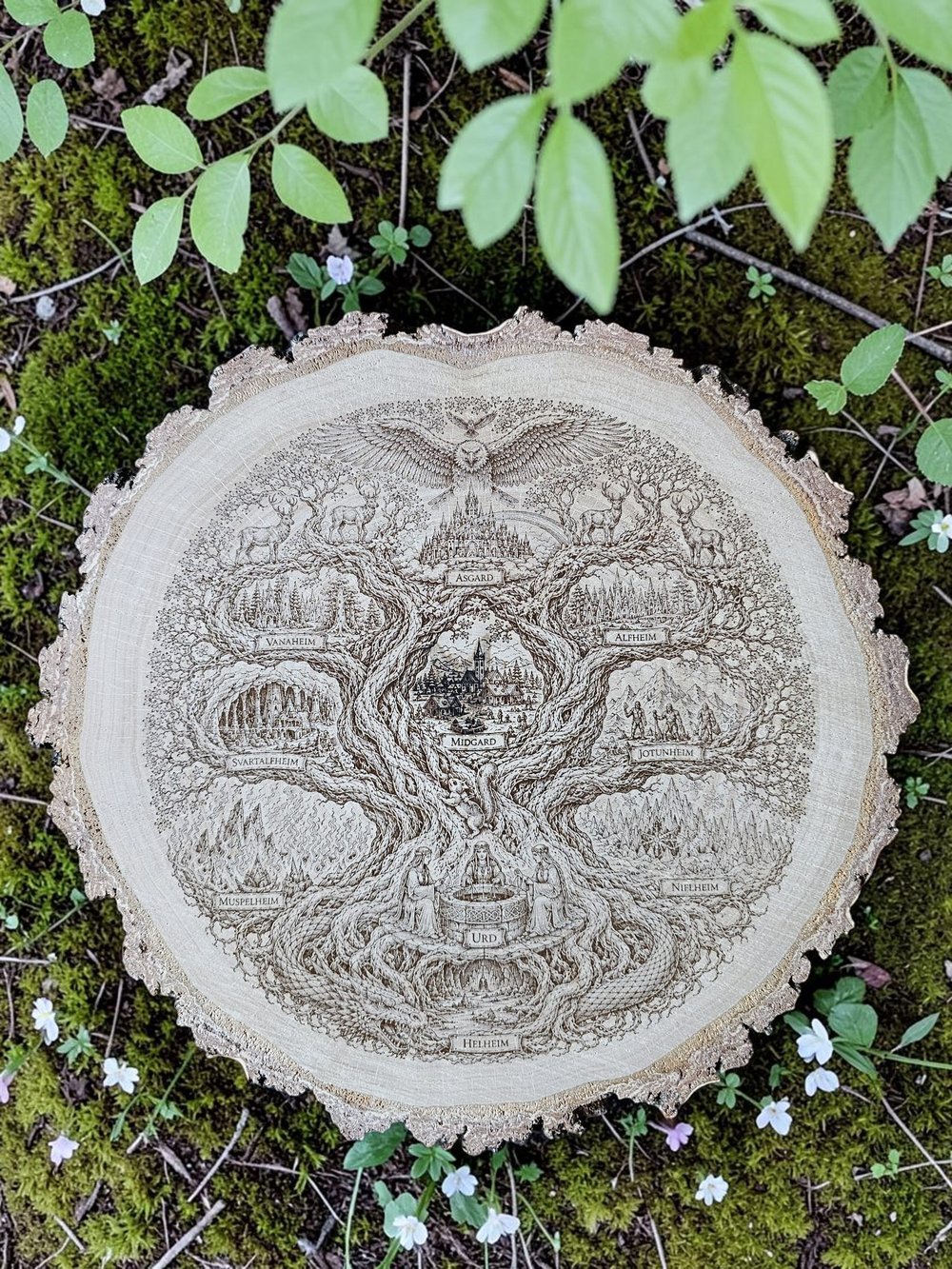
No image carries the old worldview so calmly as the tree. In the North, Yggdrasil, the world-ash, holds the nine worlds together; its roots reach to the wells of fate, its crown into the sky. The tree joins above and below, the living and the dead, the past and the coming. Whoever chooses a tree as a last place reaches – knowingly or not – for exactly this image: to pass into something that lives on.
In daily life, too, the tree stood close to people: the home-tree by the farm, the grove as a place of assembly and cult, the linden in the village. Trees were not scenery but counterparts.
Heathen thought knows no gaping hell as a threat. Death is a passage into another region of the great connection. By heathen conviction, all life – past and coming – stands in relation; in the cycle of nature nothing is truly separate. The ancestors therefore remain part of the community: one honours them, one remembers them, one knows oneself bound to them – and in the same responsibility toward those who come after us.
“Cattle die, kinsmen die, you yourself die as they; one thing I know that never dies: the fame of the dead man's deeds.” Hávamál 76/77 (after Bellows 1923, public domain)
These famous stanzas of the Hávamál are no defiance against death but a stance: nearly everything is transient – yet what a person was and did remains in the memory of their own. That is exactly the core of any worthy burial.
In practical terms: in Germany tree burial is permitted, but only on officially designated grounds – in burial forests (known for instance as FriedWald or RuheForst) or on corresponding cemetery areas. The ashes are laid at the root of a tree in a biodegradable urn. No headstone, no obligation of grave care – the tree itself is the marker.
Many families nonetheless wish to mark the place gently and to bring a name, a date, a word there. Where it is permitted, a simple, weatherproof memorial plaque of natural slate or wood can do exactly that: a quiet, lasting greeting by the tree. Only one thing matters to us here – that it suits the place and respects the setting of the grounds.
The world-tree Yggdrasil and the joining of the nine worlds are central and attested in the Edda and the Prose Edda; the Hávamál stanzas 76/77 on lasting renown are among the best known of Old Norse poetry. Heathen ancestor veneration and the idea of a continuance beyond death (in the burial mound and in memory) are likewise attested. Legally secured: tree burials are permitted in Germany on designated burial forests and cemetery grounds; the first such site was created in 2001.
One should not claim that “the Germanic peoples” regularly buried under trees – the actual burial customs were varied (cremation and inhumation, mounds, boat graves). Tree burial as a regulated form is a modern development of the 21st century. And our description of the heathen view of death is reconstructed from mostly late, partly Christian-tinged sources. The image of the tree as companion is therefore less a historical rite than a coherent, dignified interpretation – one that can be lived in peace and without false claims.
How do heathens celebrate today? · Yggdrasil – the world tree · What comes after Ragnarök · Seiðr – the magic · The Germanic feasts.
All Festivals & Belief articles →
Scarcely an image is so bound up with the Vikings as the burning ship drifting out to sea with the dead. The ship was …
Read more →They appear almost in passing in the old texts, yet they are everywhere: the disir, female spirits who watch over a …
Read more →Forget the translucent veil-ghost. The draugr of the Old Norse sagas comes back in the flesh – heavy as an ox, darkly …
Read more →In the sagas of the North, no one sleeps harmlessly. A dream there is rarely a mere echo of the day, but a messenger …
Read more →