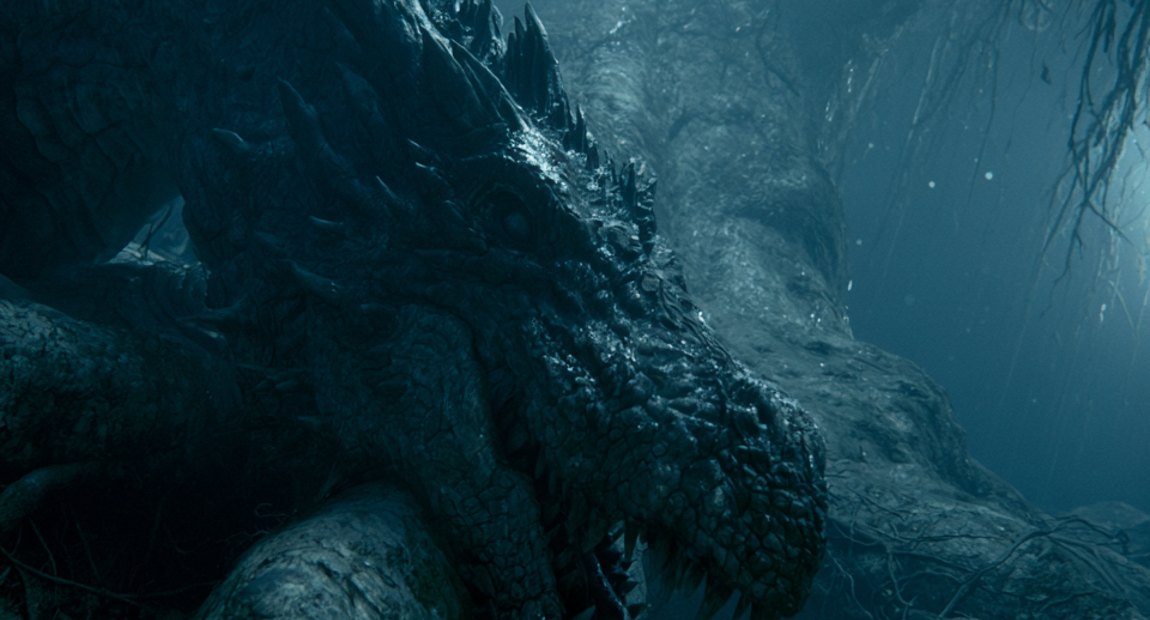
Nidhogg (Old Norse Níðhöggr) is the dragon or serpent that gnaws at one of the roots of the world tree Yggdrasil from below – so says the Poetic Edda poem Grímnismál, and Snorri Sturluson places him in the spring Hvergelmir. In Völuspá he sucks the corpses of oath-breakers and murderers on Náströnd, and in the poem's final stanza he flies over the plain with the dead in his feathers. Here is what the sources really say, what his name means and where scholars still disagree.
At the very top of the world tree sits an eagle who knows many things. At the very bottom, in the dark beneath the earth, lies something that does not know – it gnaws. In between, a squirrel scurries up and down the trunk, carrying spite from one end to the other. That is how the Old Norse sources picture the cosmos, and the creature at the bottom of the chain is called Níðhöggr. Not a god, not a giant, not a character with parents and a backstory. Just a name, a handful of stanzas and an image that refuses to fade: a dragon chewing at the roots of the world.
Because the sources say so little, Níðhöggr is easily inflated into a fire-breathing overlord or mixed up with Jörmungandr and Fáfnir. Let us untangle it: what the Poetic Edda says, what Snorri added in the thirteenth century, what the name means – and why scholars still ask whether this dragon carries a trace of the Christian hell.
Yggdrasil, the world ash, is the backbone of Norse cosmology; we explain its structure in our article on Yggdrasil. In Gylfaginning, the first part of Snorri Sturluson's Prose Edda (c. 1220), the ash has three roots. One reaches to the Æsir, one to the frost giants where Ginnungagap once yawned, and the third stands over Niflheim, the world of mist and cold. Beneath this third root lies the spring Hvergelmir, and there, Snorri says, Níðhöggr gnaws the root from below.
Hvergelmir – usually explained as "roaring cauldron" – is Snorri's source of many rivers. You can read more about it, and about the other two wells, in our article on the three wells beneath Yggdrasil, and about the cold underworld itself in our piece on Niflheim. For Níðhöggr, the crucial point is that he belongs to the lowest, darkest layer of the world.
He is not alone down there. Snorri says, in effect, that so many serpents share Hvergelmir with Níðhöggr that no tongue can count them. The Poetic Edda gives several of them names, as we will see.
The oldest detailed description of the tree is found in Grímnismál, a poem in which Odin, disguised as the tormented guest "Grímnir", pours out cosmic knowledge. It survives in the Codex Regius (c. 1270) and in the manuscript AM 748 I a 4to. Its exact age cannot be fixed, but its content is generally regarded as pre-Christian in outlook. For background on these manuscripts, see our article on the Edda.
Stanza 32 introduces the squirrel. Its name is Ratatoskr, and its job is to carry the eagle's words down from above and repeat them to Níðhöggr below. That is all the stanza says. Snorri turns it into a full-blown smear campaign: in his version Ratatoskr runs back and forth bearing words of envy between the eagle and Níðhöggr. The whole story of the little gossip is told in our article on Ratatoskr, and the bird in the crown gets its own piece on the eagle and the hawk Veðrfölnir.
Stanza 34 lists the serpents under the ash. There are more of them, it jeers, than any witless ape would imagine – and then comes the roll call: Góinn and Móinn, the sons of Grafvitnir, plus Grábakr ("Greyback"), Grafvǫlluðr, Ófnir and Sváfnir. All of them, the stanza says, will forever tear at the tree's twigs. Níðhöggr is not on this list. He gets a stanza of his own, number 35, and it may be the most powerful line ever written about him:
Askr Yggdrasils / drýgir erfiði / meira en menn viti: / hjörtr bítr ofan, / en á hliðu fúnar, / skerðir Niðhöggr neðan.
"The ash Yggdrasil endures more hardship than men know: the hart bites from above, its side is rotting, and Níðhöggr tears at it from below."Grímnismál 35, Old Norse after the Codex Regius tradition, our own translation
This stanza is the key. The world tree is no indestructible idyll; it is a suffering organism, attacked from every side: from above by harts (stanza 33 names four of them – see our article on the four stags of Yggdrasil), at the side by rot, from below by Níðhöggr. Seen this way, Níðhöggr is not the great enemy of the gods but one part of a picture of slow decay. The world holds – but it holds in pain.
The verb matters too. Skerða means something like "to notch, to damage, to diminish". Níðhöggr does not nibble politely like a beaver; he hacks gashes into the tree. The serpents of stanza 34 and the dragon of stanza 35 form an entire ecosystem of destruction, which we explore further in our article on the serpents at Yggdrasil's roots.
"Níðhöggr" is a compound. The second half is clear: -hǫggr belongs to the verb hǫggva, "to hew, to strike", and means "hewer" or "striker" – in practice probably "biter". The first half is trickier. Medieval scribes did not mark vowel length consistently, so two readings compete.
The most widespread takes the first element as níð with a long i. That is a core term of Old Norse law and honour culture: níð means slander, scorn, honour-destroying insult, often with a sexual edge. Such defamation was explicitly punishable in the medieval Icelandic law codes, and a níðingr was a man without honour, worse than a mere enemy. The infamous níðstǫng, the "scorn pole" used in the sagas to curse an opponent publicly, belongs to the same word family. Read as "the malice-striker" or "the one who strikes in spite", Níðhöggr becomes a creature of dishonour – and it is hard not to connect that with Völuspá, where he torments precisely the dishonourable.
The second reading is nið- with a short i, related to niðr, "down, below". He would then simply be "the one who strikes from below" – which fits his place at the root and the word neðan ("from below") in Grímnismál 35. Some scholars also point to the Niðafjǫll, the "Nida Fells" from which the dragon rises in the last stanza of Völuspá. That name, however, is unexplained itself; a meaning like "dark mountains" is speculation.
Our verdict: "shame/malice" is the most common reading and fits the content well, but it is not certain. The anglicised spellings "Nidhogg" and "Nithhogg" are simplifications; the Old Norse form is Níðhǫggr (or Niðhǫggr), with ǫ written as ö in modern Icelandic.
Völuspá, "the prophecy of the seeress", is the great cosmic poem of the Edda: a völva (seeress) tells Odin about the creation of the world, its decline and its renewal. It survives in the Codex Regius and, with a different stanza order, in Hauksbók (early fourteenth century), and Snorri quotes much of it. You can also read the poem in full on our site. Most scholars date its composition to around the year 1000 – the very period when Iceland was converting to Christianity. That will matter for Níðhöggr.
In stanza 38 the seeress sees a hall standing "far from the sun" on Náströnd, the "shore of corpses". Its doors face north, venom drips in through the smoke-holes, and its walls are woven from the spines of serpents. Stanza 39 tells us who ends up there: people wading through heavy streams – oath-breakers, murderous outlaws and the man who seduces another man's beloved. And then:
þar saug Niðhǫggr / nái framgengna, / sleit vargr vera.
"There Níðhöggr sucked the corpses of the dead; a wolf tore the men apart."Völuspá 39, our own translation
This is a very different Níðhöggr from the one in Grímnismál. There he was a pest on the tree; here he is an executioner of the dead. He "sucks" the corpses – the verb sjúga is the ancestor of English "suck". Whether he drains blood, marrow or something nameless, the text does not say; it stays deliberately dark. The wolf who "tears the men" is not named.
Look at who is punished. Not cowards, not people who died the "wrong" death, but oath-breakers, murderers and adulterers. These are crimes that destroy community – breaches of loyalty, of peace, of trust. And here the name comes back into play: whoever takes níð upon himself is devoured by Níðhöggr. Whether the poet intended the wordplay we cannot know.
Snorri Sturluson wrote his Prose Edda around 1220 as a handbook for poets, and he was a born systematiser. Where the poems place images side by side, Snorri builds a structure. With Níðhöggr he does three things.
First, he locates him precisely: under the Niflheim root, in Hvergelmir. Grímnismál only said "from below". Second, he links him with the squirrel into an axis of quarrel between crown and root, quoting the Grímnismál stanzas on the serpents and the suffering ash – so we can see that he knew those stanzas directly. Third, and most interestingly, he moves the Náströnd scene to the time after Ragnarök.
In Snorri's account, the figure Hárr ("High One") lists the dwellings that will exist after the end of the world. There are good places – Gimlé, the hall Brimir and the golden hall Sindri on the Niðafjǫll – and bad ones. On Náströnd stands the hall of serpent bodies where venom flows and oath-breakers and murderers wade through poisonous rivers. But worst of all, Snorri says in effect, is Hvergelmir: there Níðhöggr torments the bodies of the dead. He quotes Völuspá stanzas to back this up.
With that, Snorri has created a kind of Last Judgement: reward for the good, punishment for the wicked, a place of everlasting torment. Whether Völuspá meant it that way is disputed. In the poem itself the Náströnd stanzas come not after but before the description of the world's end, and their place in time is unclear. Snorri, in other words, probably tidied up what the poem left open. For what follows the end of the world, see our article What comes after Ragnarök?
And then comes perhaps the most puzzling stanza in the entire Edda. Völuspá has just described the end of the world – the battle of the gods, the fire of Surtr, the earth sinking into the sea. Afterwards a new, green earth rises; fields bear crops unsown, Baldr returns, the gods find golden game pieces in the grass. A hall stands, fairer than the sun, where faithful hosts will enjoy happiness forever. A happy ending, it seems. And then:
Þar kemr inn dimmi / dreki fljúgandi, / naðr fránn, neðan / frá Niðafjǫllum; / berr sér í fjǫðrum / – flýgr vǫll yfir – / Niðhǫggr nái. / Nú mun hon søkkvask.
"There comes the dark dragon flying, the gleaming adder, up from below, from the Niðafjöll; he carries in his feathers – he flies over the plain – Níðhöggr, corpses. Now she will sink."Völuspá 66 (final stanza), our own translation
Several words for dragon-like beings appear at once: dreki (a loanword ultimately from Latin draco), naðr (adder, serpent) and Níðhöggr's own name. And he has feathers – a winged dragon. Grímnismál said nothing about wings.
What does the stanza mean? Scholars have argued about it for more than a century without agreement. The main positions:
The final half-line is the crux of the debate. The manuscripts read Nú mun hon søkkvask – "now she will sink". "She" (hon) is feminine, but Níðhöggr is grammatically masculine. The obvious reading is that the seeress herself is meant: her vision complete, she sinks back into the earth from which Odin summoned her, or into the state from which she was roused. Many scholars today prefer this interpretation.
Some editors, however, have emended the text to hann ("he"), so that the dragon sinks – giving the ending a comforting note: evil goes under, the new world is safe. But that is an intervention in the manuscript tradition, and such interventions need good reasons. Ursula Dronke discussed the passage in detail in her annotated edition (1997), and the debate is still alive.
When a poem composed around the year 1000 describes a place of punishment for oath-breakers and adulterers, where a dragon torments the dead, an obvious question arises: how much of this is Norse, and how much Christian? Scholars ask it seriously, and there is no blanket answer.
Several things point to Christian influence. The idea of an otherworldly place of punishment based on moral criteria fits poorly with what we otherwise know of pre-Christian beliefs about the afterlife in the North. In the older sources Hel is a realm of the dead for many, not a place of retribution. Medieval Christian vision literature, by contrast, is full of hells with serpents, poisonous rivers and dragons tormenting sinners. The word dreki and the image of the winged dragon also point to the European, ultimately Latin tradition, in which the dragon often stands for the devil. And Snorri's sorting of good and bad after the world's end looks very much like a Christian Last Judgement in Norse dress.
There are also strong arguments on the other side. The sins of Náströnd – oath-breaking, murder, seduction – are not specifically Christian sins but exactly the offences that Old Norse law and honour culture condemned most harshly. Serpents at the roots of the world tree appear in Grímnismál, which is generally regarded as pagan in outlook. And Níðhöggr's name is thoroughly Old Norse and tied to the legal concept of níð.
The most careful answer is this: Völuspá is a poem from a time of transition. A poet may well have combined native images – the serpents under the tree, the "malice-striker" – with ideas he knew from Christian preaching and art. Snorri, an educated Christian of the thirteenth century, then systematised the whole thing further in the direction of the Last Judgement. Exactly where the line runs remains open.
On forums, in games and on T-shirts the great serpents of the North are often confused. In the sources, however, their roles are clearly distinct. For an overview of all dragons and serpents, see our article Dragons and serpents in the Norse world; here is the short version for the three best known.
Níðhöggr is a cosmological being. He has no parents, no siblings, no backstory. He lies at the root of the world tree, torments the dead on Náströnd or in Hvergelmir, and appears at the end of Völuspá as a flying dragon. He fights no god and is slain by no hero.
Jörmungandr, the Midgard Serpent, is a child of Loki and the giantess Angrboða. Odin cast it into the sea, where it grew so large that it encircles the whole world of humans and bites its own tail. It is Thor's great adversary: on the fishing trip with Hymir and at Ragnarök, where the two kill each other. It lives in the ocean, not at the root of the tree, and it has a family – Loki is its father, Fenrir and Hel are its siblings.
Fáfnir, finally, belongs not to the myths of the gods but to heroic legend. Originally a son of Hreiðmarr, he killed his father for a hoard of gold and became a serpent (ormr) lying on the treasure. Sigurd slew him, as Fáfnismál and the Völsunga saga relate; more in our article on Sigurd and the Völsungs. Fáfnir is the classic hoard dragon – a transformed man destroyed by his own greed.
No rune stone or carving from the Viking Age can be shown with certainty to depict Níðhöggr. Serpents and serpent-like beasts are everywhere in the art of the period, though – from the Urnes style to the rune serpents in whose bodies the inscriptions run on Swedish stones. The famous Urnes portal in Norway shows an interlace of serpents and a four-legged animal. Whether it represents Yggdrasil with the hart and Níðhöggr, or a Christian image of the struggle between good and evil, is a matter of interpretation and disputed.
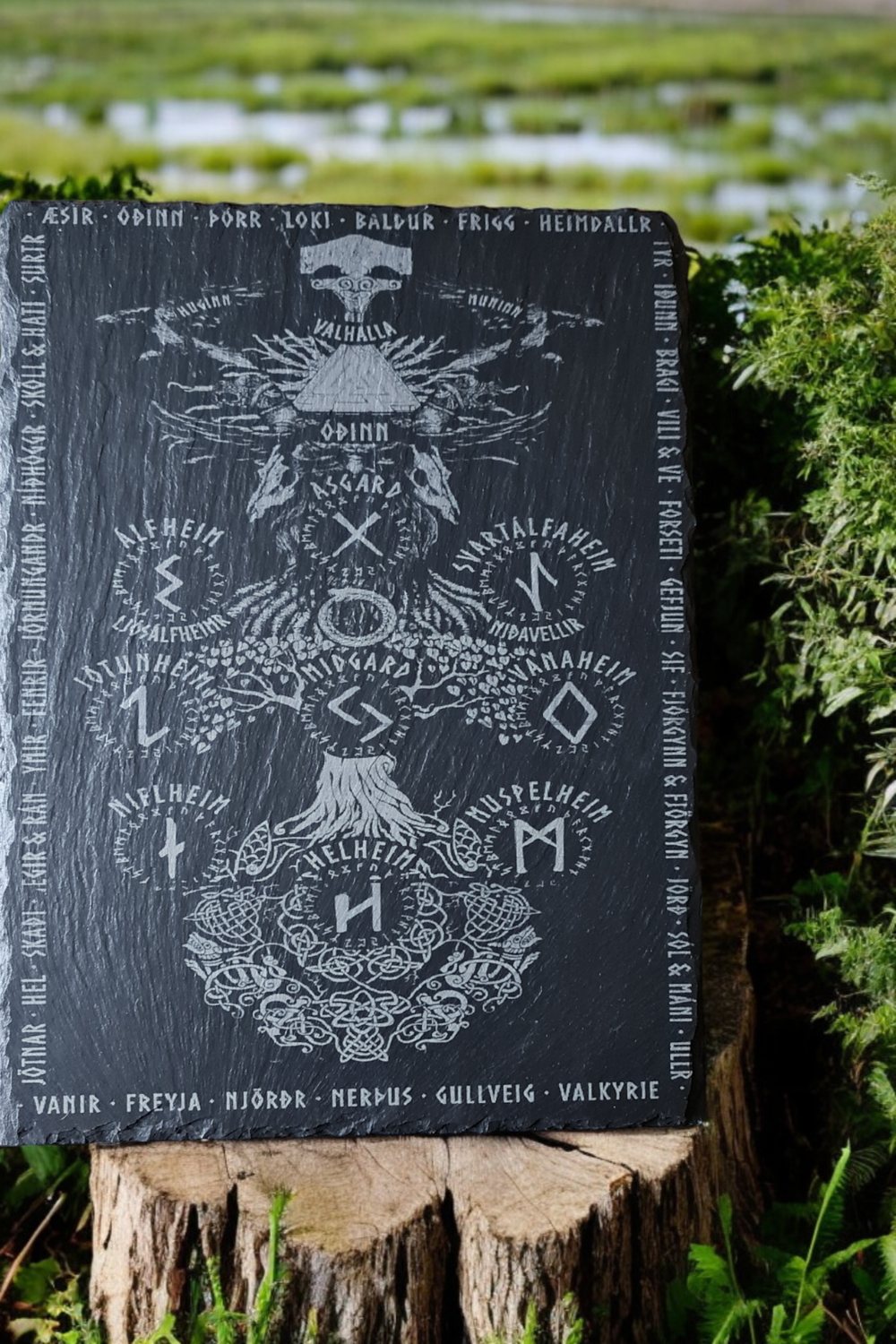
In our workshop, Níðhöggr is a rewarding motif precisely because the sources prescribe so little. We stick to what the stanzas support: a coiling serpent form at the roots of a tree, ideally in the interlace of Norse animal styles, on dark slate that brings the sense of "below" almost by itself.
In modern culture Níðhöggr has become a star: the indie game "Nidhogg" (2014) made the name a byword for a merciless fencing duel, and in video games, manga and role-playing games he is a popular final boss. Most of that shares nothing with the Edda but the name – which is proof in itself of how much force that name still carries after a thousand years.
What is Nidhogg in Norse mythology? Níðhöggr is a dragon or serpent that, according to the Edda, gnaws from below at one of the roots of the world tree Yggdrasil. In Völuspá he also sucks the corpses of oath-breakers and murderers on Náströnd.
What does the name Nidhogg mean? The second element means "hewer, striker". The first is usually taken as níð ("scorn, shame"), giving "malice-striker"; another possibility is nið- "below", giving "the one who strikes from beneath".
Where does Nidhogg live? According to Snorri, in the spring Hvergelmir beneath the root of Yggdrasil that stands over Niflheim. Völuspá links him with Náströnd, the "shore of corpses", and with the Niðafjöll.
What is the connection between Ratatoskr and Nidhogg? According to Grímnismál, the squirrel Ratatoskr carries the words of the eagle in the treetop down to Níðhöggr; Snorri turns this into a back-and-forth of envious words between the two.
Is Nidhogg the same as the Midgard Serpent? No. Jörmungandr is Loki's child, lives in the world ocean and fights Thor at Ragnarök. Níðhöggr lies at the root of the world tree and, in the sources, has neither family nor opponent.
Does Nidhogg survive Ragnarök? The final stanza of Völuspá shows him flying over the new earth after the end of the world. Whether he then sinks, or the seeress does, is disputed – the manuscripts read "she", which points rather to the seeress.
For courage. For remembrance. For legends that live on.
Yggdrasil – the world tree · Ratatoskr – the squirrel · The nine worlds · What comes after Ragnarök · Fenrir – the wolf.
All Beings & Creatures articles →
Between crown and root of the World Ash Yggdrasil scurries a small, restless creature: Ratatoskr, the squirrel. It …
Read more →Without the giants there would be no Norse world – in the most literal sense. Out of a giant it arose, against the …
Read more →In Valhalla an eternal feast holds sway – provided by a single animal that never runs out: the boar Sæhrimnir.
Read more →Two wolves race across the firmament – one after the sun, the other after the moon. It is the oldest chase in the …
Read more →