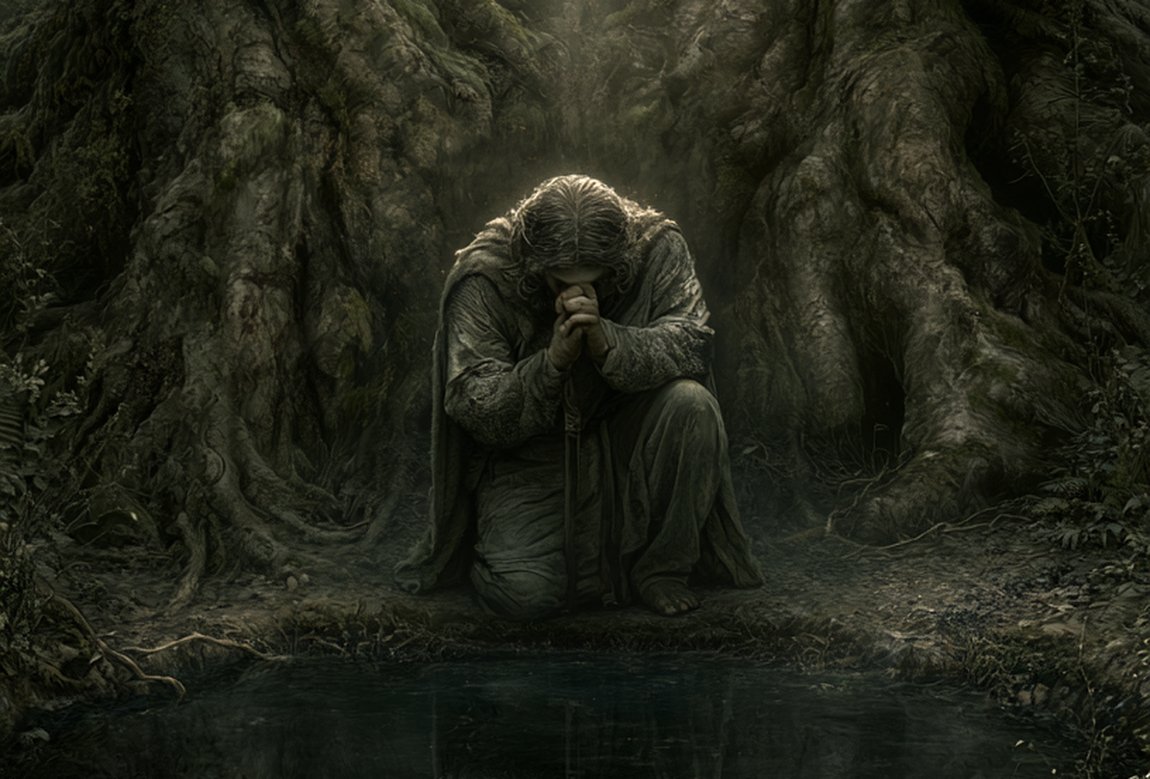
According to Snorri Sturluson, three wells lie beneath the three roots of the world tree Yggdrasil: Urd's well among the Æsir, where the Norns water the tree and the gods sit in judgement; Mimir's well among the frost giants, where Odin paid an eye for wisdom; and Hvergelmir in Niflheim, the roaring cauldron from which every river flows. That tidy picture, though, exists only in Snorri. The older poems tell it differently, and that is where the story gets interesting.
Search for "the three wells of Yggdrasil" and nearly every answer leads back to a single text: Gylfaginning, the first part of the Prose Edda, written around 1220–1230 by the Icelandic scholar and chieftain Snorri Sturluson. In chapters 15 and 16 (numbered as in Anthony Faulkes's edition), a figure called "High" describes the world ash to the disguised King Gylfi. Its branches spread over every world and reach above the sky; three roots, stretching far apart, hold it up.
Snorri's arrangement is crystal clear. One root lies among the Æsir, the second among the frost giants, "where Ginnungagap once was" – the yawning void before creation – and the third over Niflheim, the cold world of mist. Beneath each root lies a well. Under the giants' root is the well of Mimir; under the Niflheim root is Hvergelmir, where the dragon Nidhogg gnaws the root from below; and under the root of the Æsir – which, confusingly, Snorri says stands "in heaven" – lies Urd's well, holiest of the three.
It is a lovely, symmetrical picture, and it shapes books, games and tattoo designs to this day. But it comes from a Christian scholar writing some two centuries after Iceland's conversion, who built a systematic handbook out of older poems and smoothed over their gaps and contradictions as he went. Nowhere is that clearer than with the three wells.
The Old Norse name is Urðarbrunnr, "the well of Urd". Urd (Urðr) is the first of the three Norns, the women of fate, and her name is built on the verb verða, "to become": Urd is that which has come to be. At this well, Snorri says, the gods have their place of judgement. Every day they ride there over Bifröst, the bridge of the Æsir. Only Thor goes on foot, wading through the rivers Körmt and Örmt and the two Kerlaugar. Snorri takes this almost word for word from Grímnismál 29, where Thor must wade because the bridge of the gods burns all aflame. Why that applies to Thor in particular, the poem does not say; the popular explanation that he is simply too heavy is a modern embellishment.
A fair hall stands by the well, and from it come three maidens: Urd, Verdandi and Skuld. Every day they draw water from the well, together with the clay that lies around it, and sprinkle the ash with it so that its limbs will not wither or rot. The water is so holy that whatever falls into it becomes as white as the thin membrane inside an eggshell. Two birds are fed on the well, and they are called swans; every swan in the world descends from them. And the dew that falls from the tree to the earth is called hunangsfall, honeydew – the bees feed on it.
It sounds like a fairy tale, but there is real observation in it. Bees do collect "honeydew", the sugary excretions of aphids on leaves and needles, which becomes dark forest honey. Whether Snorri had this in mind, we cannot know – but anyone who has parked under a lime tree in July and returned to a sticky windscreen will get the connection.
Snorri's authority here is stanza 19 of the Völuspá, the great poem of the seeress. Henry Adams Bellows rendered its opening and closing lines like this:
An ash I know, Yggdrasil its name,
[…]
Green by Urth's well does it ever grow.Völuspá 19, translated by Henry Adams Bellows (1923, public domain)
The middle lines say, in our own rendering, that the high tree is "drenched with white aurr" and that from it comes the dew that falls into the valleys. Aurr means wet earth, mud, gravel. Pouring mud over a sacred tree seems odd. Some commentators think of mineral-rich spring water, others of healing, the way a gardener seals a tree wound with clay – interpretations, not findings.
The Hávamál, the "Sayings of the High One", know the place too. Stanza 111 opens a new section by declaring that it is time to speak "from the speaker's chair, at Urd's well". The well is a setting for solemn, authoritative speech – which fits Snorri's court of the gods. Nobody makes small talk at Urd's well.
Urd is no Icelandic oddity. Old English wyrd and Old Saxon wurd come from the same root, and Old High German has wurt. The most famous example on the continent is the Hildebrandslied, written down in the ninth century at the monastery of Fulda. When old Hildebrand realises he must fight his own son, he cries out: welaga nu, waltant got, wewurt skihit – "alas now, ruling God, woeful fate is happening".
In English the word took a road of its own. The witches in Shakespeare's Macbeth are the "weird sisters" – the sisters of fate. It was through these stage figures that the adjective weird acquired, from the nineteenth century onwards, its everyday sense of "strange, uncanny". So whenever you call something weird, you are quietly quoting the lady of the well.
A sober look at the number three is also worthwhile. In the poems only Urd is firmly rooted. Verdandi ("becoming") appears in the entire Poetic Edda only in Völuspá 20, and Skuld ("what shall be", related to "shall" and "debt") also rides in the same poem as a valkyrie with a shield. Past, present and future is a late reading of the names, not a statement of the sources. And according to Fáfnismál 12–13 there are many Norns of different descent – some from the Æsir, some from the elves, some daughters of the dwarf Dvalin – who come to women's aid in childbirth.
Beneath the root among the frost giants lies Mímisbrunnr, Mimir's well. In it, says Snorri, wisdom and understanding are hidden. Its keeper is Mimir, who is full of wisdom because he drinks from the well every day, using the Gjallarhorn as his cup. Then comes the famous line, in Brodeur's 1916 translation: Allfather asked for a drink from the well but "got it not until he had laid his eye in pledge". We tell the whole story in Odin's eye at Mimir's well; here the focus is on the sources.
Snorri leans on the Völuspá, where the seeress answers "the Old One" who has come to question her:
I know it all, Odin, where you hid your eye:
in the far-famed well of Mimir.
Mead drinks Mimir every morning
from the Slain-father's pledge. Would you know more?Völuspá 28 (numbering of Neckel/Kuhn; 28–29 in Bellows), our own rendering
Two things stand out. First, the Völuspá never says what Odin bought with his eye. That it was a single draught of wisdom is Snorri's explanation – plausible, but his. Second, Mimir drinks mead "from the pledge", as if the eye itself were the cup, or the spring from which something flows. The preceding stanza (Völuspá 27) makes the image darker still: the seeress knows that "Heimdall's hljóð" is hidden beneath the holy tree, and over it pours a muddy torrent "from the Slain-father's pledge".
What is this hljóð? The word can mean "sound", which points to Heimdall's Gjallarhorn, the horn he will blow at the end of the world. But it can also mean "hearing". In that case Heimdall, who according to Snorri can hear grass grow, would have pledged his ear at the same well where Odin pledged his eye – a sense organ traded for superhuman perception. Scholars take this reading seriously, but it cannot be proven. Snorri seems to have merged both ideas: in his version, Mimir drinks from the Gjallarhorn.
The name Mimir is usually linked to the same Indo-European root as Latin memor, "mindful", and English memory – "the one who remembers". That etymology is well grounded, though not undisputed. It would certainly fit: wisdom in the North is above all memory.
Here things get contradictory – within Snorri's own work. In Gylfaginning, Mimir is alive, guarding his well and drinking from it. At Ragnarök, the same text says later, Odin rides to Mimir's well to seek counsel for himself and his host. In the Ynglinga saga, however, the opening of Snorri's history of the kings, Heimskringla, Mimir is dead – beheaded.
The story is in chapter 4. After the war between the Æsir and the Vanir, the gods exchange hostages. The Æsir send the handsome Hœnir and the wise Mimir to the Vanir. Hœnir is made a chieftain, but without Mimir he has no answers and only says: "Let others decide." The Vanir feel cheated, cut off Mimir's head and send it back to the Æsir. Odin takes the head, smears it with herbs so that it will not rot, and sings spells over it. From then on the head speaks to him and tells him many hidden things. Chapter 7 repeats that Odin kept Mimir's head with him, and it brought him news from other worlds.
The poems know the head as well. In the Völuspá (st. 46 in Neckel's numbering), as Ragnarök breaks loose, Odin "speaks with Mim's head". And in Sigrdrífumál, a lesson in runes given by the valkyrie Sigrdrifa to the hero Sigurd, there is a mysterious scene: someone stands on a cliff with sword and helmet, and "then Mim's head spoke the first wise word and told true signs" (st. 14, our own rendering). The context is the origin of the runes – Mimir's head as a source of rune-lore.
How does all this fit together? Not neatly. Most likely several Mimir stories ran side by side – the wise one by the water, the oracular head, the counsel at the end of the world – and Snorri used them in different places without harmonising them. There is more: Hoddmímis holt, the wood in which, according to Vafþrúðnismál 45, two humans survive Ragnarök, and Mímameiðr, "Mimir's tree", in the late poem Fjölsvinnsmál. That both mean Yggdrasil is a popular interpretation, not something the sources say. For the figure himself, see our portrait Mimir – the head that keeps advising.
The name Hvergelmir is probably made of hverr, "cauldron, hot or bubbling spring", and a word for roaring or bellowing: the roaring cauldron.
In Snorri, Hvergelmir lies in the middle of Niflheim – and it exists before the world is made. Gylfaginning 4 says that in Niflheim there is a well called Hvergelmir, from which flow the rivers Svöl, Gunnthra, Fjörm, Fimbulthul, Slid, Hrid, Sylg, Ylg, Vid and Leiptr, and Gjöll, which runs close to the gates of the realm of the dead. Snorri calls these streams the Élivágar, "storm waves" or "ice waves" (Brodeur simply writes "ice-waves"). Their venom froze into ice in Ginnungagap, and where the rime met warm air from the south, the primeval giant Ymir came into being. In Snorri's scheme, then, Hvergelmir is the source of all waters and, indirectly, the starting point of creation. In chapter 16 he adds that so many serpents live in Hvergelmir alongside Nidhogg that no tongue can count them.
The Poetic Edda mentions Hvergelmir exactly once, in Grímnismál 26 – and places it somewhere quite different:
Eikthyrnir is the hart that stands on the Host-father's hall
and feeds on Lærad's branches;
from his antlers it drips into Hvergelmir,
and from there all waters find their way.Grímnismál 26, our own rendering
The hart Eikthyrnir ("oak-thorn", probably for his branching antlers) stands on the roof of Valhalla. The water runs downwards, from the gods' tree over the antlers into the cauldron, and from there out into the world. Stanzas 27 and 28 then list a whole catalogue of rivers, nearly forty names. Some flow among the gods, others among humans, and in the end they "fall down to Hel". Right in the middle of the list is a surprise for us here near the Rhine: Rín, the same name the heroic poems use for the Rhine. Whether the poet meant the real river is an open question; Bellows thought the match was accidental.
Put the poem and Snorri side by side and a cycle emerges: leaves feed the hart, water drips from his antlers into the cauldron, the rivers stream out through the worlds and fall back into the depths. Whether the old poets thought of it that systematically, we do not know. But for people whose lives depended on weather and water, seeing dew, rain, springs and rivers as one movement came naturally.
Now to the crux that many retellings skip. Grímnismál 31 also speaks of three roots, but distributes them differently:
Three roots stand in three directions
beneath the ash Yggdrasil:
Hel dwells under one, under the second the frost giants,
under the third, humankind.Grímnismál 31, our own rendering
On the frost giants, poem and Snorri agree. Otherwise they do not. The poem has one root over the dead and one over the living; Snorri has one over Niflheim and one among the Æsir "in heaven". The stanza does not mention wells at all. The rule "one well per root" is Snorri's own construction.
There are further points of friction:
None of this is a reason to look down on Snorri: he often quotes his sources so faithfully that we can read them against him. For the three wells, that means the individual images are old, while the system is a learned order of the thirteenth century.
From here on we leave the firm ground of the sources and step into interpretation. The most common reading is so neat it almost seems obvious: Urd's well stands for fate and law, Mimir's well for wisdom and memory, Hvergelmir for origin – and for the end, since all waters come from it and fall back into the deep. This scheme is a modern interpretation, but a well-founded one: it follows the names and actions the sources attach to each well.
A second, more speculative idea goes further: perhaps there was originally just one sacred spring at the world tree, where fate, knowledge and the water of life were one. In its favour, the functions overlap – wisdom is proclaimed at Urd's well (Hávamál 111), Mimir's well also lies "beneath the holy tree", and Adam of Bremen saw one tree beside one spring at Uppsala. Against it stand the very different names and stories. Stimulating, but unprovable.
One more thing stands out. At the well Odin gives his eye; on the trunk above, according to Hávamál 138, he hangs for nine nights, "myself given to myself", to win the runes. Here, knowledge only comes at the price of loss. That is our reading, but it stays close to what the stanzas say.
Are the three wells pure poetry? Not quite. Finds and written sources – mostly by Christian authors – show that springs and wells were sacred places in the Germanic and Norse world. For the bigger picture, read our article on sacred springs and the well cult of the North. Here are the key stations.
Bad Pyrmont, the Brodelbrunnen ("bubbling well"). In 1863 the mineral springs of Pyrmont in today's Lower Saxony were newly enclosed. Some four metres down, workers hit older spring structures, and in the mud of the so-called Brodelbrunnen they found one of the most important spring deposits in Central Europe: roughly 250 to 300 brooches (fibulae), depending on how they are counted, along with Roman coins and an enamelled ladle. Most of the brooches came from Germanic workshops, a smaller share from the Roman provinces, and they span several centuries of the Roman Iron Age. The finds were soon scattered across many collections; only in 1999 did Wolf-Rüdiger Teegen study them thoroughly and interpret them as a spring offering. No object tells us which deity received them. What is certain: for generations, people gave valuable things to a bubbling spring.
Trelleborg on Zealand. Beneath and beside the famous ring fortress that Harald Bluetooth had built around 980/981 lay older well-like pits. The National Museum of Denmark describes five wells, each about three metres deep, containing human and animal bones, jewellery and tools. A study in the Danish Journal of Archaeology (2014) examined three of them in detail: two held the skeletons of four children, local according to isotope analysis, along with a young billy goat, parts of a horse and a cow, and a large dog. The researchers interpret these as offerings for fertility and well-being. None of this is directly about Mimir – but it shows how seriously wells were taken.
Uppsala. Around 1075 the Bremen cleric Adam of Bremen described the temple at Uppsala. A marginal note (scholion 138 in Schmeidler's edition) says that near the temple stands a huge tree with wide-spreading branches, always green in winter and summer, of a kind nobody knows. There is also a spring where the pagans make sacrifices and submerge a living man; if he is not found again, the people's wish will be granted. Adam never visited Uppsala and wrote from reports. Even so, the parallel with Völuspá 19 is striking: an evergreen tree above a holy spring.
More witnesses. In his Life of the missionary Willibrord (ch. 10), Alcuin tells of an island of the god Fosite between the Frisians and the Danes, where water could be drawn from the spring only in silence; to the locals' outrage, Willibrord baptised three people in it. And the Indiculus superstitionum, a Frankish list of pagan practices from the eighth century, has an entry of its own, De fontibus sacrificiorum – "on sacrifices at springs". Nobody writes a rule against something no one does.
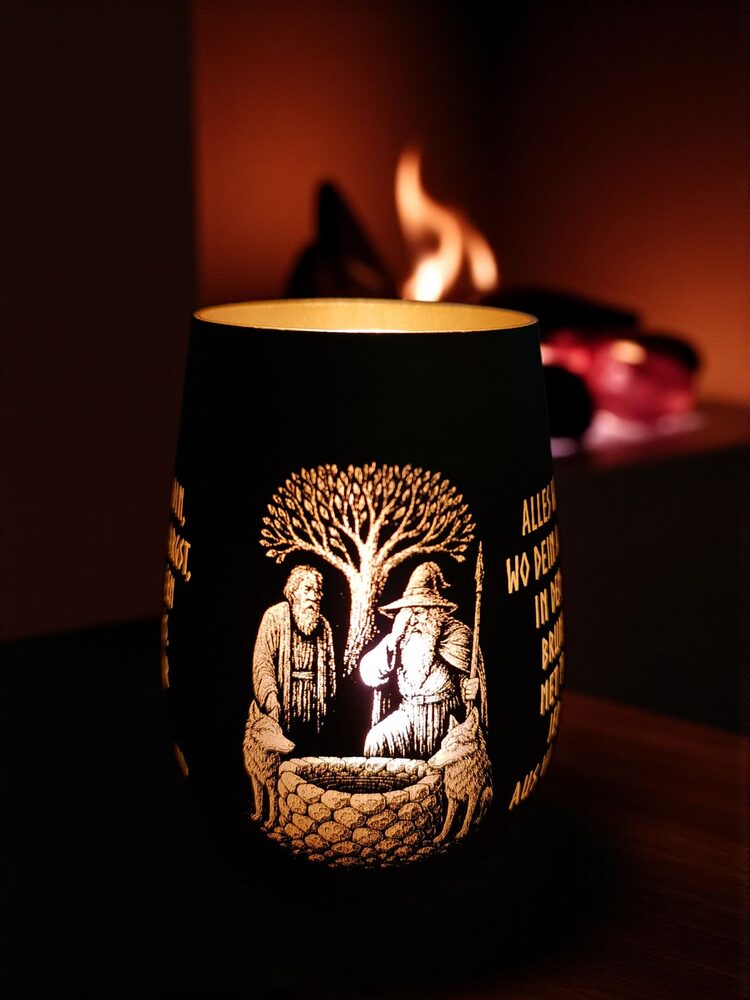
In our workshop in Alsdorf, near Aachen, the three wells are a motif with real depth. On dark slate the classic image works best: the ash at the top, three roots reaching down, a round well beneath each. Engraved slate turns pale, so the design appears as light lines on black – rather like Snorri's water that turns everything white.
If you prefer it closer to the sources, have the wells labelled – Urðarbrunnr, Mímisbrunnr, Hvergelmir – in runes or in Latin letters. On glass, Mimir's well glows in candlelight. And for a family, Urd's well with the children's names along the roots makes a fine image of where you come from – not an oracle, but a reminder of roots. We are happy to create designs like these as a custom engraving.
What are the three wells of Yggdrasil called? Urðarbrunnr (Urd's well), Mímisbrunnr (Mimir's well) and Hvergelmir. Only Snorri Sturluson describes them as a set of three, in Gylfaginning chapters 15–16.
What is Urd's well in Norse mythology? The holiest well beneath the world tree. The gods hold court there every day, and the Norns sprinkle the ash with water and white clay so that it does not wither.
Why did Odin give his eye to Mimir's well? According to Snorri, for a drink from the well in which wisdom and understanding are hidden. The Völuspá mentions only the pledge, not the reason.
Where is Hvergelmir? In Snorri, in Niflheim beneath the third root, where Nidhogg gnaws. In Grímnismál 26 it is fed by drops from the antlers of the hart Eikthyrnir on Valhalla's roof, and all rivers spring from it.
Did the Germanic peoples and Vikings have real sacred wells? Yes. The spring deposit from the Brodelbrunnen at Bad Pyrmont, the sacrificial wells at Trelleborg and Adam of Bremen's account of Uppsala all attest well offerings – though none can be matched to one of the three mythical wells.
For courage. For remembrance. For legends that live on.
Almost everything we know about the Norse gods we owe to two books from medieval Iceland. A look at the sources – and …
Read more →He was warrior and poet, killer and grave-robber, farmer and man skilled in magic – and probably the greatest skald of …
Read more →They are the chosen of the fallen: warriors who died in battle and were carried by the Valkyries to Valhalla. The …
Read more →His byname sounds like a reproach: Eyvindr skáldaspillir, „the plagiarist“ (or „spoiler of poets"). It probably means …
Read more →