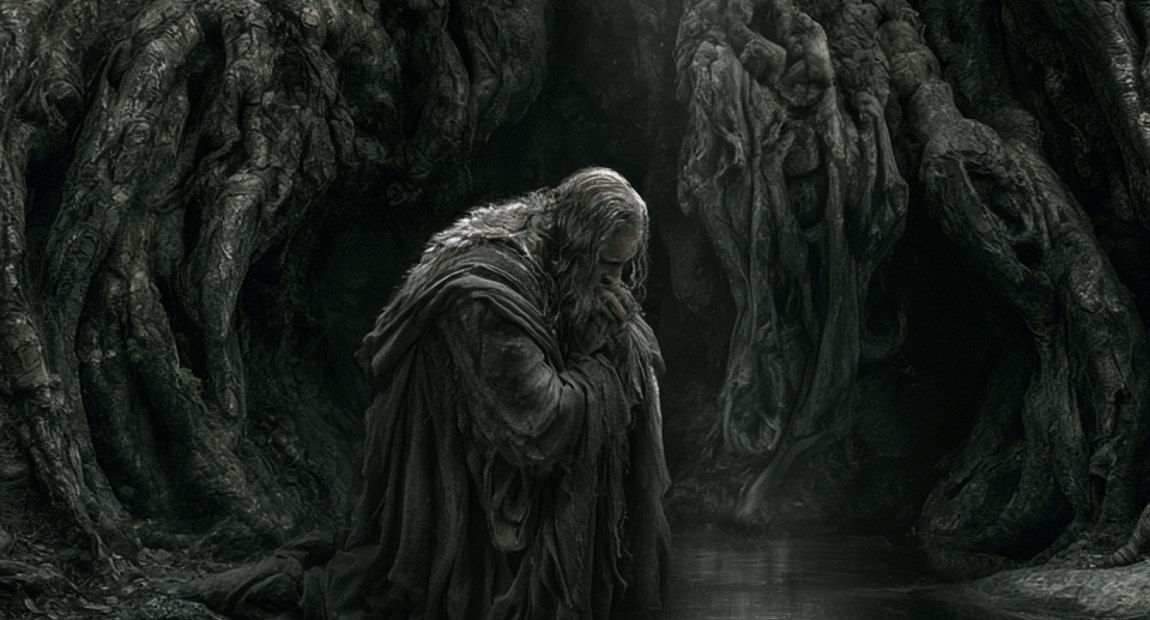
Mímir is the embodiment of wisdom in Norse mythology: the guardian of the well beneath the World Tree for which Odin gave up an eye, and also the severed head that Odin smeared with herbs against decay and made to speak again through spells. Both images come from texts of the thirteenth century that preserve older tradition – and they do not fit together neatly. Here you can follow the sources stanza by stanza, learn where his name may come from, and see exactly where evidence ends and interpretation begins.
Picture it. The sky is burning, the World Tree is shaking, somewhere Heimdall is blowing his horn. And in that moment the mightiest of the gods – lord of the slain, bearer of the spear – bends down over a severed head and asks it for advice. Not his ravens. Not his seeresses. Not his sons. A dead man's head.
That scene does not come from a fantasy novel. It comes from the Völuspá, the most famous poem of the Poetic Edda. It shows how the North saw knowledge: precious, dangerous and stronger than death. If you spend any time with Odin, you run into him sooner or later, because according to the sources a good share of Odin's wisdom came from Mímir's mouth or Mímir's water.
In this article we keep things cleanly apart: what the Eddic poems say, what Snorri Sturluson tells us, what modern scholarship argues and what is plain speculation. The well itself – its place beneath Yggdrasil's roots and its relation to Urd's well and Hvergelmir – is covered in our article on the three wells beneath Yggdrasil. This piece is about the being: about Mímir himself.
Mímir appears in surprisingly few texts. In the Poetic Edda, whose main manuscript, the Codex Regius, was written in Iceland around 1270, he turns up in Völuspá, in Sigrdrífumál and indirectly in Vafþrúðnismál. Add a late poem, Fjölsvinnsmál, and a few poetic circumlocutions, and that is roughly it. Most of the story, though, comes from one man: Snorri Sturluson, Icelandic chieftain and scholar, who wrote the Prose Edda around 1220 and, around 1230, the royal history Heimskringla, which opens with the Ynglinga saga.
This matters because Snorri was a Christian writing more than two centuries after Iceland's conversion. He knew old poems, some of which we still have and some of which are lost. And he had a gift for turning fragments into a smooth narrative. So when we read a tidy sequence of hostage exchange, beheading, embalming and oracular head, that is first of all Snorri's version. The poems presuppose the story or allude to it, but they do not tell it.
Ynglinga saga tells the story of the gods in a particular way: euhemeristically. Snorri treats them as people of the distant past, chieftains from Asia who were only later worshipped as gods. Odin is a powerful ruler, Asgard a stronghold in the east. You have to keep that frame in mind, but the building blocks of the tale are mythological.
In chapter four Odin goes to war against the people of Vanaland – the Vanir, the second family of gods alongside the Æsir. Neither side wins; both lay waste to the other's land; eventually they make peace and exchange hostages. The Vanir send their best: Njörd the Rich and his son Freyr. The Æsir send Hœnir, tall and handsome and, as Snorri puts it, thought to be well suited to be a chieftain. With him they send Mímir, "the wisest of men". In return for Mímir, the Vanir hand over the cleverest of their own: Kvasir.
Among the Vanir, Hœnir is indeed made a leader, and Mímir teaches him what he needs to know. But the Vanir notice something. Whenever Hœnir has to decide a matter at an assembly or a lawsuit without Mímir at his side, he gives the same answer every time – roughly, "let others decide". In Old Norse that is just two words, ráði aðrir. The Vanir conclude that the Æsir cheated them in the exchange. Their response is cold and logical: they seize Mímir, cut off his head and send the head back to the Æsir.
Odin took the head, smeared it with herbs so that it should not rot, and sang incantations over it.Ynglinga saga, ch. 4, public-domain translation by Samuel Laing (1844)
The Old Norse word behind "incantations" is galdrar, sung magical formulas. With them, Snorri continues, Odin gave the head the power to speak with him and tell him many hidden things. Three chapters later Snorri comes back to it: Odin had Mímir's head with him, and it told him news from other worlds.
Notice who is actually at fault in this tale. Not Mímir, who simply does his job. Not even Hœnir, who is what he is. It is the Æsir who rigged the exchange, and Mímir pays the bill. The wider conflict behind this story is told in our article on the war between Æsir and Vanir.
Völuspá, "the prophecy of the seeress", was probably composed around the year 1000, although the date is disputed. In it a völva, a seeress, tells Odin about the beginning and the end of the world. In the numbering most often used today (following Neckel's edition) stanza 28 – stanza 29 in Bellows and some other translations – holds one of the densest passages about Mímir. The seeress sits alone outside when the old god comes and looks her in the eye. Then she tells him something he thought was a secret:
I know it all, Odin, where you hid your eye: in the far-famed well of Mímir. Mead Mímir drinks every morning from the Father of the Slain's pledge. Would you know more – or what?Völuspá 28, our own rendering
The point of the stanza lies in its tone. The seeress is showing off: she even knows where Odin's eye is. "Father of the Slain" (Valfather) is Odin himself, and his "pledge" (veð) is the eye he left behind. Mímir drinks his morning mead from that pledge – an image nobody has fully solved. Does he drink from the eye as from a cup? Or from the well in which the eye lies? Both readings have their defenders. The same formula about the Valfather's pledge appears one stanza earlier, where the subject is the "hearing" or horn of Heimdall hidden under the holy tree. We look at that puzzle in our article on Heimdall.
What matters for Mímir himself: Völuspá never says why Odin gave his eye. That he traded it for a drink of wisdom is Snorri's explanation in Gylfaginning. The poem assumes the story and tells us only that Mímir drinks at the well and that the eye lies there. We have traced the whole tale of the sacrifice in our article on Odin's eye at Mímir's well.
In Gylfaginning, the first narrative part of his Prose Edda, Snorri describes the World Tree. Yggdrasil has three roots. One of them reaches to the frost giants, where Ginnungagap, the yawning void before creation, once was. Under that root lies Mímir's well, in which wisdom and understanding are hidden. Mímir, Snorri says, owns the well and is full of wisdom because he drinks from it – using the horn Gjallarhorn.
That detail is more than a footnote. Elsewhere Gjallarhorn is the horn Heimdall blows at the start of Ragnarök to warn the gods. Is it the same horn? Snorri does not say. Some scholars see a hint of an old link between Heimdall and Mímir's well, already audible in the Völuspá stanza about the "pledge". Others think it is a mix-up or an embellishment on Snorri's part. All we can say for certain is that in Snorri Mímir drinks from a horn, while in Völuspá he drinks from Odin's pledge.
Snorri then tells it briefly: the All-Father came there and asked for a single drink from the well, but did not get it until he left his eye as a pledge. And here we meet a contradiction that Henry Adams Bellows already pointed out in his 1923 notes to the Edda. In Gylfaginning Mímir lives on as guardian of the well. In Ynglinga saga he is a hostage who gets beheaded. How do the two fit? Snorri does not even try. He tells both stories in two different books with two different purposes: once as a mythological handbook for poets, once as the prehistory of the Swedish kings.
At Ragnarök Snorri picks up the Völuspá again. In chapter 51 of Gylfaginning Heimdall blows Gjallarhorn, and Odin rides to Mímir's well to take counsel from Mímir for himself and his followers. So in Snorri it is not the head that speaks but Mímir at his well. The head of Ynglinga saga and the well-keeper of Gylfaginning remain two pictures side by side.
Back to the opening scene. When Völuspá paints the end of the world, there comes a moment when everything starts to move. Stanza 46 (Bellows: 46/47) runs, freely rendered:
Mím's sons are stirring, fate is kindled at the ancient Gjallarhorn. Loud blows Heimdall, the horn is raised; Odin speaks with Mím's head.Völuspá 46, our own rendering
Every line is a small riddle. Who are "Mím's sons"? Bellows took them for water spirits; others have suggested giants or simply Mímir's retinue. No answer convinces everyone. The word rendered here as "fate", mjötuðr, means something like "measurer" and is debated as well. The final half-line, however, is clear: mælir Óðinn við Míms höfuð – Odin speaks with Mím's head.
This is the oldest clear evidence for a speaking head of Mímir, older than Snorri. So Völuspá knows both images: Mímir drinking at the well and Odin consulting his head. Whether the poet felt a contradiction there, we cannot know. Perhaps it was only the head that still drank from the spring. Speculation – but an appealing one. What follows that last consultation, Völuspá tells in dark colours; the ash tree trembles in the very next stanza, as we describe in our article on Yggdrasil.
A third Eddic passage ties Mímir's head to the runes. In Sigrdrífumál, the poem in which the valkyrie Sigrdrífa instructs the hero Sigurd in wisdom and magic runes, one group of stanzas deals with "mind runes" (hugrúnar). Odin, here called Hroptr, devised and carved them. Then comes stanza 14:
On the rock he stood with Brimir's edge, a helmet upon his head. Then Mím's head spoke wisely its first word and told true staves.Sigrdrífumál 14, our own rendering
"Brimir's edge" is a sword; who Brimir is remains unclear. The "true staves" (sanna stafi) may be runes, but they may also simply be true words – stafr means stave, letter and saying all at once. The image is powerful all the same: Mímir's head as the source of the first wise word, the origin of rune-knowledge. It sits well with Hávamál, where Odin wins the runes while hanging on the tree. Wisdom in the North comes from sacrifice, from the borderland between life and death. How much this has to do with actual runic practice is a separate question – one we always keep strictly apart from mythology.
One more trace: in skaldic poetry Odin is sometimes called Míms vinr, "Mím's friend". Snorri lists this phrase as a name for Odin in Skáldskaparmál, his handbook of poetic language. The friendship between the god and his counsellor was part of every poet's stock knowledge.
Two names push the picture towards the World Tree, and here things become properly speculative. The first is in Fjölsvinnsmál, a poem preserved only in seventeenth-century paper manuscripts and usually considered late. A visitor asks the watchman Fjölsviðr about a tree whose branches spread over every land. The answer (stanza 20 in the usual numbering): it is called Mímameiðr, "Mími's tree", and no one knows from what roots it grows. The name appears again in stanza 24.
The second name occurs in Vafþrúðnismál, the deadly contest of knowledge between Odin and the giant Vafþrúðnir. In stanza 45 Odin asks which humans will survive the great winter. The answer: Líf and Lífþrasir, who hide in Hoddmímis holt, "the wood of Hoard-Mímir". Morning dew will be their food, and from them future generations will spring. Their whole story is in our article on Líf and Lífþrasir.
Is Mímameiðr the same as Yggdrasil? Is Hoddmímis holt a forest, a single tree or Yggdrasil again? Many scholars, Rudolf Simek among them, take Mímameiðr as another name for the World Tree. Hoddmímis holt is often equated with Yggdrasil as well, since in Völuspá the ash trembles at Ragnarök but is never said to fall – a safe haven for the people of tomorrow. Against this, holt really means "wood, copse", not "tree", and "Hoddmímir" need not be the same being as Mímir. Hodd means treasure or hoard. A "treasure-Mímir" could be a by-name of our Mímir – or someone else entirely.
If the usual etymology is right, Mímir's name has a neat twist. Most linguists connect it with the Indo-European root *(s)mer-, "to remember, recall, ponder, worry". The historian of religion Bruce Lincoln explained Mímir as a reduplicated formation from that root. Related words would then include Sanskrit smárati ("he remembers"), Greek mermaírō ("I ponder, I worry") and Gothic maúrnan ("to be anxious"), which is linked to English mourn. Latin memor, "mindful", is a reduplicated form of the same root – the ancestor of English memory.
Simek accordingly translates the name as "the rememberer, the wise one". A Germanic pre-form such as *mimiz is sometimes suggested, but the exact shape and formation of the word are not securely established, and some scholars have proposed other connections. Still: a being whose name may mean "memory", sitting at a well from which wisdom is drunk – that is an image that simply works. It also echoes Odin's second raven, Muninn, whose name likewise has to do with memory.
The element "-mímir" turns up in other names too. Poetic language has giant-names formed with "-mímir", and in Grímnismál Odin boasts of having slain one Sökkmímir. So Mímir was a name with resonance, one that could be transferred to giants. Some scholars take this as a sign that Mímir himself originally belonged to the giants – after all, Snorri places his well beneath the very root that reaches to the frost giants. Then there is a reading of Hávamál 140, where Odin learns nine mighty songs from "the famous son of Bölþorn", father of Bestla – that is, from Odin's maternal uncle. Whether this unnamed uncle is Mímir, as has been suggested again and again since the nineteenth century, is written nowhere. It is a guess, not a tradition.
Æsir god, giant, water spirit, ancestral figure, personification of memory – scholars have put Mímir into many boxes. Ynglinga saga counts him among the Æsir, since they provide him as a hostage. The location of his well among the frost giants and the "sons of Mím" in Völuspá make some think of a being outside the family of gods. Bellows called him a water spirit in his notes, which ties in with widespread beliefs about prophetic spring-beings.
Another trail leads into heroic legend. In the Old Norwegian Þiðreks saga of the thirteenth century there is a smith named Mímir in whose house the young Sigurd grows up. By a winding route this tradition gave rise to the dwarf Mime in Richard Wagner's "Ring of the Nibelung". Whether the smith shares more than a name with the mythical counsellor is an open question. But the shared name shows that "Mímir" stood for cleverness and skill.
The most honest conclusion is probably this: Mímir is an old figure who already lived in several images by the time of Völuspá. A knowing one by the water. A head that speaks. A name that calls memory to mind. Snorri did not invent these images, but he cast two of them into two cleanly told stories that shape our picture to this day.
A preserved, speaking head is a motif that scholars have long compared with Celtic traditions. The Greek historian Diodorus of Sicily (first century BC), drawing on the earlier writer Posidonius, reports of the Gauls that they cut off the heads of fallen enemies, and that the heads of the most distinguished foes were embalmed in cedar oil and carefully kept in chests to be shown to visitors. The parallel with Odin preserving Mímir's head with herbs is hard to miss.
Archaeology adds sanctuaries in southern France such as Roquepertuse and Entremont, where pillars with niches for human skulls and carved stone heads have been found. And in the Welsh tale Branwen, the second branch of the Mabinogi, the mortally wounded king Bendigeidfran (Bran) orders his companions to cut off his head. The head keeps them cheerful company for many years and is finally buried in London, where it is meant to protect the island from invasion.
What does this tell us? Three possibilities are discussed: Celtic influence on the North, perhaps via the British Isles, where Norse and Irish lived side by side for centuries; a shared and very ancient heritage; or simply an obvious idea that several cultures had independently. There is no proof of direct borrowing. The comparison is fascinating all the same, and if you want to explore Celtic sanctuaries further, see our article on Celtic religion.
For many younger people Mímir is first and foremost a character from the games God of War (2018) and God of War Ragnarök (2022). There he is a chatty, wry advisor who dangles as a head from the hero Kratos's belt and comments on Norse mythology along the way. In the original he is voiced by Alastair Duncan. The game spins its own story: Odin has kept Mímir imprisoned in a tree for a long time, and only Kratos and the goddess Freya turn him into a talking head.
That has little to do with the sources, yet it captures their core surprisingly well: Mímir is the one who knows, bodiless and still alive. Which parts of the game follow the Edda and which do not, we have taken apart in our God of War fact check.
In our workshop in Alsdorf, Mímir is a motif we keep coming back to, precisely because it has so many layers. For a slate engraving the Völuspá scene works especially well: Odin bending over the water, the roots of the tree below, and around the border the half-line mælir Óðinn við Míms höfuð in Younger Futhark runes. Slate gives the motif the weight and darkness the scene demands.
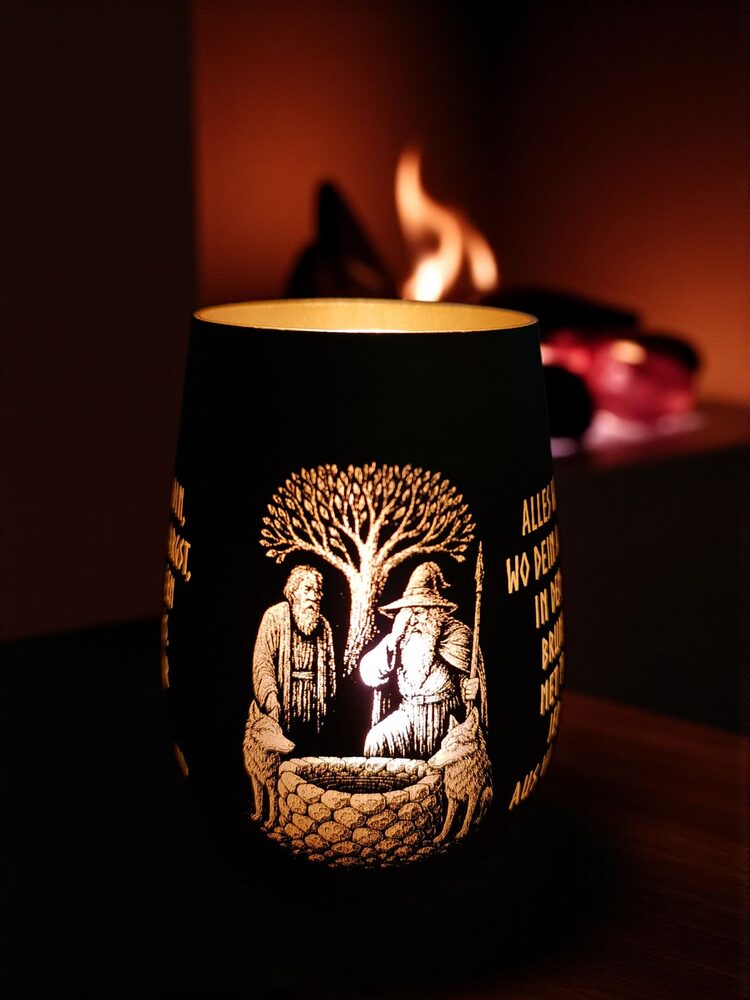
If you prefer something lighter, glass is the answer. On a lantern the well comes alive when candlelight falls through the engraved surface of the water. And if you are looking for a gift for a teacher, a mentor or the wisest person in the family, a simple "Míms vinr" – Mímir's friend – with the recipient's name says more than any certificate. We keep the runes and forms historically sound, with no fantasy flourishes.
Who is Mimir in Norse mythology? Mímir is a figure of wisdom. According to Völuspá and Snorri he keeps a well beneath Yggdrasil from which he drinks wisdom; according to Ynglinga saga he was sent as a hostage to the Vanir, beheaded, and his head was kept by Odin as an advisor.
Why does Odin have Mimir's head? The Vanir felt cheated in the hostage exchange because Hœnir could not decide anything without Mímir, so they sent back Mímir's head. Odin smeared it with herbs against decay and sang spells over it, so that it could speak and reveal secrets to him.
What does the name Mimir mean? Most scholars connect it with the Indo-European root *(s)mer- "to remember, ponder", related to Latin memor. Rudolf Simek translates it as "the rememberer, the wise one". The etymology is likely but not certain.
Is Mimir a god or a giant? The sources are ambiguous. In Ynglinga saga he belongs to the Æsir, but Snorri places his well under the root that reaches the frost giants. Many scholars think he may originally have been a giant or a water spirit.
What is the connection between Mimir and Odin's eye? Odin left his eye as a pledge to be allowed to drink from Mímir's well. Völuspá says the eye lies in the well and Mímir drinks mead from that pledge every morning; the explanation as the price of wisdom comes from Snorri.
Is Mimir in God of War accurate? Only at the core. The talking head as Odin's counsellor is in the sources; the imprisonment in a tree and the roles of Kratos and Freya are the game's own inventions.
For courage. For remembrance. For legends that live on.
Odin · The three wells · Odin's eye at Mímir's well · The war of the Aesir and Vanir · Yggdrasil – the world tree.
All Gods & Goddesses articles →
Some figures of Norse mythology stand in the bright spotlight, others in the shadow of the great ones. Nanna belongs to …
Read more →Almost a thousand years before the Edda was written down, Germanic tribes drove a veiled goddess across the fields on …
Read more →Every god has a mother. Heimdall has nine – at once. Nine sisters, giant maidens, bore the watchman of the gods “at the …
Read more →When a Viking prayed before a sea voyage for wind, safe return and a full catch, he prayed to Njörðr. The god of the …
Read more →