Some figures of Norse mythology stand in the bright spotlight, others in the shadow of the great ones. Nanna belongs to the quiet ones - and yet her story is among the most stirring the Edda has handed down to us. She is the wife of the god Baldr, and when his light goes out, she too no longer wishes to remain in the world of the living.
Nanna Nepsdottir - daughter of Nep - is in the Norse tradition the wife of Baldr, fairest and gentlest among the gods. From this marriage comes a son: Forseti, god of law and reconciliation, who later settles disputes in his gleaming hall Glitnir. Nanna is thus the ancestress of a small but dignified line among the gods.
Of Nanna's deeds, her words, or her character we learn almost nothing. She never appears as an acting figure; she wields no weapon, speaks no prophecy, joins no quarrel among the gods. Her whole meaning lies in a single moment - the death of her husband. And precisely there lies her particular power: Nanna embodies a love that does not outlive death, because it does not wish to.
The tale in which Nanna shines is at the same time the saddest of the entire Norse myth: the death of Baldr. The shining god falls to a sprig of mistletoe, hurled by the hand of his blind brother Hoedr, guided by the malice of Loki. With Baldr dies not only a god but innocence itself - and the gods stand helpless before a grief against which no power in the world can help.
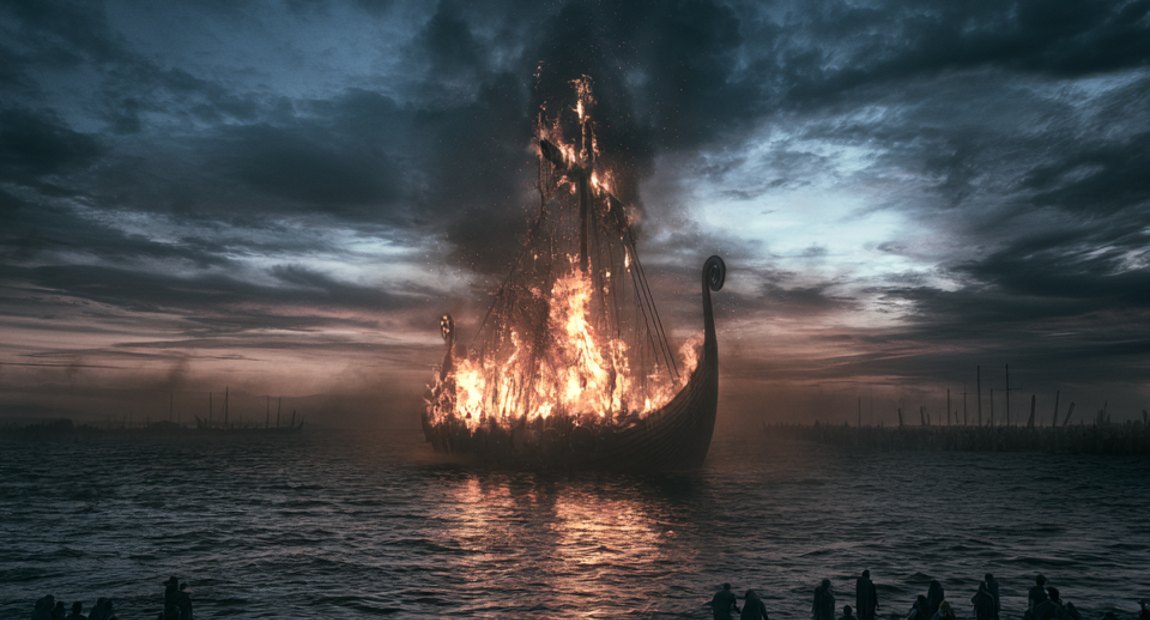
The gods prepare Baldr a funeral worthy of a prince. His great ship Hringhorni is to be his pyre. And as the body is carried aboard, the thing happens that makes Nanna immortal: Snorri reports in the Gylfaginning that at the sight of her dead husband her heart breaks with sorrow. She dies on the spot, of a broken heart, and is laid on the pyre together with Baldr.
Then Baldr's body was borne out onto the ship; and when Nanna, Nep's daughter, saw it, her heart burst with grief, and she died; she was borne to the pyre, and fire was kindled.after the Prose Edda, Gylfaginning, public-domain translation tradition
So the two pass united through the fire and onward into the depths - Baldr ahead, Nanna at his side. Where one goes, the other goes too. It is an image that says more about faithfulness in a few words than any long speech could.
After death Baldr and Nanna do not come to Valhalla but to the realm of the death-goddess Hel, deep beneath the roots of the world. The messenger Hermod rides down on Odin's steed Sleipnir to bring the shining god back. In the gloomy but by no means joyless hall he finds Baldr on the seat of honour - and at his side Nanna.
Now something beautiful happens: Nanna, the dead one, thinks of the living. As Hermod sets out on the return journey, she gives him gifts to carry back. To the goddess Frigg, Baldr's mother, she sends a fine linen robe; to Fulla, Frigg's confidante and handmaid, she sends a golden ring. From the realm of the dead Nanna reaches a bridge back into life - small gifts, but great gestures. They show that the bonds of affection reach even through the gates of Hel.
Anyone who wishes to know more about this quiet realm of the dead and its mistress will find further connections in our piece on the goddess Hel and her realm. Nanna's message from the depths fits a worldview in which death is not an utter ending but a passage - and in which the departed are honoured by keeping their tokens.
It is worth noting whom Nanna remembers: not herself, not Baldr, but those left behind. Her linen robe goes to the grieving mother-in-law, her ring to that mother's faithful handmaid - small, personal tokens for those who must go on living. Where Hermod's plea to bring Baldr back fails in the end, Nanna at least achieves this: a greeting that crosses the border. It is a soft reversal of the usual direction - normally the living bring gifts to the dead in the grave; here the dead one reaches something up to the living.
Why does this brief tale still move us after a thousand years? Perhaps because it embellishes so little and says so much. Nanna does not fight death, does not loudly accuse it - she simply follows. In a mythology full of battles, cunning, and loud heroes, her gesture is almost soft. And yet it lingers.
For a culture that prized posthumous fame and cultivated the memory of the dead, Nanna's act was an ideal in its purest form: a bond that does not end at the grave. She stands thus in a line with the many signs of Germanic honouring of the dead, in which the living and the departed never quite lose one another. Nanna is no war-image and no thunder-god - she is a symbol that love and remembrance can be stronger than the last road.
Precisely because so little is told of Nanna, she leaves much room. Her name, joined to Baldr's, stands for an affection that binds what death divides. In quiet memorial pieces, in engravings in memory of a loved one, exactly this thought echoes - not loud, but deep. Nanna reminds us that the old myths were not only about battle and honour, but also about the soft, unbreakable ties between two people.
Nanna as Baldr's wife, mother of Forseti, her death from grief and her burning with Baldr on Hringhorni, as well as the gifts (linen robe to Frigg, ring to Fulla), are recorded by Snorri in the Gylfaginning (ch. 49); Baldr and Nanna are also named in a funeral context in the skaldic poem Husdrapa. The Prose Edda was written around 1220 in Iceland, long after the heathen age.
Beware of merging two quite different Nanna figures: Snorri's faithful wife who dies of grief is not the same as the Nanna in Saxo Grammaticus (Gesta Danorum, around 1200). There Nanna is a mortal woman and the object of a love rivalry between Balderus and Hoetherus - a wholly different, more strongly humanised tradition. Both versions stand side by side; neither is a mere copy of the other.
The death of Baldr · Hringhorni – Baldr's funeral ship · Hyrrokkin – the wolf-riding giantess · Hel – goddess and realm of the dead · How the Germanic peoples honoured their dead.
All Gods & Goddesses articles →
Almost a thousand years before the Edda was written down, Germanic tribes drove a veiled goddess across the fields on …
Read more →Every god has a mother. Heimdall has nine – at once. Nine sisters, giant maidens, bore the watchman of the gods “at the …
Read more →When a Viking prayed before a sea voyage for wind, safe return and a full catch, he prayed to Njörðr. The god of the …
Read more →Odin is no comfortable sky-father. He is wanderer, war god, poet, sorcerer and lord of the dead – a god who pays almost …
Read more →