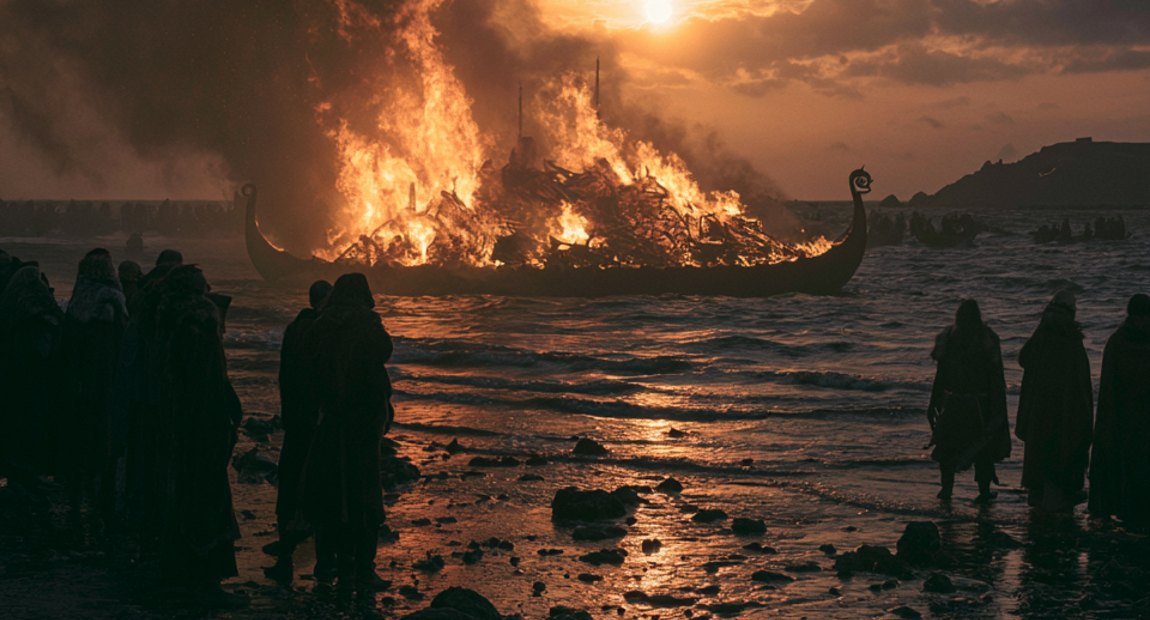
Hringhorni is the ship of the god Baldr – in Snorri's words "the greatest of all ships" – and after his death it becomes his funeral pyre. The gods carry his body to the shore, but they cannot move the ship an inch. Only the giantess Hyrrokkin, riding a wolf with vipers for reins, can push it into the water. Here you will find what Snorri and the older skald Úlfr Uggason tell us about Baldr's funeral, what a Viking Age picture stone may show, and what real ship burials from Oseberg to Salme have to say about it.
Some scenes in Norse mythology stay with you for good. Baldr's funeral is one of them. A dead god. A mother who has run out of options. A father who whispers something into his son's ear that nobody will ever know. Add a giantess, a furious thunder god and a dwarf who is in exactly the wrong place at exactly the wrong time. And at the centre of it all, a ship that refuses to go into the sea.
As always, we keep things separate: sources by age and type, then picture stones, then graves – and finally the question everyone asks after the film: was it really like that?
Old Norse Hringhorni combines hringr ("ring, circle") with horn ("horn, point"). Rudolf Simek glosses the name as "ship with a circle on the stem". The most likely reference is the tall prow that, on many Viking Age ships, curls into a spiral – on the Oseberg ship it coils into a serpent's head. Whether the "ring-horn" means that spiral or an actual ring fixed to the stem cannot be decided. The reading is plausible, not proven.
The name is not confined to the story. It also turns up in the Nafnaþulur, the versified lists of names transmitted in manuscripts of Skáldskaparmál. In the section on ships, "hringhornir" appears among dozens of words for vessels, right next to Skíðblaðnir and Naglfari. For skalds, such lists were toolkits full of synonyms.
The fullest account is in Gylfaginning, the first narrative part of the Prose Edda, written by the Icelandic scholar and politician Snorri Sturluson around 1220–1225. In chapter 49 he first tells how Baldr is killed by the mistletoe that Loki places in the hand of blind Höðr. You can read the whole build-up in our article on Baldr's death. Here we pick up the story afterwards.
The gods take the body and carry it down to the sea. "Hringhorni hét skip Baldrs, hann var allra skipa mestr" – Baldr's ship was called Hringhorni, and it was the greatest of all ships. The Æsir mean to launch it and build Baldr's pyre on board. The ship will not budge.
So they send to Jötunheimr, the land of the giants, for a giantess called Hyrrokkin. She arrives riding a wolf, with venomous snakes for reins. As soon as she dismounts, Odin calls four berserkers to guard her mount. They cannot hold it until they throw it to the ground. Hyrrokkin goes to the prow and shoves the ship off at the first push, "so that fire flew from the rollers and all the lands shook". The rollers are the hlunnar, the wooden logs on which ships were hauled across the beach.
Thor is enraged. He grabs his hammer and would have smashed the giantess's skull had all the gods not asked for peace on her behalf.
Then Baldr's body is carried onto the ship. When his wife Nanna, daughter of Nepr, sees it, her heart breaks with grief and she dies. She is laid on the pyre beside him. Snorri gives it one sentence, without pathos.
Thor steps up and hallows the pyre with Mjölnir. The verb is vígja, "to consecrate", the same word found on runestones in the formula "may Thor hallow these runes". There is more on that in our article on Thor's hammer. At that moment a dwarf named Litr runs in front of his feet. Thor kicks him into the fire, and the dwarf burns.
No comment, no explanation. Elsewhere Litr is just a name in the list of dwarfs in Völuspá. Whether the kick preserves a memory of an accompanying sacrifice, like the one Ibn Fadlan describes, is speculation. It may just as well be a crude joke about Thor's temper.
Next, Odin lays the gold ring Draupnir on the pyre. Snorri adds what makes it special: every ninth night, eight rings of equal weight drip from it. Finally Baldr's horse is led to the fire in its full harness.
Draupnir, incidentally, comes back: when Hermóðr rides to Hel, Baldr gives him the ring as a keepsake for Odin, and Nanna sends Frigg a linen cloth. The grave goods travel back out of the realm of the dead.
Snorri builds a real procession, and it tells you how important this dead god is. First Odin, with Frigg, the valkyries and his ravens. Freyr rides in a chariot drawn by the boar Gullinbursti, also called Slíðrugtanni. Heimdallr rides the horse Gulltoppr, Freyja drives her cats. And then comes the remarkable line: "a great host of frost giants and mountain giants".
So the enemies of the gods stand on the beach too. It shows the size of the loss – and that giants in Norse myth are not simply "the bad guys" but also relatives, spouses and teachers.
Snorri did not invent this scene – and that can be shown.
The Baldr stanzas of the Húsdrápa describe the very procession Snorri retells: Freyr riding his boar to the pyre, Heimdallr arriving on horseback, Odin accompanied by valkyries and ravens. And one stanza says, roughly: the mighty "Hildr of the mountains" – a poetic term for a giantess – made the "sea-Sleipnir" – the ship – lumber forward, but Odin's warriors felled her mount.
This is dense, typically skaldic language full of kennings, the figurative circumlocutions of Norse poetry: the ship is a "horse of the sea", the giantess a "valkyrie of the mountains". But the content is clear. As early as the late tenth century, still in pagan times, Icelanders knew the giantess who launches the funeral ship and the warriors who bring down her steed.
Two things are missing from the surviving stanzas, though: the name Hringhorni and the wolf. The Húsdrápa speaks only of a mount. The wolf, the snake reins, Nanna and Litr reach us only through Snorri's prose. Whether he took them from other, lost sources or added them himself, we don't know. The core is old; the trimmings may be younger.
One more thing: Úlfr describes images he saw. The oldest detailed trace of this scene is a set of pictures in wood – a lovely thought for engravers like us.
Snorri lets Hyrrokkin live because the gods plead for her. Another skald of the late tenth century, Þorbjörn dísarskáld, apparently saw things differently. In a stanza that Snorri quotes in Skáldskaparmál, he lists the giantesses and giants Thor has slain, and among them, briefly: "Hyrrokkin dó fyrri" – Hyrrokkin died before.
That shows how fluid the tradition was. There was no single authorised version of Baldr's funeral, but variants living side by side. Snorri chose one and smoothed it out.
Even the name Hyrrokkin is not clear-cut. The first element probably belongs to hyrr, "fire"; the second is usually read as "wrinkled" or "smoked". "Fire-shrivelled" is a common translation, but it is not certain. Her name also appears in the þulur lists of troll-women, but there without any story attached.
One detail is often attached to the Hringhorni scene but is not in Snorri at all: the whisper. In Gylfaginning, Odin does not bend over his son. The famous question comes from a poem of the Poetic Edda, Vafþrúðnismál. There, Odin in disguise wagers his head in a wisdom contest with the giant Vafþrúðnir. At the end he asks a question only one being can answer: what did Odin say into his son's ear before he was lifted onto the pyre?
That is how the giant realises who he is facing – and that he has lost. The same question returns as the final riddle in Hervarar saga, where Gestumblindi, Odin in disguise, defeats King Heiðrekr with it. No source tells us what Odin whispered. Modern guesses, such as a promise of return after Ragnarök, are speculation. The silence is the point.
So the poem confirms the pyre independently of Snorri – but says nothing about a ship.
Read the Danish historian Saxo Grammaticus alongside Snorri and you are in for a surprise. In his Gesta Danorum (around 1200), Balderus is no shining god but a demigod and war leader, wounded and killed in a conflict with Hotherus over the princess Nanna. His army gives him a royal funeral – in a burial mound. No ship, no giantess, no fire on the sea.
Hringhorni is therefore not "the" funeral of Baldr but the Icelandic version – one the Húsdrápa anchors firmly in the tenth century.
Skíðblaðnir belongs to the god Freyr. It was built by the sons of the dwarf Ivaldi. It is big enough for all the Æsir with their weapons and armour, has a fair wind as soon as the sail is raised, and can be folded up like a cloth so that Freyr can carry it in his pocket. Grímnismál calls it the best of ships.
Naglfar is its opposite. It is built from the untrimmed nails of the dead and carries the giants against the gods at the end of the world. Hence Snorri's advice never to let anyone die with untrimmed nails.
Between them sits Hringhorni: the greatest ship, built for the voyage of a single dead god. Three ships, three functions – life, death, the end of the world. Whether that pattern was already intended in pagan times is an open question.
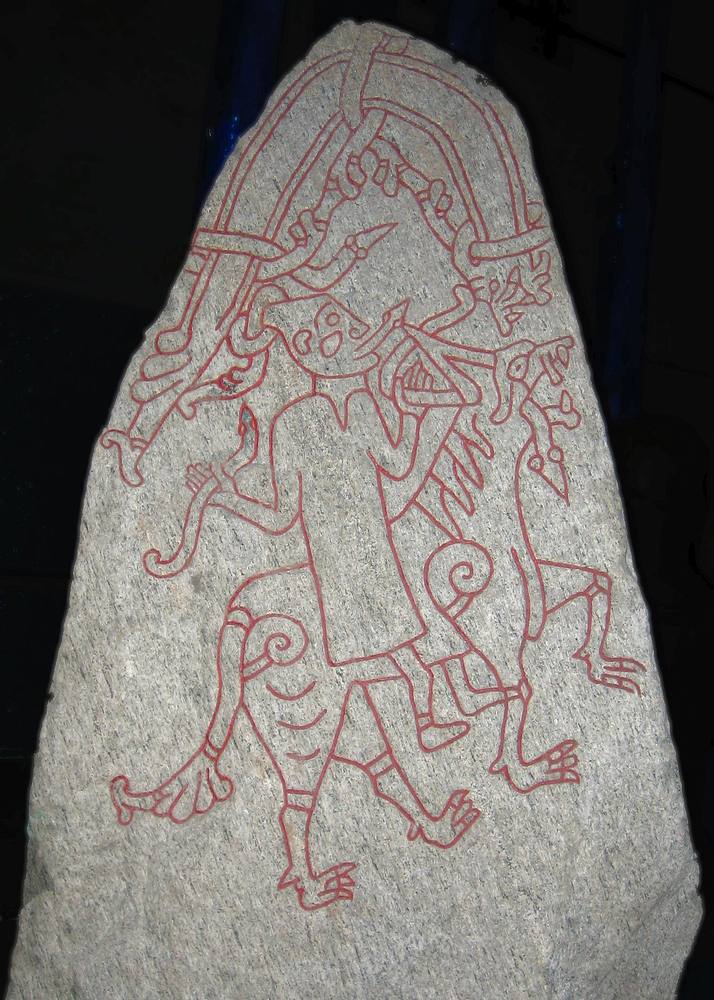
Is there a picture of the scene older than Snorri? There is one candidate. At Hunnestad near Marsvinsholm, north-west of Ystad in Scania, stood the largest Viking Age picture-stone monument in the region. Scania was Danish at the time. The Danish antiquarian Ole Worm recorded eight stones there and published a drawing of the monument in 1643 in his Danicorum Monumentorum.
In the late eighteenth century the landowner had the monument destroyed during a modernisation of the estate, probably between 1782 and 1786. Three stones were recovered in the nineteenth century and are now in Lund. Another, DR 285, came to light in December 2020 during work on a sewer line; it had been used in a bridge over a stream.
Stone DR 284 shows a figure riding a large animal with a mane and pointed ears, holding snakes in its hands. The common interpretation: this is Hyrrokkin on her wolf, with snakes for reins. The parallel with Snorri is striking.
Ship burials are attested in the North over many centuries and in very different forms:
Sutton Hoo (England, around 625): Mound 1 at Sutton Hoo held a rowing ship roughly 27 metres long, buried whole, with a burial chamber amidships. Only rivets and the imprint in the sand remained. Anglo-Saxon, not Viking – but proof of how old the custom is.
Salme (Saaremaa, Estonia, around 700–750): Two ships, found in 2008 and 2010, with at least 41 dead in total – seven in the smaller ship and at least 34 in the larger, in several layers. Isotope analysis and the finds point to an origin in central Sweden. These men apparently died on a raid and were laid in their ships on the beach, without a mound. It is the oldest known ship burial of this kind in the Baltic. More on the Salme warriors.
Oseberg (Vestfold, Norway, 834): The timber of the burial chamber has been dendro-dated to 834. Two women lay in the ship, together with a wagon, sledges, beds, weaving equipment, horses, dogs and cattle. One detail chimes with Hringhorni: in the grave, the ship was moored by a rope to a large stone. Whether that was meant symbolically to stop it "sailing off", or was simply part of the furnishing, is interpretation. More on the Oseberg ship.
Gokstad (Vestfold, around 900–905): A seaworthy ship a little over 23 metres long, in which a man was buried along with horses, dogs and even peacocks. The Gokstad ship remains a textbook example of Viking Age shipbuilding.
Ladby (Funen, Denmark, early tenth century): So far the only known Viking Age ship grave in Denmark, discovered in 1935. Of the ship, a little over 21 metres long, only the imprint and the rivets survived, together with the remains of eleven horses and several dogs and an anchor with its chain. The grave was robbed soon after the burial and the dead man was missing.
Myklebust (Nordfjordeid, Norway, late ninth century): Here the ship was not buried but burned. From rivets, nails and the ash layer its length is estimated at about 30 metres, and more than 40 shield bosses were found. That makes Myklebust one of the largest known ship cremations in Scandinavia. The link to a King Audbjørn, often told locally, is tradition rather than evidence.
Alongside these is an entirely different form: stone ships, upright stones set in the outline of a vessel, often over a cremation. At Lindholm Høje near Aalborg there are hundreds of graves, many of them inside such settings. No real ship ever lay in the ground there. The ship was a sign, not a vehicle.
For the burning of a ship we even have an eyewitness. The Arab envoy Ibn Fadlan travelled in 921–922 on behalf of the caliph of Baghdad to the Volga Bulghars, and there he watched the funeral of a chieftain of the Rus – Scandinavian traders and warriors.
The ship of the dead man is hauled onto land and set on a wooden scaffold. He lies in fine clothes in a tent on board, with food, weapons and sacrificed animals, among them horses and a dog. An enslaved woman who has agreed to "go with him" is killed after rituals Ibn Fadlan describes at length and laid beside him. Then the closest male relative, naked and walking backwards, sets the wood alight. According to Ibn Fadlan, within an hour everything has turned to ash. A round mound is raised over the site with a post of birch wood on top.
Nanna joining Baldr on the pyre, the horse in full harness: all of this has real-world parallels. Ibn Fadlan is describing Rus on the Volga, not Icelanders, and Snorri was writing three centuries later as a Christian. But the basic elements – ship, fire, horse, a companion in death, grave goods – recur.
Now for the scene everybody has in their head: a longship drifts out onto dark water, an archer on the shore draws his bow, the fire arrow flies, the ship bursts into flame. Or is it?
The image is not plucked entirely from thin air, though. In Ynglinga saga, also by Snorri, the mortally wounded sea-king Haki has a ship loaded with his fallen men and their weapons, has a pyre lit on board and sends the ship blazing out to sea. That, Snorri says, brought him great fame. And in the Old English Beowulf, King Scyld Scefing is given to the sea on a ship full of treasure – but without fire.
Hringhorni itself feeds the image: Hyrrokkin shoves the ship into the water, and then the pyre burns on board. Whether it floats while burning, or drifts out, Snorri does not say. As a real practice, the motif has no evidence behind it.
Three answers are common, and they do not exclude each other. The first: the ship as transport to the afterlife. The dead set out on a journey, so they get a vehicle – just like the wagon, sledges and horses at Oseberg. The second: the ship as status symbol. Building a seagoing ship consumed enormous amounts of timber, iron, wool and labour. Sacrificing one was the loudest statement of rank and power a family could make – an idea Neil Price has developed in his work on funerals as staged performances. The third points to the Vanir, especially Freyr and his father Njörðr, who are linked to ships, sea and fertility. That Freyr himself owns the best of ships, Skíðblaðnir, fits the picture.
None of these readings can be proven on its own. Hringhorni simply shows the gods imagined in the same logic: for the best of them, the greatest of all ships.
If you want to see a Viking ship burn today, go to Lerwick in Shetland. At the fire festival of Up Helly Aa, on the last Tuesday of January, a replica galley is dragged through the town and set alight by hundreds of torch-bearers.
But this is not a Viking Age custom. The festival grew out of Yuletide tar-barrel rolling, which the authorities suppressed as too dangerous. Torch processions are recorded from 1876, and the first galley was burned in 1889. The Viking theme came with the Victorian enthusiasm for the islands' Norse heritage. Up Helly Aa is a Victorian invention in Viking costume – a very successful one, but a modern one.
Hringhorni is the ship that will not sail until the wrong person comes along to move it. The gods, who bind wolves and build worlds, fail to shift a boat on a beach, and of all people a giantess has to help. A dwarf dies in passing. A woman dies of love.
That mix is what makes the scene so strong. It is not stiff or ceremonial, but human, with anger, grief and a crooked joke. And it rests on solid foundations: a hall in Iceland around 985 whose carvings a skald put into verse, a picture stone in Scania, ship graves from Estonia to England, and an Arab traveller who watched a ship burn on the Volga.
In our workshop in Alsdorf, Hringhorni is a motif we love to engrave – on slate, in wood, on glass. Not as a film still with a fire arrow, but the way the sources tell it.
What is Hringhorni in Norse mythology? Hringhorni is the ship of the god Baldr, according to Snorri the greatest of all ships. After Baldr's death it serves as his funeral pyre.
Who pushed Baldr's ship into the sea? The giantess Hyrrokkin. The gods could not move Hringhorni, so they fetched her from Jötunheimr. She arrived on a wolf with snakes for reins and launched the ship with a single shove.
Where is the story of Baldr's funeral told? In detail in Gylfaginning, chapter 49, of Snorri Sturluson's Prose Edda, written around 1220. Older is the Húsdrápa of the skald Úlfr Uggason from about 985, which describes parts of the scene in verse.
What did Odin whisper to Baldr? No source tells us. The question comes from Vafþrúðnismál, where Odin uses it as an unanswerable riddle. Snorri's account does not mention the whisper at all.
Were Vikings really sent out to sea on burning ships? There is no archaeological evidence for it. Ships in burial mounds, ships burned on land and stone ships are attested. The burning ship at sea is found only in saga literature, and the fire arrow comes from the movies.
What does the name Hringhorni mean? Literally something like "ring-horn". Rudolf Simek reads it as "ship with a circle on the stem", probably meaning the curled prow. The interpretation is plausible but uncertain.
For courage. For remembrance. For legends that live on.
It begins with a drunken braggart and ends with a splinter in the thunder god's skull. The tale of Thor and Hrungnir is …
Read more →In their grief for the shining god Baldr, even the gods reach their limits. His funeral ship stands fast in the sand …
Read more →Idun keeps the gods’ greatest secret in a simple box: the apples that keep them young. Without them even Odin and Thor …
Read more →She is so vast that she encircles the whole world and bites her own tail: Jörmungandr, the Midgard Serpent. Between her …
Read more →