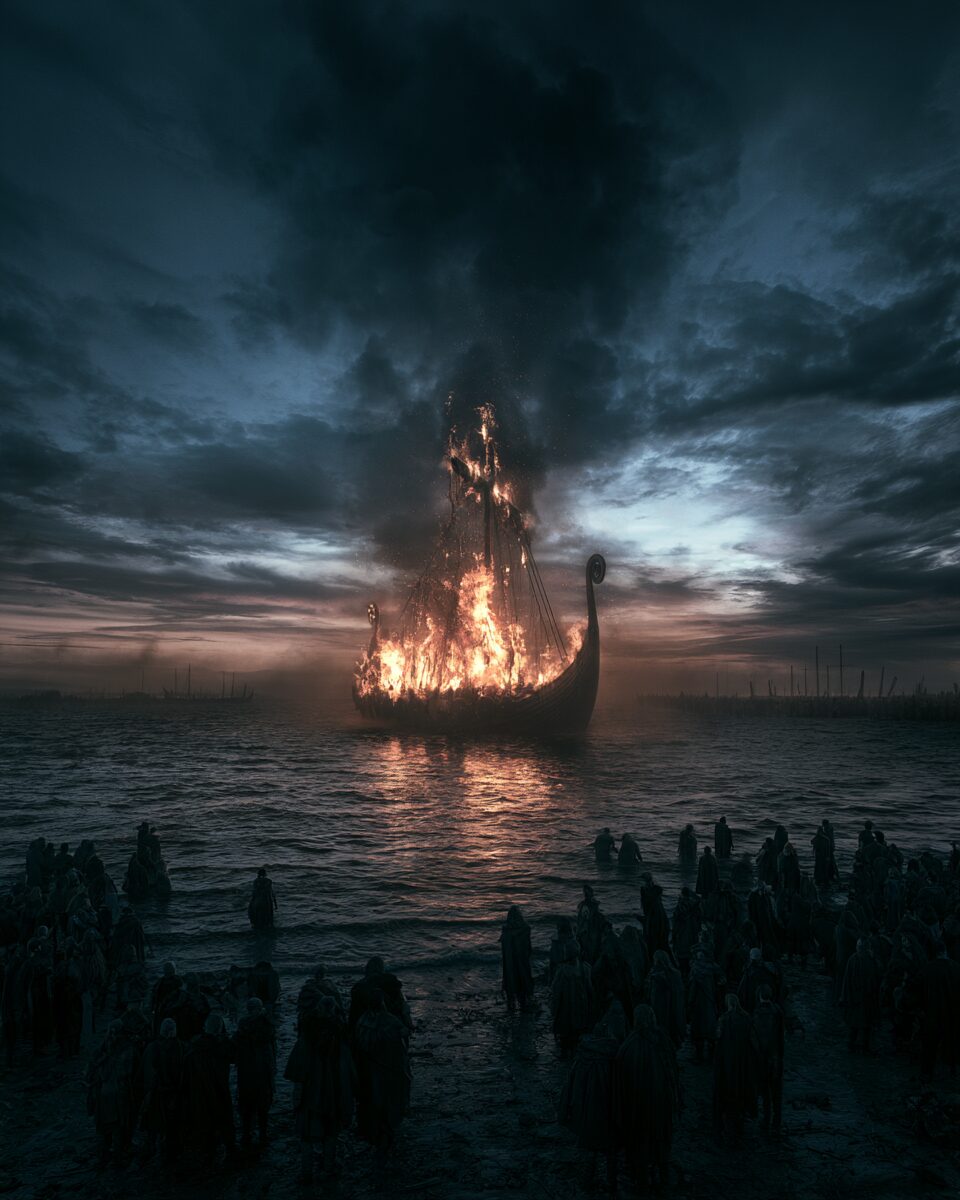
Ibn Fadlan was the secretary of an embassy sent by the Abbasid caliph al-Muqtadir from Baghdad to the Volga Bulgars in 921–922. There he met the Rus, traders with Scandinavian roots, and wrote down what he saw. His report, the Risāla, contains the only detailed eyewitness account of a ship funeral from the Norse world. Here is who he was, the route he took, how the text survived, what he says about the Rus, what archaeology confirms, and what the film The 13th Warrior made of it all.
Picture a man from Baghdad, arguably the most sophisticated city on earth around the year 900: libraries, bathhouses, paper instead of parchment. He rides north for almost a year, sits out a winter of ice and snow near the Aral Sea, and finally stands on the bank of the Volga in front of people who share a single washbasin every morning – and blow their noses into it. He writes it all down.
Few texts have been trimmed and embellished as often as his. So we will take it step by step: what it says, what it does not say, and where scholars still disagree. If you want to read the account itself, you will find it in our reading edition of Ibn Fadlan's report.
The manuscript gives his full name as Aḥmad ibn Faḍlān ibn al-ʿAbbās ibn Rāšid ibn Ḥammād. Beyond that name and what he lets slip in his own report, we know nothing about him: no birth date, no death date, no other writings, not even his ethnic origin. What is certain is that he wrote in Arabic, thought as a Muslim and had training in religious law. On the journey his job was to read out the caliph's letter, hand over the gifts and supervise the legal scholars travelling with the party.
He did not lead the embassy. That role belonged to Sawsan al-Rassī, a man of the caliph's household. Ibn Fadlan was the secretary and religious expert – and, as it turned out, the sharpest pair of eyes in the caravan.
It all began with a letter from the Volga. Almış, ruler of the Volga Bulgars – a Turkic-speaking people on the middle Volga, a little south of modern Kazan – asked the caliph al-Muqtadir for three things: teachers to instruct his people in Islam, builders for a mosque and a fortress, and money. The motive was political. The Volga Bulgars lived under the overlordship of the Khazars, a powerful steppe empire further south, and Almış wanted an ally far enough away not to become a threat himself.
By Ibn Fadlan's own dating, the embassy left Baghdad on 11 Ṣafar 309 of the Hijra, which corresponds to 21 June 921. It reached the Bulgar ruler's court on 12 Muḥarram 310, or 12 May 922. Almost eleven months on the road, roughly 4,000 kilometres.
The money became a problem. It was supposed to come from the revenues of an estate in Central Asia, but it could not be collected along the way. Ibn Fadlan tells us frankly how angry Almış was. That honesty about his own embassy's failure is one good reason to give him some credit elsewhere.
The direct road over the Caucasus ran through Khazar territory, and the Khazars were better left ignorant of this alliance. So the embassy went east: via Hamadan and Rayy to Nishapur, Merv and Bukhara, the court of the Samanid emirs, then down the Amu Darya to Khwarazm near the Aral Sea.
There they wintered. Ibn Fadlan describes a cold that was entirely new to him: rivers frozen so hard that carts drove across them, beards turning to ice, people wrapped in layer upon layer of fur and felt.
In spring 922 they struck out into the steppe, through the lands of the Oghuz, the Pechenegs and the Bashkirs, whose customs Ibn Fadlan describes as closely and as critically as he later describes the Rus. Readers who only know the Rus chapters easily miss this: the northerners are one episode in a much larger panorama. Among the Bulgars he even recorded a red glow in the night sky, which the locals explained as spirits fighting – most modern readers recognise the northern lights.
The text is usually just called the Risāla, the "epistle" or "report". No manuscript in Ibn Fadlan's own hand exists. It reached us by two routes.
The first is Yāqūt al-Ḥamawī (died 1229), a geographer who quoted long passages from Ibn Fadlan in his great geographical dictionary, the Muʿjam al-buldān, scattered across entries such as Bulghar, Khazar and Rus. The German orientalist Christian Martin Frähn published these excerpts in St Petersburg in 1823 with a German translation. From then on European scholars knew Ibn Fadlan – but only in fragments, chosen by what happened to interest Yāqūt.
The second route is a manuscript in Mashhad in north-eastern Iran. In 1923 the Bashkir scholar Ahmet Zeki Velidi Togan came across a 13th-century compilation in the library of the Imam Reza shrine that contained a much longer version of the report. Togan published an edition with a German translation in Leipzig in 1939, Ibn Faḍlān's Reisebericht.
That manuscript is incomplete too. It breaks off after the section on the Khazars; we hear nothing of the journey home. Strictly speaking, we do not even know whether Ibn Fadlan made it back to Baghdad.
Ibn Fadlan calls them al-Rūsiyya. Whether they were "Vikings" is one of the oldest arguments in Eastern European history.
A great deal points to Scandinavian origins. The Frankish Annals of St-Bertin record that in 839 envoys calling themselves Rhos arrived at the court of Louis the Pious at Ingelheim and turned out, on closer inquiry, to be Sueones – Swedes. The negotiators named in the Rus treaties with Byzantium of 911 and 944 mostly bear Norse names. The word Rus itself is usually traced through Finnish Ruotsi ("Sweden") to an Old Norse word connected with rowing. And from Lake Ladoga to the Dnieper, graves contain Scandinavian brooches and Scandinavian burial customs.
On the other hand, by 922 the Rus had been in the East for generations. They lived alongside Slavs, Finns, Balts and Turkic peoples, married into their families and adopted their clothing, titles and customs. James E. Montgomery, who retranslated the Rus section, sees a group in the middle of that process: Scandinavian roots, but with clear Khazar and steppe features.
The prevailing view today: the Rus of the 9th and 10th centuries had a strong Scandinavian core but merged into their Slavic surroundings within a few generations. Our articles on Kievan Rus and on the difference between Vikings, Normans, Varangians and Rus go into more detail. So Ibn Fadlan describes people of Norse descent in a mixed culture, more than two thousand kilometres from Scandinavia.
The Rus came to the Volga as merchants. They built large wooden houses on the riverbank, ten or twenty people to each, and sold mainly furs and enslaved women. Ibn Fadlan writes down whatever strikes him as strange – which is exactly why he is so useful.
Appearance. He had never seen more perfect bodies, he says in effect: tall as palm trees, fair-haired and ruddy. The men wore neither tunic nor caftan but a cloak that covered one side of the body and left one hand free. Each carried an axe, a sword and a knife, and the swords were broad, grooved and "Frankish". That detail fits remarkably well with the Frankish blades found in Scandinavia and along the eastern routes.
Tattoos. From fingernails to neck, he writes, the men were covered in dark green designs, "trees" and figures. Whether these were real tattoos or painted marks the text does not say outright; Montgomery thinks tattooing is the likely reading. Archaeology cannot check it, because skin does not survive in graves of this period.
Women's jewellery. Every woman wore on her breast a box or disc of iron, silver, copper or gold, depending on her husband's wealth, with a knife hanging from it, plus one neck ring for every 10,000 dirhams her husband owned. Most prized of all were green beads. This sounds very much like the paired oval brooches of Scandinavian women's graves, with strings of beads between them; the beads were usually glass.
The washbasin. The Rus, Ibn Fadlan writes, are the filthiest of God's creatures. Every morning a slave woman brings a large basin of water to her master; he washes his face and hair in it, combs himself, blows his nose and spits into it. Then the same basin goes to the next man.
For a Muslim who washed in running water before every prayer, this was revolting. Yet the scene also shows, almost in passing, that these people washed and combed every single morning – which fits the countless combs found at Hedeby and Birka. More in our article on Viking hygiene.
Commerce and religion went hand in hand. A newly arrived trader went to a tall wooden post carved with a human face and surrounded by smaller figures, prostrated himself and offered bread, meat, onions, milk and an intoxicating drink. Then he prayed, roughly: Lord, I have come from far away with so many slave women and so many sable pelts – send me a merchant with plenty of silver who will buy without haggling. If trade was slow he made offerings to the small figures too, the god's "wives and children"; if it went well, he hung the heads of sheep and cattle on the posts.
Ibn Fadlan does not say which deity the post represented. Montgomery suggests Freyr, but that is a guess. Wooden idols rot away – here the text speaks where the ground is silent.
Much of the trade was trade in people. Ibn Fadlan states plainly that the Rus had sex with their slave women inside the houses in full view of the others. A substantial share of the goods exchanged for Islamic silver were captives from Eastern Europe – the dirhams in the silver hoards of Gotland are, among other things, the proceeds of that business. More on this in our article on slavery in the Viking Age.
His "king of the Rus", with 400 retainers who would die with him and 40 slave women on his throne, is clearly hearsay. The passage resembles the sacral kingship of the Khazars and does not describe a Scandinavian royal court.
Ibn Fadlan had heard that the Rus burned their chieftains and wanted to see it for himself. When one of them died, he got his chance. We give the sequence plainly – without hiding it and without turning it into a horror story.
A poor man, he says, is burned in a small boat. When a rich man dies, his property is divided into three: one third for his family, one third for his funeral clothes, one third for the drink consumed on the day of the cremation. The dead man lay in a temporary grave for ten days while his clothes were sewn.
His people asked the enslaved women which of them would die with him. One said yes; from then on she was guarded and feasted, and she drank and sang. The ship was hauled ashore and set on wooden supports, with a tent on deck and a couch covered in Byzantine silk. The dead man was dressed in trousers, boots, a brocade caftan with gold buttons and a fur cap, seated in the tent and surrounded with drink, food, herbs and his weapons. A dog, two horses, two cows, a cock and a hen were killed and thrown into the ship.
An old woman ran the proceedings. Ibn Fadlan calls her the "Angel of Death" (malak al-mawt) and describes her as heavy and grim, neither young nor old. She sewed the clothes, prepared everything – and in the end she killed the young woman.
On the day of the cremation the young woman was lifted three times above a structure like a door frame. The first time she said she saw her father and mother; the second time all her dead kinsfolk; the third time her master in Paradise, which was beautiful and green, and he was calling her. She gave away her bracelets and anklets, drank, sang, and was led into the tent.
Before her death, the woman had to sleep with several men of the dead man's following, who told her to tell her master they did it out of love for him. In the tent she was strangled with a cord by two men while the "Angel of Death" drove a broad-bladed dagger between her ribs. Outside, men beat their shields with sticks so that her screams could not be heard – and, Ibn Fadlan explains, so that other slave women would not be deterred from one day dying with their masters.
The text says she volunteered. Can we call it voluntary when a person is legally property, plied with alcohol and surrounded by armed men? We think not. This too belongs to the Viking Age, and anyone who takes the period seriously has to look at it.
Then the dead man's closest male relative approached naked, walking backwards towards the ship, a burning torch in one hand and the other hand behind his body, and set the pyre alight. Others threw on burning wood. A wind rose, and within an hour everything had burned to ash.
Standing next to Ibn Fadlan was a man of the Rus who, through the interpreter, made a remark that is often quoted. In paraphrase: you Arabs are fools. You take the person you love most and put him in the ground, where worms eat him. We burn him in an instant and he goes straight to Paradise. Laughing, he added that God had sent the wind out of love for the dead man.
Finally they heaped a round mound over the pyre site and set up a post of birch wood in the middle, on which they wrote the dead man's name and the name of the king of the Rus. Runes are the obvious guess, but Ibn Fadlan only says that something was written on it.
The appeal of this text is that we can test it against the ground. Ship and boat burials are well documented in Scandinavia and along the eastern routes – think of the inhumations at Oseberg (834) and Gokstad (around 900), or the ship grave at Ladby on Funen. There are also countless cremation graves where only the iron ship rivets betray that a boat went onto the pyre. Our article on boat burials gives an overview.
Gnezdovo near Smolensk on the Dnieper is especially revealing: one of the largest Viking-Age cemeteries in Eastern Europe, with around 3,000 barrows mostly of the 10th century, roughly 1,300 of them excavated. Most of the dead were cremated, and some mounds contained Scandinavian brooches, weapons and boat rivets in the burnt debris – ship, fire and mound, just as Ibn Fadlan describes.
Animal sacrifice is standard in rich graves, often with the animals cut up as in the text: Oseberg held horses, dogs and cattle; Ladby eleven horses and several dogs.
Human sacrifice in graves is harder to prove, but there are candidates. At Ballateare on the Isle of Man, a young woman lay in the mound above the grave of an armed man; the top of her skull had been sliced off by a blow. Some Scandinavian double graves also contain a second, poorer-furnished person. Whether these were slaves is disputed case by case.
Not provable are the ten days, the threefold division of property, the role of the old woman and the visions above the door frame. Rituals rarely leave traces. The archaeologist Neil Price reads Viking-Age funerals as staged performances in which the grave is only the final act – and Ibn Fadlan gives us the most detailed script we have.
Still open is how representative any of this was. The great majority of people were buried in simple pits or cremation graves without ship, slave or animal offerings. For the full range, see our article on burial in the Viking Age.
How reliable is Ibn Fadlan? He did not speak the language: everything beyond what he could see came through an interpreter, and Montgomery points out that some interpretations may be misunderstandings. He judges: he calls the Rus filthy and their beliefs wrong – just as harshly as he judges the Oghuz and the Bashkirs. That is exactly why he does not romanticise them. And he is one witness in one place. Turning a group of traders on the Volga in 922 into "this is what Vikings were like" stretches the source too far.
Many people know Ibn Fadlan only from the film The 13th Warrior (1999), starring Antonio Banderas. It is based on Michael Crichton's 1976 novel Eaters of the Dead. In his afterword Crichton explained that a friend had claimed Beowulf was boring – and he set out to prove the opposite.
What is true:
What is invented:
The film became one of the most expensive flops of its day, yet it introduced Ibn Fadlan's name to a huge audience. As a "true story" it does not hold up – only the opening is grounded in fact, and even that only in broad strokes.
One report, copied three hundred years later, recovered more fully only in 1923, written by a man who could not speak the language – and still one of the most vivid testimonies of the Viking Age. It shows the Rus with gods of wood, Frankish weapons and silver from the caliphate, hoping for a green Paradise. And it shows, without varnish, that their wealth rested on human suffering.
Whenever we design motifs for our engravings, we ask the same question: how do we know this? With Ibn Fadlan the answer is unusually clear – from someone who was there. Read him yourself in our reading edition and make up your own mind.
Who was Ibn Fadlan? Ahmad ibn Fadlan was a scholar and the secretary of an embassy sent by the Abbasid caliph al-Muqtadir, which left Baghdad for the Volga Bulgars in 921. His travel report, the Risāla, is the most important eyewitness source on the Rus of the Volga.
Were the Rus in Ibn Fadlan's account Vikings? They had a strong Scandinavian core but had lived in Eastern Europe for generations and adopted many customs of their neighbours. "Rus with Norse roots" is more accurate than "Vikings from Scandinavia".
Is The 13th Warrior based on a true story? Only its beginning. Ibn Fadlan was real and described the Rus, the washbasin and the ship funeral. The trip to Scandinavia and the battle with the Wendol come from Michael Crichton's novel and from Beowulf.
Did Vikings really have burning ship funerals? Yes, but on land. Ibn Fadlan describes a ship propped up on the riverbank, burned and then covered with a mound. Burning boats drifting out to sea are a modern invention.
Who was the Angel of Death in Ibn Fadlan? That is Ibn Fadlan's name for the old woman who directed the funeral and killed the enslaved girl. The term comes from his own Islamic world; we do not know what the Rus called her.
For courage. For remembrance. For legends that live on.
For courage. For remembrance. For legends that live on.
All History & Finds articles →
Carved in stone over 1,000 years ago, a king proclaims the unification and baptism of Denmark – the same king whose …
Read more →Long before the Vikings they settled between the Eifel and the Danube, leaving behind gold hoards and princely graves …
Read more →Without their ships the Vikings would never have become Vikings. The longship was the high technology of its time …
Read more →It is not two centimetres tall and weighs nine grams – and yet it set off one of the most exciting debates in Norse …
Read more →