 The Viking Age is often told as a world of free farmers and warriors. That is half the truth. Beneath the free lived a large, largely rightless class of the unfree – the thralls. Their labour carried the farms, their trade filled the silver purses. This text looks at it soberly, without glossing over and without romanticising.
A romantic glow still lies over the Vikings: free men, proud farms, open assemblies. What is often left out: this society rested to a considerable degree on unfree labour. Slavery was not a marginal phenomenon but a load-bearing pillar of economy and daily life. This article treats the subject as it deserves – seriously, factually and without minimising.
At the bottom of Norse society stood the thrall (Old Norse þræll; female ambátt or þír). A thrall was not a person with limited rights but, in law, property – „cattle“ in the language of the sources. He could be bought, sold, inherited and given away. Contemporaries drew a sharp line between the free and the unfree; the whole order of the North was built on that contrast. How many unfree there were and exactly what their daily life looked like, we know only in fragments – because almost all sources speak from the viewpoint of the masters, not the mastered.
There were several roads into unfreedom. The most important was violence: prisoners of war and people carried off on raids in the British Isles, Ireland, the Baltic and the Slavic lands became goods. The Irish annals report again and again great „spoils“ of people – men, women and children dragged away; Frankish and Anglo-Saxon sources also mention the carrying-off of captives. Alongside this stood birth – children of the unfree were themselves unfree, so the lower class reproduced itself even without fresh raids. And there was the road of debt: whoever could not settle their debts could fall into debt-bondage, as could those who committed certain crimes and could not redeem themselves. Even free people, then, could slide into unfreedom at the bottom edge of society. The Viking expeditions, which appear in popular culture mostly as a fight for gold and land, were to a considerable extent also the seizure of people – the human being itself was booty. This is an uncomfortable but well-documented part of the picture.
Slaves were among the most important trade goods of the Viking Age. Great hubs such as Dublin, Haithabu (Hedeby) and Birka were markets not only for furs, silver and metalwork but also for people. In the 9th and 10th centuries Dublin grew into one of the most important slave markets of north-western Europe; from there and from the Scandinavian trading places the routes ran far: across the Russian rivers and the Volga into the lands of the Caliphate, across western Europe as far as al-Andalus. Captives from the north and north-west were sold east and south, where demand – and the price in silver – was high. The stream of Arab silver that filled the Norse hoards is directly connected with this trade: for people, silver came back to the North. It is important to say plainly: part of the wealth of the Viking Age – of the silver we admire in museums today – was the proceeds of trade in human beings.
The law books that survive – such as the Icelandic Grágás or the Norwegian Gulathing law – are younger than the Viking Age proper and written from the masters' side, but they show the main lines. A thrall had no wergild of his own in the full sense; if he was killed, that was a matter of compensation to the owner, not a matter of blood-feud as for a free man. As a rule he could claim no right to bear arms, no full property, no free contract, and he could not act independently in court. The heaviest and most unpleasant work fell to the unfree: building walls and fences, spreading manure, cutting peat and firewood, herding livestock, turning hand-querns. Unfree women (ambátt) ground grain, milked, wove and were subject to sexual exploitation – the sources say so openly too. Masters could chastise their thralls, and in the longhouse the servants slept at the lower, dark end, often near the animals. There were regional differences and degrees of unfreedom – some unfree held a little plot of land and a few possessions – but the core remains: the absence of self-determination over one's own life and one's own body.
One of the most striking sources is the account of the Arab envoy Ibn Fadlan, who in 922 met a group of the Rus on the Volga. He describes a burial in which a slave woman was killed and burned with her deceased master. The text is disturbing and must be read soberly: it shows that, in the extreme case, an unfree person was treated as possession to be disposed of at the master's death. At the same time caution is needed – Ibn Fadlan describes a single case at a distant trading post, not a rule valid everywhere, and he writes as an outside observer. As evidence of how total the rightlessness could be, his account is nonetheless hard to set aside.
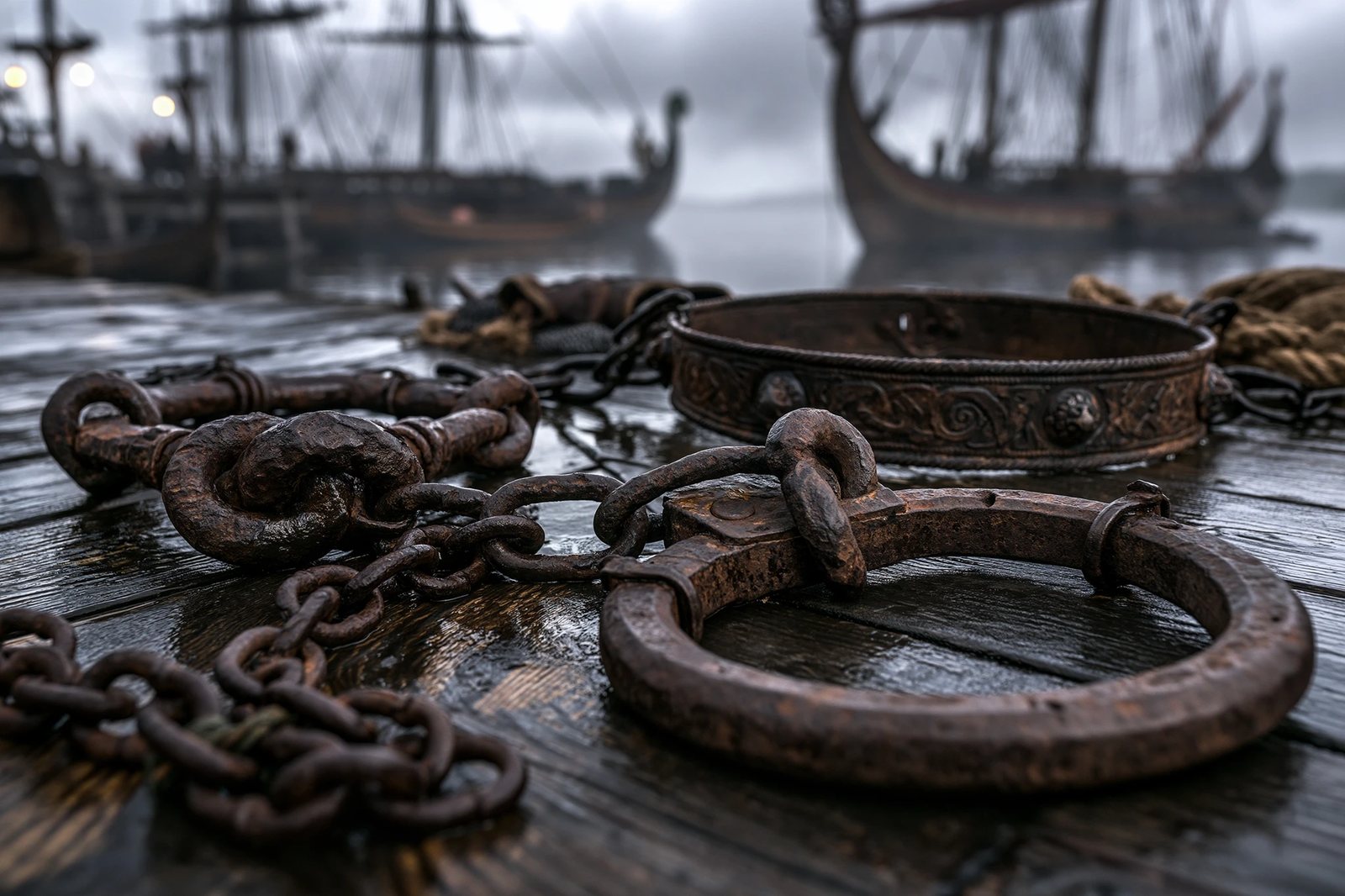
Slavery rarely leaves monuments, but traces exist. At trading places such as Birka and Haithabu, iron neck-fetters and chains have been found – objects associated with captivity and the trade in people. They are a silent but telling proof that people were chained and passed on here. Certain burials, too, in which a dead person was buried with a second, apparently violently killed individual, are discussed by scholars in connection with unfree dependence – though every single interpretation must remain cautious, since a second body in a grave can mean many things. And because the unfree were usually buried without grave-goods and often at the edge of cemeteries, they are hard to grasp archaeologically: their very poverty makes them invisible. The record nonetheless confirms what the texts suggest: unfreedom was real and reached even into death.
Unfreedom did not have to be forever. A thrall could be freed – by the master, by redemption or as a reward, for instance for loyal service. The freedman was called leysingi. Manumission was not a mere word but a formal legal act before witnesses: under Norwegian law the person to be freed had to lay down part of the redemption price in silver and then, in a rite known as the „freedom ale“ (frelsis-öl), publicly mark his new standing – only then was the transition valid and visible to the community. But freedom did not mean equality: the leysingi often remained bound by obligations and dues to his former master, could not dispose freely of his inheritance and ranked far below the born free. Only after several generations could his descendants rise fully into the ranks of the free. Manumission was thus a real road upward – but a narrow, slow one that confirmed the old order of ranks rather than abolishing it.
How Norse culture interpreted its own order of ranks is shown by the Eddic poem Rígsþula. In it the god Ríg wanders the world and fathers, with three couples, three sons from whom the three estates spring: from Þræll (Thrall) the race of the unfree, from Karl the race of free farmers, from Jarl the race of lords. The poem depicts the thrall with rough skin, a bent back and heavy labour; his children bear telling, demeaning names, and their lot is drudgery on the farm. The jarl, by contrast, learns weapons, hunting and runes. This is a view from above that glorifies the social order as given by nature and willed by the gods. That is precisely why the Rígsþula is so revealing: it is not a report about slaves but a justification of inequality from the pen of those who stood at the top – a glimpse of the unfree, but through the eyes of their masters.
Wrinkled the skin, and rough, on his hands, / knotted his knuckles, and thick his fingers; / ugly his face, and bent his back, / and long his heels. So began the race of thralls.Rígsþula (Poetic Edda), trans. Henry Adams Bellows, 1923 (public domain)
It is documented that Viking-Age Norse society had an unfree lower class and that the trade in people was a central branch of the economy (Dublin, Haithabu, Birka; trade routes across the Volga into the Caliphate and to al-Andalus). The legal status of the unfree is accessible through the – younger – law books Grágás and Gulathing, and manumission through the term leysingi and the „freedom ale“. Ibn Fadlan's account of 922 and iron neck-fetters from Birka and Haithabu provide material and written evidence. Importantly: all textual sources come from the masters' side.
The image of the Viking world as a free, egalitarian society of free farmers is one-sided. Unfreedom was ubiquitous and economically central – the farms ran to a large extent on unfree labour, and part of the famous silver wealth came from the trade in people. At the same time, caution is warranted with numbers and details: how many thralls there were and exactly what their daily life looked like is poorly documented, because the sources come almost exclusively from the masters. Anyone who looks honestly at the Viking Age must name this dark side as well.
Everyday Viking life · Hedeby · Birka – the trading hub · Ibn Fadlan & the Rus · Viking women.
Rígsþula (Poetic Edda), trans. Henry Adams Bellows, 1923; Grágás (Icelandic law book); Gulathing law; Ibn Fadlan, Volga account 922. Secondary literature/museums: National Museum of Denmark (natmus.dk); Historiska museet, Stockholm (historiska.se); R. Karras, Slavery and Society in Medieval Scandinavia. On leysingi: Norse legal tradition (frelsis-öl).
All History & Finds articles →
Many call the Varus battle the „big bang of Germany". Yet another battle shaped our lands far more deeply – one in …
Read more →