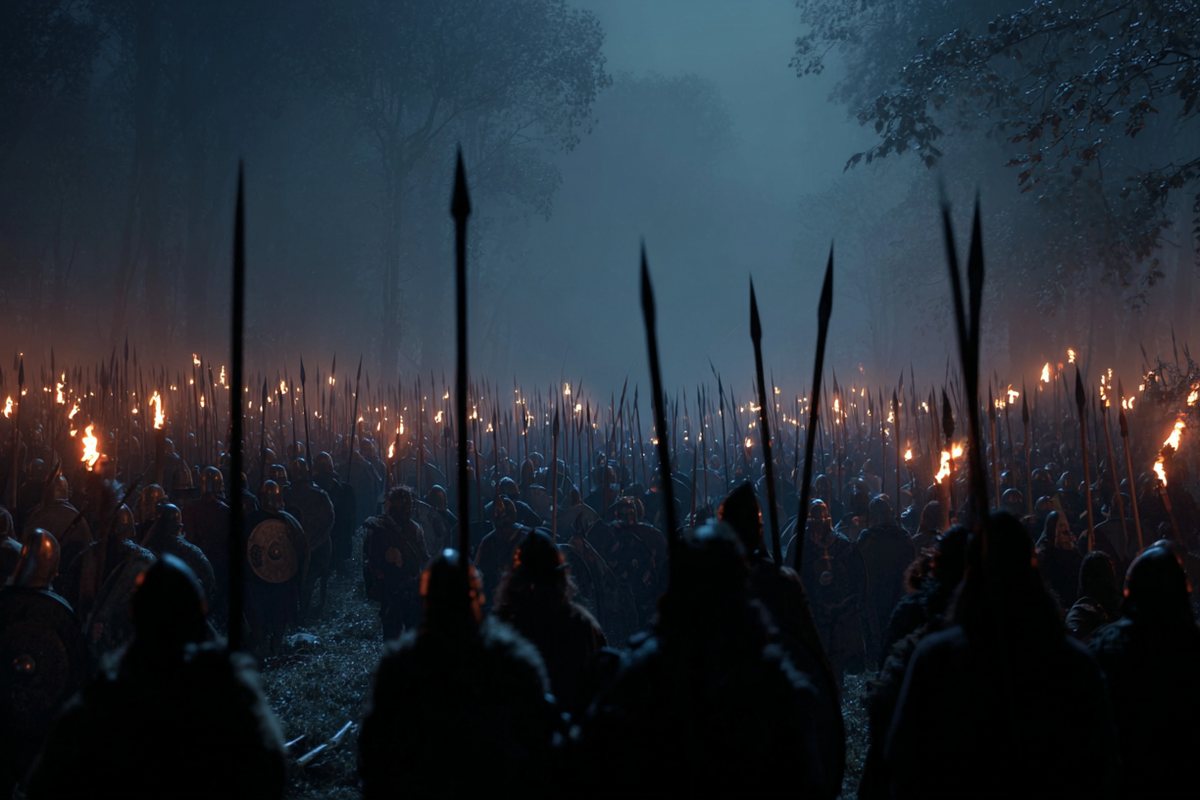
Many call the Varus battle the „big bang of Germany". Yet another battle shaped our lands far more deeply – one in which Germanic fought Germanic: at Zülpich in 496, it was decided that Europe would become Catholic. And the place lies practically on our doorstep.
The Western Roman Empire had collapsed, and Germanic tribes were struggling for supremacy. The Merovingian Clovis I led the Franks against the Alemanni – seeking to bring the strategically vital region on the Rhine under his control. At Zülpich (Latin Tolbiacum) the decision came.
The battle was part of a longer struggle; it is one of several clashes between Clovis and the Alemanni. Legend has it that the Franks were hard pressed – and in this critical moment Clovis is said to have made a momentous promise.
Clovis, as Bishop Gregory of Tours reports, called on Christ in his hour of need and swore to be baptised if he won. The Franks prevailed. Clovis kept his word: at Christmas he was baptised at Reims by Bishop Remigius – tradition says together with thousands of his warriors.
“Jesus Christ … if you grant me victory over these foes, I will believe in you and be baptised in your name.”— Clovis’s vow after Gregory of Tours, Historia Francorum II.30 (public domain)
The decisive point: Clovis chose the Catholic faith – not the Arian Christianity of most other Germanic peoples. This minimised conflict with the Gallo-Roman, long-Catholic population of his realm. The peoples merged quickly, and the Frankish empire became a core of Latin Christian Europe. Wodan’s warriors and Donar’s farmers became God’s children.
For us in the Rhineland this is close to home: Zülpich lies between Aachen, Cologne and Bonn. The Alemanni’s final defeat followed in 506 at Strasbourg; after that their northern territory fell under Frankish rule. A turning point for Europe, happening just around the corner.
Zülpich is far older than the famous battle. As the Roman Tolbiacum the place lay on the important road from Cologne to Trier, with a fort, baths and water supply. Remains of it can still be seen today. This favourable position on the trade route, in the fertile Zülpich basin, made the place important for centuries – and in the year 496 the scene of a decision that would shape Europe.
That the decisive battle fell here of all places was no accident. Zülpich lay at the crossing point of important roads between Rhine and Meuse, in the border zone between Frankish and Alemannic spheres of influence. Whoever controlled this fertile basin and its routes controlled access to the Rhineland. Thus a place right on our doorstep became the scene of a turning point whose consequences – the baptism of Clovis and the rise of the Christian Frankish kingdom – still echo across Europe today.
Donar’s Oak · The Únětice Culture · The Externsteine.
Gregory of Tours, Historia Francorum (6th c.). Dieter Geuenich (ed.): Die Franken und die Alemannen bis zur „Schlacht bei Zülpich" (496/97) (de Gruyter 1998). Bruno Bleckmann: Die Germanen (C. H. Beck 2009).
All History & Finds articles →
High above the world of humans, beyond the burning rainbow bridge, lies Asgard – the fortified home of the Æsir. It is …
Read more →Almost 1,500 years before the first Germanic peoples entered Roman history books, a highly developed Early Bronze Age …
Read more →Between the world of humans and the world of the gods a bridge of light is stretched: Bifröst, the rainbow. It is the …
Read more →Long before the Edda was written down, the people of Gotland told their stories in stone – in images that still puzzle …
Read more →