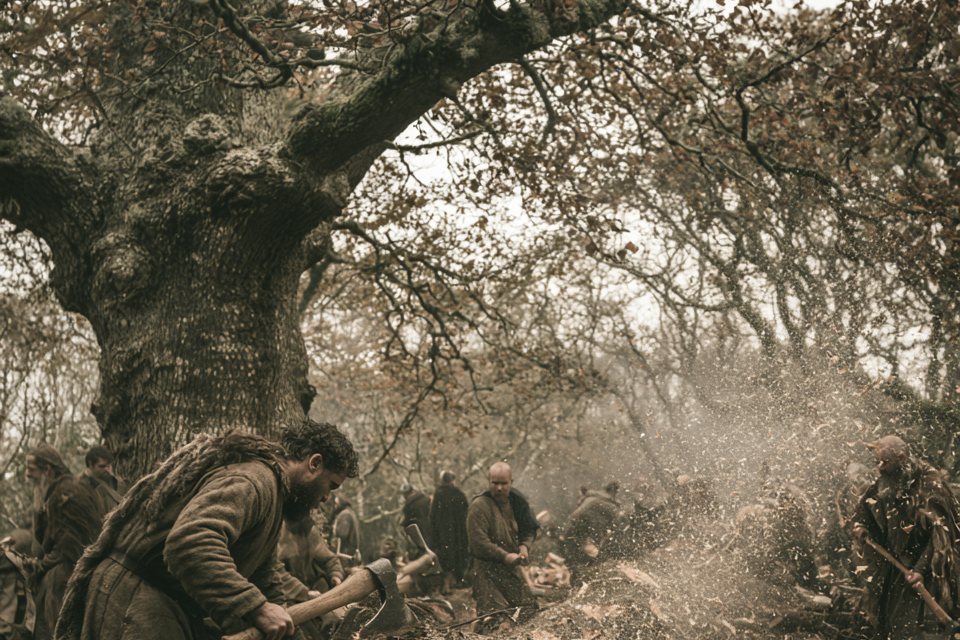
Donar's Oak (also called Thor's Oak or Jove's Oak) was a huge sacred tree in northern Hesse that the Anglo-Saxon missionary Boniface had cut down around 723 – according to the only source we have, Willibald's Life of Boniface, written some forty years later. Willibald calls it "robor Iobis", the oak of Jupiter; the name Donar comes from modern interpretation. Here we read that source line by line, check where "Gaesmere" lay, look at what was excavated at Geismar and Fritzlar, and separate the record from what later storytellers added.
An axe. A tree of astonishing size. A crowd of locals cursing the foreigner who dares to raise his blade against it. Then a creak in the crown, a blast of wind from above, and the giant crashes down and bursts into four pieces of exactly equal length. The curses fall silent. The pagans begin to believe. From the timber, the missionary builds a small wooden chapel for the apostle Peter.
That is the story. It is told once, in one text. And yet it has become one of the defining images of early medieval Germany, reproduced in school textbooks, oil paintings, monuments and, eventually, Christmas tales. At Glanz & Gravur we work with wood and stone every day, which may be why this one fascinates us: a tree of which not a single splinter survives has carved itself deeper into memory than many cathedrals. So let us look closely at what the source really says, and at what we can and cannot know beyond it.
Everything we know about the oak comes from the Vita Bonifatii, the Life of Saint Boniface. Its author was Willibald, an Anglo-Saxon priest living in Mainz, who wrote it probably between 763 and 768 at the request of Boniface's successor, Archbishop Lul of Mainz, and Bishop Megingoz of Würzburg. Willibald never met Boniface. He relied on the memories of disciples and companions; whether he also used Boniface's letters is debated.
Two facts shape everything else. First, roughly forty years separate the event from the text. Second, the text is hagiography: a saint's life, written to present its subject as holy and worthy of imitation, not to file a neutral report. Willibald's models included Gregory the Great's Dialogues, a collection of miracle stories, and miracles and the triumph over paganism belong to the genre's basic blueprint.
The episode sits in chapter 6 of the Vita in the standard edition by Wilhelm Levison (Monumenta Germaniae Historica, 1905). Willibald gives no year. The usual date of 723, or 723/724, is inferred from context: Boniface had been consecrated bishop in Rome in November 722 and then received a letter of protection from the Frankish mayor of the palace, Charles Martel. Only after that did he return to Hesse, and that is where Willibald places the scene.
Willibald first describes the state of the Hessians. Many had already accepted the faith and been confirmed by the laying on of hands. Others, he says, sacrificed secretly or openly to "trees and springs" (lignis et fontibus), practised divination from entrails, soothsaying, spells and incantations. This is not a solid pagan block resisting a Christian one. It is a mixed landscape where old and new practices overlapped.
Then comes the key sentence. On the advice of those Hessians who had rejected the old rites (quorum consultu atque consilio), Boniface set out to fell an oak "of wondrous size" (roborem quendam mirae magnitudinis), which "in the ancient term of the pagans" was called robor Iobis, the oak of Jupiter. It stood "at a place called Gaesmere".
A great crowd of pagans was present, cursing the enemy of their gods. But when the tree had been cut only a little, the vast trunk was shaken "by a divine breath from above" (divino desuper flatu), its crown broke, it fell and split into four parts – four huge trunks of equal length, and, Willibald stresses, without any effort from the brethren standing by. The pagans who had been cursing now blessed the Lord and believed. After consulting his companions, Boniface used the timber to build a wooden oratory, a small house of prayer, and dedicated it to Saint Peter the apostle. Then he moved on to Thuringia.
Here is a detail that many retellings skip: Willibald never writes "Donar". He writes Iobis, the genitive of Jupiter in the spelling of his day (classical robur Iovis). Identifying this Jupiter with the Germanic thunder god is an inference – but a well-founded one.
Since Roman times, foreign gods had been described with Roman names, a practice scholars call interpretatio romana. The days of the week show how firmly Jupiter was equated with the thunder god: the Latin dies Iovis became German Donnerstag and English Thursday. Our article on the Germanic days of the week traces this in detail. A text from the very milieu of the mission supports the equation too. The Old Saxon baptismal vow, preserved in a manuscript of the eighth or ninth century, has converts expressly renounce "Thunaer ende Uuoden ende Saxnote" – Donar, Woden and Saxnot. The thunder god was a living name among the continental Germanic peoples of the time, and the missionaries targeted him by name.
For more on this god before he became the Norse Thor, see our pieces on Donar, the Germanic thunder god and on Wodan, Donar and Ziu. Note that Tacitus usually calls the Germanic strongman god Hercules rather than Jupiter, a reminder that the Roman labels shifted over time; our article on Hercules Magusanus shows the same pattern on the Lower Rhine.
Put honestly: in the source, the tree is "Jupiter's oak". That the Hessians linked it to their thunder god is highly likely. What they called it themselves, we do not know. "Donar's Oak" is a label coined by modern scholarship and memory.
Does that make the story fiction? No. Most historians accept a real event behind it: a missionary under Frankish protection publicly fells a revered tree and builds a church from its wood. That fits everything we know about early medieval mission. But the story has been shaped, and in places the hagiographer's hand is plain to see.
The wind from above. A tree toppled by a heavenly breath after a few strokes is a miracle, not a weather report. The message is that God himself, not a man, brings the tree down. Whether a real gust helped, or whether the felling took hours, we cannot say.
Four equal trunks. A tree breaking into four pieces of precisely the same length is physically far-fetched and narratively loaded. Willibald does not explain whether he had the four Gospels, the four corners of the world or the cross in mind. Later retellings liked to turn the four pieces into a cross; that is not in the source.
Instant conversion. The switch from curse to praise within a single sentence is a stock pattern. Letters from Boniface's circle paint a slower picture: decades later, popes and synods still complained about sacrifices at groves and springs, lot-casting and amulets. The council of 743, known as the Concilium Germanicum, explicitly banned pagan sacrifice and soothsaying. The Indiculus superstitionum et paganiarum, an eighth-century list of forbidden customs, includes "sanctuaries in the woods" and feasts held for Jupiter and Mercury. One axe did not end that world in an afternoon.
Frankish power. No soldiers appear in the scene. But Willibald mentions Charles Martel's protection just before it, and Boniface himself later wrote to Bishop Daniel of Winchester that without the Frankish ruler's protection he could neither govern his church nor prevent idolatry. Anyone who fells the most revered tree of a district in front of a hostile crowd and walks away unharmed has backing. The Frankish fortress on the Büraberg lay within sight.
Daniel of Winchester offers a counter-image. In a letter he advised Boniface not to mock the pagans but to ask them questions, such as whether their gods had a beginning. Mission knew conversation as well as the axe. For his portrait of a saint, Willibald chose the more dramatic scene.
Willibald names the place but does not describe it. The Reallexikon der Germanischen Altertumskunde suggests he assumed his readers knew where it was. Since the nineteenth century, scholars have almost unanimously identified Gaesmere with Geismar near Fritzlar, today a district of the town of Fritzlar in northern Hesse. The main argument is proximity to the Frankish stronghold of Büraburg and the later monastery of Fritzlar, the bases of the mission.
The picture is not entirely settled. Other places called Geismar have been proposed, including Hofgeismar and Geismar near Frankenberg, and some scholars, among them the translator George W. Robinson (1916) and the historian Thomas F. X. Noble (2000), explicitly called the site unidentified. Around Fritzlar there is a further debate about the exact spot. A widespread view places Peter's oratory where Fritzlar's cathedral of St Peter stands today, though no trace of it has been found there. Whether the oak itself stood on the cathedral hill, which may have belonged to the territory of Geismar, or whether tree and chapel stood in different places, remains open. The Johanniskirchenkopf, a hill north-west of Geismar, has also been suggested.
As for the name: Gaesmere belongs to a family of place-names ending in -mar, which are linked with standing water, marsh or springs. The first element is often read as "bubbling, welling up". That would suit the mineral spring north-west of Geismar known as the Sauerbrunnen, nowadays also nicknamed the "Donar spring". The etymology is not certain, though, and the nickname is modern; no source links a Donar cult to that spring. Willibald's formula "trees and springs" does show that the two belonged together; read more in our article on sacred springs.
After 1,300 years an oak leaves nothing to dig up, least of all one whose wood went into a church. What archaeology can show is the setting, and at Geismar that setting has been unusually well studied.
Between 1973 and 1980, Hesse's state archaeology service, funded by the German Research Foundation, excavated a large settlement south-south-west of the modern village, known as Alt-Geismar ("Old Geismar"). Andreas Thiedmann published the full analysis in 2019. The result is a village site occupied from the pre-Roman Iron Age, roughly from the second century BC, into the age of the Salian emperors in the eleventh century. People lived on the same spot for more than a thousand years, through the Roman period, the Migration Period and Christianisation. Boniface's Gaesmere was no lonely forest shrine in the wilderness but part of a long-settled farming landscape.
No cult site, sacred enclosure or tree pit has been found. Anyone claiming otherwise should be asked for the evidence.
The Frankish side is easier to grasp. The Büraburg, a fortified hilltop on the south bank of the river Eder opposite Fritzlar, was a Frankish stronghold with a mortared wall and several gates. Archaeological dating suggests it existed before Boniface and was strengthened during the eighth century. In 742 Boniface made it a bishop's see, alongside Würzburg and Erfurt, with his companion Witta as its first bishop. The diocese was short-lived and was absorbed into Mainz.
Who was the man with the axe? Boniface was born Wynfreth in Wessex around 675. After a failed first mission to Frisia in 716 he went to Rome, where Pope Gregory II gave him a missionary commission in May 719, along with the name Boniface. After working alongside Willibrord in Frisia, he turned to Hesse in 721 and founded a first cell at Amöneburg. In November 722 he was consecrated bishop in Rome – without a fixed see, bound directly to the pope.
So the Hessian mission was not a first encounter with Christianity. There were already Christians in the region, but, as Willibald himself hints, with plenty of hybrid practice. Felling the tree was a signal: to the hesitant, to the baptised who still sacrificed in secret, and to the Frankish lords.
From Peter's oratory, Fritzlar grew. Boniface founded a monastery there with a church of Saint Peter; its first abbot was Wigbert. A date around 732 is usually given. Today's cathedral of St Peter stands on the site, although no remains of the first building have been found; the foundations uncovered in 1970 belong to a predecessor of the late eighth century or later.
The Royal Frankish Annals add an epilogue. For 774 (entered under 773), they describe a Saxon raid into Hesse while Charlemagne was in Italy. The Saxons tried to burn the church at Fritzlar that Boniface had consecrated and that, he had prophesied, would never burn; two young men on white horses protected it, and the raiders fled in terror. The note is a later marginal addition and is missing from one manuscript, but it shows how early the place was remembered as Boniface's own. The wider story of those wars is told in our article on the Saxons.
The people Willibald calls Hessians (Hessi) first appear under that name in the eighth century. In Roman times the same area was home to the Chatti, whom Tacitus describes as unusually disciplined. In AD 15, Germanicus burned their chief place, Mattium, whose location is still disputed. Most linguists think the name "Hesse" derives from "Chatti", but the derivation is not beyond doubt, and a name alone cannot prove an unbroken population.
By 700 the region had long been under Frankish rule, yet barely organised as a church. Boniface did not arrive as a conqueror but as an organiser of a church under the shelter of an existing power. How that process unfolded over centuries is the subject of our article on the Christianisation of the Germanic peoples.
The oak at Geismar does not stand alone. Around AD 98, the Roman historian Tacitus wrote in his Germania (chapter 9) that the Germans consecrated groves and woods to their gods and gave divine names to that hidden presence they perceived only in awe. In chapter 39 he describes the sacred grove of the Semnones, which could be entered only in bonds – see our article on the grove of the Semnones. In his Annals he mentions a forest sacred to "Hercules" near the Weser, where the Cherusci gathered in AD 16.
Tacitus wrote as a Roman about outsiders, more than 600 years before Boniface. He does not prove an unbroken tradition leading to Geismar, but he shows that sacred trees and groves struck Roman observers as a hallmark of Germanic religion. For the bigger picture, read our overviews of sacred trees and groves and of Germanic religion.
Why the oak for the thunder god? A common explanation is that tall, free-standing oaks are struck by lightning more often than other trees. That sounds convincing, but it is a modern explanation, not an ancient testimony. Elsewhere, too, oaks belonged to the sky and weather god – think of the oak of Zeus at Dodona – but whether this points to a shared root is debated.
There are later comparisons in the North as well. Around 1075, a marginal note to Adam of Bremen's history of the archbishops of Hamburg describes a huge evergreen tree beside the temple at Uppsala. Some scholars see such trees as earthly counterparts of the world tree Yggdrasil. That is an interpretation, not a finding, and it cannot be demonstrated for Geismar.
Donar's Oak and the Irminsul are often confused or merged. They were two different sanctuaries of two different peoples in two very different situations. The Irminsul was a Saxon sanctuary destroyed by Charlemagne in 772, the first year of his Saxon Wars, near the Eresburg, usually placed at today's Obermarsberg. The Royal Frankish Annals report its destruction briefly. About ninety years later, Rudolf of Fulda described it as a large upright wooden trunk worshipped under the open sky and translated its name as "universal pillar".
The differences are telling. At Geismar a missionary with local support and the backing of an established power fells a tree; a church is built from the wood, and the story ends in conversion. At the Irminsul a king at war destroys the sanctuary of a people not yet subdued, and three decades of fighting follow. Both later became symbols. Historically, they belong to different worlds.
Boniface was killed near Dokkum in Frisia in 754 and buried at Fulda. He was soon revered as the "Apostle of the Germans", and the oak became his emblem; many images show him with an axe or a book.
In the nineteenth century, when national history and church memory flourished in Germany, the story found a new stage. In 1842 Werner Henschel's large Boniface monument was unveiled in Fulda, and the Geismar scene became the textbook image of the end of paganism. Later retellings embellished it: sometimes the tree falls in the shape of a cross, sometimes a young fir springs up in its place. That Christmas-tree legend comes from devotional stories of the late nineteenth century, not from the source. In Fritzlar a statue of Boniface has commemorated the felling since 1999; it is not uncontroversial locally.
Strip away the embellishments and a strikingly plain core remains. In the 720s a very large, revered tree stood in Hesse, which Christians associated with Jupiter and thus most likely with the thunder god. Boniface had it felled with local support and used the timber for a church of Saint Peter. That suited his programme of not just destroying old cult places but taking them over.
Everything else – the wind from above, the four trunks, the instant conversion, and later the missing thunderbolt, the cross and the fir tree – is storytelling. That does not make the story worthless. It shows how memory works: it condenses and it interprets. The wood of a tree that no longer exists still carries a whole library of images.
Where did Donar's Oak stand? According to Willibald, "at a place called Gaesmere". Scholars almost unanimously identify this with Geismar near Fritzlar in northern Hesse, Germany; the exact spot, possibly today's cathedral hill in Fritzlar, is not certain.
When did Saint Boniface cut down Donar's Oak? The source gives no year. Context places it after his consecration as bishop in November 722, so 723 or 723/724 is the usual date.
Why is it called Donar's Oak if the source says Jupiter? Willibald writes "robor Iobis", the oak of Jupiter. Romans and learned Christians equated Jupiter with the Germanic thunder god, as the weekday Thursday shows. "Donar's Oak" is a well-founded modern label, not a word from the source.
Is there archaeological evidence of Donar's Oak? No. A settlement near Geismar, inhabited from the Iron Age into the High Middle Ages, was excavated between 1973 and 1980, but no cult site and no remains of the tree were found.
Is Donar's Oak the same as the Irminsul? No. The oak stood in Hesse around 723; the Irminsul was a Saxon sanctuary destroyed by Charlemagne in 772.
Did Donar's Oak give rise to the first Christmas tree? No. That legend comes from nineteenth-century retellings; Willibald only reports a house of prayer built from the oak's timber.
For courage. For remembrance. For legends that live on.
Thor / Donar · Thor’s Hammer · The Externsteine.
All History & Finds articles →
Vikings were not only raiders. In the Rhine-Meuse delta they sat in the very middle of the greatest trading centre of …
Read more →Some 1,700 years ago a man from the Near East settled in a Germanic village in present-day Thuringia – and rose into …
Read more →Two horns of heavy gold, covered all over with puzzling figures, and on one of them a line of runes in which, for the …
Read more →The Roman Tacitus praised Germanic women as chaste, honoured and even brave at the edge of battle. But above all he was …
Read more →