
Seeresses to whom Roman generals sent envoys. Women who counted their men's wounds at the edge of battle. Queens who ruled kingdoms. And a Roman author who wrote it all down to hold up a mirror to his own countrymen. Anyone who wants to understand the women of the Germanic peoples first has to learn to read the sources against the grain.
This article deals with the Germanic peoples of antiquity and the Migration Period, roughly from the first century BC to the seventh century AD. The women of the later Viking Age have their own, equally detailed article: Women in the Viking Age. At the end there is a short comparison of what continues between the two periods and what does not.
"The Germani" were not one people with a shared government, language and culture, as the 19th century imagined. The name is a Roman umbrella term for dozens of tribes east of the Rhine and north of the Danube, who fought each other, allied and constantly regrouped. What held for the Cherusci on the Weser need not have held for the Goths on the Black Sea. For that reason alone, any statement about "the Germanic woman" is a simplification.
On top of that comes a source problem greater than for the Vikings. The Germanic peoples of antiquity wrote down almost nothing themselves. What we read about them comes from Greeks and Romans: from Caesar, who waged war on them, from Strabo and Plutarch, who reported on the Cimbri, from Cassius Dio and above all from Tacitus. Only from the fifth century onwards are their own texts added – the law codes of the Germanic kingdoms, the so-called leges barbarorum, written in Latin and already under Christian influence.
The third source is archaeology: graves, settlements, bog finds, clothing. It speaks directly from the period, but it speaks silently. A grave shows what someone was given, not what they thought or were allowed to do.
Around AD 98 the Roman senator and historian Publius Cornelius Tacitus wrote a slim book about the Germanic peoples, the Germania. It is the most detailed ancient text about them, and it is full of statements about women. The problem: Tacitus had probably never been to Germania himself. He relied on older works, such as the lost German Wars of Pliny the Elder, and on reports from traders and soldiers.
Above all, he had an agenda. The Germania is also a moral mirror. Where Tacitus praises the Germanic peoples, he often criticises Rome at the same time: the adultery of the Roman upper class, childlessness, luxury, the hunt for inheritances. His Germanic women are chaste, faithful, brave and simple – exactly what, in his eyes, the Roman women of his day no longer were. That does not mean he invented everything. But it does mean that with every fine sentence one must ask whom it serves.
Scholars call a second filter the interpretatio Romana: Tacitus describes the foreign in Roman terms. When he speaks of a dowry, he means a Roman legal concept that may not have fitted Germanic conditions at all. When he calls deities Mercury or Hercules, we do not know which Germanic gods stood behind them.
On marriage Tacitus is surprisingly specific in chapters 18 and 19. The Germani, he says, are almost the only barbarians content with a single wife; only a few nobles have several wives, not out of lust but because of their rank, since alliances are sought with them.
Then comes an observation that must have astonished Roman readers: it is not the wife who brings the husband a dowry, but the husband the wife. Parents and relatives inspect the gifts – not trinkets, but cattle, a bridled horse, a shield with spear and sword. The wife in turn brings the husband a weapon. In this, Tacitus says, they see the strongest bond, their sacred mysteries, the gods of marriage. The woman is not to think herself outside of courage and war; she comes as a partner in toil and danger.
What lies behind this? Most historians see the "husband's dowry" as a bride gift of the kind known from many later Germanic laws: a payment by the groom to the bride's family that at the same time was meant to secure the woman. Perhaps Tacitus did not know the difference between the Roman dos and a bride price, or he used the reversal deliberately as a punchline. The exchange of weapons, on the other hand, is hard to interpret. Whether it actually took place like this or whether Tacitus exaggerated a symbolic gift cannot be decided.
Chapter 19 brings the reverse side. Adultery, he says, is very rare, but the punishment is immediate and left to the husband: he cuts off the woman's hair, drives her naked out of the house in front of the relatives and flogs her through the whole village. A woman who has lost her honour finds no new husband, neither through beauty nor youth nor wealth. In some tribes only virgins married at all, and widows did not marry again.
This passage is a model example of Tacitus' intent: it reads like a sermon against Roman society, in which divorce and remarriage were commonplace among the upper class. How widespread such punishments really were among the Germani, we do not know. One thing is certain: the bog bodies that were happily explained by this chapter in the 20th century are of little use for it. More on that below.
Tacitus writes less about everyday life, but what he writes is revealing. In chapter 15 he claims that between wars the men spent their time hunting, but above all sleeping and eating. The care of house, hearth and fields they left to the women, the old and the weakest of the family. This is exaggerated and fits a Roman cliché of the lazy barbarian. Still, there is probably a kernel of truth in it: a large part of daily work in the farming economy lay with the women.
What this work involved is shown by settlement finds. In the longhouses of the Roman Iron Age, for example in the terp settlement of Feddersen Wierde at the mouth of the Weser, people and livestock lived under one roof. Loom weights, spindle whorls, quernstones and pottery stand for tasks that, by comparison with later sources, are attributed mainly to women: textile production, grain processing, cooking, storage, dairying. In individual cases the attribution is not certain, because tools do not reveal who used them.
On children, Tacitus notes in chapter 20 that every mother nursed her own children and did not hand them over to maids or wet nurses – another dig at the Roman upper class. Another sentence is remarkable: a sister's sons were held in the same honour by their uncle as by their own father, and some even considered this bond more sacred and closer. Hence sister's sons were preferred as hostages. This special role of the mother's brother is also known from later Germanic and Norse sources. It shows that kinship through the mother carried weight, without any "mother right" following from it.
Tacitus even comments on clothing in chapter 17: the women wore the same dress as the men, only more often linen garments decorated with purple. The upper part was sleeveless, arms and shoulders were bare, and the upper part of the breast was visible. Whether "purple" really means the expensive dye or simply red decoration is unknown. The bog finds, at any rate, show mainly wool.
One image runs through several ancient reports: Germanic women accompanied their men to war, not as fighters in the battle line, but behind it. Tacitus writes in chapter 7 that their families were close to the fighters; one could hear the wailing of the women and the crying of the children. They were each man's most sacred witnesses and greatest praisers. To their mothers and wives the warriors brought their wounds, and the women were not afraid to count and examine them; they brought the fighters food and encouragement.
In chapter 8 he adds: it is reported that some battle lines already wavering were restored by the women, through persistent pleading, by baring their breasts and pointing to the captivity that threatened. The men feared this far more for their women than for themselves.
Here Tacitus has better support than on marriage, because older sources say similar things. Caesar describes how the Germani under Ariovistus drew up their army in 58 BC and placed wagons and carts all around so that no hope of flight remained. On them they set the women, who with tears and outstretched hands begged the men not to let them fall into Roman slavery (De bello Gallico I, 51).
Even more drastic is a report on the Cimbri, whose migration shook Rome around 100 BC. After the defeat at Vercellae in 101, according to Plutarch, the women defended the wagon fort. Dressed in black, they stood on the wagons and killed those who fled – their own husbands, brothers and fathers – then their children and finally themselves (Marius 27). Plutarch wrote some two hundred years after the events. The account is dramatically heightened, and yet it shows something that fits the other sources: the women came along, and their fate hung on the outcome of the battle.
It does not follow that Germanic women regularly fought with weapons. No ancient author describes Germanic women warriors in the battle line as the normal case. They stood at the edge; they supplied, cheered on and had the most to lose if the battle was lost.
On one point all sources agree: among the Germanic peoples, women had a special closeness to the sacred. Tacitus puts it this way in chapter 8: they believed there was something holy and prophetic in women, and therefore they neither scorned their advice nor ignored their answers.
"They even believe that there is something holy and prophetic in women, and so they neither reject their advice nor disregard their answers."— Tacitus, Germania 8
Caesar already knew this. He reports that Ariovistus delayed battle because the matres familiae, the mothers of families, had declared by lots and divination that the Germani could not win if they fought before the new moon (De bello Gallico I, 50).
Far darker is Strabo on the Cimbri (Geography 7.2.3). Their priestesses were grey-haired, dressed in white, with linen cloaks fastened by clasps, bronze girdles and bare feet. They met the prisoners of war in the camp with swords, crowned them with wreaths and led them to a great bronze cauldron, cut their throats over it and prophesied from the blood; others opened the bodies and foretold victory from the entrails. How much of this is observation and how much Greek horror story cannot be settled. It is striking that Strabo's description has repeatedly been linked to the Gundestrup silver cauldron, without any connection being demonstrable.
The most famous seeress is Veleda of the Bructeri. During the Batavian revolt of AD 69–70 she became a political force. Tacitus reports in the Histories that she lived in a tower on the Lippe and stayed invisible to people so that her veneration would grow; envoys were not admitted to her, and a relative carried questions and answers. She had foretold the rebels' success. The rebels sent her the captured Roman legate Munius Lupercus as a gift, who was killed on the way, and later a captured Roman flagship, which they rowed up the Lippe. Even the city of Cologne sought her mediation in a dispute.
What became of Veleda afterwards is uncertain. A poem by Statius suggests that around AD 77 she fell into Roman hands – whether as a prisoner or as a refugee is open. When Tacitus wrote the Germania, she was dead. He mentions her there together with Albruna, another venerated woman, whose name, however, is uncertain in the manuscripts. More about Veleda in her own article Veleda.
The series continues. According to Cassius Dio, around AD 86 a seeress named Ganna, said to have succeeded Veleda, travelled with Masyos, king of the Semnones, to Rome to Emperor Domitian, was received with honours and returned home. And on a potsherd from Elephantine in Egypt, probably from the second century, there is a name that has been read as "Waluburg, Semnonian sibyl". The reading is disputed and the context unclear. But if it is right, a Germanic seeress stood on a Roman pay list on the Nile.
These women were not witches on the margins of society but political actors. Their word could forge alliances and influence wars. Their power, however, rested on a role that men granted them – and that could vanish as soon as a prophecy failed. More on these roles in the articles on Germanic priests and seeresses and on Germanic oracles.
That women stood close to the sacred is also shown by the goddesses. In chapter 40 of the Germania Tacitus describes the cult of Nerthus, whom he calls "Terra Mater", Mother Earth. Seven tribes worshipped her together. In a sacred grove on an island in the ocean stood her veiled wagon, which only a priest was allowed to touch. When he sensed that the goddess was present, the wagon was drawn through the land by cows; then peace reigned and all weapons were locked away. Afterwards wagon, cloth and goddess were washed in a hidden lake, and the slaves who helped were at once swallowed by the same lake. Where Tacitus got this description and how accurate it is, nobody knows. The sanctuary has not been securely located by archaeology.
Far better documented are the Matronae. In the Rhineland, especially between Cologne, Bonn and the Eifel, a great many votive stones survive from the second and third centuries, dedicated to groups of usually three mother goddesses with epithets such as Aufaniae or Vacallinehae. The stones show them seated, two with large round bonnets, one with loose hair in the middle. They were dedicated by Germani, Celts and Romans alike. The cult is thus a hybrid of the frontier region – but it shows how firmly female protective powers were anchored in belief.
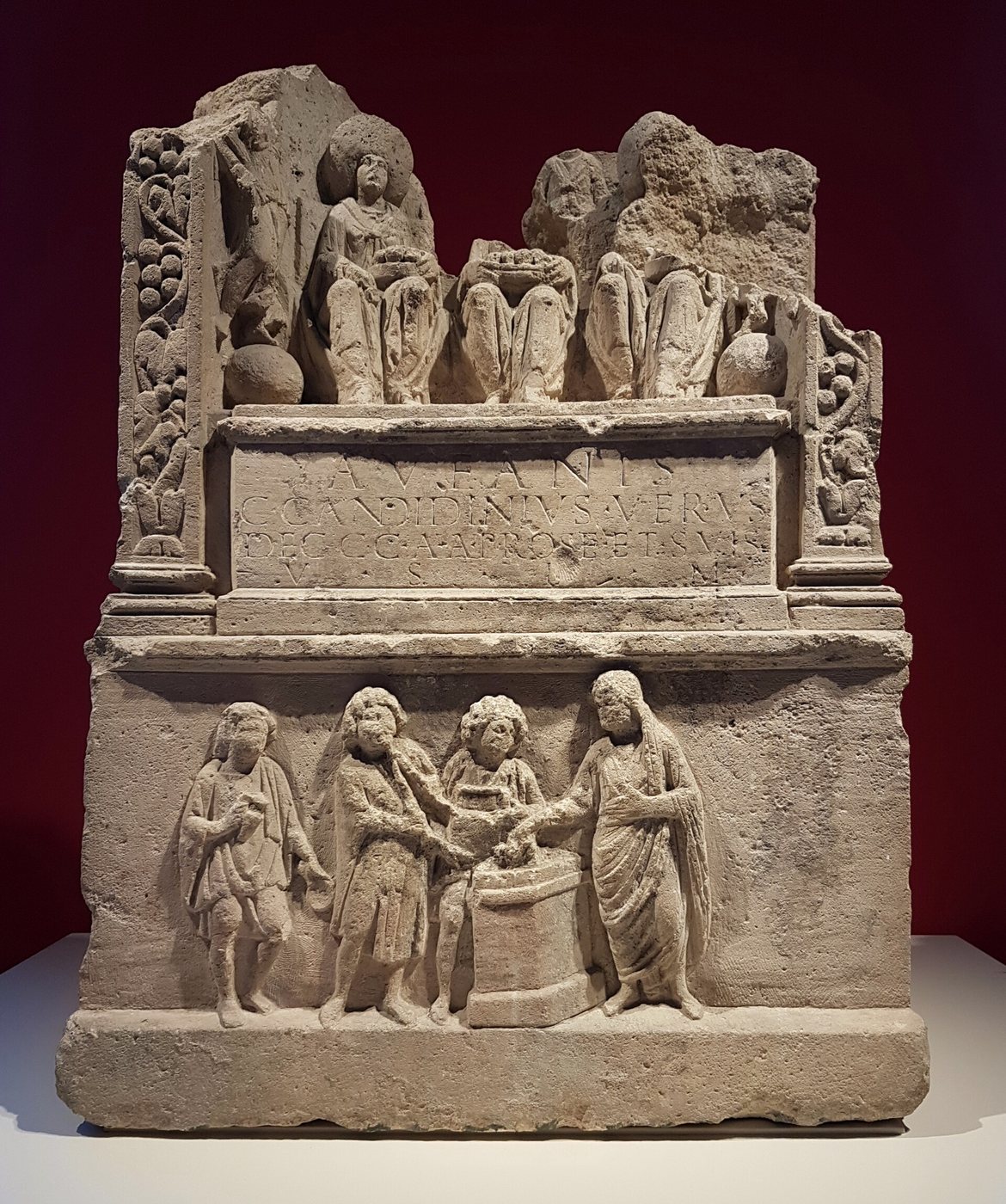
Then there are goddesses known only by name: Tanfana, whose sanctuary Germanicus destroyed in AD 14; Baduhenna, in whose grove Roman soldiers were killed in AD 28; or Nehalennia at the mouth of the Scheldt. How they were worshipped we barely know. But they exist, and there are many of them.
Only one Germanic woman of antiquity is known to us with a real life story: Thusnelda, daughter of the Cheruscan noble Segestes. Her father was pro-Roman. She, however, became the wife of Arminius, who in AD 9 had destroyed three Roman legions in the Teutoburg Forest, against her father's will. Tacitus speaks of an abduction; whether the bride was willing he does not say.
In AD 15 Thusnelda fell into Roman captivity – not in battle, but because her own father handed her over to Germanicus. Tacitus describes her in the Annals with a remarkable sentence: she was more of her husband's spirit than her father's, did not weep or plead for mercy, but held her hands folded in her robe, her gaze on her pregnant belly. In captivity she gave birth to a son, Thumelicus. In AD 17 she was led through Rome in the triumph of Germanicus; the geographer Strabo explicitly names her and her three-year-old son among the captives. After that her trail fades.
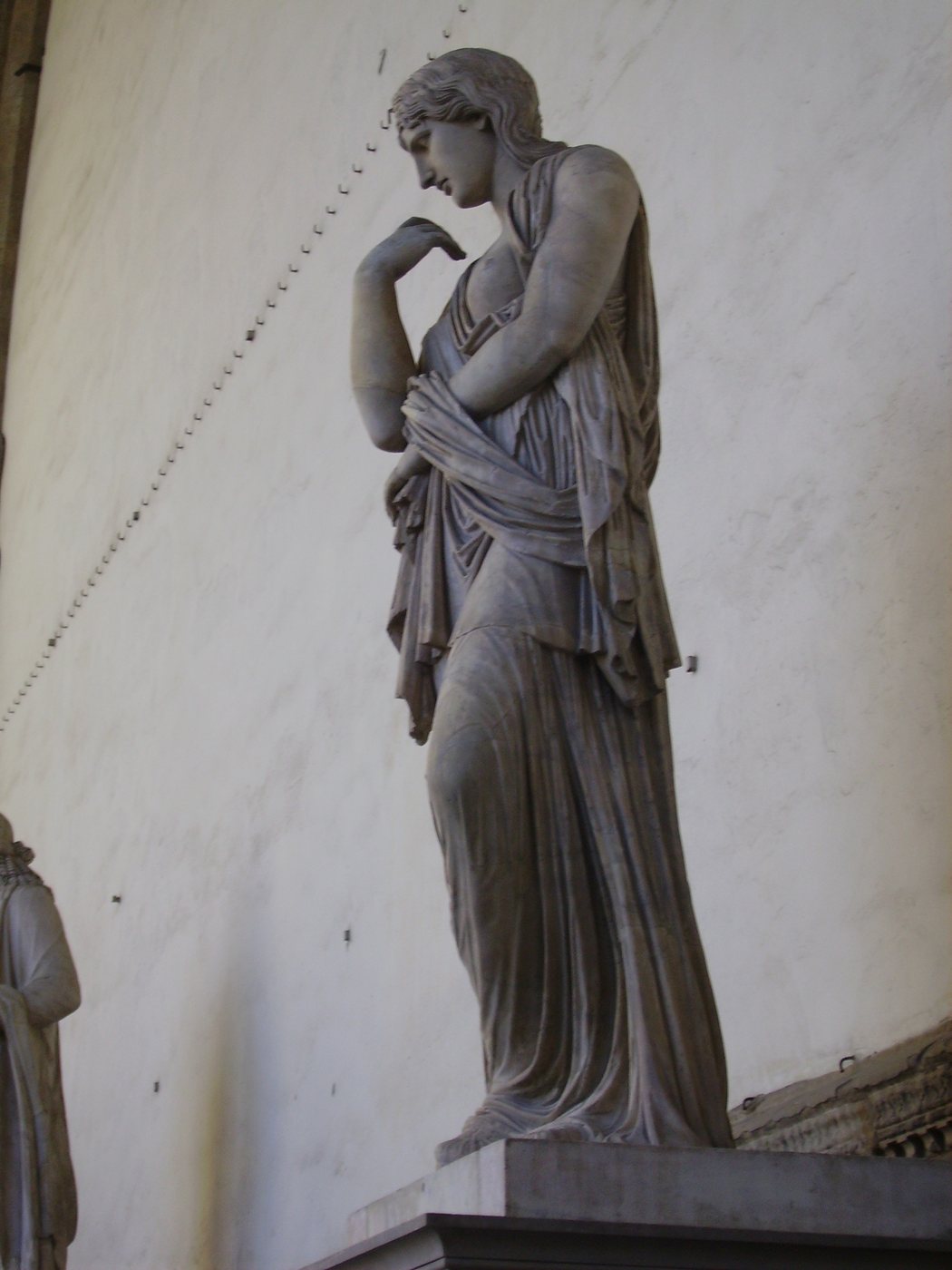
Thusnelda is a stroke of luck for the record, but also a lesson. We know her only because, for Roman authors, she was a figure in the drama between Arminius and Rome. What she herself wanted we learn only through the eyes of a historian who admired the dignity and defiance of a defeated enemy.
In the bogs of northern Germany, Denmark and the Netherlands, people from the pre-Roman Iron Age and the Roman period have been preserved with skin, hair and clothing. Several women are among them. They strongly shaped the image of the Germanic peoples in the 20th century, often in ways that must now be corrected.
The best-known example of such a correction is Windeby I from Schleswig-Holstein. Found in 1952, the body was interpreted as a girl, with a band over the eyes and hair shaved on one side. The find was linked to Tacitus' punishment of adulteresses and described as a punishment. New studies led by the anthropologist Heather Gill-Robinson in the mid-2000s showed: the person was a boy of about 13 or 14. The band was probably a hair band that had slipped, the bare side of the head a result of decay and recovery. The "Windeby girl" became a textbook example of how strongly a source like Tacitus can steer the interpretation of a find.
Real women from the bog do exist, though. The Haraldskær Woman in Jutland died around 490 BC; in the 19th century she was taken for the legendary Queen Gunnhild. The Huldremose Woman, also from Jutland, wore sheepskin capes, a checked woollen skirt and a scarf. Her clothing is one of the best sources for how women dressed in the Iron Age of the North.
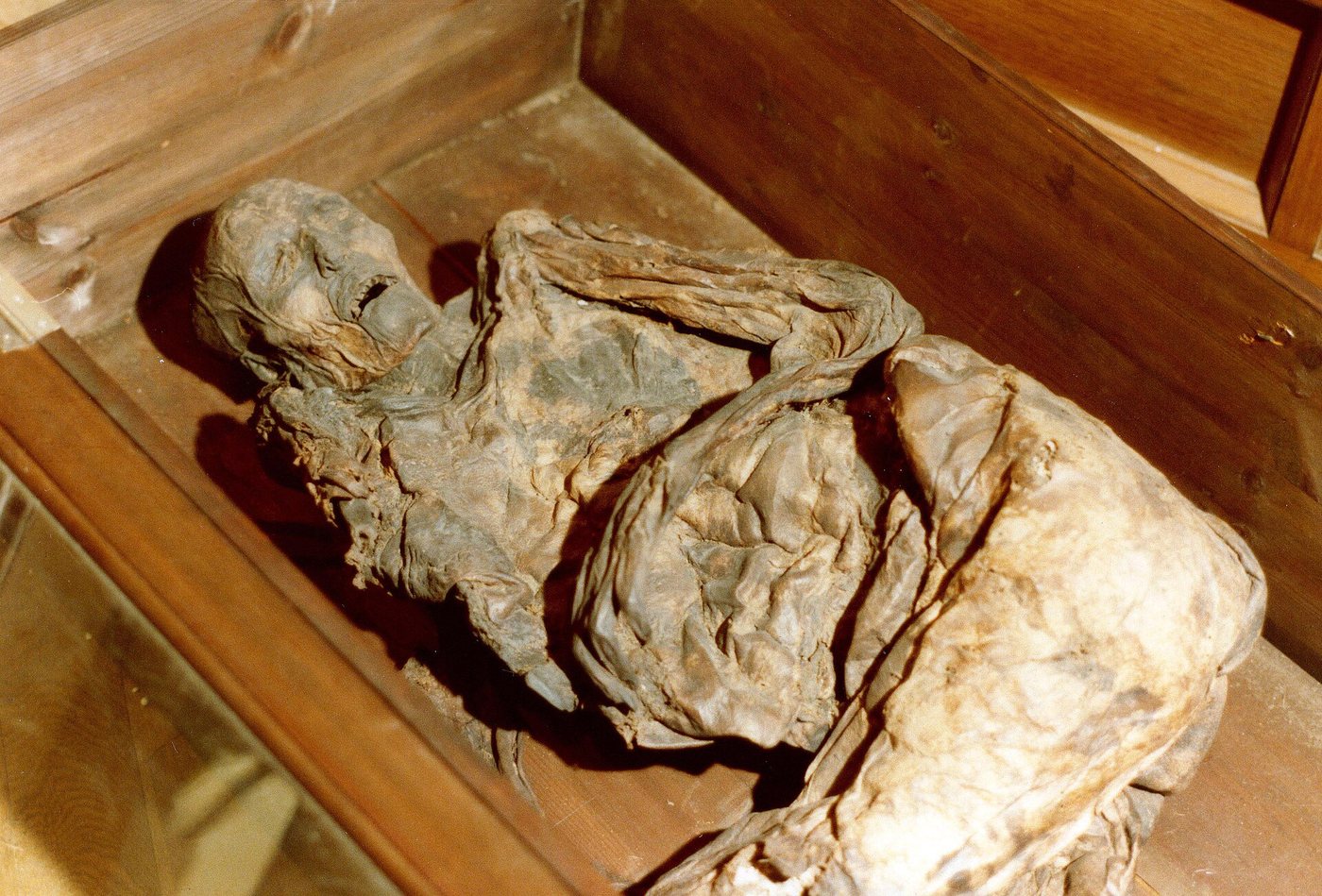
Whether the dead in the bogs were sacrifices, executed people or accident victims differs from case to case and often cannot be determined. The finds do not support a blanket talk of "Germanic punishments of women". More in the article on sacrificial bogs.
Women's clothing can be traced fairly well over the centuries. In the Iron Age and the Roman period, women in the Germanic world often wore a tubular garment held at both shoulders by brooches, a kind of peplos, with further layers beneath or above. Roman depictions of Germanic women, for instance on victory monuments, show sleeveless dresses and long cloaks, though with such images one must always reckon with Roman clichés.
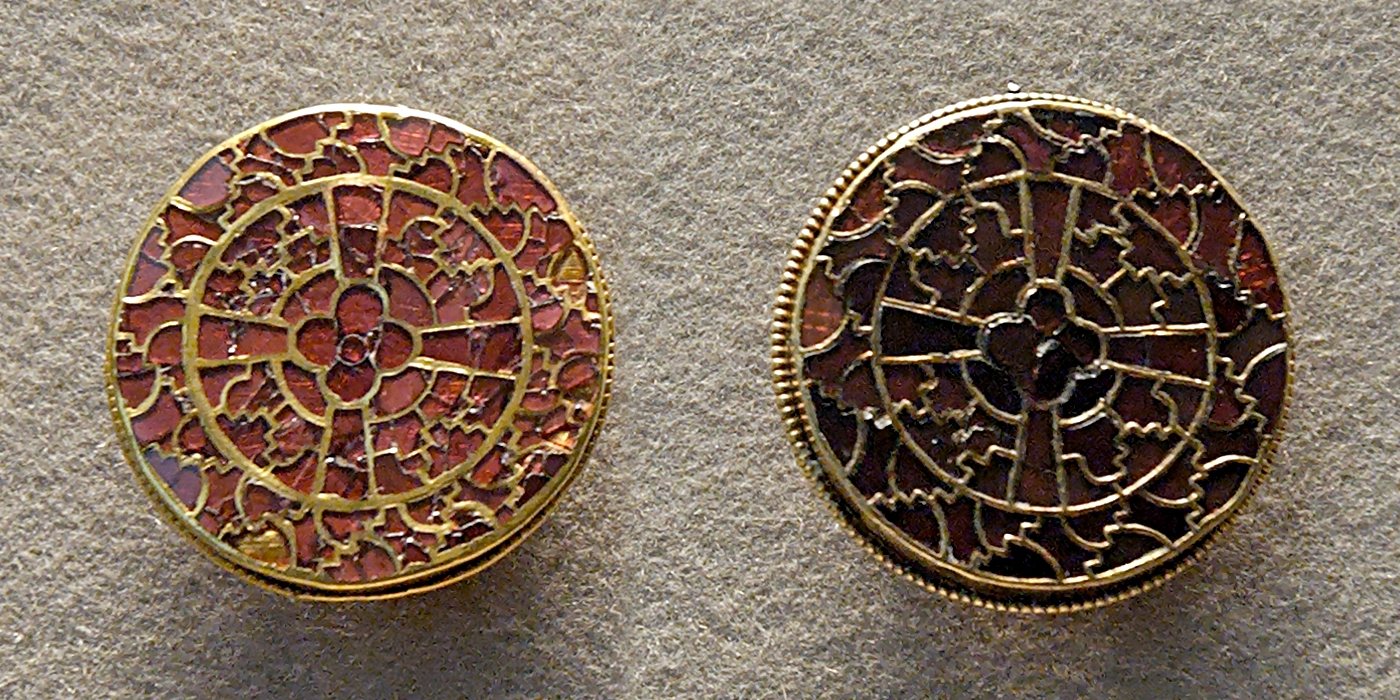
In the Migration and Merovingian periods women's dress became more splendid. Wealthy women wore pairs of bow brooches, bird or disc brooches, long bead necklaces and a belt from which a hanger dangled: knife, comb, small amulets, openwork discs, crystal balls, sometimes keys. This recalls the keys of Viking women several centuries later and points to a similar role as manager of the household. A direct tradition, however, cannot be proven.
As with the Vikings, the graves of the Germanic peoples show that women of the upper class were buried with great effort. In the Roman period, women's graves in the Germanic world contain Roman glass, bronze vessels, silver jewellery and gold pendants – signs of rank and of connections across the frontier.
A Merovingian high point lies not in Germania but beneath the basilica of Saint-Denis near Paris. In 1959 archaeologists opened a woman's grave there with gold jewellery, large brooches, belt buckles and remains of costly silk clothing. A gold ring bears the name ARNEGUNDIS and a monogram read as REGINE, "of the queen". The grave is therefore regarded as that of the Frankish queen Aregund (Arnegunde), a wife of Chlothar I, who died around 580. Some voices doubt that ring and body belong together. Most scholars, however, consider the attribution plausible.
With the law codes of the Germanic kingdoms from the fifth to eighth centuries we have, for the first time, texts written not by Romans about Germani but by Germanic rulers for their own people – albeit in Latin and under Christian influence. They are sober, often harsh, and they say quite a lot about women.
Best known is the compensation, the wergild, to be paid for a killing. In the Frankish Pactus legis Salicae of the early sixth century, killing a free Frank costs 200 shillings (solidi). For a free woman of childbearing age, by contrast, 600 were due, for a pregnant woman as much as 700. For a woman who could no longer have children, 200 again. That sounds like high esteem, and in a sense it is. Above all, though, it shows what was being protected: the ability to bear children for the kin group.
The same law contains the provision that later became famous: no part of the "Salic land" was to pass to a woman; the whole inheritance was to go to the male sex. In the late Middle Ages this became the argument that women could not inherit the throne of France. Originally it was about landed property, not crowns. And already in the sixth century an edict of the Frankish king Chilperic softened the rule: if there were no sons, daughters were to be able to inherit the land.
A basic concept of many Germanic laws is the mund, the power of protection or guardianship. A woman stood under the mund of a man – her father, then her husband, as a widow often a son or relative. It is clearest in the Lombard Edictum Rothari of 643: a free woman was not allowed to live under her own authority but always needed a guardian. The mund protected the woman but at the same time took away her legal independence. Whoever acquired the mund at a wedding paid for it.
Between law and reality there was always a gap, however. Widows managed estates, daughters inherited when there were no sons, and queens ruled. The laws describe an order, not biographies.
Precisely in the kingdoms that arose on the soil of the Roman Empire, women came powerfully to the fore. The sources about them come mostly from churchmen and are often partisan.
Amalasuntha, daughter of the Ostrogothic king Theoderic, held the regency in Italy for her under-age son after her father's death in 526. She was highly educated, spoke Latin and Greek and corresponded with the emperor in Constantinople. After her son's death she shared rule with her cousin Theodahad, who had her imprisoned and killed in 535. Her death gave Emperor Justinian a pretext for war against the Ostrogoths.
Theodelinda, a Bavarian princess, became queen of the Lombards around 589. After the death of her first husband she was allowed, Paul the Deacon reports, to choose her next husband herself, who thereby became king. She promoted the Catholic Church among the Lombards and was in contact with Pope Gregory the Great. The treasury of Monza Cathedral preserves objects associated with her.
In the Frankish realm two queens shaped politics for decades: Brunhild, a Visigothic princess, and her rival Fredegund. Gregory of Tours depicts their conflict as a bloody feud. Brunhild ruled for years on behalf of sons and grandsons until, as an old woman, she was cruelly executed in 613. Gregory and later chroniclers paint both women in dark colours. How much of this was agitation against powerful women is seriously debated today. What is certain is that both exercised power for decades that the law did not actually grant to women.
Clotilde, the Burgundian wife of the Frankish king Clovis, also belongs in this line. According to Gregory of Tours she urged her husband to be baptised. Whether her influence was really so decisive is open – but the pattern of the Christian queen converting her pagan husband recurs later in the North too.
Some seven hundred years lie between Tacitus and the first Viking raids. No unbroken "Germanic" line can be drawn across that time, and the Scandinavians of the Viking Age were not descendants of the Cherusci or the Franks. Nevertheless, a few things in common stand out.
Both societies linked women closely to the sacred: Veleda and Ganna here, the völva and the seeress of Fyrkat there. In both, marriage was a contract between families with payments by the groom. In both, women managed house and stores, and keys or belt hangers made this visible. And in both, public power – the thing and the army – remained largely a male affair, while individual women of high rank crossed that line.
There are differences, too. The Norse laws granted widows and heiresses more independence than, for example, Lombard law with its lifelong mund. And divorce, which seems so easy in the sagas, has no counterpart in the sources on the ancient Germani; Tacitus, on the contrary, stresses the indissolubility of marriage – which may say more about Rome. For the North in detail, see the article Women in the Viking Age.
"The Germanic peoples once had a matriarchy." This idea goes back mainly to the Basel legal historian Johann Jakob Bachofen, who published his book Das Mutterrecht (Mother Right) in 1861. He believed all cultures had passed through an early phase of rule by women. There is no evidence for this, neither among the Germanic peoples nor elsewhere. High esteem for seeresses and goddesses is something other than rule by women. The legal historian Uwe Wesel thoroughly dismantled the theory in his book Der Mythos vom Matriarchat.
"Tacitus describes how it was." Tacitus is indispensable, but he is neither an eyewitness nor a neutral reporter. He wrote about the Germani partly in order to criticise Rome. Where other sources support him, as with the women at the edge of battle or the seeresses, much of what he says can be believed. Where he stands alone, as with the marriage punishments, caution is needed.
"Germanic women fought in battle." The ancient sources show women behind the battle line, and among the Cimbri also in the desperate defence of the wagon fort. No one describes Germanic women warriors as a regular part of the army. Anyone looking for such images will find them rather in medieval Norse literature – and there, too, as the exception.
"The bog bodies prove harsh punishments for women." The "Windeby girl" was a boy, the supposed mark of punishment a slipped hair band. With other bog finds the cause of death is often unclear. The link to Tacitus' adultery punishment is a 20th-century interpretation, not a finding.
Women in the Viking Age · Veleda · Germanic priests & seeresses · The Matronae · The Nerthus league · The Cherusci & Arminius · Cimbri & Teutons · Sacrificial bogs · Germanic tribal laws · Germanic tribes.
All History & Finds articles →
Somewhere a story must begin. For the kingdom of Denmark this beginning is a man named Gorm – Gorm the Old, the first …
Read more →In 865 an army landed in England that did not want to raid and sail home, but to stay: the „Great Heathen Army". Two …
Read more →The name says it all: Gudme means „home of the gods". On the Danish island of Funen lay one of the richest cult and …
Read more →They are so small and so thin that you can barely hold one without creasing it: the guldgubber, “gold men,” tiny …
Read more →