The Cimbri and Teutones were Germanic peoples who – probably from Jutland – set out south around 113 BC with women, children and cattle. Not a war expedition but a migration: an entire people searching for new land.
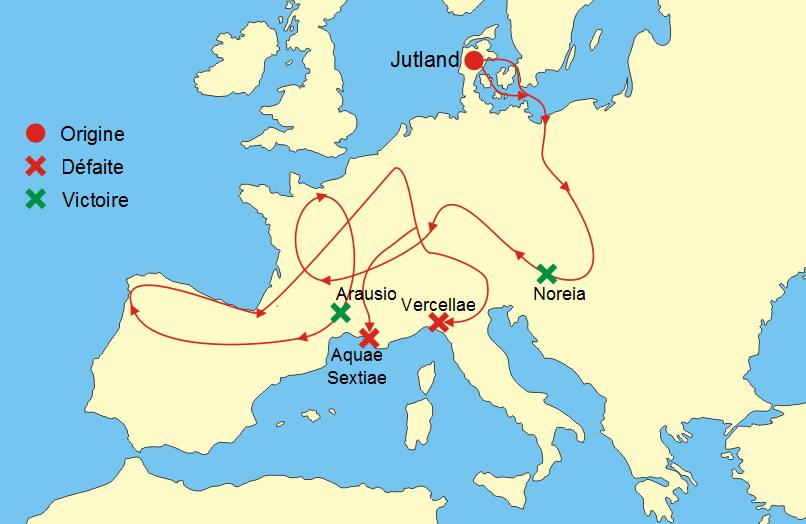
Again and again they beat Roman armies. The low point for Rome was the battle of Arausio in 105 BC – one of the heaviest defeats in Roman history, in which two armies were destroyed at once. In Rome the "terror cimbricus", the Cimbrian terror, was born.
The general Marius reformed the army and finally brought the migrants to battle: the Teutones were destroyed at Aquae Sextiae in 102 BC, the Cimbri at Vercellae in 101 BC. The great trek ended – but the memory of the people from the north stayed burned deep into Rome.
"A small people now, but the glory is immense."after Tacitus, Germania 37, on the Cimbri (public domain, own translation)
Cimbri and Teutones were Germanic peoples who around 113 BC – long before the actual Viking Age – set out from the north and moved through whole regions. Their vast migration with women, children and cattle threw Rome into years of terror.
Several times they crushingly defeated Roman armies. The catastrophe of Arausio in 105 BC, where two Roman armies perished, is regarded as one of Rome's heaviest defeats ever. The "terror Cimbricus" – the fear of the Cimbri – became proverbial.
Only the general Marius turned the tide: in 102 BC he destroyed the Teutones at Aquae Sextiae (Aix-en-Provence), in 101 BC the Cimbri at Vercellae in northern Italy. The great migration ended in two battles.
The ancient authors mostly locate the homeland of the Cimbri in Jutland (called the "Cimbrian peninsula"). Tacitus later calls them "a small people, but of great fame" – the memory of their terror lasted for centuries.
The Cimbri and Teutones are the first great clash of north and south – long before the Vikings. Continue with the Rugii and Heruli.

The Chauci · The Suebi · The Cherusci & Arminius · The Rugii · The Heruli.
All History & Finds articles →
Without their ships the Vikings would never have become Vikings. The longship was the high technology of its time …
Read more →