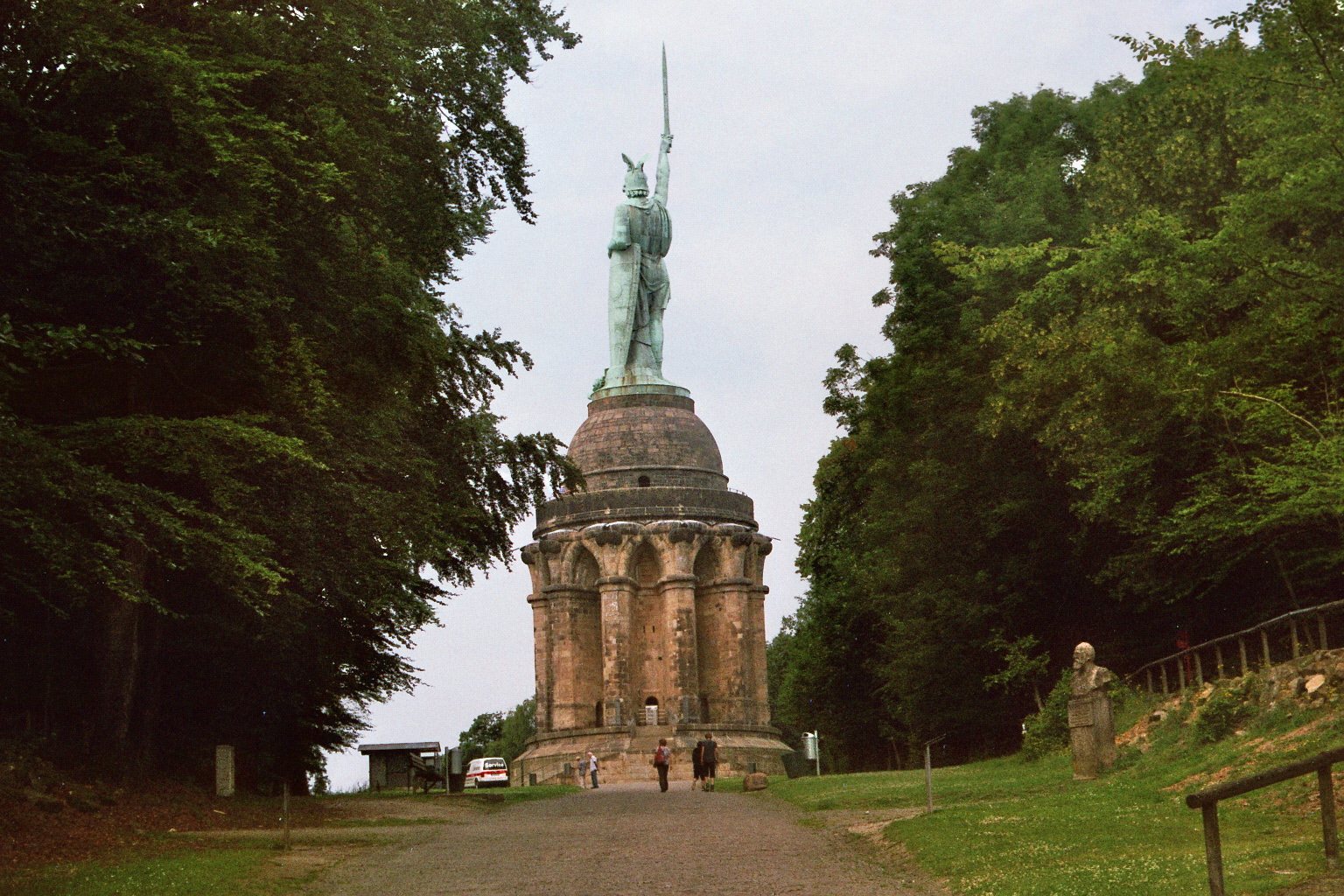
 In the autumn of 9 AD, three Roman legions perished in the Germanic forests. The man behind it was Arminius, a chieftain's son of the Cherusci – and a Roman officer. What really happened is more gripping than the monuments later built to him.
The Cherusci were a West Germanic tribe between the Weser and Elbe, in what is now Lower Saxony and eastern Westphalia. Tacitus names them in his Germania and reports on them at length in the Annals. They are not a great trading or migrating people of the history books – they became famous through a single man and a single autumn.
Arminius (Germanic probably *Erminaz, the form is reconstructed) was the son of the Cheruscan chieftain Segimer. As a young man he served in the Roman army, led Germanic auxiliaries, received Roman citizenship and the rank of knight. He knew Rome from the inside – its tactics, its weaknesses, its self-assurance. That very knowledge became Rome's undoing.
Publius Quinctilius Varus, governor of Germania, led three legions (XVII, XVIII, XIX) through difficult terrain back to winter quarters. Arminius, whom Varus took for an ally, lured the column into an ambush. For days the fighting dragged through forest, bog and rain; the Roman column was miles long and defenceless. Varus fell on his sword. Rome lost three complete legions – the numbers XVII to XIX were never issued again.
"Quintili Vare, legiones redde!" – "Varus, give me back my legions!"Suetonius, Divus Augustus 23 (public domain), words he attributes to Augustus
For a long time the site was disputed. Since the 1980s, Kalkriese at the Wiehengebirge (near Osnabrück) has been the strongest candidate: a Germanic rampart, hundreds of Roman coins (none after Varus), sling bullets, equipment, bone pits. Lead-isotope studies in 2022 linked finds to the Legio XIX. The attribution is not certain, though – a geoarchaeological study dates parts of the rampart to the Middle Ages, and scholars still argue. As a rule of thumb: Kalkriese is the best candidate, not the proven site.
The victory did not free "Germania" – it merely shifted a border. Rome struck back: Germanicus led campaigns (14–16 AD), found the old battlefield with the bones of the fallen, won battles (Idistaviso), but achieved no lasting conquest. Arminius himself was drawn into tribal feuds, fought the Marcomannic king Marbod, and around 21 AD was slain by his own kin. Tacitus passes a remarkably sober judgement on him.
"liberator haud dubie Germaniae" – "without doubt the liberator of Germania"Tacitus, Annals II,88 (public domain, own translation) – yet in the same sentence: he fell with mixed fortune
The Cherusci vanished from the sources within a few generations – absorbed into larger tribal confederations. What remained is one of the great stories of the ancient world: a man who knew Rome from within and defeated it on a rain-soaked autumn.
The Chatti · The grove of the Semnones · The bog army-offerings · The Germanic feasts · The cemetery of Frienstedt.
All History & Finds articles →
Sometimes a war is won not with the sword but with the purse. In 991 the English ealdorman Byrhtnoth faced a Viking …
Read more →In 723 an Anglo-Saxon missionary stood axe in hand before the holiest tree of the Hessians – the oak sacred to the …
Read more →Vikings were not only raiders. In the Rhine-Meuse delta they sat in the very middle of the greatest trading centre of …
Read more →