Danegeld is the name for the silver tribute late Anglo-Saxon England paid to Viking armies to make them leave – first 10,000 pounds in 991, shortly after Ealdorman Byrhtnoth was killed at Maldon in Essex. Over the next 27 years, according to the Anglo-Saxon Chronicle, the sums climbed as high as 72,000 pounds. Here is what we actually know about the battle, why the Maldon poem nearly vanished in a fire, how far the figures can be trusted, and where that English silver still turns up today: in Scandinavian hoards and on runestones.
Picture the Essex coast in high summer. Salt marsh, mudflats, a wide estuary where the sea comes in and goes out twice a day. On a small island sits a Viking army that has already raided Folkestone, Sandwich and Ipswich. On the mainland opposite stands the shire levy, led by an old, unusually tall man with white hair. Between the two armies runs a narrow causeway that only appears at low tide.
What happened there in August 991 survives in a few lines of the Anglo-Saxon Chronicle, a saint’s life written soon afterwards, and one of the most famous poems in Old English. The outcome is clear: Byrhtnoth died, and the Vikings held the field. Within the same year King Æthelred and his councillors decided to pay the raiders rather than only fight them. That decision opened a flood of silver across the North Sea – a flood we can still trace in Swedish soil and on Uppland runestones.
The word Danegeld sounds as if the Anglo-Saxons used it themselves. They did not. The Chronicle normally calls these payments gafol (tribute) or gyld (payment). “Danegeld” appears only after the Norman Conquest of 1066, when England’s new rulers used it for a national land tax, looking back to its origins in the Danish wars.
Historians today distinguish two things that are often blurred together:
Both depended on a state able to assess land in hides (the standard unit of taxable land) and raise silver on an enormous scale. Late Anglo-Saxon England did that better than almost any kingdom of its day – which is exactly what made it such an attractive target.
Buying off Vikings was not a new idea in 991. In the ninth century Frankish rulers had paid raiders to go away, and English kings had bought truces from the Great Heathen Army. What was new after Maldon was the scale and the regularity.
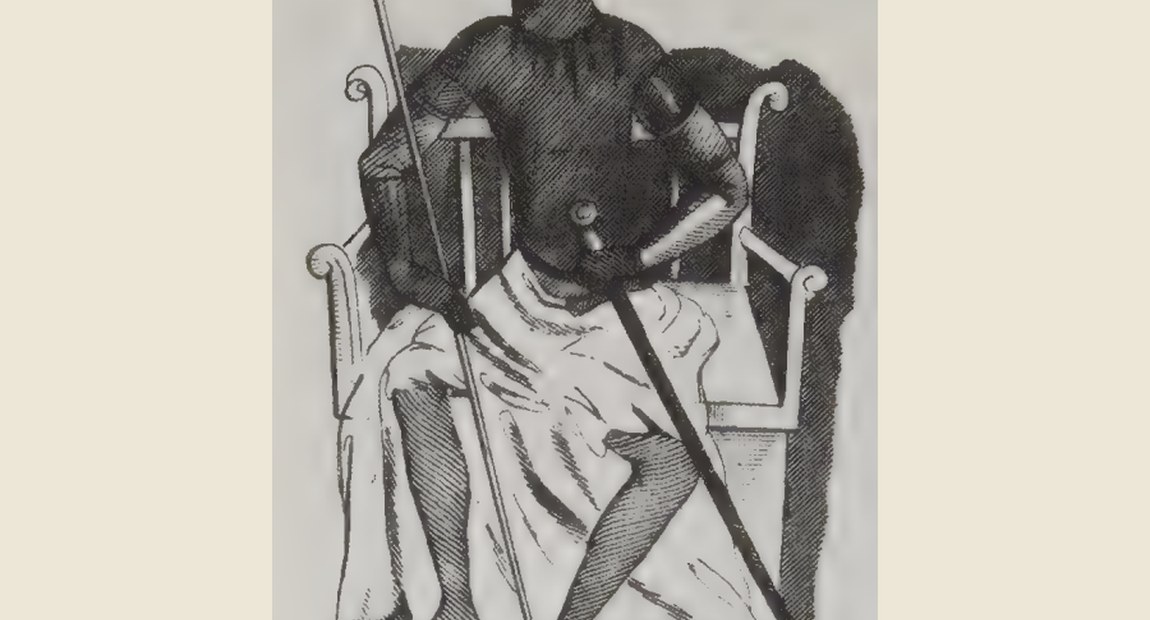
Byrhtnoth was no minor thegn. He had been ealdorman of Essex – the king’s governor over a whole region – since the 950s, a wealthy magnate and a generous patron of the abbeys of Ely and Ramsey. By 991 he was an old man, probably around sixty. The Life of St Oswald, written by Byrhtferth of Ramsey around the year 1000, mentions his swan-white hair; the poem calls him a hār hilderinc, a “grey-haired warrior”.
He was buried at Ely. The Liber Eliensis, a twelfth-century history of the abbey, says the monks recovered his body from the battlefield without its head, which the victors had carried off. When the remains of Ely’s early benefactors were uncovered during building work in 1769, the skeleton attributed to Byrhtnoth was indeed headless, and the measurements taken then suggested a man of about 6 ft 9 in (roughly two metres). An eighteenth-century measurement should be treated with care.
According to the Liber Eliensis his widow Ælfflæd gave Ely a wall-hanging showing her husband’s deeds. It is lost.
No source names the exact spot. The poem describes a river called Pante – the old name of the Blackwater – and a bricg or ford, a crossing covered at high water. In 1925 E. D. Laborde identified the site as Northey Island, just east of Maldon, which is still reached only by a tidal causeway. Most historians accept the identification, and the island now belongs to the National Trust, though other sites further upstream have been proposed.
The military logic is obvious. The English could not reach the island, and the Vikings could not reach the mainland, as long as a handful of men held the causeway. That is exactly what the poem describes: Wulfstan, Ælfhere and Maccus block the crossing and no raider gets past. A stalemate, timed by the tides.
The poem speaks of the bordweall, the wall of shields Byrhtnoth arranges before the fighting – more on that formation in our piece on the shield wall.
“The Battle of Maldon” is an Old English heroic poem in alliterative verse. 325 lines survive; both beginning and end are lost. Even those lines survive only by luck. The single manuscript belonged to the library of Sir Robert Cotton (shelfmark Cotton Otho A. xii) and was destroyed in the Ashburnham House fire in London in 1731 – the same fire that scorched the Beowulf manuscript.
A few years earlier someone had copied it. The antiquary Thomas Hearne printed the text in 1726, and the handwritten transcript itself, long thought lost, was rediscovered in the Bodleian Library in Oxford in the 1930s. Who made it is still debated; John Elphinstone and David Casley have both been proposed. Every modern edition therefore rests on an eighteenth-century copy.
When the poem was composed is also open. Its many precise personal names suggest it was written soon after 991; some features of its language point to a date decades later.
The most famous exchange comes right at the start of the surviving text. A Viking messenger shouts across the water: give us rings and we will go, and there need be no battle. Byrhtnoth’s reply, roughly: Do you hear, seafarer, what this people says? As tribute they will give you spears, poisoned points and old swords.
Hī willað ēow tō gafole gāras syllan, / ǣttrynne ord and ealde swurd.The Battle of Maldon, lines 46–47 (Old English, public domain); our translation: “They will give you spears as tribute, poisoned points and ancient swords.”
That word gafol is the very word the Chronicle uses for the tribute paid after the battle. The poet is deliberately playing with the question England would soon answer so differently.
Then comes the passage scholars have argued over for decades. The Vikings ask to be allowed across the causeway so that the two sides can fight on open ground. And Byrhtnoth agrees:
Ðā se eorl ongan for his ofermōde / ālӯfan landes tō fela lāþere ðēode.The Battle of Maldon, lines 89–90; our translation: “Then the earl in his ofermōd began to yield too much land to the hateful people.”
What does ofermōd mean? Literally something like “over-spirit” or “excess of mind”. Elsewhere in Old English it denotes pride in a bad sense – it is used of Lucifer’s pride. In 1976 Helmut Gneuss argued that the word is practically always negative in Old English.
J. R. R. Tolkien, himself a professor of Old English, read the line severely in the essay accompanying “The Homecoming of Beorhtnoth Beorhthelm’s Son” (1953): Byrhtnoth sacrificed his men to a chivalric love of glory, and the poet was criticising him. Others disagree. They point out that the rest of the poem presents Byrhtnoth as an ideal lord, and they offer a down-to-earth military reason: had he refused, the Vikings would simply have sailed off on the next tide and plundered some undefended stretch of coast instead. An ealdorman who wanted to protect his shire needed the battle.
The poem goes on to tell how Byrhtnoth falls and how Godric, son of Odda, flees on his lord’s horse – many of the English take him for the ealdorman himself, and the army breaks. Only the core of the retinue stands, and an old retainer, Byrhtwold, speaks the lines found in every anthology of English verse:
Hige sceal þē heardra, heorte þē cēnre, / mōd sceal þē māre, þē ūre mægen lӯtlað.The Battle of Maldon, lines 312–313; our translation: “Will shall be the harder, heart the bolder, courage the greater, as our strength grows less.”
The poem names no one on the Viking side, and most versions of the Chronicle do not either. Only manuscript A, under the year 993 – evidently misdated and merged with events of 994 – records that Anlaf came with 93 ships to Folkestone, then to Sandwich, Ipswich and Maldon, where Byrhtnoth met him and was killed.
A second clue is a surviving treaty text known as II Æthelred. It sets out terms between King Æthelred and the leaders Anlaf, Iosteine and Guðmund and mentions a payment of 22,000 pounds in gold and silver. It is usually dated to 994. Anlaf is the English form of the Norse name Óláfr.
Most historians identify this Anlaf with Olaf Tryggvason, who became king of Norway in 995. The Chronicle records under 994 that Æthelred stood sponsor to Anlaf at his confirmation in Andover, and that Anlaf promised never to come to England in hostility again – “and he kept that promise”. Still, no text says in so many words that Olaf, son of Tryggvi, fought at Maldon. The identification is plausible, not proven.
Several leaders, several fleets, shifting alliances – that is how we should picture the armies of these years. How such war-bands were organised is explained in our article on lið, hird and leiðangr.
Here are the payments as recorded in versions C, D and E of the Anglo-Saxon Chronicle. Keep in mind that these are chronicle figures, not audited accounts. The versions sometimes disagree, and the unit is the pound of silver, 240 pennies to the pound.
| Year | Sum according to the Chronicle | Context |
|---|---|---|
| 991 | 10,000 pounds | “for the first time”, after Maldon, on the advice of Archbishop Sigeric of Canterbury |
| 994 | 16,000 pounds | after Olaf and Swein Forkbeard attacked London; the treaty II Æthelred gives 22,000 pounds |
| 1002 | 24,000 pounds | truce; in November comes the order for the St Brice’s Day massacre |
| 1007 | 36,000 pounds | one version gives 30,000 pounds |
| 1012 | 48,000 pounds | to the army of Thorkell the Tall, after the murder of Archbishop Ælfheah |
| 1018 | 72,000 pounds | under Cnut, plus 10,500 pounds from the city of London |
On top of these come regional payments, such as 3,000 pounds from East Kent in 1009 and 21,000 pounds to the fleet at Greenwich in 1014. The major payments alone add up to more than 200,000 pounds – taken literally, something like fifty million silver pennies.
Two episodes in this sequence are especially grim. In 1002 England paid 24,000 pounds, and a few months later, on 13 November, Æthelred ordered – as one of his own later charters puts it – that all the Danes in England be killed, because he believed they were plotting against him. In 1011 Thorkell’s army took Canterbury and carried off Archbishop Ælfheah. He refused to let a ransom be raised for him, and on 19 April 1012 at Greenwich drunken warriors pelted him with bones and an ox’s head and killed him, according to the Chronicle. Afterwards Thorkell went over to Æthelred’s service with 45 ships. The saga tradition of the Jomsvikings later made him one of its heroes – but that belongs to legend, not record.
The credibility of the Chronicle’s figures has been hotly debated since the 1980s. In 1984 M. K. Lawson argued that they are broadly plausible: late Anglo-Saxon England had a highly efficient coinage system with dozens of mints, and the number of known coin dies from Æthelred’s reign points to enormous output. In 1989 John Gillingham replied that the round, steadily rising numbers look more like the rhetoric of a chronicler painting the misery of the age. The question remains open.
There is also hindsight. The Chronicle’s account of these years seems to have been written after 1016, with Cnut already on the throne, and it dwells on treachery and bad counsel. Read the figures as orders of magnitude, not as a bank statement.
In English he is still “Æthelred the Unready”. That is a misunderstanding. The Old English nickname is Unrǣd, meaning “bad counsel” or “no counsel”, and it is a pun: Æthel-rǣd means “noble counsel”. King Noble-Counsel becomes King No-Counsel. Importantly, the nickname is not contemporary; it is first recorded more than a century and a half after his death.
The image of an incompetent king owes much to the retrospective Chronicle. Simon Keynes has shown how Æthelred’s reputation sank further with every century. Seen soberly, Æthelred reigned for 38 years under extraordinary pressure: the Danish monarchy of Swein Forkbeard was centralised and formidable, and England was rich and close.
Paying tribute was not automatically cowardly either: war costs harvests and lives, silver can be raised again. But every payment bought only a breathing space – and proved to every chieftain in the North that a voyage to England paid off. In 1013 Æthelred fled to Normandy and Swein was accepted as king. Swein died in 1014, Æthelred returned, and died in 1016. In the end Cnut the Great sat on the English throne – and in 1018 collected the largest tribute of all, this time from his own new kingdom, to pay off his army.
In 1012 a quiet but momentous change took place. Once Thorkell and his fleet had entered English service, they had to be paid continuously. An annual tax was introduced for the purpose: the heregeld.
Cnut kept the system going. Version D of the Chronicle records under 1051 that King Edward the Confessor abolished the heregeld Æthelred had imposed, in the thirty-ninth year after it was introduced.
After 1066 the Normans revived the idea of a general land tax and now called it explicitly Danegeld. Under Henry II it last appears on the royal accounts, the Pipe Rolls, for 1161–62.
Now the evidence becomes tangible. Tens of thousands of English silver pennies from the reigns of Æthelred and Cnut have been found in Scandinavia, above all in Sweden and on Gotland. For some coin types of these years more specimens are known from Scandinavian finds than from England itself. The reason is simple: in England old coins were called in and reminted whenever the type changed, while in Scandinavia they ended up in hoards that nobody came back for.
Æthelred’s coinage was a remarkable organisation. Roughly every six years a new type was introduced – with designs such as a cross (“Crux”), a long cross (“Long Cross”) or a helmeted royal bust (“Helmet”). The dies were cut centrally, but the coins were struck in dozens of towns, and each names its moneyer and mint.
In the North, weight often mattered more than face value. Many English coins in Scandinavian finds carry test nicks, where a wary trader checked the silver, and others have been cut up and reckoned by weight. How that silver economy worked is explained in our article on hacksilver, and the great treasure finds are presented in the great silver hoards of the Vikings.
Even more striking: from around 995 Scandinavian kings began striking their own coins on the English model. At Sigtuna, King Olof Skötkonung issued pennies imitating Æthelred’s Crux type, apparently in part with English die-cutters. A coin of Swein Forkbeard with the legend ZVEN REX AD DENER also follows English patterns. For the earlier story of Scandinavian coinage, see our article on Ribe and the North’s first coins.
The finest source for Danegeld does not stand in England at all, but in Uppland, north of Stockholm. Around thirty Swedish runestones mention journeys to England; they are known as the England runestones. Some explicitly speak of gjald, payment – the Norse counterpart of the English gyld.
The most famous is U 344 at Yttergärde (Orkesta). It was raised by Ulf of Borresta, and its inscription ends with a sentence that reads like a summary of the English Chronicle:
En Ulfr hefir á Englandi þrjú gjald tekit. Þat var fyrsta þat’s Tosti galt. Þá galt Þorketill. Þá galt Knútr.Runestone U 344, Yttergärde, Uppland (normalised Old Norse reading); our translation: “And Ulfr has taken three payments in England. The first was the one Tosti paid. Then Thorketill paid. Then Cnut paid.”
Notice the perspective. It is not “England” that pays, but the leader who paid out each warrior’s share. Thorkell fits well with the tribute of 1012, Cnut with 1018. Tosti is harder to pin down; he is often identified with a Swedish chieftain active in the 990s, but that remains an interpretation.
Other stones fill in the picture. The Lingsberg stone U 241 says Ulfríkr took two payments in England. On U 194 at Väsby a man named Alli raised the stone in his own memory and recorded that he had taken Cnut’s payment in England. Sö 166 at Grinda in Södermanland commemorates Guðvér, who was in the west, shared out payment in England and manfully attacked towns in Saxony.
As with the stones for the eastern voyage of the Ingvar expedition, these inscriptions are contemporary, set up within years or decades of the events – which makes them primary sources of the first rank.
The word Danegeld took on a life of its own. In 1911 Rudyard Kipling wrote a poem called “Dane-Geld” for a school history of England, and its closing lines are still quoted whenever someone warns against giving in to blackmail:
That if once you have paid him the Dane-geld / You never get rid of the Dane.Rudyard Kipling, “Dane-Geld” (1911), public domain
Pithy, but historically too simple. England’s real problem was less the tribute itself than a Danish monarchy working towards conquest and an English elite that was increasingly divided.
And Maldon? Militarily it was one defeat among many in the 990s. It is remembered because of a poem that very nearly went up in smoke – a poem that turns a lost coastal skirmish into a meditation on loyalty and duty. Byrhtwold’s lines about courage that must grow as strength fails are among the strongest the early Middle Ages produced. For the bigger picture, from Lindisfarne to Hastings, see our overview of the Vikings in England.
For us as an engraving workshop, Ulf of Borresta remains the most appealing figure in the whole story. He had his three payments carved in stone so that people would remember him. In a thousand years, that wish has hardly changed.
What is Danegeld in simple terms? Danegeld was the silver tribute late Anglo-Saxon England paid to Viking armies from 991 onwards to make them leave or keep the peace. The name itself only dates from after 1066.
How much Danegeld did England pay in total? According to the Anglo-Saxon Chronicle: 10,000 pounds (991), 16,000 (994), 24,000 (1002), 36,000 (1007), 48,000 (1012) and 72,000 pounds plus 10,500 from London (1018). Whether these round figures are accurate is debated among historians.
Who won the Battle of Maldon? The Vikings. Ealdorman Byrhtnoth was killed in August 991 and the raiders held the field. Shortly afterwards England paid its first tribute.
Was Olaf Tryggvason at the Battle of Maldon? Possibly. One version of the Chronicle names an Anlaf as leader, and most historians identify him with Olaf Tryggvason, but no source names him in full in connection with the battle.
What does ofermod mean in The Battle of Maldon? Literally something like “over-mind”; in Old English it usually carries a negative sense of pride or arrogance. Whether the poet is criticising Byrhtnoth or describing heroic daring is still debated.
Why is Æthelred called “the Unready”? It is a misreading of the Old English nickname Unrǣd, “bad counsel”, a pun on his name, which means “noble counsel”. The nickname is only recorded long after his death.
For courage. For remembrance. For legends that live on.
Hacksilver – silver as currency · Ribe & the North's first coins · Ragnar's sons · Stiklestad – the fall of Saint Olav · The Ulfberht sword.
All History & Finds articles →
In 723 an Anglo-Saxon missionary stood axe in hand before the holiest tree of the Hessians – the oak sacred to the …
Read more →Vikings were not only raiders. In the Rhine-Meuse delta they sat in the very middle of the greatest trading centre of …
Read more →Some 1,700 years ago a man from the Near East settled in a Germanic village in present-day Thuringia – and rose into …
Read more →Two horns of heavy gold, covered all over with puzzling figures, and on one of them a line of runes in which, for the …
Read more →