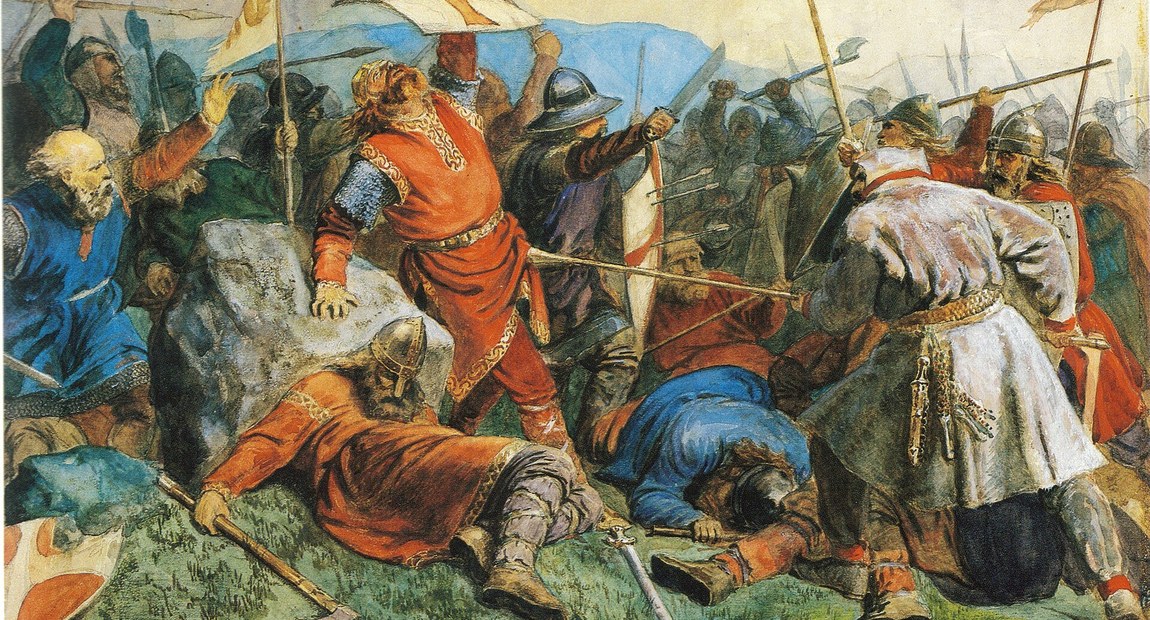
The Battle of Stiklestad was fought, according to tradition, on 29 July 1030 in Trøndelag, Norway: King Olaf Haraldsson, back from exile in Kievan Rus, was defeated and killed by a peasant army led by Norwegian magnates loyal to Cnut the Great. Only a year later Bishop Grimkell declared the dead king a saint. Here is what the sources actually tell us about the road to the battle, the fighting and the men who killed him, why the famous eclipse does not fit the date, and how a deposed king became Saint Olaf.
A king cut down by his own people. A body smuggled off the battlefield by a farmer and buried by night in the sand of a riverbank. And a year later a bishop who opens the grave and announces that the man inside is holy. Stiklestad is one of the strangest turning points in Scandinavian history. Olaf Haraldsson lost everything there – army, crown, life. And by losing, he gained a kind of power he never had while he was alive.
Most of what people "know" about Stiklestad – the blood-red sky, the dying king leaning on a stone, the war cries – comes from one author writing two centuries later. So we will do what we do in the workshop before any engraving: draw the outline that is certain first, then add the shading, and tell you each time where a line comes from.
Olaf Haraldsson – Old Norse Óláfr Haraldsson, later Óláfr inn helgi, "the Holy" – was born around 995 according to the sagas, possibly a little earlier. His mother was Ásta Guðbrandsdóttir, his father Harald Grenske, a petty king in south-eastern Norway. He grew up with his stepfather Sigurd Sýr in Ringerike. From that second marriage came a half-brother who will matter later: Harald Sigurdsson, remembered as Harald Hardrada.
Like many ambitious sons of the elite, Olaf spent his youth raiding – in the Baltic, in England and in France. Norway's national encyclopaedia, the Store norske leksikon, considers it likely that he fought in the Danish king Sweyn Forkbeard's war against Æthelred of England. Later he served Duke Richard II of Normandy, and he was probably baptised in Rouen around 1013/14. The saga claim that he was baptised as a child with Olaf Tryggvason as his godfather is regarded as doubtful.
In 1015 Olaf sailed to Norway with just two ships. His timing was sharp: Earl Eiríkr, the strongman of the country, was in England fighting alongside Cnut the Great. On Palm Sunday 1016 Olaf defeated the earls' party at sea at Nesjar near the mouth of the Oslofjord, and the same year he was proclaimed king at the Øreting assembly in Trøndelag. He now ruled most of Norway, from Viken in the south to Hålogaland in the north.
For roughly a decade Olaf ruled with real success and real harshness. He placed landed men in the districts, controlled them through royal stewards (ármenn) of humbler birth, confiscated estates and minted coins.
Above all, he made religion a matter of state. At the assembly of Moster in Sunnhordland – traditionally dated to 1024, with his English court bishop Grimkell at his side – a Christian law was adopted: churches and priests across the country, baptism, fasting, burial in consecrated ground, and a ban on practising any other religion. Those who refused risked their property and could be driven abroad. The assembly of free men, the thing, became an instrument of royal power. The surviving manuscripts of this law date only from the 12th century onward, though, and how much of it truly goes back to Olaf is debated.
Snorri Sturluson describes a king who smashed pagan cult sites and had the stubborn maimed, blinded or exiled – and he praises it as zeal for the faith. Conversion in the North often meant coercion, as we show in our piece on the Christianisation of the Germanic peoples. With Olaf, coercion was policy.
The real threat came from across the North Sea. Cnut, king of England from 1016 and soon of Denmark too, regarded Norway as part of his sphere. The old dynasty of the earls of Lade was firmly on his side.
In 1026 Olaf allied with the Swedish king Anund Jakob against Cnut. They met Cnut at the river Helgeå in Scania, in a battle with no clear winner that nevertheless weakened Olaf in the long run. Cnut then used the weapon he had in abundance: English silver. According to Snorri and contemporary skaldic verse, many Norwegian magnates accepted gifts from Cnut's envoys. Olaf made their choice easy. His confiscations, trade restrictions and low-born stewards had alienated the coastal aristocracy. In December 1027 Erling Skjalgsson, the most powerful man in western Norway, was killed in a clash with Olaf's men. After that, support for the king collapsed.
In 1028 Cnut sailed to Norway with about fifty ships and was acclaimed king at the Øreting. Olaf fled over the mountains to Sweden without a fight.
From Sweden he went on to Garðaríki, the Norse name for the realm of the Rus. Its ruler was Grand Prince Yaroslav the Wise, whose wife Ingigerd was a daughter of the Swedish king Olof Skötkonung – and the sister of Olaf's own wife Astrid. For more on this eastern world of Scandinavian traders and warriors, see our article on the Rus.
In Norway Cnut installed his nephew Håkon Eiriksson as earl. But in 1029 Håkon drowned in the Pentland Firth between Scotland and Orkney. Olaf saw his chance. In early 1030 he set out, leaving his young son Magnus with Yaroslav, and moved west through Sweden. Snorri says Anund Jakob gave him around four hundred men; to these came retainers, men from Jämtland and a small band under his half-brother Harald. Through Jämtland and down the Verdal valley he descended into Trøndelag.
Snorri also tells us that Olaf gave the pagans in his army a choice: baptism or go home. Some were baptised, others left. That alone hints that the battle lines at Stiklestad did not follow the later picture of a holy war.
Olaf did not face a spontaneous uprising of outraged pagans. He faced a levy organised by the leaders of Norway's coastal aristocracy in Cnut's interest. The sources call it the bóndaherr, the "farmers' army". A bóndi here is a free, landholding householder obliged to serve in the levy – not a poor tenant.
Þórir hundr ("Thorir the Hound") of Bjarkøy in northern Norway was one of the richest men in the North, grown wealthy through trade with the Sami. He had been one of Olaf's landed men but became his mortal enemy after one of the king's followers killed his nephew Ásbjǫrn. Snorri says Þórir had magic reindeer-skin coats made by the Finnar – the Norse name for the Sami – and that in the battle Olaf's sword would not bite on him; it only raised dust. That is saga writing with a taste for the marvellous, but it is a vivid glimpse of how 13th-century Icelanders imagined the far North.
Kálfr Árnason of Egge in inner Trøndelag had been one of Olaf's men; as late as 1027 he still stood with the king. At Stiklestad, Snorri makes him leader of the peasant host, and later tradition branded him a traitor. A third leader was Hárekr of Þjótta (Hårek of Tjøtta) from Helgeland. What united these men was not religion but interest: they wanted to keep their old power, and Cnut promised them exactly that.
Snorri gives the farmers more than 7,000 men and Olaf about 3,600. Historians trust these numbers least of all. The Store norske leksikon reports the current view that the king probably had only a few hundred men. Sigvatr does confirm in one stanza that Olaf was clearly outnumbered, the farmers being about twice as many.
Foreign sources from the 11th century sound even more modest. The Anglo-Saxon Chronicle notes briefly that Olaf was killed by his own people. Adam of Bremen, writing around 1075, speaks of an ambush. The great pitched battle with thousands of warriors appears in full only with the Icelandic writers of the 13th century. There was a fight – but we do not know its size, and no archaeological finds from the battlefield have yet pinned it down.
The fighting took place at Stiklestad, a farm in the Verdal valley north-east of Trondheim. Snorri turns the night before into a spiritual prelude: Olaf dreams of a ladder reaching up to heaven and has reached the top rung when he is woken. That is hagiography in its purest form – the king knows he will die and accepts it.
The war cries Snorri records have become famous. Olaf's men shouted Fram, fram, Kristsmenn, krossmenn, konungsmenn! – "Forward, forward, Christ's men, cross men, king's men!" The farmers answered Fram, fram, bóndmenn! – "Forward, farmers!" Whether anyone really shouted this, nobody knows. But the lines sum up exactly the reading the saga wants: Christ's followers on one side, the farmers on the other.
Militarily the outcome seems to have been decided quickly. Olaf's smaller force attacked and was stopped by greater numbers, probably in the kind of fighting we describe in our article on the shield wall: rank against rank, shield against shield, and whoever gives way first has lost.
There are several versions of Olaf's death. Sigvatr names Þórir hundr as the man who struck the fatal blow. The Norwegian history Ágrip af Nóregskonungasǫgum (c. 1190) has the king wounded in the knee by one of Kálfr's men; he sinks down, prays, throws away his sword, and then Þórir hundr and Þorsteinn knarrarsmiðr ("the shipwright") kill him. Snorri turns this into three wounds: the leg, Þórir's spear thrust into the belly, and Kálfr's blow to the neck. The later the source, the more precise the choreography.
After Olaf fell, his kinsman Dag Hringsson is said to have charged once more with his late-arriving troops – "Dag's storm", as Snorri calls it. That attack collapsed too.
In the king's army fought a boy who would make history. Harald Sigurdsson, Olaf's half-brother, was fifteen according to Ágrip, "a handsome man of great stature". Snorri tells us Olaf wanted to leave him in camp, but Harald insisted on fighting. He was wounded, hid with a farmer and escaped via Sweden to the Rus, and from there to Constantinople and the Varangian Guard. You can follow the rest in our article on Harald Hardrada: king of Norway from 1046/47, killed in 1066 at Stamford Bridge. Thirty-six years separate the two battles – a whole warrior's lifetime, framed by two defeats.
No detail of Stiklestad is retold more often: in the middle of the battle the sky turns red, then it grows as dark as night. Snorri describes this darkening at length and supports it with a stanza by Sigvatr, which says, in paraphrase, that it was no small wonder that the sun gave no warmth that day and the day had no proper colour.
The problem: there was no solar eclipse over Norway on 29 July 1030. There was one, however, on 31 August 1030, in the early afternoon, clearly visible in Trøndelag. The Norwegian astronomer Christopher Hansteen calculated this in the 1830s and concluded that the battle must have been fought on 31 August. The idea still has supporters.
Most historians disagree. Sigvatr was not at the battle; according to tradition he was on pilgrimage to Rome. His memorial poem, the Erfidrápa, was composed years later, when the Olaf legend was already taking shape. A darkened sun at a saint's death is also a familiar image – in the Gospels the sun is darkened at the Crucifixion. Most likely the real eclipse of August 1030 merged in memory with the day of Olaf's death. The year is very probably right, the day comes from church tradition, and the eclipse belongs to the legend.
What happened to the body is again mostly Snorri's story. A farmer named Þorgils Hálmuson and his son Grímr are said to have secretly taken the dead king to Nidaros – modern Trondheim – and buried him in the sand on the bank of the river Nidelva, exactly where the cathedral would later rise.
In the saga, the miracles start on the battlefield itself. Þórir hundr, tending the body, got the king's blood on a wound on his own hand, and the wound healed at once. A blind man who rubbed the king's blood on his eyes could see again. These are classic motifs of European saints' lives, and they show how tradition turns even Olaf's killer into a witness of his holiness.
After Stiklestad, Cnut installed his young son Sweyn and Sweyn's mother Ælfgifu of Northampton (Old Norse Álfífa) as regents in Norway. New dues and harsher laws soon made them hated. The magnates who had fought Olaf realised they were no freer under Cnut than under him.
In that climate Bishop Grimkell, Olaf's English court bishop, opened the grave in the summer of 1031. Snorri dates this to a year and five days after the death, that is, 3 August. The body was found uncorrupted, hair and nails had grown. Grimkell declared Olaf a saint, and the body was placed in a shrine on the high altar of St Clement's church in Nidaros. The 3rd of August remained in the calendar as the feast of his translation (translatio).
There was no papal canonisation in 1031, and none was needed. Saints were "made" locally then, by bishops and popular devotion. A confirmation by Pope Alexander III in 1164 is sometimes mentioned, but it is not securely documented.
The strongest evidence for the early cult is a poem: the Glælognskviða ("Sea-calm Poem") by the Icelandic skald Þórarinn loftunga. It is addressed to Sweyn Cnutsson, so it was composed in the early 1030s while he still ruled Norway. It describes the uncorrupted body, growing hair and nails, bells ringing by themselves and candles burning over the altar – and urges Sweyn to pray to Olaf for his land. The historian Matthew Townend sees no contradiction in this: Cnut actively promoted the cults of royal saints in England. Only later did Olaf's cult become a weapon against Danish rule.
And what a weapon. In 1034/35 Kálfr Árnason and Einarr þambarskelfir – of all people – fetched Olaf's son Magnus from the Rus. Sweyn and Ælfgifu had to flee, and after Cnut's death in 1035 his North Sea empire fell apart. Magnus the Good became king at about eleven – as the son of a saint.
Contemporary skaldic verse: Sigvatr Þórðarson, Olaf's court poet and marshal, composed the Erfidrápa Óláfs helga, a memorial poem for the king. He was not at Stiklestad but knew the people involved. Þórarinn loftunga's Glælognskviða dates from the early 1030s and is the oldest surviving witness to Olaf's sainthood. Both poems survive only as quotations in later sagas.
Foreign chroniclers of the 11th century: The Anglo-Saxon Chronicle records the death briefly; one manuscript adds that Olaf was afterwards holy. Adam of Bremen, around 1075, already describes Nidaros as a pilgrimage centre.
Norwegian and Latin works of the late 12th century: the Passio Olavi, a Latin account of his martyrdom with a collection of miracles, probably compiled under Archbishop Eystein Erlendsson; Theodoricus Monachus' Historia de antiquitate regum Norwagiensium around 1180; and Ágrip around 1190.
Icelandic kings' sagas of the 13th century: the so-called Legendary Saga of St Olaf, then Snorri Sturluson's separate Óláfs saga helga and its version in Heimskringla, around 1230. Roughly a third of Heimskringla is devoted to Olaf. Snorri's account is masterfully told, but it stands about two hundred years after the battle. More on the author: Snorri Sturluson.
The rule of thumb is simple: the older the source, the shorter the account and the heavier the stress on the miraculous; the younger the source, the more names, numbers, speeches and battle order. The colourful details of Stiklestad are almost all Snorri.
From the grave in the riverbank sand grew one of the best-known saints of the North. In 1152/53 Nidaros became the seat of Norway's own archdiocese, and the cathedral over Olaf's grave became the great pilgrimage goal of Scandinavia. The medieval routes are walked again today as the St Olav Ways. In this view Norway's kings ruled on behalf of someone else: Olaf was rex perpetuus Norvegiae, "Norway's eternal king".
The earliest known church dedicated to Olaf is not in Norway but in England. The Anglo-Saxon Chronicle reports under 1055 that Earl Siward died at York and was buried in the church at Galmanho, which he had built in honour of St Olaf; St Olave's still stands on the site. London has St Olave Hart Street, Scandinavian merchants in Novgorod had their own church of St Olaf, and in Tallinn the spire of St Olaf's (Oleviste) rises over the old town. In the Faroe Islands, 29 July – Ólavsøka – is still the national holiday.
In art Olaf became the most frequently depicted saint of the North after the Virgin Mary. His attribute is the axe, and he often stands on a beast with a human head. In the 13th century the axe passed into the paws of the Norwegian heraldic lion, where it remains today. For the weapon itself, see our article on the Viking axe.
The Reformation ended the cult abruptly. The shrine was broken up around 1540, about 95 kilograms of its silver went to Copenhagen, and in 1568 the bones were buried anonymously in Nidaros on royal orders. Nobody knows where they lie.
Stiklestad lies in the municipality of Verdal, north-east of Trondheim. Tradition holds that the 12th-century stone church stands on the spot where Olaf fell; a stone he is said to have leaned on is built into it – whether it is really that stone cannot be proven.
In Norway the day of his death is called Olsok, from Old Norse Ólafsvaka, "Olaf's vigil" – the night of prayer before the feast. Since 1930, 29 July has been an official flag day. Every year around Olsok, the open-air play Spelet om Heilag Olav (The Saint Olav Drama) is staged in the natural amphitheatre at Stiklestad, written by Olav Gullvåg with music by Paul Okkenhaug. First performed in 1954, it has run every year since 1960; according to the Store norske leksikon, 12,000 to 15,000 people see it. It shows Olaf in his last days before the battle and blends history with free invention.
What remains is still remarkable: a king who lost his realm in 1028 without striking a blow became, through his death, the foundation of Norway's monarchy and church. You will find the other great rulers of the age in our overview of the kings of the Viking Age.
When was the Battle of Stiklestad? According to church tradition, on 29 July 1030. The year is broadly accepted; the exact day rests on the feast-day tradition, and some scholars argue for 31 August 1030 because of the solar eclipse.
Who killed Saint Olaf? The sources mainly name Þórir hundr, along with Þorsteinn knarrarsmiðr and Kálfr Árnason. The near-contemporary skald Sigvatr credits Þórir hundr with the fatal blow.
Why was Olaf Haraldsson made a saint? Miracles were reported after his death, and resentment against Danish rule grew. In 1031 Bishop Grimkell opened the grave and declared Olaf a saint.
Was there really an eclipse at Stiklestad? Not on 29 July. The nearest eclipse over Norway happened on 31 August 1030 and was probably linked to Olaf's death in the legend.
Was Harald Hardrada at the Battle of Stiklestad? Yes. At about fifteen he fought for his half-brother, was wounded and escaped via Sweden to the Rus.
What is Olsok? Olaf's feast day on 29 July, from Old Norse Ólafsvaka. Around this date the open-air Saint Olav Drama is performed at Stiklestad.
For courage. For remembrance. For legends that live on.
Thyra Danebod – Denmark's mightiest woman · Trelleborg – Harald's ring fortresses · Ribe & the North's first coins · Ragnar's sons.
All History & Finds articles →
A whole royal ship, buried beneath a mound, full of gold and weapons – and a helmet that became the face of an entire …
Read more →Some Vikings raided, others had Danegeld paid to them – Sweyn Forkbeard did both and then reached for the crown itself …
Read more →The Vikings had no central state power. Law and politics arose at the assembly of free people – the Thing.
Read more →A handle that turned out too short, a fly at the bellows and over a thousand silver amulets in the earth: Thor's hammer …
Read more →