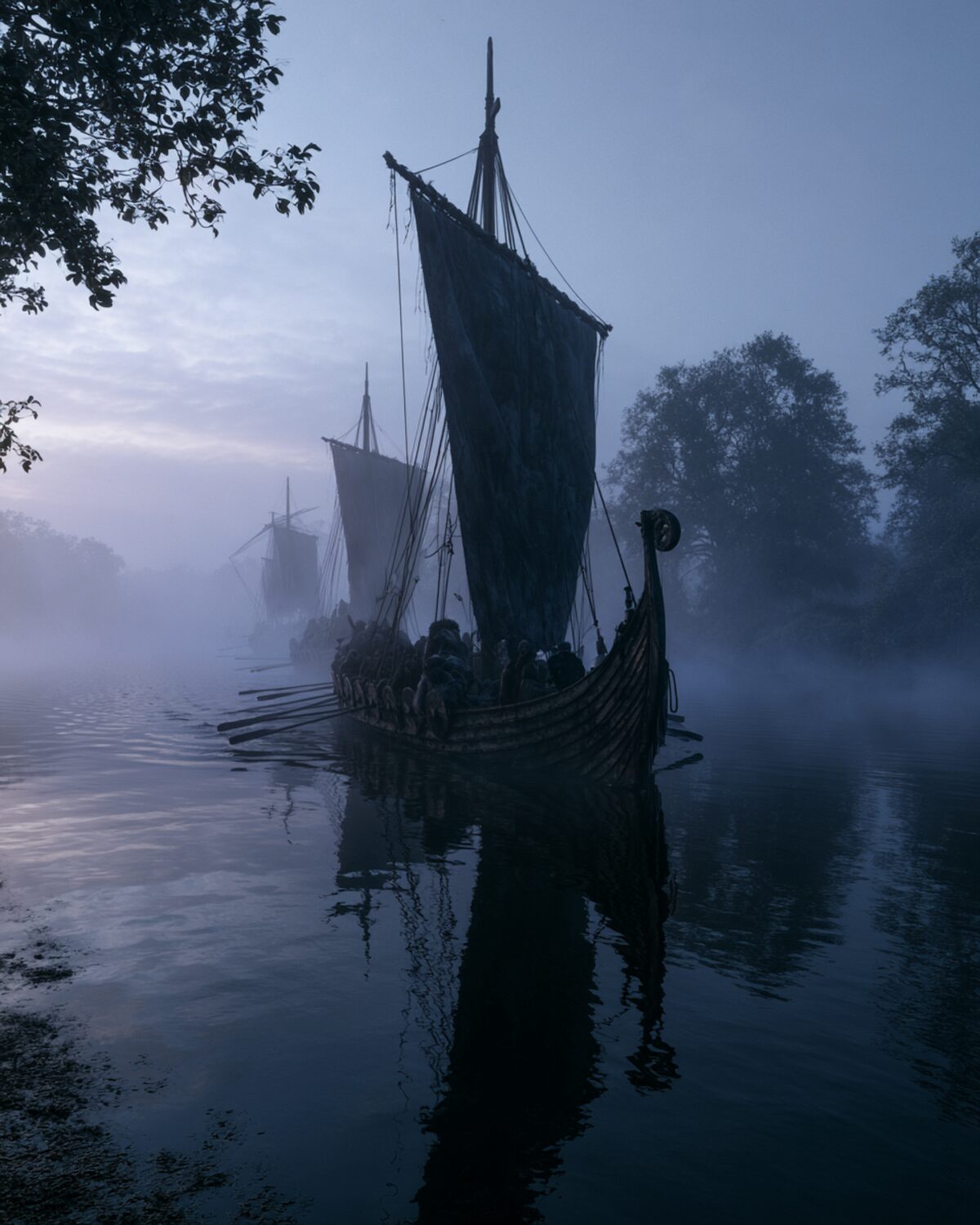
The Viking Age had two directions. While the Danes and Norwegians went west, the Swedes and Gotlanders turned east: across the Baltic, down the Russian rivers, to the Black and Caspian Seas. These Norse traders and warriors were called Rus (or Varangians) – and from them grew a realm that gave today's Russia and Ukraine their name.
The name leads straight to the Swedish coast: the Finnish word for Sweden, Ruotsi, probably goes back to Old Norse *rōþs- ("oar, rowing") – the "rowers" who came across the Baltic. From Ruotsi came Slavic Rus. The reading is still debated (the old "Normanist" controversy): was the Rus a Norse or a Slavic phenomenon? The honest answer is: both. A Norse warrior-and-trader elite laid itself over a Slavic majority – and merged with it within a few generations into a new people.
The Old Russian Primary Chronicle tells how the quarrelling tribes of the north, around 862, called in the Varangian Rurik to rule over them – the legendary "Invitation of the Varangians". Rurik settled in Novgorod; his successor Oleg moved downriver in 882 and made Kiev the "mother of Russian cities". So arose the Kievan Rus, a loose realm along the trade road, ruled by princes of Scandinavian descent with Slavic names – over the generations the Rurikids became Russian grand princes.
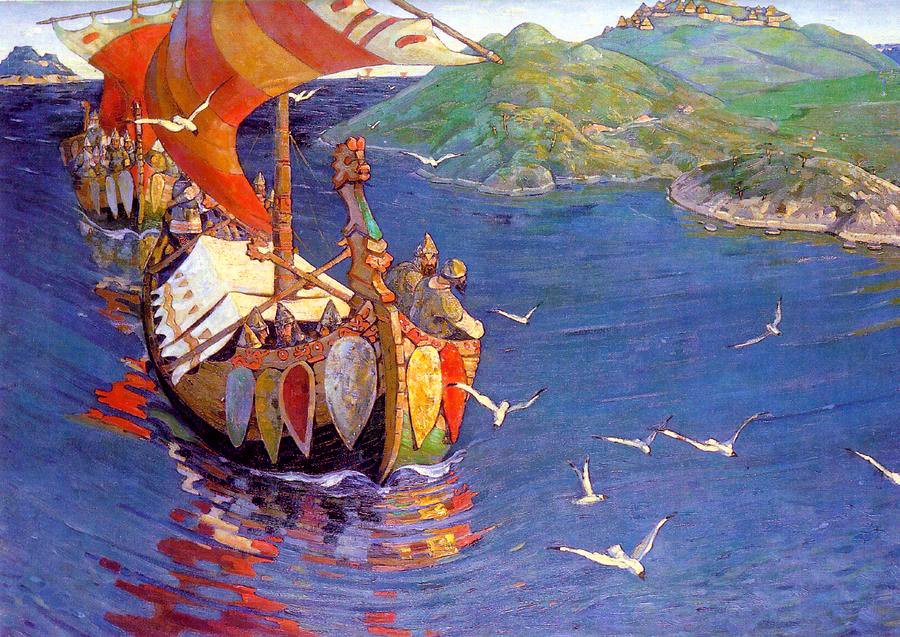
The backbone of the realm was the trade road "from the Varangians to the Greeks": from the Baltic through Novgorod, down the Dnieper to Constantinople. Emperor Constantine VII even describes, in his work De administrando imperio, the names of the Dnieper rapids – giving them in two languages, "in Rus" (Old Norse) and "in Slavic". These double names are among the strongest proofs of the Norse origin of the Rus. Traded were furs, honey, wax, weapons – and slaves; in return silver (Arabic dirhams), silk and wine came to the north.
The Rus were not only traders. Several times their fleets attacked Constantinople (860, 907, 941); the Rus-Byzantine treaties of 911 and 944 then regulated trade and peace – and their witness lists are full of Norse names like Karl, Ingjald, Farulf. From Varangian warriors the Byzantine emperor later recruited his famous Varangian Guard. The Arab envoy Ibn Fadlan met the Rus on the Volga in 922 and left the most vivid eyewitness account of all – down to the ship burial of a Rus chieftain.
Like the west, the Rus too became Christian. Princess Olga was baptised around 957; her grandson Vladimir the Great adopted Orthodox Christianity from Byzantium in 988 and had his people baptised in the Dnieper. With that the Rus turned culturally toward Constantinople – Church Slavonic, the Cyrillic script and Orthodox art shaped the realm from then on. The Norse origin faded; the "rowers" had finally become Slavs.
The legacy of the Rus is immense: from the Kievan Rus came Russia, Ukraine and Belarus, all of which trace themselves to it. The name of a people of "rowers" from Sweden became the name of the largest country on earth. For the Viking world the Rus are the eastern counterpart to Vinland: proof that the Norsemen were not only raiders but also state-founders, long-distance traders and bridge-builders between cultures – from the North Cape to Baghdad.
The eastern route was active before Rurik. In Staraya Ladoga on the Volkhov, one of the oldest trading places, Norse and Slavic finds mingle from the 8th century on. Down the rivers flowed a stream of Arabic silver to the north: tens of thousands of dirhams lie in the hoards of Gotland and Sweden – witness to a long-distance trade reaching from Baghdad to the Baltic. Runestones in Sweden commemorate the men who travelled "east" and stayed in "Serkland" (the land of the Saracens) or in Greece. The Rus were the eastern end of the same network to which Wolin, Hedeby and Birka belonged.
Almost all written sources on Slavic history come from their neighbours and opponents – German, Danish, Byzantine and Arab authors. They wrote from afar or from a Christian or Islamic view, often with their own agenda. That is why archaeology matters so much: ringforts, coin hoards, graves and trade finds complement and correct the picture of the texts. Only both together give an honest picture – and that is exactly how we separate here what is documented from what remains interpretation.
The fame of the eastern travellers reached Constantinople. From Varangian warriors the Byzantine emperor formed his Varangian Guard – an elite corps in which the later Norwegian king Harald Hardrada also served before returning home and falling at Stamford Bridge in 1066. Swedish runestones recall men who stayed "in the east" or "in Greece"; the famous Greece-runestones and the Ingvar stones testify to whole expeditions that went down the Dnieper and across the Black Sea. So the Rus linked the Baltic with Byzantium and the Caliphate – a network of trade and warriors of incredible reach.
The Rus are perhaps the most striking example of how closely the worlds of the Viking Age were intertwined. A Norse warrior lineage that joined with Slavic farmers, princes and towns, built Byzantine churches and counted Arabic silver – from this mixture a new culture arose. Whoever knows the Vikings only as raiders in the west misses this eastern half of their story. For us the Rus belong inseparably to the larger picture: from the fjords of Norway through the farms of the Slavs to the walls of Constantinople stretched a single, far-branching world.
"And they chose three brothers with their kin, and these took all the Rus with them … and came to the Slavs."after the Primary Chronicle (Povest vremennych let), public domain, own translation
The Suiones · Ibn Fadlan & the Rus · Wolin & Jomsborg.
All History & Finds articles →
Without their ships the Vikings would never have become Vikings. The longship was the high technology of its time …
Read more →