The Suiones were a Germanic people in today's Sweden. Tacitus describes them as strong in men, arms and above all in their fleets – an early hint of the later Norse sea power.
Almost everything Rome knew about the Suiones stands in one brief chapter: Tacitus, Germania 44, written around AD 98. The Roman historian never saw the north; he wrote at second hand, from the reports of traders and soldiers. And yet he struck a nerve. The Suiones, he says, are powerful "not only in men and arms, but also in fleets". So at the very start of Swedish history stands, of all things, the thing that would make the north world-famous centuries later: mastery of the water. To understand the Suiones you must take this one sentence seriously – and everything archaeology and philology have added since.
Tacitus is most precise about shipbuilding. The vessels of the Suiones, he writes, have the same shape at both ends – a prow fore and aft, so they can put in at either end. The oars are not fixed in rows as on Roman ships, but loose and movable, to be shifted as the situation demands. He mentions no sail – which fits: in his day the north still moved by muscle power; the sail only came into its own centuries later.
This "ship with two prows" is no fantasy. Just such double-ended rowing boats are known from the bog: the Hjortspring boat (c. 350 BC), and above all the Nydam ship (c. AD 310–320), a nearly 24-metre oak rowing boat with symmetrical ends. From here a straight line runs through the Kvalsund boat and the ceremonial ships of the Vendel period to the famous longships of Oseberg and Gokstad. Without knowing it, Tacitus describes the ancestor of the Viking ship.
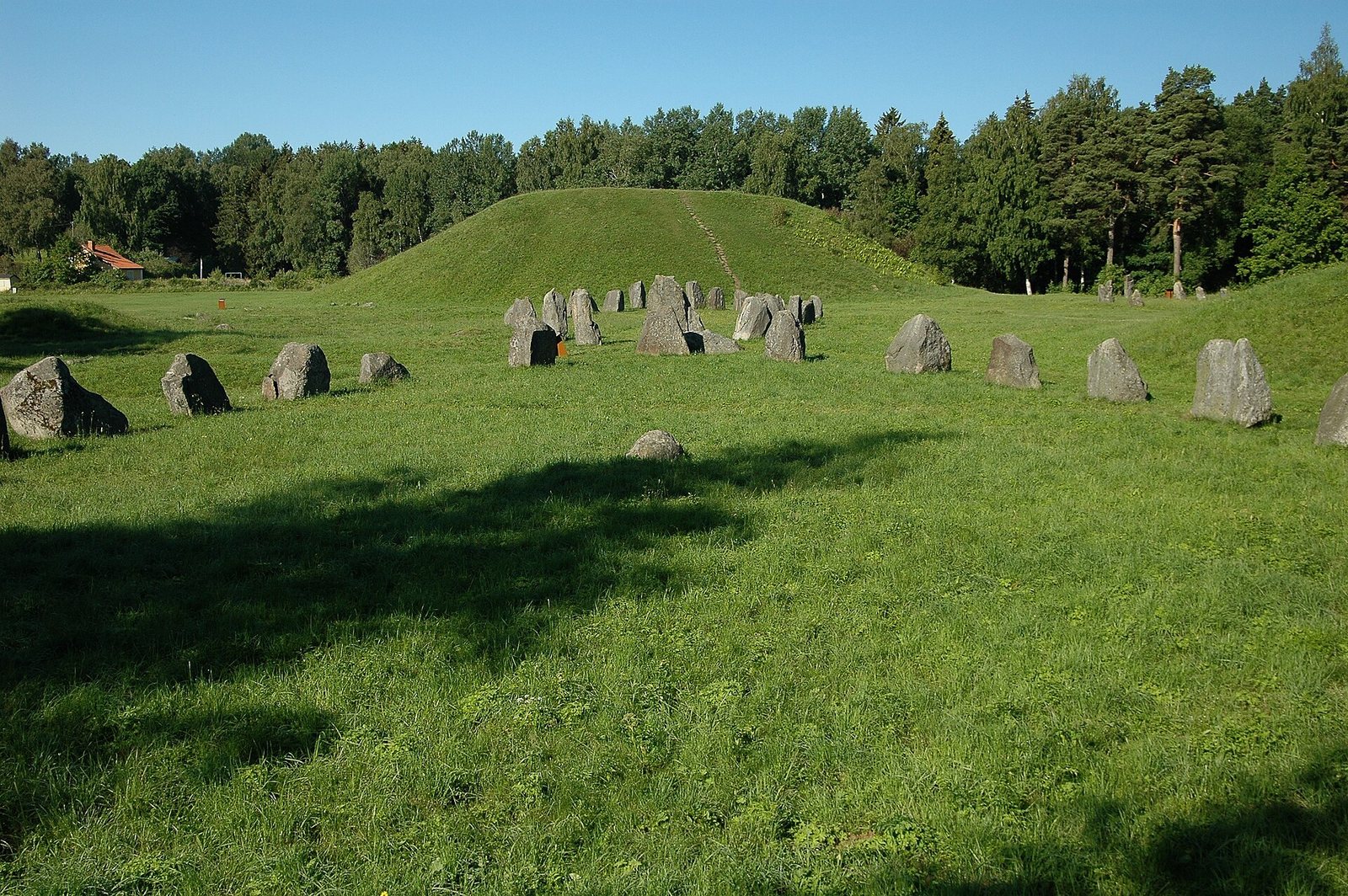
Where did this people sit? Every trace points to the country around Lake Mälaren in central Sweden – to Uppland and the region still called Svealand, "the land of the Svear". Here the great find-sites of the following centuries lie close together: the royal mounds of Gamla Uppsala, the boat-grave fields of Vendel and Valsgärde, later the trading place Birka. It is no accident that this water-rich lakeland produced a people whose power rested on boats: Mälaren was then an open sea inlet, a web of waterways linking every farm to the Baltic.
The name is the strongest bridge. Latin Suiones becomes, via Proto-Germanic *Sweoniz, the Old Norse Svíar (the Svear), and their land Svíþjóð finally becomes Sverige – "Sweden". The same people appear in Old English Beowulf as the Sweon, the great rivals of the Geats. Linguistically the line Suiones → Svear → Sweden is cleanly drawn. One must stay honest, though: nearly 900 years lie between Tacitus and the first Swedish kings, years from which almost no written sources survive. The continuity is well founded, but over long stretches it is proved by the spade, not by charters.
Tacitus notes something else remarkable: among the Suiones wealth is respected, and so one man rules – with unlimited power and unconditional obedience, unlike the looser tribal confederations further south. Here, at the beginning, stands the northern idea of kingship. Later saga tradition traces the kings of Uppsala, the Ynglingar, back to the god Freyr (Snorri's Ynglinga saga, 13th c. – far later and literarily shaped). More tangible are the three great royal mounds of Gamla Uppsala from the 5th/6th century and the description of a great sanctuary at Uppsala by Adam of Bremen (11th c.) – which must be read as the hostile outside view of a Christian author, not an eyewitness report.
Archaeology builds the most striking bridge between Tacitus's Suiones and the Vikings with the Vendel period (c. AD 550–800). At Vendel and Valsgärde near Uppsala, boat graves were found: warriors buried in their boats, with gilded ceremonial helmets, ring-swords, shields and horse harness. This imagery – dancing warriors, riders, birds of prey – recurs almost unchanged on Viking helmets and in the Sutton Hoo find in England. Here we see a warrior elite that already lived, believed and fought like the later Vikings, generations before the first raid on Lindisfarne. Tacitus's Suiones and the Vikings are not two peoples but two chapters of the same story.
When the Viking Age began around 800, the descendants of the Suiones did not set out westward like the Danes and Norwegians, but above all eastward: across the Baltic, down the Russian rivers, as traders and warriors as far as Constantinople and the Caliphate. By a widespread interpretation, Svíar gave rise to the name of the Rus – those Norse trader-warriors who gave today's Russia its name (also a debated, not finally proven, derivation). The trading place Birka on Mälaren became the gateway east. So the circle closes: the people Tacitus praised for their fleets became, a thousand years later, the sea power that ranged across half of Europe.
One detail in Tacitus has occupied generations of historians. Unlike other Germani, he writes, the Suiones do not carry their weapons at all times; rather they lie locked away, guarded even by a slave. The reason: under a kingship of so strong a hand, peace is the rule and sudden war the exception – and idle, armed men a danger to order. Whether this was a real custom or a Roman reading of foreign conditions is open. But the passage shows how much Tacitus felt the Suiones to be something other: not the loose warrior folk of the Rhine Germani, but a tightly led commonwealth at the edge of the known world. For him this was almost the end of the earth – beyond the Suiones, he adds, begins the "other sea", sluggish and almost motionless, that girdles the world.
Tacitus places the Suiones in a chain of northern peoples, and the neighbourhood is telling. Right beside them he names the Sitones – who, scandalously to the Roman, let a woman rule them. Further east sit the Aestii, who gather on the coast the amber Rome so craved. This picture of a networked Baltic world is no accident: long before the Viking Age, the Baltic was not a dividing but a connecting sea, a road for goods, boats and news. The Suiones sat at one of the most important knots of this web – where Mälaren joined the inland farms to the open sea.
Why did a hull "the same at both ends" matter so much? A double-ended boat need not turn to retreat – the rowers simply switch about and row the other way. In the narrow, shallow skerries and river mouths of the north this was a decisive advantage: quick landing, quick launching, no vulnerable manoeuvre in a fight. The same idea, refined and later given keel and sail, made the Viking ship one of the most successful designs in history: shallow enough for rivers, seaworthy enough for the Atlantic. Tacitus's plain description already holds the principle that would carry the north across the seas.
The Suiones became the Svear – but the kingdom of Sweden was still far off. For centuries two great peoples shared the Scandinavian peninsula: the Svear around Mälaren and the Götar further south (Väster- and Östergötland). Only gradually, in the High Middle Ages, did the two merge into one realm; for a long time the full royal title still named them separately. But the land-name Svearike ("realm of the Svear") prevailed – to this day in Swedish Sverige. So modern Sweden carries in its name exactly the people Tacitus praised nearly two thousand years ago for their fleets.
The Suiones are proof that the Viking Age did not come from nowhere. Almost a thousand years before the longships reached the monasteries of England, a people sat on Mälaren whose power already rested on boats, on a strong kingship and on trade across the Baltic. Anyone who wears a Norse motif today, or sets one in their home, reaches back not only to the Vikings but to a far older, unbroken line – from the double-ended boats of Tacitus through the splendid helmets of Vendel to the dragon ships of the sagas. It is exactly this depth that makes northern history so fascinating: it reaches further back than most people suspect.
"Beyond these, out in the sea, are the states of the Suiones, powerful not only in men and arms but also in fleets. The shape of their ships is alike at both ends, so that the prow is always ready to put to shore."Tacitus, Germania 44, after a public-domain translation
The Sitones · The Aestii · The Goths · The Gutones · Viking traces in Germany.
All History & Finds articles →
A whole royal ship, buried beneath a mound, full of gold and weapons – and a helmet that became the face of an entire …
Read more →Some Vikings raided, others had Danegeld paid to them – Sweyn Forkbeard did both and then reached for the crown itself …
Read more →