The Tencteri and Usipetes were two Germanic tribes who in 55 BC, under pressure from the Suebi, crossed the Lower Rhine to seek new land – in the area around the Meuse estuary.
Caesar would tolerate no Germanic immigration into Gaul. While negotiations were still under way and the Germanic leaders were in his camp, he attacked. The result was a massacre among the leaderless tribes; Caesar himself speaks of enormous numbers.
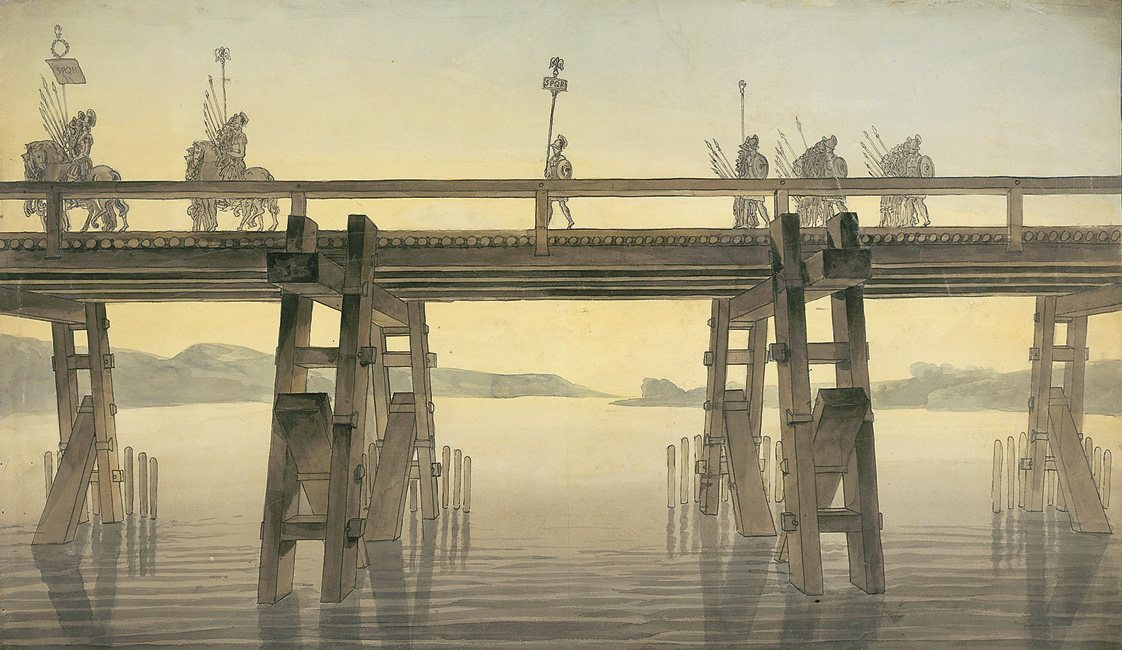
The affair was so harsh that even in Rome voices condemned it: Cato the Younger is said to have demanded that Caesar be handed over to the Germani for breaking the truce. Afterwards Caesar built his first bridge across the Rhine and led a short campaign into Germania east of the river.
"When they saw their leaders detained, they lost their heads."freely after Caesar, The Gallic War IV (public domain, own translation)
The Tencteri and Usipetes were two Germanic tribes forced by the pressure of the powerful Suebi to leave their seats east of the Rhine. In the winter of 55 BC they crossed the Lower Rhine in great numbers and sought new land – in exactly the region that later, between Lower Rhine, Meuse and the Frankish kingdom, became the scene of great history. Caesar saw in this movement a threat to the Roman order in Gaul and advanced against them.
What then happened is among the darkest chapters of the Gallic War. During an agreed truce – the Germanic leaders were in Caesar's camp for talks – the Roman army attacked the leaderless camp of the Germani. Ancient authors report a vast number killed, including women and children driven into the mouth of the Rhine. Whether the transmitted figures are accurate is uncertain; the brutality of the deed, however, is not in doubt.
Even in Rome there was outrage: the stern Cato demanded that Caesar be handed over to the Germani for breaking the truce. But Caesar set a sign of power: in only ten days he had a wooden bridge built over the Rhine, crossed the river and showed that Rome could reach the right bank at any time. The bridge was demolished afterwards – the message remained.
The Tencteri were regarded as excellent horsemen; Tacitus praises their horsemanship a century and a half later. Remnants of both peoples stayed on the Lower Rhine and later merged into the larger tribal confederations. Thus their story plays out directly in the landscape that is also our home – between Rhine, Ruhr and the border of the Frankish land.
Almost everything we know about these events comes from Caesar's own account – and he wanted to justify his actions before the Roman Senate. The breach of the truce is presented there as a clever stroke, and the huge casualty figures are meant to justify his severity. Historians therefore read these passages critically: they show less the naked truth than the image a Roman general wanted to paint of himself. For us it remains to note that here two Germanic peoples met a tragic end on the Lower Rhine.
Tencteri and Usipetes show the harshness of war on the Rhine. Continue with the Sugambri and Ubii.

The Sugambri · The Ubii · The Eburones · The Cherusci & Arminius · The Treveri.
All History & Finds articles →
The Vikings had no central state power. Law and politics arose at the assembly of free people – the Thing.
Read more →A handle that turned out too short, a fly at the bellows and over a thousand silver amulets in the earth: Thor's hammer …
Read more →A king raises a stone for his wife and calls her on it “Denmark's adornment.” A son sets both parents an even greater …
Read more →