Thyra Danebod (runic Þyrvé) was a tenth-century queen in Denmark, wife of Gorm the Old and mother of Harald Bluetooth – and the only solid evidence for her is carved in runestones. Gorm called her “Denmark's bót” on the small Jelling stone, Harald honoured her on the great Jelling stone, and two stones at Bække and Læborg name her too. Everything else – the English princess, the builder of the Danevirke, the wise interpreter of dreams – comes from chronicles and sagas written two or three centuries later. Here we keep the two apart.
Imagine that a thousand years from now, all that survives of you is four inscriptions on granite boulders in southern Jutland. No letters, no portrait, no chronicle. And yet people still tell stories about how you outwitted an emperor, raised a great border wall and broke the news of a son's death to a grieving king. That is Thyra's fate. She is the first Danish queen historians can genuinely grasp – and one of the most legend-wrapped figures of the entire Viking Age.
So we let the stones speak first, and only then ask what the later storytellers added – and how much of it survives the archaeologist's trowel.
The hard facts fit on a beer mat. Thyra lived in the tenth century. She was the wife of Gorm the Old, founder of the Jelling dynasty, and the mother of Harald Bluetooth. She died before her husband, because Gorm raised a memorial stone for her. That is the full extent of what her own lifetime tells us.
As far as we know, no tenth-century written source mentions her. Adam of Bremen, writing around 1075, does refer to a cruel Danish king “Vurm” – most likely Gorm – but says nothing of Thyra. Every story about her comes from the late twelfth and thirteenth centuries: from Sven Aggesen (c. 1185), from Saxo Grammaticus (c. 1200) and from Icelandic sagas such as the Saga of the Jomsvikings. These texts are two to three hundred years younger than the woman they describe.
Her name carries a clue of its own. On the stones it is spelled þurui or þąurui, normalised as Þyrvé or Þorwi. Danish name scholars derive it from a form meaning “consecrated to Thor” – Þór plus vé, “sanctuary, holy place”. A queen with a thoroughly pagan name, whose son would later boast of making the Danes Christian.
In Jelling, a village north-west of Vejle in Jutland, two runestones stand between two enormous mounds. The smaller one, known as Jelling 1 or by its catalogue number DR 41, is a modest granite block. Its runes run vertically in bands across two faces, framed by double lines. They are written in the Younger Futhark, the sixteen-rune alphabet of the Viking Age, and read in transliteration:
kurmR : kunukR : karþi : kubl : þusi : aft : þurui : kunu : sina : tanmarkaR : butSmall Jelling stone (DR 41), mid-tenth century, runic text after the Rundata database
In our own rendering: “King Gorm made this monument in memory of Thyra, his wife, Denmark's bót.” The word kubl (Old Norse kuml) means a funerary monument in the broad sense – the stone itself, or a whole complex of stone, mound and stone setting. The plural, “these monuments”, has long puzzled scholars: did Gorm build more than just the stone?
The stone can only be dated indirectly. It was carved before Gorm's death, and that death is usually inferred from the north mound at Jelling, whose burial chamber was built from oaks felled in the winter of 958/59 – assuming the mound was Gorm's grave. Gorm's stone may originally have been linked to the vast ship-setting at Jelling, perhaps at its prow, but that is not certain; the stone has been moved more than once over the centuries.
Memorial stones for women are rare in Denmark, which makes this one remarkable in itself. For the whole site, see our guide to the Jelling stones.
Two words at the end of the inscription have generated more ink than all the rest: tanmarkaR but, normalised Danmarkar bót. They gave Thyra her epithet “Danebod”. But what does bót actually mean?
The Old Norse word is related to English boot, as in “to boot”, and to German Buße. Its core sense is “betterment, remedy, compensation”. In the 1940s the Danish scholar Nielsen argued for “Denmark's adornment” – a woman who brought honour to her land – while Lis Jacobsen read something stronger: “Denmark's improvement, strength, salvation”. The choice matters. As an “adornment”, Thyra looks like a celebrated consort, perhaps the partner in a vital marriage alliance. As a “remedy” or “salvation”, she becomes an active force in the making of the kingdom.
A more basic question lurks beneath: who is the phrase about? Grammatically it could refer to Gorm – “King Gorm, Denmark's remedy, made this monument” – and that reading was once defended. Today, according to the Danish national encyclopaedia lex.dk, there is broad agreement that it honours Thyra; its position right after “his wife” supports that. The honest summary: it very probably means Thyra, and it is very probably high praise. Just how high remains a matter of interpretation.
A few metres away stands the famous sibling: the great Jelling stone (DR 42), a three-sided granite boulder bearing the oldest image of Christ in Scandinavia and a great beast locked in combat with a serpent. Harald Bluetooth raised it after his baptism around 965 and before his death around 987. The inscription opens with his parents:
haraltr : kunukR : baþ : kaurua kubl : þausi : aft : kurm faþur sin auk aft : þąurui : muþur : sinaGreat Jelling stone (DR 42), c. 965–987, runic text after the Rundata database
In our rendering: “King Harald ordered these monuments made in memory of Gorm, his father, and in memory of Thyra, his mother.” Then the tone shifts and Harald talks about himself – the Harald who won all of Denmark and Norway and made the Danes Christian. Thyra stands on an equal footing with Gorm, with her own separate “and in memory of”, almost like a legal formula. Why Harald's nickname now lives in every smartphone is a story we tell in your phone carries a Viking king.
A telling detail: the great stone spells Thyra's name with one extra rune (þąurui rather than þurui) and favours strikingly old-fashioned spellings such as þausi and tanmaurk. The authors of the 2023 3D study suggest the king deliberately ordered this archaic style to lend his message weight – much as we still reach for blackletter or classical capitals on certificates and gravestones.
About 25 to 30 kilometres south-west of Jelling, around Bække and Læborg, stand more stones naming a Þyrvé. For a long time nobody could be sure it was the same woman. The name was not unique, and these stones mention no king.
The Læborg stone (DR 26) reads rhafnukatufi hiau runaR þasi aft þurui trutnik sina – roughly, “Ravnunge-Tue cut these runes in memory of Thyra, his lady.” The key word is dróttning, the ancestor of modern Danish dronning, “queen”. In the Viking Age it described a woman who headed a retinue, the female counterpart of dróttinn, the lord of a war-band. Ravnunge-Tue, “Tue of Ravn's kin”, presents himself as her man – her retainer.
Bække 1 (DR 29) is even more specific: rafnukatufi auk futin auk knubli þaiR þriR kaþu þuruiaR hauk – “Ravnunge-Tue and Fundin and Gnyple, these three made Thyra's mound.” So this is not just a stone but a burial mound for Thyra, raised by a team from her own circle. Where exactly that mound lay is uncertain; the Bække area has a large ship-setting and several mounds.
The so-called Bække–Læborg group also includes Bække 2 (DR 30), the Horne stone (DR 34) and the Randbøl stone (DR 40), which names a “Tue” – whether he is the same Ravnunge-Tue is open. Thyra does not appear on these three.
In 2023 runologist Lisbeth M. Imer of the National Museum of Denmark, together with Laila Kitzler Åhfeldt and Henrik Zedig, published a study in the journal Antiquity under the memorable title “A lady of leadership”. They examined seven stones with high-resolution 3D scans: the two Jelling stones from older scans, plus Bække 1 and 2, Læborg, Horne and Randbøl.
The principle is familiar to anyone who engraves. Every hand has its habits: the angle of the chisel, the force of each blow, the profile of the groove. In 3D data, the depth and cross-section of every cut can be measured and compared, alongside the shapes of the runes and the carver's spelling habits.
The result: the Læborg stone and the great Jelling stone share so many traits that the researchers attribute both to the same hand – Ravnunge-Tue's. Bække 1, Horne and perhaps Randbøl look like the work of a second carver, possibly an apprentice or colleague; Bække 1 and Horne share an unusual spelling of the word “made”. Bække 2 seems to be the work of a novice, with small, irregular runes. The small Jelling stone, sadly, is too weathered to identify its carver.
If Ravnunge-Tue worked both for “his lady Thyra” at Læborg and for King Harald at Jelling, the Thyra of Læborg and the Thyra of Jelling are very probably one and the same. That puts her on four stones, while Gorm and Harald, according to the National Museum, appear on two each. No other person from Viking-Age Denmark is named in stone so often. Imer's verdict was that Queen Thyra was far more important than previously assumed.
The study draws a cautious but intriguing conclusion. Because all the Thyra stones stand in southern and central Jutland, and because she had a retinue of her own there, she may have come from a powerful Jutlandic, perhaps royal, family. In that case the marriage to Gorm was an alliance that gave his kingship the backing it needed in the south. That is an interpretation, not a finding – but it fits everything the stones tell us.
Where did Thyra come from? The stones are silent. Medieval writers, by contrast, know exactly – only each of them knows something different.
Saxo Grammaticus, in his Gesta Danorum (c. 1200), makes her the daughter of an English king called Ethelred. That cannot stand as history: no English king of that name fits the chronology convincingly, and English sources know nothing of such a marriage.
Sven Aggesen, Saxo's slightly older contemporary, tells a different version in his short history of the Danish kings, in which relations with the German emperor play the central role; his account is usually read as giving Thyra a southern, German origin. In his telling she is also still a pagan.
The Saga of the Jomsvikings, written down in Iceland in the thirteenth century, names her father as an earl called Harald, nicknamed Klakk-Harald, who ruled Holstein (Holtsetaland). It calls Thyra the wisest of all women, better at reading dreams than anyone else. That too is late tradition, though at least it places her in the south – a lucky hit that sits well with the runestones in southern Jutland.
Three origins, then, that rule each other out, and not one of them contemporary.
The later texts turn Thyra into a shrewd, far-sighted woman. In the Jomsvikings' saga she sets Gorm a condition before agreeing to marry him: he must sleep for three nights in a house built for the purpose and tell her his dreams. Gorm dreams of white, red and black oxen rising out of the sea; Thyra reads them as hard winters, years of plenty and a time of trouble. In Saxo, Gorm instead dreams of two birds flying from Thyra's womb – a sign of sons to come.
In the saga those sons are Knut and Harald. Knut is killed, and Gorm has sworn to put to death anyone who brings him the news. Thyra has the hall hung with mourning cloth overnight; in the morning Gorm speaks the news aloud himself, and she answers, in effect, that he said it, not she. Shortly afterwards the old king dies. Versions of this scene travelled through Danish historical writing as far as Arild Huitfeldt's chronicle of the realm around 1600.
Is any of it true? That Gorm and Thyra had a son named Knut is widely assumed but not attested in any inscription. The dream and mourning scenes are wandering motifs – crafted tales of female wisdom found elsewhere in saga literature too. They tell us nothing reliable about the tenth century. For another example of how Saxo works with such material, meet his enigmatic shieldmaiden Lagertha.
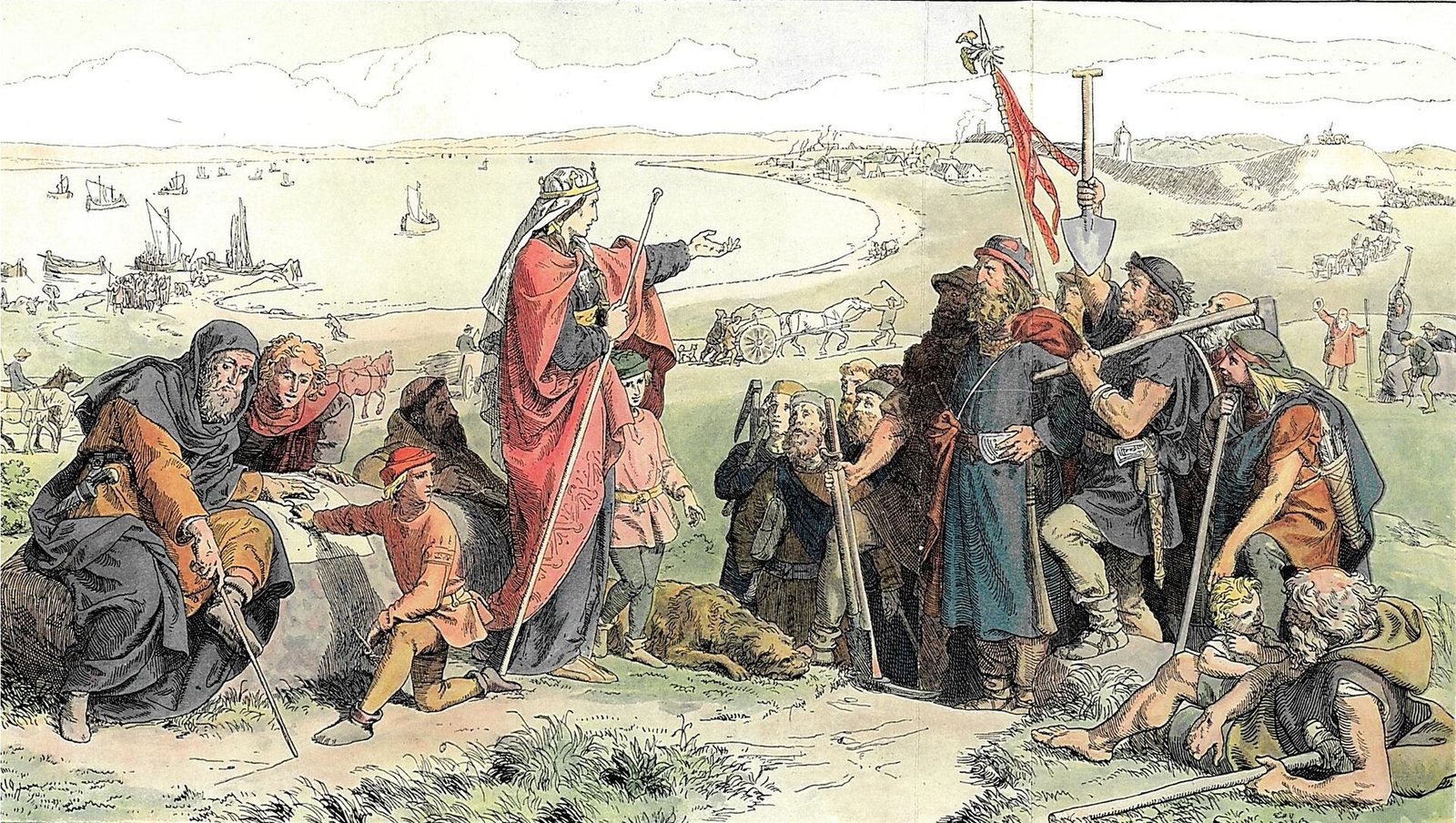
The most stubborn story of all, still repeated on signboards and in travel guides, says Thyra built the Danevirke, the great border rampart across the neck of Jutland near Schleswig. Sven Aggesen and Saxo both tell it, Aggesen most colourfully: the queen refuses to keep paying tribute to the emperor and even deceives him about what the wall is for. Later chronicles embroider further – in Huitfeldt she summons men from Scania, Zealand, Funen and Jutland, each building their own section.
Archaeology now has a clear view. The oldest earthen ramparts of the Danevirke date from before AD 500, perhaps around 450 – almost half a millennium before Thyra. A massive timber front on the main rampart is tree-ring dated to 737, as is the north rampart. A fieldstone wall followed. In the tenth century there was indeed major building again: work on the main rampart is dendro-dated to before 954, and the connecting wall between the main rampart and the semicircular rampart of Hedeby to 964/65–968. That falls in the reign of Harald Bluetooth, the king who also built the Trelleborg ring fortresses.
Why Thyra, then? In the late twelfth century, when Valdemar the Great reinforced the rampart with a brick wall, the frontier with the Empire was a burning issue – and a wise queen from the dawn of the kingdom made an ideal founder figure.
Since the Middle Ages the north mound at Jelling has been known as “Thyra's mound” and the south mound as Gorm's. Sven Aggesen and Saxo both report that Gorm and Thyra lay in two mounds. Excavation has thoroughly scrambled that picture.
The north mound is about 62 metres across and 8 metres high. At its core lies a burial chamber of oak planks almost seven metres long. It was discovered in 1820, when a dried-up pond on the summit was dug deeper. The chamber was nearly empty. Only a few finds of the highest quality remained, including the famous Jelling cup, a silver beaker just over four centimetres tall whose animal ornament gave the Jelling style its name. The timber was felled in the winter of 958/59; some accounts give 959 or 959/60.
The south mound, about 70 metres across, is even bigger – the largest man-made mound of the Scandinavian Viking Age. Yet excavations in 1861 and 1941 found no grave inside. It was probably heaped up from the late 960s or early 970s as a monument, most likely a display of Harald's power. It was never Gorm's grave.
Then there is the church. Excavations beneath Jelling church in 1976–79 uncovered the skeleton of a man aged 35 to 50, buried with a strap fitting in the same style as the Jelling cup. A popular theory holds that Harald, after his own baptism, had his pagan father moved from the north mound and reburied in the first wooden church. In that case the north mound was originally Gorm's grave. It remains unproven; no DNA could be recovered from the bones.
The 2023 Antiquity study, for its part, finds the traditional attribution of the north mound to Thyra entirely compatible with her rank. Meanwhile the Bække stone speaks of a separate “Thyra's mound” at Bække. Was that a second memorial, a cenotaph – a mound without a body? Nobody can say today.
Thyra became truly famous some eight hundred years after her death. In the nineteenth century, as Denmark and the German states fought over Schleswig and Holstein, the Danevirke became the symbol of Denmark's southern frontier – and Thyra, its supposed builder, the emblem of Danish self-assertion. Her epithet was now happily read as “she who mended Denmark”, the defender of the land.
Lorenz Frølich depicted her in 1855 as the builder of the Danevirke. Christen Dalsgaard painted a very different Thyra in 1869, after the defeat of 1864: quiet, resigned, seeking comfort in faith. The shift in the images mirrors the mood of the country. Associations and newspapers took her name; Royal Copenhagen issued a Thyra Danebod plate in 1919, just before the new border of 1920; and Princess Thyra, daughter of Christian IX, born in 1853, was named after her.
How a woman known from four inscriptions became a national symbol tells us more about the nineteenth century than about the tenth.
Other women of her time raised stones themselves: Ragnhild on the Glavendrup and Tryggevælde stones, or Harald's wife Tófa on the Sønder Vissing stone for her mother. Thyra, by contrast, had stones raised for her – by a king, by a king's son and by men of her own retinue. That makes her position unique. Read more in our article on women in the Viking Age.
What moves us about Thyra, as an engraving workshop, is simple: her entire historical existence hangs on a handful of cut grooves. A man wanted his wife's name remembered – and it worked, for more than a thousand years. That is the heart of what we do every day.
The idea for you: a slate plaque bearing the name of someone you love in Younger Futhark runes, with an honorary epithet of your own in the spirit of “Danmarkar bót” – “my strength”, “the blessing of our family” – framed by double lines like Gorm's stone. Our rune translator helps with the transliteration, and our honest introduction to the runes explains the basics. We write the name the way it would have been written in the tenth century, not in fantasy runes.
For courage. For remembrance. For legends that live on.
Who was Thyra Danebod? Thyra was a tenth-century Danish queen, wife of Gorm the Old and mother of Harald Bluetooth. She is securely attested only by runestones, above all the two Jelling stones.
What does Danebod mean? The epithet comes from Danmarkar bót on the small Jelling stone. Bót means “betterment, remedy”; it is usually translated “Denmark's adornment” or “Denmark's strength, salvation”.
How many runestones mention Queen Thyra? Four: Jelling 1 and 2, Læborg and Bække 1. Since a 3D study in 2023 it is very likely they all mean the same woman, though not proven.
Did Queen Thyra build the Danevirke? No. The oldest parts of the rampart are around 450 years older, and the major expansion around 968 belongs to her son Harald's reign. The story comes from twelfth-century chronicles.
Where was Thyra from? Nobody knows. Saxo makes her an English king's daughter, the Saga of the Jomsvikings the daughter of an earl in Holstein. The runestones point to a power base in southern and central Jutland.
Is Thyra buried in the north mound at Jelling? That is open. The chamber in the north mound dates from 958/59 and was empty; many scholars see it as Gorm's original grave, while tradition and some recent interpretations favour Thyra.
Runes & their meaning · Ragnar's sons · Which rune to engrave? · The skull-cup myth · The Golden Horns of Gallehus.
All History & Finds articles →
A lake named after a god. A lord’s hall the size of a church. Weapons sunk in the water, and a gold ring heavier than …
Read more →Its name means “the god's lake.” On the shore of Tissø on the Danish island of Zealand lay, for centuries, one of the …
Read more →Sometimes a whole world of gods sits on a thumb-sized piece of bronze. The four Torslunda dies from the island of Öland …
Read more →From above they look as if drawn with a compass: perfectly circular ramparts, divided into exact quarters, with four …
Read more →