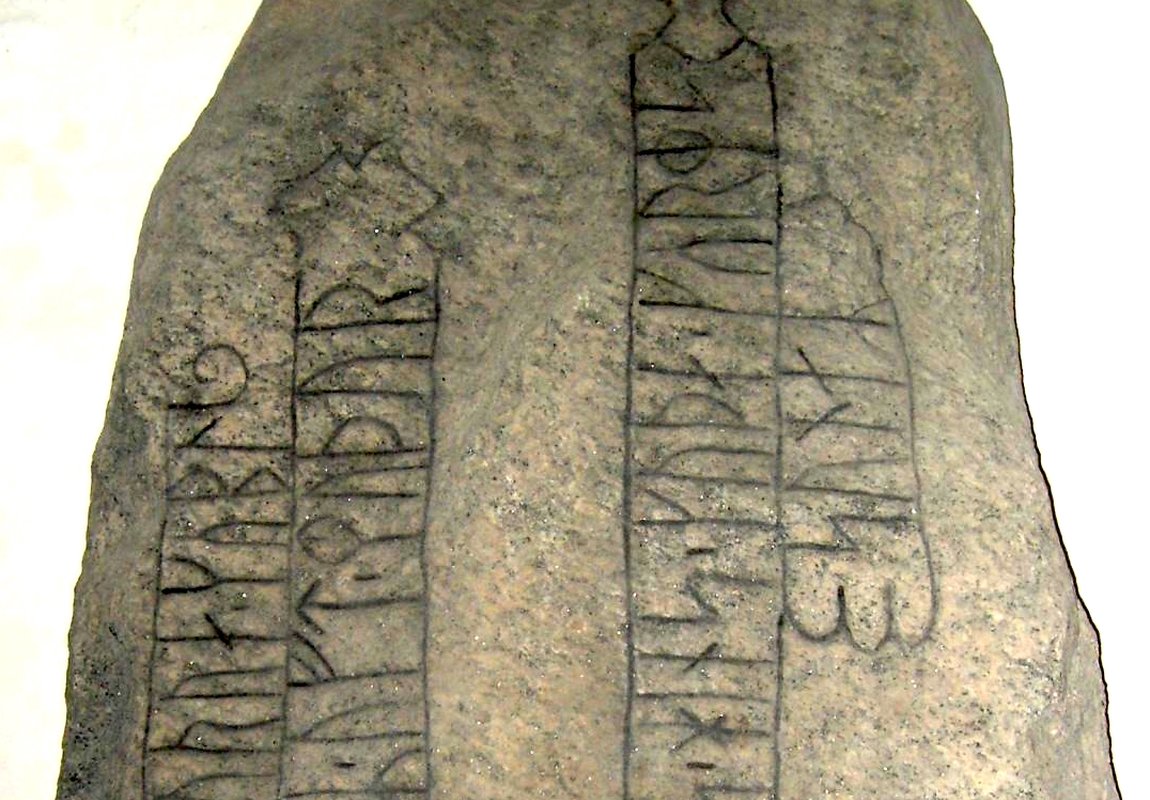
The Sønder Vissing stone 1 (DR 55) is a late tenth-century runestone raised by Tófa, daughter of Mistivi, in memory of her mother – and on it she calls herself "wife of Harald the Good, Gorm's son". That Harald is almost certainly Harald Bluetooth, and her father most likely Mistivoj, prince of the Obodrites in what is now Mecklenburg. The granite slab stands in Sønder Vissing church in East Jutland and is the only evidence we have for this Danish–Slavic marriage. Here is what the stone really says, what German chroniclers tell us about Mistivoj, and where scholars stay cautious.
In 1836, at the main entrance to the churchyard of Sønder Vissing, an unremarkable stone sat in the churchyard wall. It propped up the side beam of the gate, its carved face turned outwards. For who knows how long, villagers walked past it on their way to Sunday service. Then somebody looked closely – and the gatepost turned into one of the most intriguing inscriptions of Viking Age Denmark.
Because on this granite a woman names herself whom no other northern source remembers: Tófa, daughter of a man with the foreign-sounding name Mistivi, wife of a king called Harald, whose father was Gorm. No saga tells her story, no skald praises her, Adam of Bremen never mentions her. Everything we know about Tófa is carved on this single stone. That is exactly what makes it precious – and what makes it such fertile ground for legend. We will look at both: the hard evidence and what later writers built on top of it.
The same year a second runestone emerged from the churchyard wall. It had been lying in the paving of the entrance and is far more worn. Today both stand inside the church – two memorials from the very generation in which Denmark was being forged into a Christian kingdom under Harald Bluetooth.
The inscription runs in two framed bands across one broad face of the stone. Each band is read from the bottom up, starting on the left, and short vertical strokes separate the words. The runes are 12.5 to 15 centimetres tall and belong to the Younger Futhark, the sixteen-character alphabet of the Viking Age. In scholarly transliteration the text reads:
tufa · lʀt · kaurua · kubl · mistiuis · tutiʀ · uft · muþur · sina · kuna · harats · hins · kuþa · kurms · sunaʀSønder Vissing stone 1, DR 55 (transliteration after Danske Runeindskrifter)
Normalised into Old Danish: Tōfa lēt gørva kumbl, Mistivis dōttiʀ, øft mōður sīna, kona Haralds hins gōða, Gōrms sonaʀ. In English:
Tófa had the monument made, Mistivi's daughter, in memory of her mother, the wife of Harald the Good, Gorm's son.DR 55, our own translation
A few words deserve a closer look. Kumbl means "monument" or "memorial" and in Old Danish can describe a whole ensemble – stone, mound, stone setting. Whether Tófa's stone originally belonged to something larger we cannot say, because its first location is unknown. Øft ("after", "in memory of") is the standard formula on Danish runestones. And the carver uses the ʀ-rune not only for the palatal r at the end of words but also for the long e in lēt ("had", "let") – a quirk seen on a few other stones of the period. The m-rune is rounded. These are the small fingerprints of a workshop whose name we do not know: no rune carver signed this stone.
If you want to get to grips with the characters themselves, start with our honest introduction to the runes.
Here lies the real point of the stone – and a trap that is easy to fall into. The inscription says "in memory of her mother, wife of Harald". In English, as in German, you might think it was the mother who was Harald's wife. Scholars have in fact considered that reading: it would make Mistivoj's widow the Danish king's wife, rather than his daughter.
Old Danish is more precise than our translation. Muþur sina ("her mother") is in the accusative, because it depends on øft. Kuna ("wife"), on the other hand, is most probably nominative – just like tufa, the subject of the sentence. If the mother were meant, you would expect the accusative form kunu. The Danish runic database of the National Museum therefore considers the link to Tófa the most likely. Intriguingly, kuna sits slightly outside the main rune line, as though it was squeezed in or added afterwards.
The sentence structure is telling. The dead woman, for whom the stone was raised, is not even named. Instead the sponsor introduces herself at length: daughter of, wife of – and the husband once more as son of. For this pattern the Danske Runeindskrifter point to none other than the great Jelling stone, where Harald likewise praises himself in a long appositive clause. The mother is the occasion, but Tófa is the protagonist. Anyone reading this stone was meant to grasp one thing above all: the queen is speaking.
A Harald, son of a Gorm, in Jutland, in the second half of the tenth century: anyone would think at once of Harald Gormsson, the king we call Harald Bluetooth. The Danmarks Runeindskrifter edition by Lis Jacobsen and Erik Moltke (1941–42) considers this identification likely but notes a snag: Harald bears the epithet hinn góði, "the Good", nowhere else. "Bluetooth", for its part, is a nickname that only turns up in much later texts. On his own stone at Jelling, Harald calls himself simply "King Harald".
Why "the Good", then? Probably because a wife describes her husband the way a public monument demands. "Good" is common praise on runestones – for fathers, brothers, retainers. It tells us more about the language of honour than about Harald's personality. No other Harald Gormsson of that time and region is known, and that is precisely what makes the identification so persuasive. At the same time the Danske Runeindskrifter state soberly that no other source confirms the marriage.
The location fits. Sønder Vissing lies in East Jutland, between Horsens and Silkeborg, some 40 kilometres north-east of Jelling, the power centre of Gorm and Harald. Just a few kilometres away is Tamdrup, whose church was adorned around 1200 with gilded copper plates that show, among other scenes, King Harald being baptised by the priest Poppo. That a queen would raise a stone here for her mother is not far-fetched: it suggests that the royal family had land, followers or at least close ties in this part of Jutland.
In terms of craftsmanship, too, the stone sits close to the Jelling circle. Its runes run in framed bands whose ends simply trail off, with no animal heads. In the Swedish classification of runestone styles used by Rundata this is called the Rak style: a text band without head or tail. The framing of the rune lines connects DR 55 with the Jelling stones. And the formula in which Tófa introduces herself as Harald's wife, and him as Gorm's son, practically echoes the dynastic pride of Jelling.
A quick reminder: at Jelling, Gorm the Old raised a stone for his wife Thyra, "Denmark's adornment". His son Harald soon afterwards set up the great Jelling stone for his father and mother, with its famous claim that he won all of Denmark and Norway and made the Danes Christian. The burial chamber in Jelling's north mound has been tree-ring dated to 958/959. Tófa's stone belongs to this world of dynastic self-display in stone: the royal family speaks through granite, and a woman of that family uses the very same medium.
One detail is worth bearing in mind: the stone carries no cross and no Christian wording. Whether Tófa was baptised we do not know. Since the German sources describe her father as a Christian and Harald accepted baptism around 965, it would be a reasonable guess. It is not documented.
The father's name on the stone, mistiuis, is a genitive: "of Mistivi" or "of Mistivir". It is not a Norse name. It matches a Slavic personal name that the German chroniclers record in a range of spellings: Mistav in Widukind of Corvey, Mistui in Thietmar of Merseburg, Mystewoi in Adam of Bremen, Mistiwoi in Helmold of Bosau. Modern scholars usually call him Mstivoj or Mistiwoj. The name combines a Slavic root meaning "to avenge" with woj, "warrior" – roughly "avenging warrior".
Mstivoj belonged to the Nakonid family, named after his father Nakon. Around 965 Nakon was the ruler whom the Andalusian Jewish traveller Ibrāhīm ibn Yaʿqūb describes in the far west of the Slavic world. The realm of the Obodrites (also Abodrites) centred on western Mecklenburg; under Mstivoj it also took in further sub-tribes such as the Wagrians in eastern Holstein and the Polabians around Ratzeburg. The chief princely seat was the Mecklenburg near Wismar – the hillfort that would later give its name to the whole region.
After Nakon's death around 965/967, Mstivoj took over. Widukind of Corvey (III,68) tells of a quarrel between him and the Wagrian prince Selibur, settled by Duke Hermann Billung. Thietmar (II,14) notes briefly that Hermann made Selibur and Mistui pay tribute. In the end Mstivoj emerged as overlord of a large confederation, with strongholds, armoured horsemen and income from farming and long-distance trade. And he was a Christian: like the other Nakonids he had been baptised – according to one scholarly hypothesis under the baptismal name Billug, after his godfather Hermann Billung.
For the Saxons, Mstivoj was no exotic stranger but a neighbour – someone to negotiate with, quarrel with and collect tribute from. Accordingly he and his family appear in several chronicles, though with gaps, contradictions and occasionally a good deal of hostility.
Thietmar of Merseburg, bishop and chronicler, wrote between 1012 and 1018, which makes him the closest to a contemporary witness. In Book III, chapter 18, he reports that Mistui, duke of the Obodrites, burned and laid waste to Hamburg, and that a golden hand came down from heaven into the flames. Later, Thietmar adds, Mistui lost his mind – clearly divine punishment in the bishop's eyes. Crucially, Thietmar gives no year, and historians now doubt that the burning of Hamburg belongs to the uprising of 983. Adam of Bremen links the destruction of Hamburg with later events, and some scholars think of the years around 1012/1018 under Mstivoj's son.
In Book IV, chapter 2, Thietmar mentions Mistui again, this time as a political player of real weight. At Easter 984 in Quedlinburg, the dukes Mieszko, Mistui and Boleslav came to Henry the Quarrelsome, who was claiming the crown after Otto II's death, and pledged him their support. The Obodrite prince thus stood alongside the ruler of Poland and the duke of Bohemia. Whoever married his daughter was marrying into the top tier of the Empire's eastern neighbours.
Adam of Bremen, who wrote his history of the archbishops of Hamburg around 1075, also knows Mstivoj, but partly confuses him with his similar-sounding son Mistislav. Adam says not a word about Tófa, even though he was well informed about the Danish royal house – he had talked with Harald's great-grandson Sven Estridsen. To see how reliable Adam is and where he relies on hearsay, read our piece on Adam of Bremen.
Finally, Helmold of Bosau wrote around 1170, almost two centuries later. His chronicle (I,16) contains the most famous anecdote: a Saxon duke promised Mstivoj the hand of his niece, and when the Obodrite prince came to claim her, Margrave Dietrich of Haldensleben sneered that a great prince's kinswoman was not to be given to a dog. Mstivoj thereupon turned to the pagan Liutizi and ravaged Nordalbingia. Adam already knows a version of this insult; the details – who was supposed to marry whom – differ between the sources. As a snapshot of mood the story is valuable. As a record of events it is not.
Why would a Danish king marry the daughter of a Slavic prince? One look at the map answers the question. Between Jutland and the Obodrite lands lay only Holstein, the Kiel fjord and a stretch of the Baltic. To Harald's south ran the Danevirke, behind it Hedeby, the great trading town on the Schlei. Further east, in Wagria, stood the fortress of Starigard/Oldenburg, a Slavic princely seat and from around 972 the see of a bishop. And over all of them loomed the Ottonian Empire with its Saxon margraves, keen to keep Danes and Obodrites alike in check.
In that situation an alliance between Jelling and the Mecklenburg made sense for both sides. Harald secured his south-eastern flank, gained access to a dense network of Slavic trading places along the Baltic coast and won a partner against Saxon pressure. Mstivoj, for his part, tied himself to the most powerful ruler in the North. Marriage alliances were among the most important tools of foreign policy in early medieval Europe, and princes' daughters were – there is no gentler way to put it – political capital.
When the marriage took place, no source says. Precise dates circulate online, such as a wedding "in January 963" or a first marriage of Tófa to Harald's brother Knut. None of these claims is backed by any tenth- or eleventh-century source; they come from genealogical reconstructions and should not be passed on as fact. Careful accounts say only: before Harald's death, which is usually placed around 986/987. Since Mstivoj came to power around 965/967, a marriage in the late 960s or the 970s seems plausible – nothing more.
It is tempting to think the alliance paid off in 983. In 974 Emperor Otto II had broken through the Danevirke and stationed a Saxon garrison on the Schlei. About ten years later the border zone was back in Danish hands, and in the same years the Saxons came under heavy pressure on the Elbe as well. Coordinated Danish–Slavic action is conceivable and has been suggested in the literature. It is not directly attested.
For all we know about Mstivoj from the chronicles, we know remarkably little about his daughter. Even her name is a small puzzle. Tófa is a well-attested Norse woman's name, often explained as a short form of names beginning with Þór-. An Obodrite princess with a Norse name? Perhaps she took a new name on marriage; perhaps Norse names were already in use in the princely family. We simply do not know.
Whether Tófa had children is equally open. The Danish encyclopaedia lex.dk, in its article on Harald Bluetooth, explicitly calls it unclear whether she was the mother of any of his known children; its article on Sweyn Forkbeard, by contrast, lists her as his mother. Adam of Bremen names a Gunhild as Harald's wife; Saxo Grammaticus, around 1200, names a Gyrid. Like many rulers of his day, Harald probably had more than one marriage or union. Which woman bore which child cannot be settled from the sources.
And the mother for whom the stone stands? She remains nameless. Helmold reports that Mstivoj was married to a sister of Bishop Wago of Oldenburg, and that this marriage produced a daughter, Hodica, who later became abbess of the nunnery on the Mecklenburg. Whether that woman was also Tófa's mother is impossible to say. What is striking is something else: the mother evidently died, or was at least commemorated, near her daughter in Jutland. Perhaps she had followed her daughter to her new home. That too is a guess – but one that makes the stone very human.
Runestones were mostly raised by men for men. Stones raised by women and for women are rarer, and DR 55 is both: a daughter honouring her mother. That places it in a small but striking group. At Jelling it is Gorm who honours his wife Thyra; on Funen and Zealand a woman called Ragnhild had two stones raised for her husbands, as you can read in our article on Glavendrup and Tryggevælde.
Such stones expressed grief, but they also staked claims and displayed status. Whoever raised a memorial showed publicly whose inheritance they took up and which family they belonged to. Tófa uses the stone to fix her double standing in granite: daughter of a prince, wife of a king. That fits what we know more generally about women in the Viking Age: high-status women managed property, brokered alliances and could act visibly in public when family and rank allowed.
To see the stone, head for the small village of Sønder Vissing in Horsens municipality, in the rolling hills of East Jutland between Horsens, Silkeborg and Skanderborg. The church itself is younger than the stone: chancel and nave are Romanesque, probably from the second half of the twelfth century, built of rough fieldstone and calcareous tufa. Tower and porch were added in brick in the late Middle Ages. So by the time the church went up, Tófa's stone had already stood somewhere in the landscape for nearly two centuries.
The stone is impressive: about 2.45 metres tall, just over a metre wide, 15 to 30 centimetres thick, of granite or gneiss. Below the rune bands are four or five cup-shaped hollows. Such "cup marks" are best known in Scandinavia from Bronze Age stones; whether these predate the inscription is not certain. After its discovery in 1836 the stone was soon brought into the church, and in 1839 the philologist P. G. Thorsen devoted a separate publication to it. Close by stands the second stone, Sønder Vissing 2 (DR 56): Tóki had it raised for his father Api or Ebbi, whom he calls "a not unwise man" – praise by understatement.
The church is usually open during the day. If you are heading to Jelling anyway, the detour is worth it: within an hour's drive you can connect the dynasty's power centre with the quiet testimony of a queen who is never mentioned there.
The Sønder Vissing stone dismantles a stubborn cliché: that of a sealed-off North. Harald's world was a Baltic world. His strongholds were manned by men who traded and fought with Slavs; his commanders knew the harbours on the Oder and the Warnow; his son Sweyn would later marry a princess of the Piast dynasty. According to Adam of Bremen, Harald, wounded in battle against Sweyn, fled at the end to a Slavic town at the mouth of the Oder and died there – later sagas turned this into the tale of Wolin and Jomsborg. A Danish king marrying a Slavic prince's daughter was therefore no exotic one-off but an expression of close entanglement. There is more on this in our overview of the Vikings in the Baltic and the land of the Wends.
That entanglement is exactly what interests us when we engrave Norse motifs in our workshop in Alsdorf. We are not telling the story of an isolated warrior people but of people who crossed boundaries – with ships, with trade and, like Tófa, with their whole lives. A runestone for a mother, raised by a daughter who stood between two worlds: for us it is one of the most moving testimonies of the entire Viking Age.
What does the Sønder Vissing runestone say? Roughly: "Tófa had the monument made, Mistivi's daughter, in memory of her mother, the wife of Harald the Good, Gorm's son." It is written in Younger Futhark runes and catalogued as DR 55.
Was Tófa (Tove) the wife of Harald Bluetooth? Very probably. The word for "wife" is grammatically nominative and so belongs to Tófa rather than her mother, and "Harald, Gorm's son" fits Harald Bluetooth. No other source confirms the marriage, however.
Who was Mstivoj? A prince of the Obodrites in present-day Mecklenburg who ruled from about 965/967 until 990/995. Thietmar of Merseburg, Adam of Bremen and Helmold of Bosau mention him under various spellings.
How old is the Sønder Vissing stone? It is dated to the second half of the tenth century, roughly 950–1000, the age of the Jelling dynasty.
Where is Queen Tove's runestone? Inside Sønder Vissing church in East Jutland (Horsens municipality), about 40 kilometres north-east of Jelling. It was found in the churchyard wall in 1836.
Did Mstivoj destroy Hamburg? Thietmar of Merseburg says so but gives no year. Whether it happened in 983, during the great Slav uprising, or later is debated.
For courage. For remembrance. For legends that live on.
Harald Bluetooth · Runes · Hedeby & the Baltic · Women of the Viking Age.
All Runes & Writing articles →
The passage from the heathen to the Christian North did not happen overnight – and sometimes both worlds stand on one …
Read more →A single rune, cleanly lasered into slate or wood, is a strong motif: minimal, ancient, full of meaning. The only …
Read more →Leifr Eiríksson, Guðrún Ósvífrsdóttir, Ragnar Loðbrók: names from the North sound like little stories – and that is …
Read more →England, the year 1073 – seven years after the Norman Conquest. In the margin of a Christian manuscript someone carves …
Read more →