Anyone who knows the Viking Age only as a string of raids on monastic coastlines has not yet seen the Baltic. Between Jutland, Skåne, Gotland, the mouths of the Oder and the Vistula, and the eastern shores lay no border sea but a single vast web of trade and relationships. Norse seafarers, West Slavic Wends and Baltic peoples shared the same bays, the same markets and often enough the same workshops. Silver travelled from the Caliphate all the way to Gotland, furs went south, amber from the Baltic beaches went halfway across the world – and people, seized and sold, went the other way. This page is your guide through that world: the harbours, the neighbours, the silver, the sagas and the ending. If you want the bigger picture, you will find it in our overview Vikings by Region.
For a sailing ship the Baltic was not an obstacle but a highway. From Haithabu on the Schleswig isthmus all the way to Novgorod in the east, almost the entire route could be covered by water or across short land bridges. Wind and coastline did the rest. That is precisely why, within a few generations, dozens of trading places grew up around this inland sea – places that lived off one another far more than they warred with one another. The north needed the south and the south the north; those who raided usually raided elsewhere and traded at home. That makes the Baltic perhaps the most honest stage of the Viking Age – here it mattered what you could deliver, not which gods you sacrificed to.
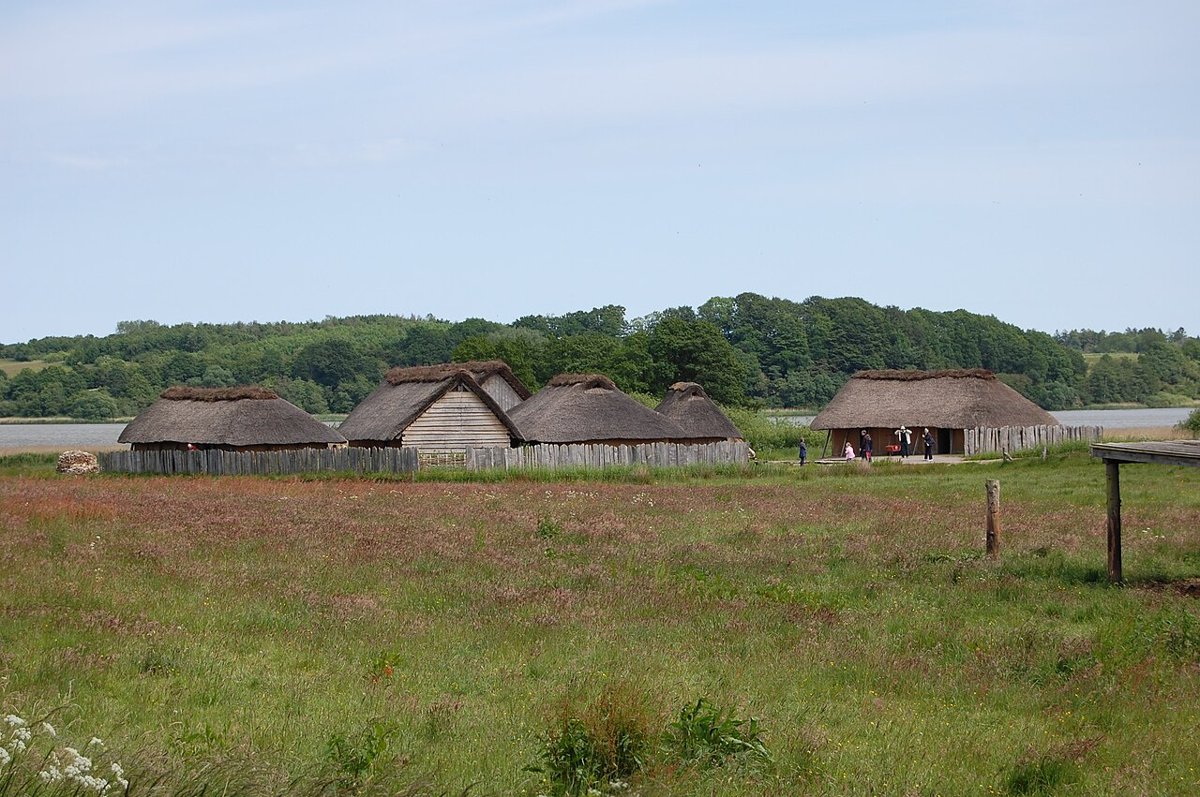
The backbone of this world was its emporia: fortified or open market towns where ships put in, goods changed hands and crafts were produced in series. Haithabu on the Schlei was the largest and most thoroughly researched of them – a place where Frankish pottery, Arab silver and Norse craftsmanship met in the tightest of spaces. On the Swedish island of Björkö in Lake Mälaren lay Birka, the gateway to the east, whose cemeteries still tell us how far its contacts reached. At the mouth of the Oder Wolin grew into a great trading town that astonished even Arab and German chroniclers. The Obodrite market of Reric was so important that the Danish king Godfred destroyed it in 808 and forced its merchants to resettle in Haithabu – a deliberate act of trade politics. And along the German Baltic coast, sites such as Ralswiek on Rügen and Menzlin on the Peene show that there was no clean dividing line between "Norse" and "Slavic" at all: in the graves and workshops both worlds lie side by side.
"Wends" was the name Franks and Saxons gave the West Slavic peoples who settled the southern and south-eastern Baltic shore from the 7th century onward. It was no single people but a colourful patchwork of confederations. The Obodrites sat in Mecklenburg and manoeuvred cleverly between Franks and Danes. On Rügen ruled the Rani, whose temple fortress of Arkona with its four-headed god Svantevit remained a centre of power feared even by Danish kings until it was finally stormed in 1168. Further east the loose league of the Liutizi came together, a confederation that did without a king and made its decisions in assembly. To these were added the Pomeranians along the Pomeranian coast and the Wagrians in western East Holstein. With all these neighbours the northerners kept the same shifting relationship: sometimes trading partner, sometimes ally, sometimes enemy – depending on what the year happened to demand.
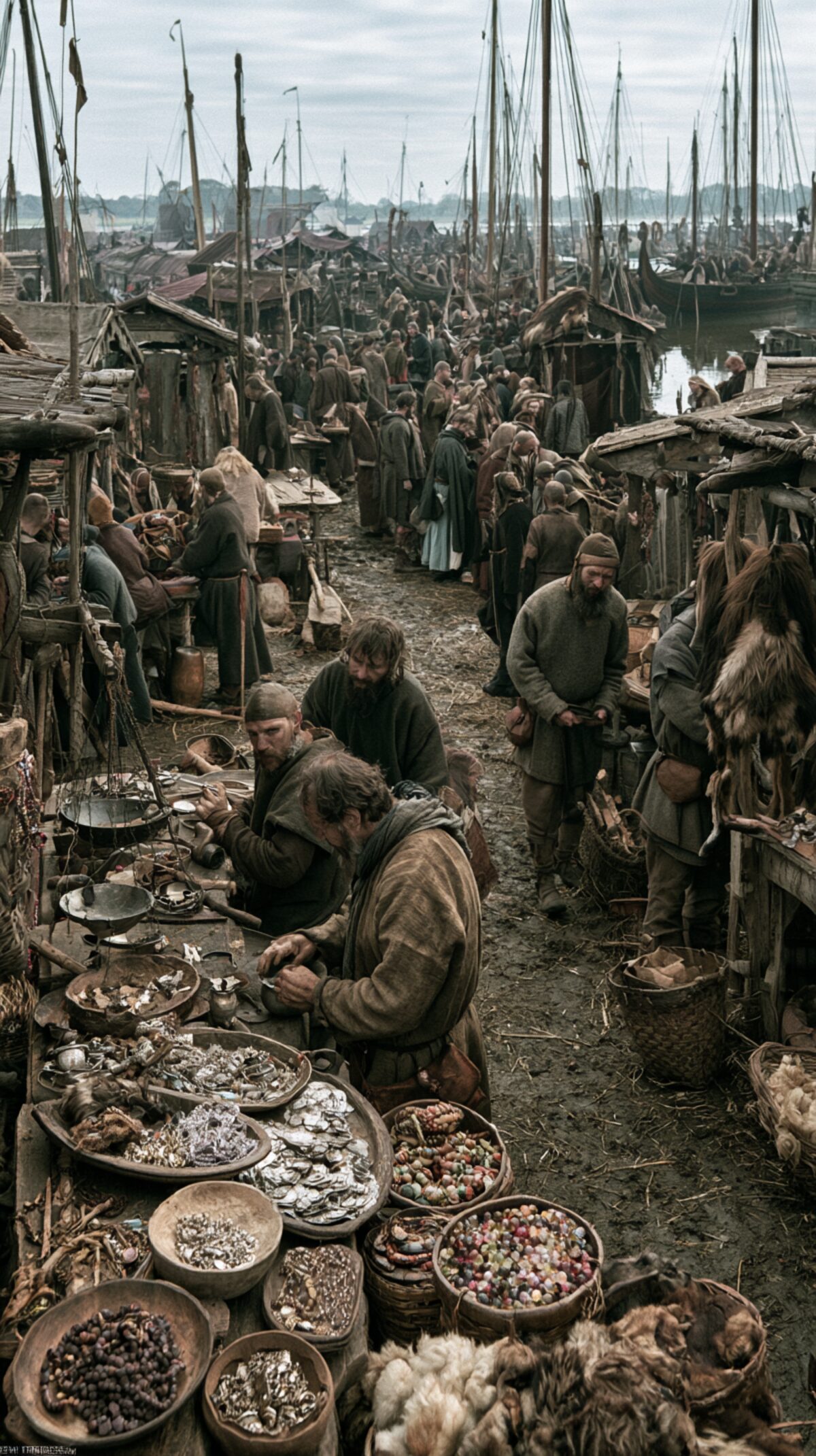
The fuel of this economy was silver – not as a coin with a fixed value, but as weight. In a weight-money economy what counted was what the scale showed: struck dirhams from the Caliphate, chopped hacksilver, ingots and rings were weighed and reckoned with small folding balances. Millions of Arab dirhams flowed across the Russian rivers into the Baltic, and Gotland became the silver island above all others. The Spillings hoard of 1999, the largest Viking silver hoard in the world, weighed some 67 kilograms – a fortune that waited in the ground for better times. As glittering as that sounds, the other side is dark: a considerable part of this silver was owed to the trade in enslaved people. Captives and the abducted were sold across the Baltic into the markets of the east. That belongs to an honest picture of this world too, even if it is no motif for an engraving.
No other saga figure of the Baltic has fired the imagination like the Jomsvikings, a legendary warrior brotherhood with a strict code, said to have sat in the fortress of Jomsborg somewhere at the mouth of the Oder. The Jómsvíkinga saga paints them as an elite force that awaited death without flinching. Historically, caution is called for: the saga was not written down until the 13th century, long after the events, and idealises its heroes vigorously. Whether Jomsborg ever existed as a fixed place, and whether it is identical with the archaeologically well-attested Wolin, remains open. The equation "Jomsborg = Wolin" is popular but unproven – a fine story set at a place where great things really were traded.
Where the Baltic ended, the land border began. Straight across the Schleswig isthmus ran the Danewerk, the greatest border rampart of the north, which shielded the Danish heartland against the south while controlling the land route between the North Sea and the Baltic. King Godfred greatly enlarged the wall in 808 – the same resolute trade policy that had cost Reric its life. Anyone bringing goods from the North Sea to the Baltic had to use this land bridge at Haithabu, and whoever controlled it controlled the toll. The Danewerk shows that the Baltic world was made not only of sails and silver, but also of earth, timber and the sober art of holding the right bottleneck.
As everywhere in the north, the Viking Age of the Baltic ended not with a battle but with a slow change. The trading places lost importance or grew into Christian towns; Haithabu became Schleswig, weighed silver became struck coin. For the Slavic neighbours the upheaval came harder: in 1147 the Wendish Crusade, as part of the great crusading movement, turned against the still pagan Elbe Slavs, and in 1168 Danish troops under King Valdemar and Bishop Absalon stormed the temple fortress of Arkona and toppled Svantevit from his pedestal. With that the last great pagan sanctuary of the Baltic fell. What remained was a sea that went on carrying trade – only under new masters and a new faith.
It is truly the greatest of all the cities that Europe holds; Slavs and other peoples dwell there, Greeks and barbarians. For even the Saxons who arrive receive the right of equal residence, provided only that while they stay they do not openly profess their Christianity.Adam of Bremen on Jumne (Wolin), History of the Archbishops of Hamburg-Bremen, II,22, public-domain rendering after J. C. M. Laurent
Attested: Haithabu, Birka, Wolin, Ralswiek and Menzlin are well-researched Baltic trading places. The destruction of Reric and the forced resettlement of its merchants to Haithabu in 808, together with Godfred's enlargement of the Danewerk, are recorded in the Frankish Royal Annals. The Spillings hoard (Gotland, found 1999) is, at around 67 kg, the largest known Viking silver hoard; the Baltic ran on a weight-money economy fed by Arab dirhams. The storming of Arkona in 1168 under Valdemar I and Bishop Absalon is reported by Saxo Grammaticus.
Myth-check: "Wend = hostile Slav" is a Franco-Saxon outside view, not a finding. Archaeology shows intense exchange instead: mixed settlements such as Menzlin and Ralswiek, Slavic pottery in Haithabu, Norse finds on Slavic coasts. The equation Jomsborg = Wolin is popular but unproven to this day; the Jómsvíkinga saga is a literary glorification of the 13th century. And the Baltic was neither a border sea nor a front line, but a space of relationships where people traded far more often than they fought.
The Vikings before Aachen · Hedeby · Dorestad – the great trading place · The North Frisian ring forts · The Viking winter camps.
All History & Finds articles →
The Vikings came, raided – and stayed. Over the winter, at least. Instead of sailing home after every raid, they …
Read more →Many call the Varus battle the „big bang of Germany". Yet another battle shaped our lands far more deeply – one in …
Read more →High above the world of humans, beyond the burning rainbow bridge, lies Asgard – the fortified home of the Æsir. It is …
Read more →Almost 1,500 years before the first Germanic peoples entered Roman history books, a highly developed Early Bronze Age …
Read more →