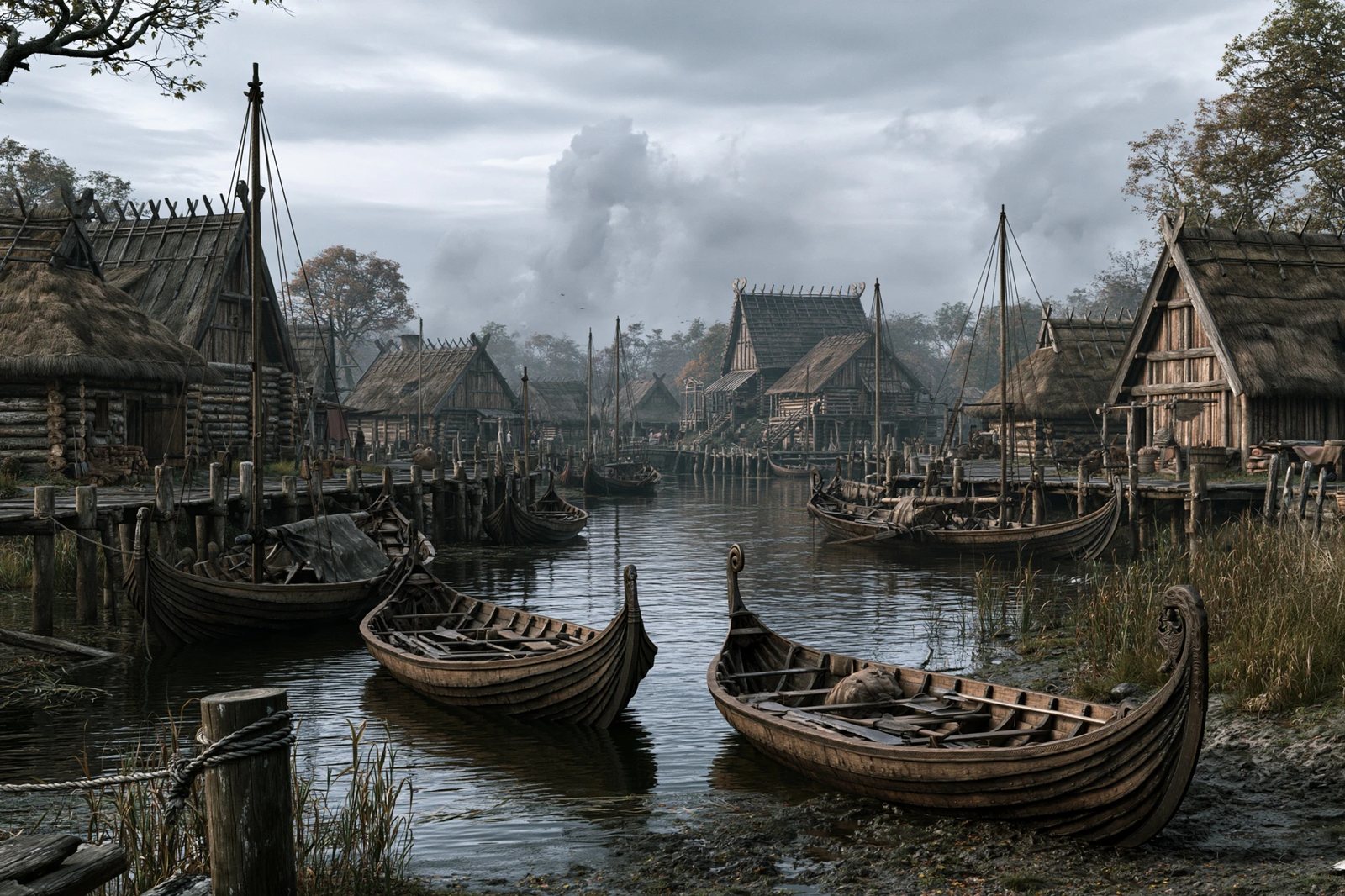
Ralswiek was a 9th- and 10th-century trading port of the Slavic Rani on the Großer Jasmunder Bodden lagoon on Rügen, a place where Scandinavians came to do business. Excavations led by Joachim Herrmann uncovered farmsteads, boat landing channels, four boats, a cult site and more than 2,200 Islamic silver coins. Here is what is solid evidence, what is interpretation – and why Ralswiek was never a "Viking village", but something far more interesting: a junction where two worlds traded.
Picture a summer morning around the year 850. Beyond the narrow land bridge at Lietzow, the Großer Jasmunder Bodden lies flat as glass. Along the shallow shore, small inlets have been dug into the sand, and a boat rests in each of them. The air smells of tar, smoke and fish. Someone is weighing pieces of silver on a folding balance – silver struck in mints between Baghdad and Central Asia. Most people around speak a Slavic language, a few perhaps Old Norse. This is Ralswiek: not a place from a saga, but one that archaeologists have recovered from the ground layer by layer.
Anyone looking for Vikings in Germany usually ends up at Hedeby on the Schlei. Ralswiek belongs to the same league of early Baltic trading places, yet it tells a different story. Here the hosts were not Danes but the West Slavic Rani. That is exactly what makes the site so valuable if you want to understand the Viking Age honestly.
A bodden is a shallow coastal lagoon, largely cut off from the open sea by islands and spits – a landscape typical of Western Pomerania and Rügen. The Großer Jasmunder Bodden reaches deep into the island. If you moored here, you were sheltered from storms and from unwelcome eyes out at sea, yet still connected to the Baltic through narrow channels. For a trading place that is close to ideal: a waterway out, and a hinterland of fields and pasture behind.
The early medieval settlement lay where the centre of present-day Ralswiek and its shoreline are now, on a beach ridge – a sandy bank pushed up by the water between lagoon and hinterland. According to current research it began in the late 8th century, and its heyday as a trading port came in the 9th and 10th centuries. People went on living there afterwards, but the long-distance harbour faded. The name itself first appears in a charter of 1311 as "Ralswiik" – centuries after the golden age that only archaeology knows about.
The Rani (Latin Rani or Rugiani) were a West Slavic people living on Rügen and the opposite mainland. They belonged to the wider group of Baltic Slavs, alongside the Obotrites in Mecklenburg and the Pomeranians around the Oder mouth. Despite the similar name, they have nothing to do with the Germanic Rugii of the Migration Period: the island's name was passed on, the people were not.
The Rani are best known for their sanctuary at Cape Arkona, where the god Svantevit was worshipped. Writing around 1200, the Danish historian Saxo Grammaticus describes at length how King Valdemar I and Bishop Absalon captured Arkona in 1168 and smashed the idol. That is a victor's account and should be read as one, but it shows how powerful and independent the Rani remained into the 12th century. They traded by sea, launched raids of their own across the water and were a serious opponent for Danes and Saxons alike – not extras on the margins of Viking history.
For Ralswiek this means the people running the harbour were Rani. Scandinavians came as merchants and guests, perhaps also as families who stayed. How many there were, and what role they played, is one of the site's open questions.
The story of discovery does not begin with a professor but with an excavator bucket. In 1967, while a drainage ditch was being dug near the shore, workers hit the timbers of a boat wreck, and the following day, about 15 metres away, the planks of a second. In 1968, as the work continued, a third boat appeared. The first investigations were led by Peter Herfert of the museum in Bergen auf Rügen, who soon presented Ralswiek as an early medieval seaborne trading place.
This grew into one of the major research projects of East German archaeology. Joachim Herrmann (1932–2010), director of the Central Institute for Ancient History and Archaeology at the Academy of Sciences in Berlin, led extensive excavations in the settlement, its surroundings and the cemetery during the 1970s and 1980s. Over well above a thousand square metres, house plans, harbour structures and thousands of finds were recorded. What stands out: Herrmann did not let the project vanish into a drawer after 1990. Between 1997 and 2008 the full results appeared in five volumes of the series "Beiträge zur Ur- und Frühgeschichte Mecklenburg-Vorpommerns", the last one on the barrow cemetery (with Dieter Warnke, 2008). Many large excavations of that era are still known only from preliminary reports.
What sets Ralswiek apart from an ordinary village is how it faced the water. The settlement consisted of individual farmsteads along the shore, and these apparently had their own boat landings: narrow inlets dug into the shallow beach, into which boats could be hauled. Lech Leciejewicz, a leading authority on West Slavic seafaring, described Ralswiek's 9th-century harbour facilities as simpler than the later quays at Wolin or Gdańsk – practical, but without timber wharves on a large scale.
The houses were timber buildings, in later phases also log construction of the kind common in the Slavic world. Herrmann distinguished several phases; an early one ended in a fire, after which the settlement was rebuilt. The finds show the crafts you would expect at any trading place of the period: pottery mostly of Slavic type, spindle whorls and loom weights for textile work, iron tools, antler comb-making and amber working. Alongside these come objects of Scandinavian origin and style, proof of regular links to the north.
A place like Ralswiek lived on transshipment. What exactly changed hands is only partly visible, because so much was perishable: furs, wax, honey, grain, salt, textiles – and, it must be said, very probably people. The slave trade was a lucrative business in the Viking-Age Baltic, and the Islamic silver that flowed north in such quantities was often connected with it. This is not directly proven for Ralswiek, but it belongs to the wider picture of Viking trade.
The Ralswiek boats are the reason the site appears in every handbook on early medieval shipbuilding. They lay under roughly a metre of peat in the silted-up shore zone. Since the waterlogged wood could not be conserved immediately in 1967/68, the wrecks were recorded and covered again with sand and peat – the ground kept them better than any improvised store.
Four boats are known in total:
The boats are dated on archaeological grounds to the 9th and 10th centuries, Boat 4 somewhat earlier, to the 8th or 9th. We could not verify a complete, published dendrochronological (tree-ring) dating for all four wrecks, so read these dates as ranges, not as years of construction.
The construction is the exciting part. The boats are clinker-built, with overlapping planks like roof tiles, as in Scandinavian ships. Yet the fastenings show features known from West Slavic boatbuilding: wooden treenails play a major role, and the seams were caulked with moss, animal hair and wool under tar. For Boat 4 the records list tar, human hair, sheep's wool and moss as caulking. Researchers therefore like to speak of a blend of Slavic and Scandinavian traditions – a finding that suits Ralswiek better than any label. For the basics, see our article on Viking shipbuilding.
That the boats were systematically dismantled and usable parts recycled tells us something else: Ralswiek was not just a landing place but somewhere boats were repaired, rebuilt and finally stripped for timber – a small-scale shipyard.
Boat 2 was recovered from 1993 onwards and conserved in Schleswig and Schwerin. Parts of it, including the keel and stem, were later displayed at the Museum of Underwater Archaeology in Sassnitz. Two replicas made the boat sail again: the "Svarog" (1997, at the Ukranenland open-air site near Torgelow) and the "Bialy Kon", the "White Horse" (1998), which now stands in the Groß Raden open-air museum. Their trials showed that such boats were seaworthy and quick. For a comparison with the Danish counterparts, look at the Skuldelev ships: the Danish ship expert Erik Andersen used them to reconstruct a square sail for Boat 2 – no rigging survives at Ralswiek itself.
On 10 July 1973 the excavators found what made Ralswiek famous among numismatists. Inside a house plan in the settlement lay a hoard of Islamic silver. The find catalogue of Germany's Numismatic Commission records "at least 2,211 coins or their fragments with a total weight of 2,750 g". The latest coin – the terminal coin – dates from 841/842. The hoard is kept today in the Münzkabinett (Coin Cabinet) of the Berlin State Museums.
For archaeologists the terminal coin is a dating tool: the hoard cannot have gone into the ground before that coin was struck. Since Islamic coins took some years to travel from the caliphate's mints along the Russian rivers to the Baltic, the burial is usually placed around the middle of the 9th century. Popular accounts sometimes give different figures – 844 as the closing year, or slightly different coin counts. We follow the find catalogue, because it is based on the study of the coins themselves.
A little arithmetic shows what kind of hoard this is: 2,750 grams divided by 2,211 pieces gives an average of only about 1.2 grams. A complete Abbasid dirham weighed just under 3 grams. So a large share of the Ralswiek silver consists of cut coins – some fragments in the Berlin collection weigh barely a tenth of a gram. That is typical of the Baltic's weight-based silver economy: silver counted by weight, not face value. If you paid, you cut and weighed. We explain this in more detail in our article on hacksilver.
The coins come from the caliphate – Umayyad and above all Abbasid issues, and according to local accounts also pieces from the Persian world. That places Ralswiek among the early large dirham hoards of the southern Baltic. It cannot compete with Gotland's giants such as the Spillings Hoard, but for the German Baltic coast it is outstanding. For an overview of the best-known finds of this kind, see our article on the great Viking silver hoards.
Why was the hoard never dug up again? There is no secure answer. Perhaps the owner died, perhaps they fled, perhaps they were attacked. Burying silver inside your own house was the early medieval version of a safe. That it was never opened is archaeology's good fortune and the misfortune of a person whose name we will never know.
North-east of the village, along the road towards Sassnitz, lies one of Rügen's most impressive monuments, hidden in woodland: the barrow cemetery in the "Schwarze Berge" ("Black Hills"). Across an area of roughly 400 by 700 metres there are around 400 burial mounds of the Slavic period, dated between the 8th and 12th centuries. A large part has been excavated and was published in 2008 as the fifth Ralswiek volume.
Most of the dead were cremated and their remains buried under the mounds; there are also inhumations. Notable features include a rider's grave in a wooden chamber and graves in which boats or boat parts played a role. Burying the dead with or in a boat is best known from Scandinavia – see our article on boat burials. Whether individual Ralswiek graves therefore belonged to Scandinavians, or whether Rani adopted a custom that was "in the air" around the Baltic, cannot be decided from grave form alone.
The social picture matters too: the mounds vary in size and in what was placed in them. That reflects a stratified society of wealthy families, warriors and ordinary people. Walking through the Schwarze Berge today means walking through a cemetery where the merchants, boatbuilders and farmers of old Ralswiek lie. A little respect on your stroll does no harm.
One of the most debated features is an area that Herrmann interpreted as a cult site. It lay directly on the former lagoon shore. Descriptions mention a kind of platform, animal bones and human skeletal remains, including men and women in the prime of life. Herrmann and later accounts saw it as a place of sacrifice where animals and possibly people were offered; local writers suggest Slavs and Scandinavians may have used it together.
Caution is called for. Human bones at a site do not by themselves prove human sacrifice. They may come from violence, executions, disturbed burials or conflict. The reading as a sanctuary rests on analogies: West Slavic cult places with temples and offering sites are known from written sources of the 11th and 12th centuries – Arkona, Garz (Charenza) or Rethra. But those texts are later than early Ralswiek and were written by Christian authors with their own agenda.
A fair interim verdict: Ralswiek has an unusual waterside feature that is interpreted as ritual, and there are good arguments for that reading. Turning it into "Viking human sacrifice" stretches the evidence twice over – neither the sacrifices nor the Scandinavian identity of the people involved are certain.
Archaeologists call places like Ralswiek emporia or seaborne trading places: open or lightly defended settlements on the water where long-distance trade and craft production came together. The southern Baltic had a whole chain of them.
Hedeby on the Schlei was the great Danish trading town, enclosed from the 9th century by a semicircular rampart and tied into the Danevirke. It was much larger than Ralswiek and far more tightly controlled by royal power, and it came to an end in the 11th century after being destroyed. What a traveller from al-Andalus observed there in the 10th century is the subject of our article on Ibrāhīm ibn Yaʿqūb.
Wolin at the mouth of the Oder grew into the most important trading town of the southern Baltic. Around 1075, Adam of Bremen describes it under the name "Jumne" as a huge city where Slavs, Saxons and other peoples lived. With its quays and dense building, Wolin is in a sense Ralswiek's big sister.
Menzlin on the Peene near Anklam is probably the closest parallel. It flourished mainly in the 9th century, and its cemetery with stone ship settings is clearly Scandinavian in character. At Menzlin, then, the Norse share is easier to see than at Ralswiek, where the graves are predominantly Slavic in form.
And there is Reric in Mecklenburg, the Obotrite trading place that the Danish king Godfred destroyed in 808, moving its merchants to Hedeby. It shows how much such places were pawns of the powerful.
What makes Ralswiek special in this line-up is the combination: a small but well-researched site that offers harbour, boats, cemetery, cult site and hoard in a single context. Precisely because Ralswiek never reached the size of Hedeby or Wolin, it shows how the network worked day to day – not only at the main hubs but at the smaller stations too. For the bigger picture, read our article on the Vikings in the Baltic and the land of the Wends.
Herrmann's publication series is titled "The Slavic-Viking settlements". That double label is deliberate and sums up the state of research rather well. The core population was Slavic, as house building, pottery and graves show. Scandinavian objects, boatbuilding techniques and some grave forms prove close contacts, possibly settlement as well.
The word "Viking" itself is a trap. In Old Norse sources, "víkingr" first means someone who goes off on an expedition, often a raid – not an ethnicity. A Ralswiek merchant family was not "Viking" just because it traded with Gotlanders. Conversely, the Rani were feared seafarers themselves, raiding Danish coasts in the 12th century. The Baltic was not a sea on which "the Vikings" sailed while everyone else watched. It was a shared space with many players.
If you want to know how terms like Viking, Varangian and Rus differ, see our article Vikings, Normans, Varangians, Rus.
The Danish conquest of Rügen in 1168 opened a new chapter. The island was Christianised and placed under the Danish diocese of Roskilde, whose bishop Absalon had helped lead the conquest. Ralswiek became an ecclesiastical administrative centre with a provostry; Gothic remains of the later provost's house survive. Long-distance trade had by then moved elsewhere, soon to the new Hanseatic towns such as Stralsund.
Ralswiek later changed hands several times, among others to the von Barnekow family. In 1891 Count Douglas bought the estate and had today's Schloss Ralswiek built in 1893–1896 in Neo-Renaissance style; it is now a hotel. The village itself has stayed small, with around 250 inhabitants.
Today Ralswiek is best known for the Störtebeker Festival, staged every summer since 1993 on the open-air stage by the lagoon. The pirate tales of Klaus Störtebeker, which belong to the late 14th century, have nothing to do with early medieval Ralswiek. Still, there is a nice irony in ships ruling the stage again on the shore where boats were hauled onto the sand more than 1,100 years ago.
There is no large open-air museum with reconstructed houses at Ralswiek. If you want the early Middle Ages on site, walk to the barrow cemetery in the Schwarze Berge, reachable on footpaths, and look out over the lagoon from there. The replica of Boat 2 stands in the Groß Raden open-air museum near Sternberg, which has reconstructed a Slavic fortress with a temple site. Parts of the original were shown in Sassnitz; check before you go whether the exhibition is currently open. For more places along the coast, see our guides Experiencing the Vikings and Viking traces in Germany.
Travelling with children? Burial mounds in the woods, stories of boats found by accident and a view across the lagoon work surprisingly well together. Tell them about the excavator that woke a thousand-year-old boat in 1967 – that one sticks.
At Glanz & Gravur we love places like this, because they show that the history of the North does not stop at the Danish border. It lies here too, in Mecklenburg-Western Pomerania, under peat and sand – and in the hands of people who take their past seriously without romanticising it.
Were there Vikings at Ralswiek? Yes, Scandinavians visited and left traces in finds, boatbuilding and perhaps some graves. The settlement itself, however, belonged to the Slavic Rani.
How old is the Ralswiek trading site? It began in the late 8th century and flourished in the 9th and 10th centuries. The place name is first recorded in a charter of 1311.
How many coins were in the Ralswiek silver hoard? At least 2,211 Islamic coins and coin fragments, weighing 2.75 kilograms together. The latest coin dates from 841/842.
Where are the Ralswiek boats today? Parts of Boat 2 were conserved and displayed in Sassnitz, and a replica stands in the Groß Raden open-air museum. The other wrecks were recorded and largely left in the ground.
Can you visit the barrow cemetery near Ralswiek? Yes. The Schwarze Berge, with around 400 burial mounds, lie freely accessible in the woods north-east of the village and can be reached on footpaths.
What does the Störtebeker Festival have to do with Ralswiek? Only the location: it has been staged on the lagoon-side open-air stage since 1993. Historically, Störtebeker has nothing to do with the Slavic trading port.
For courage. For remembrance. For legends that live on.
Reric · Hacksilver – silver as currency · Viking traces in Germany · The Danevirke · Hedeby.
All History & Finds articles →
King Hákon the Good, a son of Harald Fairhair, fought all his life against the sons of his brother Eric Bloodaxe. Two …
Read more →Long before there were Vikings in the sense of the sagas, there was already a town in south-west Jutland: Ribe, founded …
Read more →The Viking battle was no wild scramble but a hard struggle shield to shield. A look at tactics and weapons beyond the …
Read more →