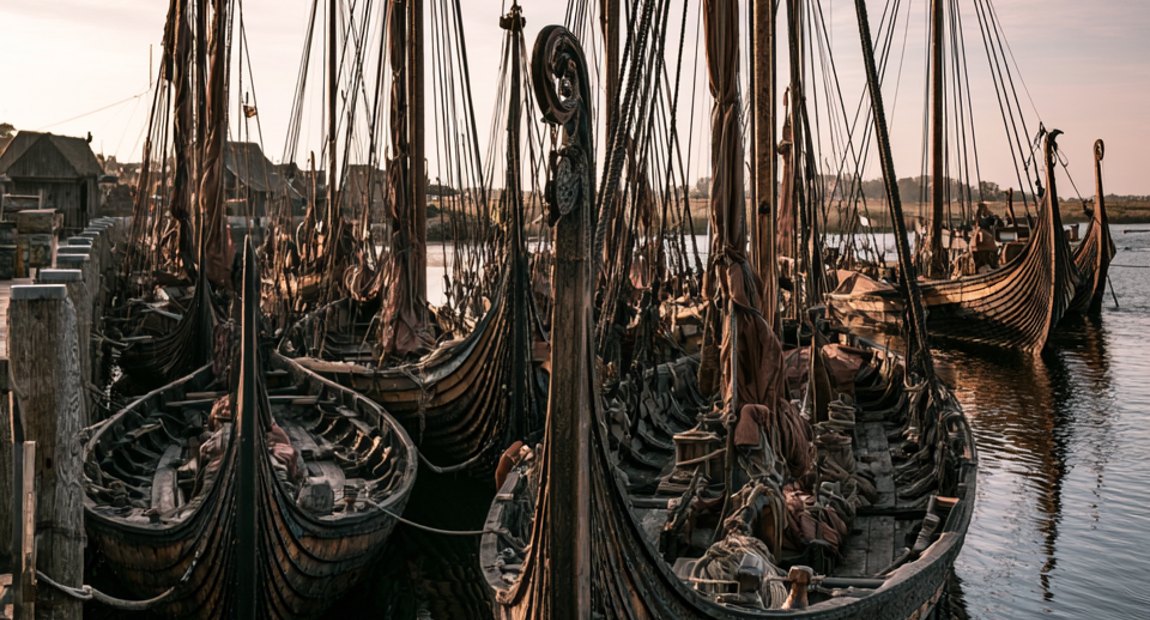
The Skuldelev ships are five 11th-century Viking ships that were filled with stones and deliberately sunk in the Peberrenden channel of Roskilde Fjord to block the sea route to Roskilde. In 1962 they were excavated inside a steel cofferdam. Today they stand in the Viking Ship Museum in Roskilde: an ocean-going trader, a coastal trader, a fishing and cargo boat and two warships – one of them a 30-metre longship built from Dublin oak. Here you will find how the barrier came about, what makes each ship special, and what replicas such as the Sea Stallion from Glendalough have taught us about how they were built.
Summer 1962. In the middle of Roskilde Fjord a wall of steel rises from the water, enclosing a basin of about 2,500 square metres. As the water level drops, stones appear out of the mud, then soft, dark timbers, then whole planks still pierced with rivet holes. Nobody is pulling up gold here. What comes to light is rarer: five working ships of the Viking Age – worn, patched, stripped – and, for exactly that reason, more honest than any royal grave ship.
The Oseberg ship and the Gokstad ship came out of burial mounds, chosen for a dead person's final voyage. The Skuldelev ships were used until they were worn out, and then spent as building material. That is precisely why archaeologists treasure them.
In the 11th century Roskilde was one of Denmark's key places: a royal seat, a bishop's seat and a trading town. It lies at the southern tip of a long, branching fjord that reaches roughly 40 kilometres inland from the Kattegat. If you wanted to reach Roskilde by sea, you had to sail up that fjord. And at one point it narrows: near the village of Skuldelev, about 20 kilometres north of the town, the Peberrenden channel runs between the small islands of Peberholm and Kølholm. It was the most direct shipping lane to Roskilde.
That is where people of the late Viking Age towed old, worn-out ships, filled them with fieldstones and sank them across the channel. The result was a sea barrier: an underwater obstacle on which any ship without local knowledge would run aground. The Danish heritage agency also mentions a warning system of signal fires to give defenders time to prepare.
Who the barrier was meant to stop, no contemporary text tells us. Modern writers usually point to Norwegian attacks – the decades after Cnut's death saw bitter wars between Denmark and Norway, in which Harald Hardrada also raided Danish coasts. That specific link, however, cannot be proven.
This deserves a closer look, because many texts simply say "around 1070". That is a simplification. Two things are secure. First, the ships themselves were built between about 1030 and 1042, according to tree-ring dating of their timbers. Second, they were already old when they were sunk – the Danish reference work Den Store Danske reckons with 20 to 30 years of service. That puts us in the second half of the 11th century.
The excavators could also show that the barrier was not built in one go. Skuldelev 2, the big warship, lay on top of wrecks 1 and 3, placed there, according to the excavation report, "some years" after they had been scuttled. Skuldelev 6 in turn was sunk some time after Skuldelev 5 and partly covered it. The Viking Ship Museum today puts it this way: three ships were sunk first, and about twenty years later the barrier was reinforced with two more. For the first phase the museum now gives a date of around 1060; other accounts place the whole structure between roughly 1060 and 1080. We do not know the exact year – anyone who gives you one is rounding.
The fishermen of the fjord had always known that something blocked Peberrenden. A ridge of stones lay across the channel, and local tradition had an explanation ready: it was a ship sunk on the orders of Queen Margrethe I, who died in 1412. The story was off by roughly three centuries – but right at its core.
In the summer of 1957 the National Museum of Denmark, led by the archaeologist Olaf Olsen, began investigating underwater. It was the museum's first underwater archaeological excavation ever. Staff had trained as frogmen; they flushed away sand and mud with a fire hose and recorded everything with steel measuring wires and waterproof paper in murky water. The plan was for two weeks of work. It turned into three summers, from 1957 to 1959.
One moment from those years has become a museum anecdote. Among the stones a second keel turned up. Can a Viking ship have two keels? Of course not. So there was not one wreck down there, but several. The single "Queen Margrethe's ship" turned into a complete blocking system.
The fragile timbers could not be properly recovered underwater. So the water had to go. In 1962 an iron sheet-pile wall was driven into the seabed around the barrier. This cofferdam – a watertight enclosure from which the water is pumped out – created an artificial island of around 2,500 square metres.
The pumps started on 6 July 1962. The water level was lowered step by step so the waterlogged wood would not dry out too quickly. After about a month the inside level stood 1.7 metres below the fjord. On 3 August 1962 all five ships lay exposed, and the famous aerial photograph was taken. Some 28,000 people came out by boat that summer to watch.
The ships were not lifted whole but in thousands of fragments. Each piece was drawn, numbered, sealed in airtight plastic tubing and taken to the National Museum's conservation workshop, where it was first stored in water tanks. A purpose-built hall was erected on the waterfront in Roskilde, and in 1969 the Viking Ship Museum opened.
Standing in front of the ships in the museum, you read the numbers 1, 2, 3, 5 and 6. Number 4 is missing. The reason: during the excavation the team assumed there were six wrecks and numbered them accordingly. Only during analysis did it become clear that the parts of "Wreck 4" belonged to Skuldelev 2 – something later confirmed by tree-ring analysis. Rather than renumber everything, they simply dropped number 4.
Skuldelev 1 is a broad, full-bellied cargo ship, about 16 metres long and 4.8 metres wide. It was built around 1030 in the Sognefjord area of western Norway, from thick pine planks. The ship is designed for cargo and seaworthiness rather than speed under oars: it had only a few oars for manoeuvring in harbour and otherwise relied on its sail. A crew of six to eight was enough. Den Store Danske gives a carrying capacity of more than 20 tonnes. About 60 per cent survives.
Skuldelev 1 is often called a knarr (Old Norse knörr), the ocean-going cargo ship known from the sagas, on which settlers sailed to Iceland and Greenland. The label is plausible, but it is an interpretation: no type name is written on the wreck, and the sagas were only written down in the 13th century. More on this in our article on Viking ship types.
The ship's life story is the fascinating part. It was repaired several times, using oak and lime wood – timber that did not come from its home yard. According to the analysis, the repairs were carried out in the Oslo Fjord region and in eastern Denmark.
Skuldelev 2 is the star of the find – and at the same time the worst preserved of the five. Only about a quarter of the hull survives. Almost everything above the waterline was already gone when it was excavated. The excavators think useful parts were salvaged soon after the scuttling; winter ice tore away more, and the after stem was found some 20 metres from where it belonged.
What remained was still enough for a reconstruction: a slender warship about 30 metres long and only around 3.7 to 3.8 metres wide, built of oak. The museum reckons with 60 oars and a crew of 65 to 70. That makes it one of the longest Viking ships known. Considerably longer is Roskilde 6, a warship of about 37 metres found in the late 1990s when the museum harbour was being extended. For comparison, the Gokstad ship measures about 23 metres. Those who want a type name for Skuldelev 2 usually reach for the skeið, the great warship of skaldic poetry – again an interpretation, not an inscription.
The real sensation came from the laboratory. Dendrochronology – dating wood by its sequence of wide and narrow tree rings – revealed two things. First, the trees for the ship were felled around 1042. Second, the ring patterns did not match Danish or Norwegian oak but Irish oak, specifically from the Dublin area. The museum puts it soberly: built of oak "in the vicinity of Dublin". The replica's name, "from Glendalough", points to the forests of the Wicklow Mountains south of Dublin, where the timber most likely came from according to current interpretation.
Dublin was a town with Scandinavian roots, ruled for generations by Norse kings – you may know Olaf the White or the Ostmen of Dublin. A great warship from there, ending its days decades later in a Danish fjord, shows how tightly the Viking world around the North Sea was knit together. How it got to Denmark – as a gift, as booty, or in the service of a lord – we do not know.
If you only study one ship from the find in detail, make it Skuldelev 3. Around 75 per cent of the hull survives, more than any other. The ship is 14 metres long and 3.3 metres wide, built of Danish oak around 1040. It could carry about 4.6 tonnes of cargo with a crew of five to eight. It was made for Danish coastal waters and the Baltic: goods between harbours, trips to markets such as Hedeby, transport among the islands.
Because so much survives, Skuldelev 3 became the textbook for stems, cross-beams, knees and frames. It is often assigned to the byrðingr, a smaller cargo ship – again an interpretation.
Skuldelev 5 is the everyday warship. About 17.3 metres long but only 2.5 metres wide, with 26 oars and a crew of about 30. It was built around 1030 in Denmark, probably in the Roskilde area, in a building tradition similar to Skuldelev 3. It is regarded as a typical small longship of a war fleet, the kind the sources call a snekkja, suited to Danish coastal waters and the short, choppy Baltic swell. The top plank carried a shield rack on which the crew could fasten their shields.
What makes this ship remarkable is its thrift. The planks are mostly oak, but there is pine and a single ash plank too – and those pine and ash planks were demonstrably taken from other, older vessels. Recycling in the 11th century. Why remains open: time pressure or a lack of timber? Late in its career the ship was repaired several times. The forward keel was renewed, a 1.8-metre patch was let into the keel, and the top strake with the oar ports was replaced by a plank whose ports no longer lined up with the rowing benches. The old oar ports were closed with small wooden plates and new ones cut beside them. A ship that was kept going to the very end.
According to the museum, this ship's lifetime spans the end of Cnut the Great's North Sea empire and four changes on the Danish throne; the barrier dates to shortly before or around the time of Stamford Bridge in 1066. Which events Skuldelev 5 took part in, we do not know.
The smallest vessel, Skuldelev 6, is about 11.2 metres long. Like Skuldelev 1, it comes from the Sognefjord area of western Norway and is built mainly of pine, with some birch and oak. The museum describes it as a fishing boat. Den Store Danske deliberately leaves its use open: fishing, sealing or transport. Later the boat was rebuilt and apparently served as a small coastal cargo vessel or ferry – a second life before it ended as part of the barrier. About 70 per cent survives.
Add up the origins and you get a picture that surprises many: of five ships in a Danish barrier, only two were built in Denmark. Two come from western Norway, one from Ireland. The Danish heritage agency puts it briefly: timber from Ireland, Denmark and Norway.
All five ships follow the same basic principle that shaped Nordic shipbuilding for centuries: clinker building. The planks overlap like roof tiles and are fastened with iron rivets. First the shell is built – keel, stems, strakes – and only then are the frames and cross-beams inserted to stiffen the hull from inside. That is why it is called shell-first construction. Boats were built by eye and by inherited rules of thumb, not from drawings. We explain the basics in our article on Viking shipbuilding.
Yet the Skuldelev ships also show how differently this technique could be applied. First, the timber: the Norwegian ships are pine, the Danish and the Irish ones oak. The planks were not sawn but split from logs and dressed with the axe. Second, the shape: the cargo ships have broad, full hulls with lots of hold space and few oars, while the warships are long, narrow and shallow, with oars along their whole length. A length-to-beam ratio of about 3.3 to 1 for Skuldelev 1 stands against roughly 8 to 1 for Skuldelev 2.
Third, the tool marks. When the Roskilde boatbuilders made the replica of Skuldelev 1 in 1999–2000, they found strange axe marks on a cross-beam (Old Norse biti) of the original that nobody could identify at first. A Norwegian recognised them: sprett-telgjing, a technique for working pine with a special axe that strikes at a slightly obtuse angle and bounces back out. The same marks appear on the Oseberg ship, on Norwegian stave churches and on medieval houses.
Fourth, the repairs show how ships lived day to day. Grave ships show us what a ship could look like; Skuldelev shows how ships wore out and were kept afloat.
"á skip skal skriðar orka, en á skjöld til hlífar" – Ask speed of a ship, and shelter of a shield.Hávamál, st. 82 (Old Norse text; our own translation)
Read more about this gnomic poetry in our article on the Hávamál.
The Viking Ship Museum follows one principle: for each of the five Skuldelev ships there should be a full-size, sailing reconstruction. A replica does not prove how things were – it shows what was possible.
The first was Roar Ege, the replica of Skuldelev 3, built in 1982–84. Deliberately, no professional boatbuilders were involved, so that no modern habits crept in; every decision was documented and tested on a 1:10 model. Roar Ege sailed for 32 years until its hull was worn out in 2016. A second replica, Estrid Byrding, was launched on 7 May 2022. Based on a fresh study of the excavation drawings, it turned out a little different: with more rocker in the keel, about 12 centimetres wider amidships, and with the irregularities of the original that the first replica had smoothed out.
Next came Helge Ask, the replica of Skuldelev 5: keel laid in 1990, launched in 1991. Because mainly the bottom and port side of the original survive, the starboard side had to be mirrored. For several years a second, reinterpreted replica has been under construction; 2025 was already its fourth building season. Skuldelev 6 has two replicas, Kraka Fyr (1998) and Skjoldungen (2010), which interpret bow and stern differently. Skuldelev 1 got its replica Ottar in 1999–2000 – the project that turned up those puzzling axe marks.
The most ambitious project was the replica of Skuldelev 2. From 2000 to 2004 the Roskilde boatbuilders worked on Havhingsten fra Glendalough, the Sea Stallion from Glendalough. Around 40,000 working hours went into the ship; according to English Wikipedia it cost about 1.34 million euros. Each of its roughly 90 oak planks was shaped by hand with axe, wedge and hammer, using reproduction tools. The ship was unveiled on 4 September 2004. Its sail measures 112 square metres according to the museum, and 60 people can row it.
On 1 July 2007 the Sea Stallion left Roskilde, bound for the city where its original had been built. The route led north towards Norway, across the North Sea, around Scotland and south through the Irish Sea. On board were just over 60 volunteers, each with barely a square metre of space. In the first days two crew members had to be treated for hypothermia, it rained for weeks, and during a calm the ship was towed for about 24 hours to keep to schedule. On 6 August the crew ran into heavy weather in the Irish Sea: gusts above 80 km/h and waves of around four and a half metres. The leather straps holding the side rudder snapped. The crew hauled in the rudder, more than three metres long, and replaced the straps with nylon. Such rudder problems, a museum archaeologist said afterwards, had still not been solved.
On 14 August 2007 the Sea Stallion sailed up the Liffey into Dublin to the sound of ships' horns and church bells. Until May 2008 it stood at the National Museum of Ireland in Collins Barracks; then it returned south around England to Roskilde, arriving on 9 August 2008.
The five originals stand in the museum's Viking Ship Hall, the oldest part of the complex, built as a great showcase around the ships. Through its glass front you look out over the fjord they came from. The originals are not complete: the surviving timbers are mounted on metal frames that suggest the original shape.
The replicas lie in the museum harbour, and the boatyard works in the open. If you are planning a trip with more stops, see our overview of Viking museums and sites. At Skuldelev itself a sign from the Danish heritage agency marks the barrier.
Nothing on this scale is made in our workshop in Alsdorf. But we know the feeling of finding a person's handwriting on an old piece: an axe mark, a patched spot, a plank that is not quite symmetrical. The Skuldelev ships are full of it. They tell of people who built a ship, used it for decades, patched it – and in the end sacrificed it once more to protect their town. When we engrave a dragon prow or a longship in slate, those are the people we think of. More on the great warships in our article on dragon ships and longships.
What are the Skuldelev ships? Five 11th-century Viking ships that were sunk as a barrier in the Peberrenden channel of Roskilde Fjord and excavated in 1962. They are on display in the Viking Ship Museum in Roskilde.
Why is there no Skuldelev 4? The excavators first assumed there were six wrecks. Later it turned out that "Wreck 4" belonged to Skuldelev 2, so the number was dropped.
Where was Skuldelev 2 built? Tree-ring analysis shows that the longship was built around 1042 from oak from the Dublin area. That is why its replica is called the Sea Stallion from Glendalough.
When were the Skuldelev ships sunk? In the second half of the 11th century, in at least two phases. "Around 1070" is often quoted; the museum now dates the first phase to around 1060.
Which Skuldelev ship is best preserved? Skuldelev 3, the small coastal trader of Danish oak, with about 75 per cent of its original hull.
Can you sail on the replicas? Replicas of all five ships lie in the museum harbour in Roskilde. In season the museum offers trips on which visitors can row and sail.
For courage. For remembrance. For legends that live on.
The longships · Boat burial – the burning ship · Ragnar's sons · Thyra Danebod – Denmark's mightiest woman.
All Ships & Seafaring articles →
Sometimes a ship stands in the middle of a wide landscape – only it is not made of wood, but of upright boulders …
Read more →There is an Old Norse word for the quietest terror of seafaring: hafvilla, the “sea-bewilderment.” It does not mean the …
Read more →Some graves are so rich that they still take our breath away. The Oseberg grave near Tønsberg in Norway is one such: a …
Read more →