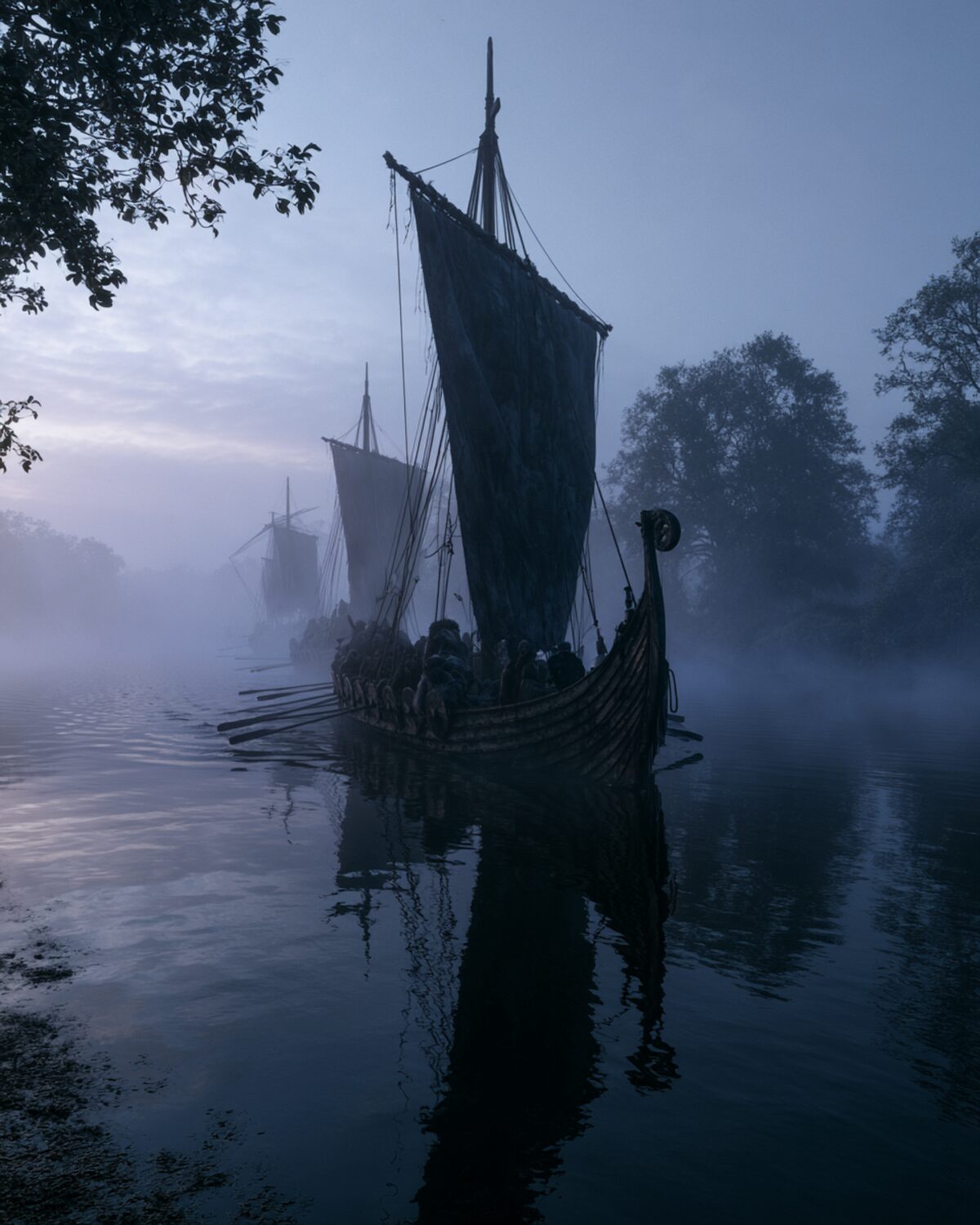
The Viking ship has become the emblem of an entire age – usually a slim hull with a dragon head and shields along the rail. Yet that was only one of many forms. The Norse did not build a single all-purpose vessel but a whole family of craft: slender warships built for speed, broad-bellied freighters built for cargo, small multi-purpose boats for fjord and coast. Knowing the types means understanding the Viking Age better – and recognising how much later romanticism has crept into the picture.
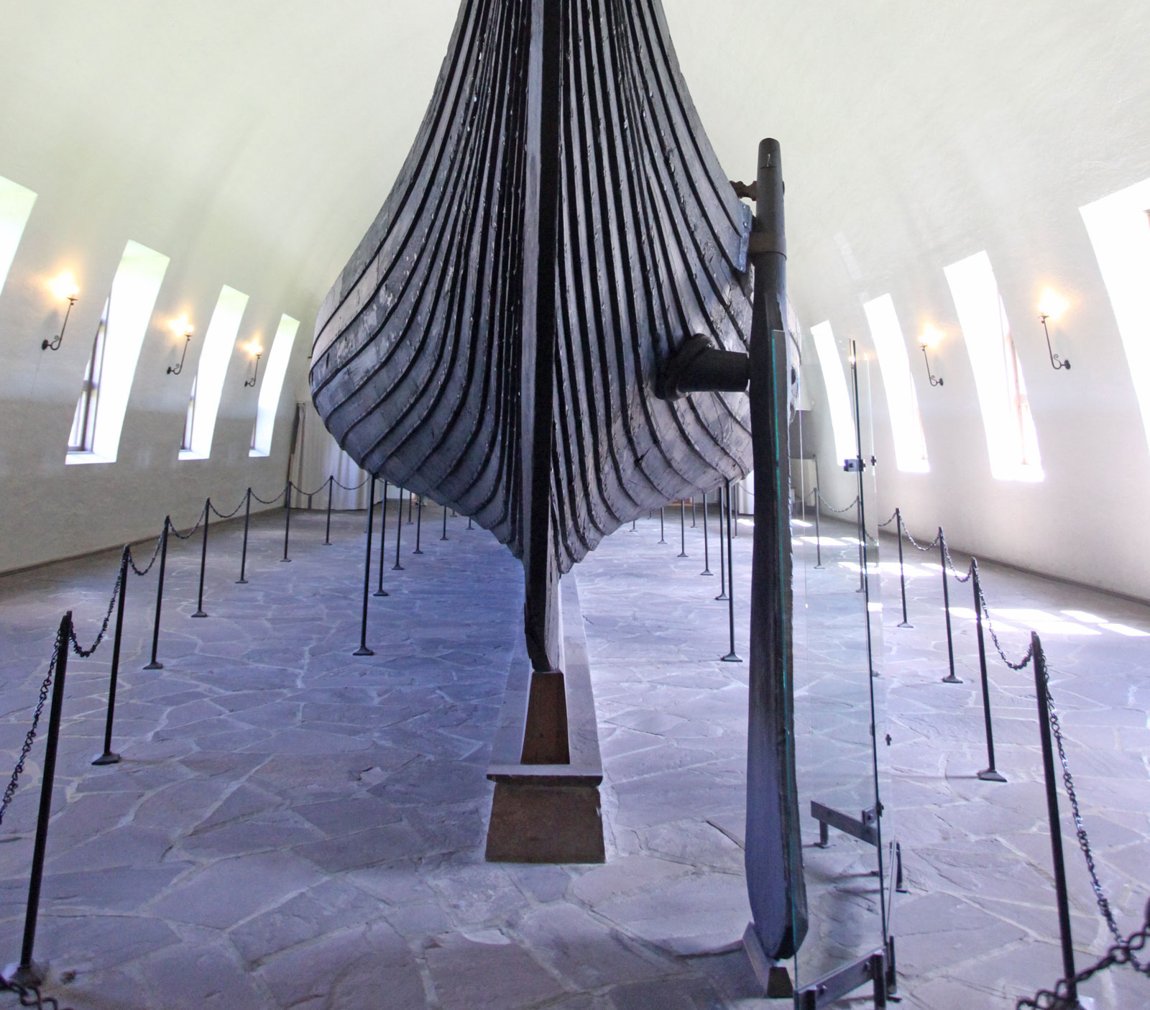
There was no such thing as "the" Viking ship. Both the written sources and the archaeological record show a whole range of hull types that differ sharply in length, beam, draught and means of propulsion. The reason is simple: a ship meant to row up a river and beach on a flat shore must be built differently from one that carries heavy bales of wool, barrels and livestock across the open North Sea. The Norse did not solve this with compromises but with specialised hulls.
The old language draws a rough line between two families: the langskip – long, narrow, fast warships – and the kaupskip or cargo ships, broad, deep and built entirely for carrying capacity. Within these families there were many sub-forms with their own names. The exact boundary between types is not always sharp; the terms overlap in the sagas, and one ship could be described by several names depending on its size.
The longship (Old Norse langskip) was the warship of the North. Its hallmark is an extremely slender length-to-beam ratio: often seven to one or more. Such a hull slices through the water with little resistance, is quick to row and accelerates fast under sail. Its shallow draught – sometimes less than a metre – allowed it to travel far up rivers and to land on open beaches without needing a harbour. It was precisely this mobility that made the raids of the Viking Age possible.
Longships were counted not in metres but in rúm – the spaces between the rowing benches, the seat intervals of the oarsmen. A ship with 20 seats per side (a "twenty-seater", Old Norse tvítugsessa) thus had about 40 rowers. The royal show-ships of the sagas reached 30 seats a side and more. This count also says something about fighting power: every rowing place was also a warrior's place.
Within the longships, size mattered. The snekkja ("snake" or "thin one") was the smallest regular warship, with around 20 seats per side a nimble type built in large numbers – the workhorse of every fleet and the backbone of the Norwegian leiðangr, the naval levy. The skeið was larger and longer, with 25 to over 30 seats per side a heavy battleship of the elite and of kings.
This gradation was practical: a fleet was not made up of giants alone but of many medium-sized snekkjur and a few large skeiðar as command ships. That balanced speed, numbers and striking power.
The word dreki (plural drekar, "dragon") denoted the largest and most splendid longship, named after the carved animal head at bow and stern. These ships were not a separate class with different technology but especially large skeiðar richly adorned – floating symbols of the power of kings and jarls. The most famous example in the tradition is Olav Tryggvason's Ormrinn langi, the "Long Serpent", celebrated in the sagas as the largest and finest ship in Norway.
"That was the largest and most carefully built ship that had then been made in Norway."Snorri Sturluson, Heimskringla, Saga of Olaf Tryggvason (on the Long Serpent); translation after Laing, public domain
What matters here: the dragon head was a mark of rank, not a standard feature. It did not sit on every ship, and it was removable – more on that in the myth check below. And the dreki was the exception, not the rule: for every royal show-ship there were many plain snekkjur without any animal head at all. The splendid dragon ship shapes our image because the sagas celebrate it – in the everyday life of the fleets it was a rarity.
The karvi was a smaller multi-purpose ship that stood between warship and freighter. With usually around 13 to 16 seats per side, it suited coastal travel, the transport of goods, display, and, at need, combat. It was the ship of a well-to-do farmer or lesser chieftain – large enough for prestige, small enough for everyday use.
The famous Gokstad ship from Norway is usually assigned to this type: a roughly 23-metre, surprisingly seaworthy vessel with 16 oar ports per side. Its replica crossed the Atlantic in 1893 – striking proof that these boats could do far more than hug the coast.
As much as the longship shapes the image, the true foundation of the Viking world was the knörr (plural knerrir). This type was broad, deep and high-sided, with a roomy open hold amidships. It lived by its sail, not its oars – only a few rowers sat at bow and stern for harbour manoeuvres. The knörr carried the wool, the grain, the timber, the livestock and the supplies that made a colony possible in the first place.
Without the knörr there would have been no settlement of Iceland, Greenland and Vinland. The long Atlantic crossings were carried by these robust, ocean-going freighters, not by the slender warships. Anyone who reads the Viking Age as a story of raiding alone overlooks the fact that most ships were trading vessels.
Alongside the great knörr stood the byrðingr, a smaller freighter for coastal and Baltic trade. It was handier, could work narrower waters and carried lighter loads over shorter distances. For everyday life on the fjord there were small rowing boats such as the færing (a four-oared boat) and even smaller skiffs for fishing, ferrying and errands. These unassuming boats were surely the most common of all in sheer numbers – the sagas simply rarely write about them.
Counting by rúm is more than a technical quirk – it reveals the whole thinking behind the longship. Every rowing place stood for a man, and every man was both oarsman and warrior. A "twenty-seater" therefore required around 40 rowers, plus a steersman, a lookout and often further fighters resting during the voyage. On a raid a larger ship meant not only more speed but simply more swords. That is exactly why the number of seats was a mark of status in the sagas: whoever commanded a ship with 30 seats a side also commanded a small army.
With a cargo ship the ratio is reversed. Here what counted was not the number of rowers but the volume of the hold. A knörr sailed with a small crew of perhaps half a dozen and left the work to the sail. Those few hands sufficed because the ship was built for the long haul, not for quick manoeuvring in a fight. Warship and freighter thus differ not only in shape but in the whole logic of their use.
How much a knörr held can be estimated from the Skuldelev 1 ship: the roomy hull could carry on the order of a couple of dozen tonnes of cargo – wool, grain, soapstone, iron bars, timber, barrels of supplies, plus draught animals and the people who wanted to found a new settlement. For the North Atlantic, where Iceland was almost treeless and Greenland depended on imports, this capacity was a matter of survival. A longship would have held neither the cargo nor the provisions for such a voyage.
At the same time these freighters were astonishingly seaworthy. The high sides kept the waves out, the deep hull lay stable in the water, and the great square sail carried the ship for weeks. The famous sailing directions of the Icelandic sources – "from Hernar in Norway westward to Hvarf in Greenland" – presuppose exactly such ships: they sailed west along a line of latitude, guided by the sun, the stars and the height of land above the horizon.
A sea battle of the Viking Age was rarely a fight in the open sea. Usually the fleets lashed their longships together at bow and stern, creating a floating fighting platform – a land battle on the water. From this platform they loosed arrows and spears and finally boarded the enemy ship. The king's ship with the most seats formed the centre, the smaller snekkjur the wings. Whoever had the largest ship fought, quite literally, from above.
As for travel itself: rowing was hard labour and served above all for manoeuvring, for setting out and for combat. Over long distances even the longships sailed. The image of the Viking rowing without pause is exaggerated – the square sail was the true engine, the oar the reserve for calms and narrow waters.
How well this typology matches the record is shown by a single site: Skuldelev in the Roskilde Fjord. Around 1070 the Danes sank several worn-out ships there as a barrier to protect the approach to the town of Roskilde. Five ships were recovered – and each stands for a different type, like an archaeological sample catalogue.
Skuldelev 1 is a seagoing knörr, broad and deep, built of Norwegian pine – the classic Atlantic freighter. Skuldelev 2 is a large skeið, a warship for around 60 men, dated by dendrochronology to a build near Dublin around 1042. Skuldelev 3 is a smaller freighter (often read as a byrðingr), Skuldelev 5 a smaller snekkja, and Skuldelev 6 a light fishing and cargo boat. More on this key find is in our piece on the Skuldelev ships.
All these types share the same construction technique: clinker building. The planks overlap like roof tiles and are joined with iron rivets, the hull built first and only then stiffened from within. This yields a light, elastic shell that flexes with the sea rather than breaking. At its heart lies the continuous keel, which gives the slender hull its lengthwise stiffness and, in the longship, is the precondition for high speed. To this came the woollen square sail, which turned the Vikings into long-distance seafarers in the first place. Anyone who wants to go deeper will find the details in our piece on Viking shipbuilding and on the longships.
The types were not rigid pigeonholes but developed over the centuries. In the early Viking Age warships and merchant ships still resembled one another more closely; only over time did the lines diverge ever more clearly – here the ever slimmer racer, there the ever broader load-carrier. In the Baltic, where the routes were shorter and the waters shallower, smaller types such as the byrðingr dominated; on the North Atlantic the robust knörr was needed. The building material too followed the landscape: in the timber-poor island world building wood often had to be brought from afar, which explains the repairs with foreign timber demonstrable on some finds.
At the end of the Viking Age the development continued: the broad-bellied freighters became, through intermediate stages, the high-sided merchant ships of the Middle Ages, while clinker building remained alive in the North for a long time. Yet the sharp separation of the fast warship and the broad freighter was the decisive invention that allowed the Norse to do both: to raid and to build a world of trade routes and colonies.
Steering was done not with a rudder at the stern but with a side rudder, the stýri. It sat on the right-hand side of the ship – the stýribord, from which our "starboard" derives. Because this rudder hung to the right, a ship came alongside a quay with its free left side: the bakbord, in English port. This small linguistic trace lives on in the language of the sea to this day – a likeable legacy of the Viking ships.
What is documented: The variety of types is firmly established archaeologically. The Skuldelev site yielded five different ships, from the ocean-going knörr (Skuldelev 1) to the large skeið (Skuldelev 2, dated by dendrochronology to a build near Dublin around 1042). Counting warships by rúm/rowing benches is attested in the Old Norse sources (for instance tvítugsessa, a twenty-seater). The word stýribord for the right-hand side is the demonstrable root of "starboard".
Myth check: "Drakkar" is not a Viking word. The term goes back to the French naval historian Augustin Jal (1840), who misread an Old Norse plural form; the Norse themselves said langskip, skeið or dreki. Nor did dragon heads belong on every ship: they were marks of rank, and under Icelandic law the menacing animal heads had to be taken down before the home coast so as not to frighten the protective land spirits (landvættir). And the oft-quoted "20 knots" is legend – replicas such as the Skuldelev 2 ship reached considerably less even in good conditions; realistic top speeds lie in the mid single to low double digits of knots, not sustained. Finally: most journeys of the Viking Age needed the broad knörr, not the slim longship – trade and settlement weighed more heavily than the raid.
Viking Shipbuilding · The Skuldelev ships · The longships · The Gokstad Ship · The Oseberg ship & the two women.
All Ships & Seafaring articles →
There is an Old Norse word for the quietest terror of seafaring: hafvilla, the “sea-bewilderment.” It does not mean the …
Read more →Some graves are so rich that they still take our breath away. The Oseberg grave near Tønsberg in Norway is one such: a …
Read more →Around the year 1070 the people of Roskilde deliberately sank several old ships in a narrow channel of their fjord – as …
Read more →