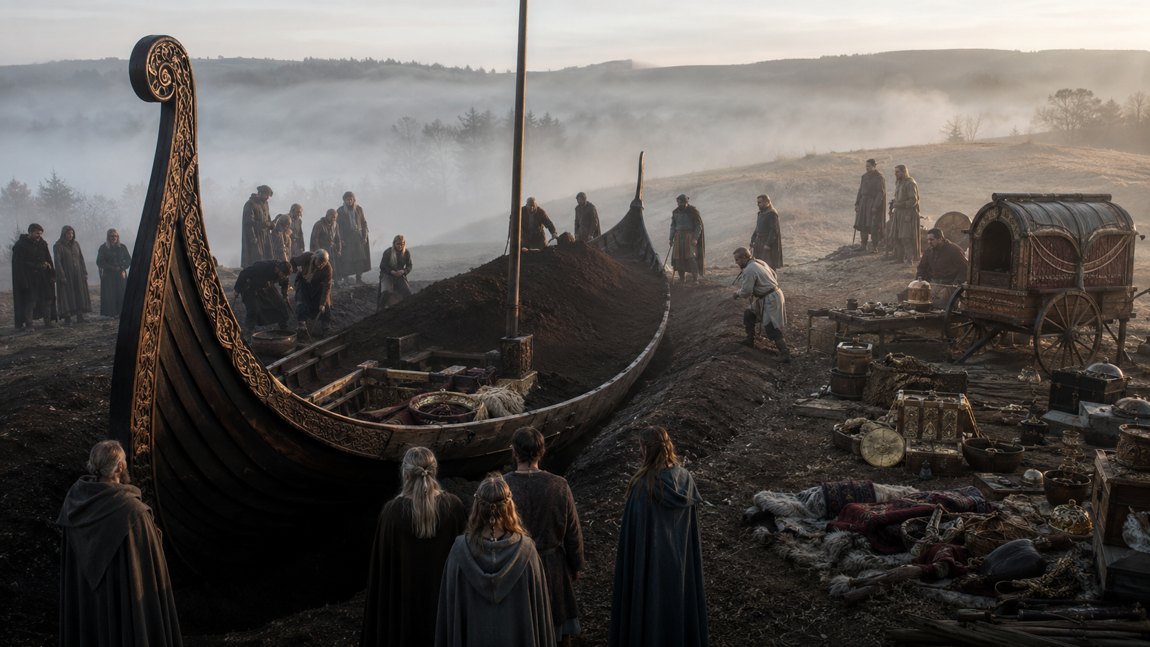
The Oseberg ship is a richly carved oak vessel, roughly 21.5 metres long, in which two women were buried near Tønsberg in Norway in 834 – together with a wagon, four sledges, beds, textiles and sacrificed animals. It was discovered in 1903 and excavated in 1904. This guide sets out what is actually known about the ship, the burial chamber and the two women, why the Queen Åsa theory is now considered unlikely, what the grave robbers did, and when you will be able to see the ship again in Oslo.
In the summer of 1903 a farmer from Slagen, just outside Tønsberg, brought an odd object to the university in Kristiania, today's Oslo. It was a carved piece of wood studded with small nails, dug out of a mound on his farm, Oseberg. Many accounts call him Knut Rom; the cultural heritage department of Vestfold county gives his name as Oscar Rom, so the literature is not fully consistent on this point. The archaeologist Gabriel Gustafson of the university's antiquities collection saw at once that the wood was old. He travelled out, ran a trial excavation on 10 and 11 August 1903, and came away certain: the mound held a Viking Age ship burial.
Then Gustafson did something sensible. He stopped. Autumn was too close, and a large dig in wet clay would have drowned in the rain. What he lifted out of the ground the following year is still the richest grave the Scandinavian Viking Age has left us – and one of the most puzzling.
At Glanz & Gravur we have a soft spot for Oseberg. Not because of gold – there is hardly any – but because of the wood. Few finds show so clearly how much care people put into cutting lines, beasts and interlace into a material twelve centuries ago. If you work with ornament yourself, these carvings make you very quiet.
The main excavation began in spring 1904 and ended on 5 November. Gustafson led it; his assistant was the young Haakon Shetelig, and the engineer Fredrik Johannessen handled the technical questions about the ship. The team kept diaries and sketchbooks and took photographs, a careful record for its time.
The mound was huge: about 44 metres across and originally around six metres high. The ship had been set halfway into blue clay, filled with stones and covered with turf. That airtight, waterlogged clay preserved the wood for more than a thousand years. It also crushed it. The weight of stone and earth had flattened the ship and its contents and broken them into countless fragments, each of which had to be recorded, lifted, dried and later reassembled. The mound itself was never fully investigated; the aim was to recover the ship and what lay in it.
The Oseberg ship is about 21.5 metres long and just over five metres wide. It is built almost entirely of oak in the clinker technique: the planks overlap like roof tiles and are riveted together, and only then were the frames inserted to brace the hull from inside. How that technique worked, and why it served the North so well, is explained in our article on Viking shipbuilding.
There are 15 oar holes on each side, room for 30 rowers. A mast carried a square sail, and the ship was steered with a broad side rudder on the right-hand side – the "steer board", which is where the word starboard comes from. Its gear included an iron anchor, a gangplank and a bailer. Tree-ring dating shows that the ship was built around 820 in western Norway. When it was hauled into the mound in 834, it was already more than a decade old.
What makes it unique are the stems. Bow and stern rise into tall spirals, and at the front the spiral ends in a coiled serpent's head. The stem boards are covered along their whole length with animals that seize one another, bite into each other's bodies and clamp their claws around the framing bands. These "gripping beasts" are the signature of an entire art style, which we will come back to below.
Could it actually sail? A replica, the Saga Oseberg, was launched in Tønsberg in 2012, and under full sail in 2014 it reached around ten knots. Still, this was no warship – more likely a showpiece for a lady who meant to be seen. For the contrast with the great fighting ships, see our overview of Viking longships.
For a long time the grave was dated to "around 850" on stylistic grounds. Then the wood spoke for itself. Using dendrochronology – dating by the pattern of annual growth rings – Niels Bonde and Arne Emil Christensen examined the planks of the burial chamber. Their result, published in the journal Antiquity in 1993: the trees used for the chamber were felled in 834, and the burial most likely took place in summer or autumn of that year.
For the Viking Age that is extraordinary precision. To put it in context: the raid on Lindisfarne was only four decades earlier, and there was no kingdom of Norway yet. Petty kings ruled around the Oslofjord, and Vestfold, with the trading site of Kaupang and the mounds at Borre, was one of the power centres of the North. You can read more about this region in our article on the people of Vestfold.
Behind the mast, the mourners built a gabled chamber of wooden planks. Inside stood beds with down quilts, small buckets and several wooden chests, along with large quantities of woven cloth. The walls were probably hung with narrow pictorial bands. And here lay the two women.
The rest of the ship was organised by zones. The stern held knives, axes, cooking gear, a hand quern and an ox – a galley for eternity. The bow held the wagon, the sledges, more beds, barrels, harness and an animal-head post. Between the mast and the chamber stood a box-shaped chair made of beech; the Norwegian national encyclopedia (SNL) notes that its closest parallels are thrones further south in Europe.
The bones of both women had been thrown about and partly dragged away – more on that shortly. The first anatomical studies were made by Gustav Adolf Guldberg and later by the anatomist Kristian Emil Schreiner. In 1948 the remains were returned to the mound in an aluminium container inside a granite sarcophagus. They were taken out again in 2007 and examined with modern methods by Per Holck of the Institute of Basic Medical Sciences at the University of Oslo.
According to these studies the older woman was around 80, possibly older. She had severe joint changes, and her pelvis and ribs showed traces of cancer metastases that point to breast cancer. Thickening of the skull may indicate Morgagni syndrome, a metabolic disorder. The younger woman had long been seen as a servant of 25 to 30. Analysis of her tooth roots, however, gave an age of about 50 to 55. Both stood around 1.58 metres tall.
Holck also reported that both women had eaten a diet rich in meat, whereas fish played a major role for most people – a mark of high status. Grooves on the younger woman's teeth were read as the use of a metal toothpick. That reading is disputed: similar marks can come from holding needles or thread between the teeth.
Few Oseberg details circulate online as stubbornly as the younger woman's DNA. Holck reported that her mitochondrial DNA belonged to haplogroup U7, which today is found mainly in the region between the Black Sea and Iran. That quickly turned into "the Persian woman of Oseberg". The trouble is that three later studies could not confirm the result. The samples apparently contain little original DNA or have been contaminated. Whether the two women were related could not be determined either, for lack of usable DNA.
As far as we have been able to establish, there is also no published, reliable isotope result – the chemical traces that childhood food and water leave in tooth enamel – that would answer the question of where they came from. What holds up today: age, illness, height and a meat-rich diet. Everything else is open.
The robbers left far more than they took. Precious metal is almost entirely missing. What remains is what was worthless to them and priceless to us: wood, textiles, daily life.
First comes the Oseberg wagon, a four-wheeled wooden cart and the only complete wagon known from the Viking Age. Its body is carved with figure scenes that probably show old legends. One depicts a man entwined by snakes – some see Gunnar in the snake pit from the Nibelung legend, though that remains an interpretation. Whether it ever served for everyday transport is doubtful; the body lifts off, and much suggests a ceremonial or processional vehicle.
Then there are four sledges, three of them lavishly decorated with animal ornament and geometric patterns. Scholars still name them after the people who worked on them, such as "Gustafson's sledge" and "Shetelig's sledge". The bow also held animal-head posts – sources give four or five, depending on how the fragments are counted. Nobody knows what they were for.
Add to that several beds, chests, buckets and tubs, barrels, a hand quern, cooking equipment, oars and farm tools. Buckets in the chamber and the bow contained wild apples and blueberries. The plant remains were studied by the botanist Jens Holmboe, who published them as "Nytteplanter og ugræs i Osebergfundet" (useful plants and weeds in the Oseberg find). The literature mentions, among other things, cannabis seeds in a small leather pouch and cress seeds. Building a drug cult on that, as sometimes happens online, goes far beyond the evidence.
Animal sacrifices were laid in and around the bow. The numbers differ between sources. Vestfold county's heritage department lists fifteen horses, four dogs and two oxen (one in the stern, one in the bow); other summaries give fourteen horses, three dogs and one ox. The bones were mixed and crushed, which explains the discrepancies. What is certain is that more than a dozen horses were killed – an enormous outlay, because horses were costly and carried high prestige. How closely horse, cult and status were linked in the North is the subject of The horses of the Vikings.
One of the grave's most famous objects is a bucket of yew wood with brass or bronze fittings. Where the handle attaches sit two small figures: men sitting cross-legged with grave, almost sorrowful faces, decorated with enamel. Gustafson called them "the Buddha" because of the posture, and the name stuck. The figure has nothing to do with Buddhism.
Hanne Lovise Aannestad of the Museum of Cultural History in Oslo assigns the figures to Irish or British art of the eighth century, probably from a monastic workshop. As early as 1928 Sigurd Grieg noted that the metalworking technique was not Norwegian. So the bucket was about a hundred years old at the time of the burial. Did it come as plunder from a monastery raid, as a gift, or through trade? Nobody knows. Yew is toxic, so it was hardly used for food or water. Either way, it shows that the world of these women reached far beyond the Oslofjord. How such goods travelled north is explored in our article on Viking trade.
The chests contained remnants of cloth, fine sewing kit and weaving tools, including parts of looms and tablets for tablet weaving. There was woollen clothing and imported silk. The textile scholar Marianne Vedeler studied the silk from Oseberg and other graves in her book Silk for the Vikings; it reached the North along long trade routes, probably from the Byzantine or Persian world. How Viking Age women spun, wove and dyed is covered in Viking weaving and textile craft.
The best-known textile is the so-called Oseberg tapestry. In reality it is more than a hundred fragments of narrow pictorial bands, only about 16 to 23 centimetres wide, made of wool and plant fibres; the plant-based threads have almost vanished, and the once bright colours have faded to browns and greys. Vedeler reckons with at least three separate works.
They show a procession of people, horses and covered wagons moving from right to left. Some figures carry spears or staffs, one apparently wears a horned helmet, another an animal mask. All the women wear dresses with trains, a status marker. On one fragment two black birds hover above a horse; the archaeologist Anne Stine Ingstad saw them as Odin's ravens, Huginn and Muninn. A separate, folded fragment shows a large tree from which figures seem to hang. Vedeler thinks they may be nine men and, explicitly as an interpretation, links the scene to Odin and the world tree Yggdrasil. A current project at NTNU, TexRec, is testing whether image processing and AI can help match fragments, though the researchers themselves doubt a fully automatic reconstruction is possible.
Soon after the dig, people went looking for a name. The obvious candidate came from the royal sagas: Åsa, daughter of King Harald Granraude of Agder. According to the Ynglinga saga, written down by Snorri Sturluson around 1230 as part of Heimskringla, she was married against her will to King Gudrød of Vestfold, later had him killed and returned to Agder with her son. That son was Halfdan the Black, father of Harald Fairhair, the first king of all Norway. A proud, dangerous queen, one generation before unification, in the right district – it fitted almost too well.
The catch is the source. Snorri wrote some four hundred years after the burial, his chronology for the ninth century is shaky, and nothing in the grave names anyone. Besides, the theory took the older woman for the queen and the younger for a servant – a picture that no longer works now that both are known to have been old, well fed and of high rank. The Norwegian national encyclopedia, SNL, now considers the Åsa identification unlikely. Some have even heard an echo of Åsa in the farm name Oseberg; linguistically, that is not established.
A second, equally popular reading sees one of the women as a völva, a seeress. Anne Stine Ingstad argued strongly along these lines, connecting the burial with fertility cult and the goddess Freyja. The arguments include the procession scenes on the textiles, the mysterious animal-head posts, a wagon that recalls the progress of a deity, and the cannabis seeds. In other Scandinavian graves women were buried with iron staffs that are interpreted as seeresses' staffs; no such unambiguous staff is known from Oseberg. If this world interests you, you will find it in depth in Seiðr – the magic of the völva and The völva – seeress of the North.
Our view: the Oseberg women were powerful and wealthy and were buried with an effort that has no equal in the Viking Age. Whether their power was secular, religious or both, the grave does not say – and in a society where rule and ritual were tightly bound together, that may be the wrong question anyway. For more on women's roles, read Women in the Viking Age.
Gustafson noticed during the dig that a shaft led into the mound from the front towards the chamber. The robbers had broken in, dragged out the dead and scattered the bones; much of the older woman's skeleton lay in the robbers' passage in front of the mast. SNL even raises the possibility that a third person, perhaps a man, was removed at the time – an idea that remains unproven.
For a long time the break-in was thought to have happened soon after the funeral. But the robbers left their wooden spades behind. Jan Bill and Aoife Daly dated them by tree rings and showed in Antiquity in 2012 that the spades were made shortly after 953 – some 120 years after the burial. They found a similar pattern at Gokstad. Bill and Daly read the looting as power politics: it falls in the period when the Danish king Harald Bluetooth extended his influence over Vestfold and promoted Christianity. The old royal mounds were symbols of a pagan local dynasty, and desecrating them sent a message. A well-argued interpretation, not a confession.
The carvings are so rich that art history named a whole style after the grave. The Oseberg style stands at the beginning of Viking art, roughly in the first half and middle of the ninth century, bridging the older Broa style and the later Borre style. Its hallmark is the gripping beast: a squat creature with big eyes that grabs whatever it can reach – its neighbour, its own body, the edge of the frame.
Remarkably, several different hands can be told apart at Oseberg. Shetelig and later scholars assigned the animal-head posts and sledges to individual carvers and gave them nicknames such as "the Academician" for the strict, classical master and "the Baroque master" for the one whose beasts tangle in wild abundance. These are modern labels, but they capture something real: artists with their own handwriting. How the styles developed from Oseberg to Urnes is traced in Viking art styles.
After recovery the wood had to be dried without shrinking or falling apart. Oak, ash, pine and yew were in good condition and were mostly air-dried, including the hull. But the finely carved pieces of maple and birch, among them the sledges and parts of the wagon, were as soft as wet bread. For these the conservators turned to the state-of-the-art method of the day: alum treatment.
The fragments were boiled in a concentrated solution of potassium aluminium sulphate at about 90 °C. The salt replaced the water and crystallised, and the wood kept its shape. Thousands of fragments were treated this way, yielding about 200 objects after reconstruction.
The problem showed itself decades later. Alum does not penetrate deeply, so the core of the wood stayed weak. By the 1990s the alum-treated sledges and wagon parts were badly damaged: too heavy, crumbling inside, their metal fixings corroded. One animal-head post had already lost its fine detail during treatment, so the other posts were kept in water for almost fifty years until they could be treated with tertiary butanol and freeze-dried. Since 2007 the Museum of Cultural History has been studying how to stabilise the alum-treated wood in its "Saving Oseberg" project.
Since 1926 the Oseberg ship has stood on the Bygdøy peninsula in Oslo. The old Viking Ship Museum was built for about 40,000 visitors a year and in the end received almost 600,000. It closed in 2021 and is being transformed into the Museum of the Viking Age, which at around 13,000 square metres will be more than three times its size.
On 10 September 2025 the ship was moved for the first time in 99 years: inside a vibration-damped steel box, along a crane track in the ceiling, a few centimetres per minute, about 100 metres into the new building. The move took around twelve hours. The Gokstad and Tune ships, the sledges and some 5,000 other finds followed. The opening is planned for 2027. When we checked in October 2026, no exact date had been officially announced, so check the website of the University of Oslo's Museum of Cultural History before you travel. More destinations for a trip north are collected in Experience the Vikings: museums and sites.
And the mound itself? It still lies at Slagen near Tønsberg, rebuilt after the excavation – a green hump in the landscape. You can stand there and picture horses being led, a wagon pulled and chests carried in the autumn of 834, for two women whose names we do not know.
When was the Oseberg ship found? It was discovered in 1903 on the Oseberg farm near Tønsberg, with a trial dig in August 1903. The full excavation took place in 1904 under Gabriel Gustafson and Haakon Shetelig.
How old is the Oseberg ship? The ship was built around 820. Tree-ring dating of the burial chamber places the funeral in 834.
Who was buried in the Oseberg ship? Two high-ranking women, aged about 80 and 50 to 55. Their names are unknown; the identification with Queen Åsa is now considered unlikely.
Was one of the Oseberg women sacrificed? There is no evidence for it. The younger woman's broken collarbone had been healing for several weeks when she died.
What is the Oseberg Buddha bucket? A yew-wood bucket with metal fittings bearing two cross-legged figures. The figures are Irish or British work of the eighth century and have nothing to do with Buddhism.
Can you visit the Oseberg ship? The old Viking Ship Museum in Oslo has been closed since 2021. The ship already stands in the new Museum of the Viking Age on Bygdøy, which is scheduled to open in 2027.
For courage. For remembrance. For legends that live on.
The Skuldelev ships · Stone ships – ships of stone · Boat burial – the burning ship · Viking jewellery · The Ulfberht sword.
All Ships & Seafaring articles →
Around the year 1070 the people of Roskilde deliberately sank several old ships in a narrow channel of their fjord – as …
Read more →Sometimes a ship stands in the middle of a wide landscape – only it is not made of wood, but of upright boulders …
Read more →There is an Old Norse word for the quietest terror of seafaring: hafvilla, the “sea-bewilderment.” It does not mean the …
Read more →