The first news of Vestfold comes not from Norway but from the Frankish realm. Under the year 813 the Royal Frankish Annals record that two Danish kings had marched with an army to "Westarfolda", because its chiefs and people refused to obey. The farthest edge of their kingdom, the annalist writes. That is the key to this landscape on the western shore of the Oslofjord: splendid ship burials, Norway's oldest trading town, a royal pedigree with gods at its head – and over it all the long shadow of Denmark.
Vestfold is the country west of the mouth of the Oslofjord, from Horten in the north to Larvik in the south. Flat, fertile land, sheltered bays, short sea routes to the south. From here you could reach Jutland in a few days. To reach Trøndelag took weeks.
That position explains almost everything that follows. In the ninth century Vestfold was one of the richest regions of Scandinavia, and it looked south. The most famous finds of the Norwegian Viking Age come from here: the Oseberg ship, sunk into a burial mound in 834, and the Gokstad ship from a grave of around 900. Both have their own pieces with us. Here the subject is the people who left them behind.
The Royal Frankish Annals report under 813 that the Danish kings Harald and Reginfrid were not at home when Frankish envoys arrived. They had gone with an army to Westarfolda – in substance, to the farthest region of their kingdom between north and west, facing the northern tip of Britain, whose chiefs and people would not submit to them. The kings subdued them and returned – and were promptly driven out by the sons of King Godfred.
This is the oldest written mention of Vestfold, and it tells us two things. First: from the Frankish court's point of view, Vestfold belonged to the realm of the Danish kings. Second: the people there did not necessarily see it the same way. Both will stay with us through the whole century.
Eighty years later a man from the far north sat at the court of King Alfred of Wessex and described his voyages: Ohthere of Hålogaland. His account, written down in Old English, names a port in southern Norway:
Þonne is ān port on sūðeweardum þǣm lande, þone man hǣt Sciringeshēal.
"Then there is a trading place in the southern part of the land, which is called Sciringes heal."Ohthere's account, inserted into the Old English Orosius, late ninth century; English rendering our own
From there, Ohthere says, he sailed to Hedeby in five days, with Denmark to port. More on that harbour in our piece on Hedeby. The name Sciringes heal corresponds to Old Norse Skíringssalr, the hall of Skiring. In Tjølling near Larvik the name is attested into the late Middle Ages. At Huseby, not far from the shore, a large hall was excavated in 2000 and 2001, more than thirty metres long, standing from about the middle of the eighth century until around 900. With it go an assembly site and, according to later tradition, a sacrificial feast attended by people from the whole Viken region.
A few kilometres from the hall lies Kaupang, Old Norse for "market harbour". As early as 1867 Nicolay Nicolaysen investigated burial mounds there. Charlotte Blindheim excavated graves and parts of the settlement over decades from the 1950s. But today's picture comes from the University of Oslo's Kaupang project under Dagfinn Skre, which ran from 1998 to 2003 and whose results appeared in several volumes from 2007.
According to Skre, Kaupang was founded around 800, with plots laid out along the shore on which houses and workshops stood. Smiths, bead-makers and amber carvers worked here; trade was done with weights and hacksilver. The finds include Arabic silver coins, Frankish glass, pottery from the Continent, soapstone from Norway's mountains and iron from the interior. The place lived by exchanging goods from the north for goods from the south. It was abandoned around the middle of the tenth century; Skre links this to changes in the religious and political order of the region.
That Kaupang is Ohthere's Sciringes heal is now considered very likely. It is not entirely undisputed, since no find bears the name. But location, date and importance fit, and no other candidate presents itself.
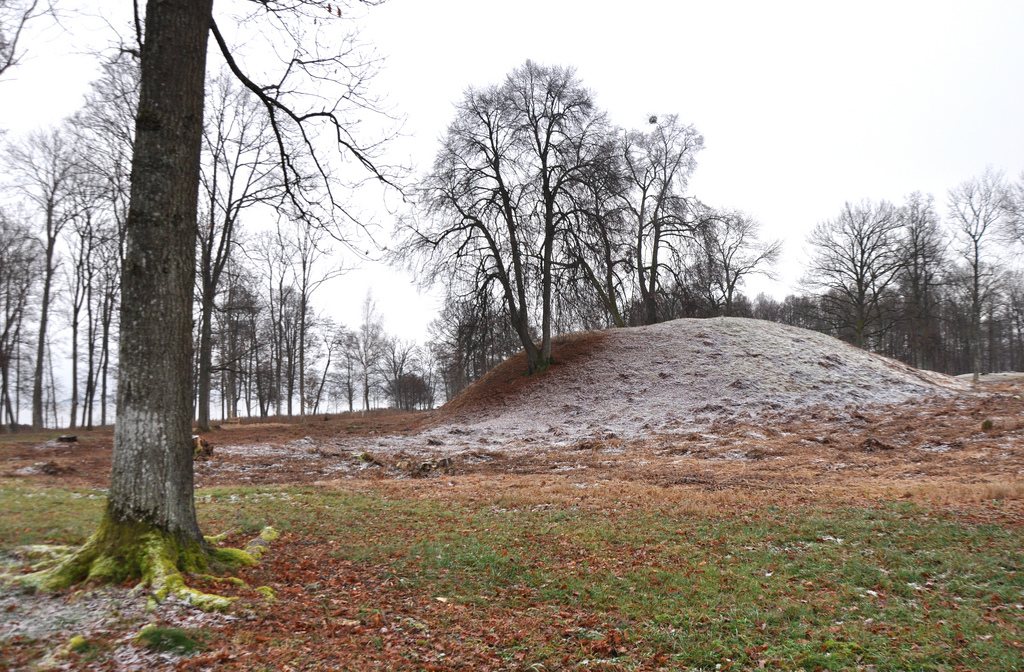
In the north of Vestfold, near Horten, lies the Borre cemetery: seven large and more than twenty smaller burial mounds, plus cairns. The oldest mounds go back to around 600, before the Viking Age. Here power was put on display for centuries.
In 1852 road-builders used one of the large mounds as a gravel pit and destroyed a ship burial in the process. Nicolaysen saved what could be saved: weapons, riding gear, mounts. Among them were gilt bronze bridle mounts decorated with interlocking ring-chains and animals that grip everything around them with their paws. Art history has named a whole style after these pieces: the Borre style, in use roughly from the middle of the ninth into the second half of the tenth century and found from Iceland to Russia. More in our overview of Viking Age art styles.
Since 2007 ground-penetrating radar has revealed the plans of large halls at Borre. A study published in 2020 describes three buildings, the largest about 63 metres long. Two date from before the Viking Age; the third is undated. The mounds, then, did not stand alone in the landscape, but beside halls where people feasted, took counsel and ruled.
Anyone who wants to name the kings of Vestfold ends up with Ynglingatal. The poem is attributed to the skald Þjóðólfr of Hvinir and lists the ancestors of a king Rǫgnvaldr, back to the Ynglings at Uppsala and the god Freyr. For each king it gives a death and a grave, and two of the graves are in Vestfold:
Ok Skereið í Skíringssal of brynjalfs beinum drúpir.
"And Skereið in Skiringssal bows over the bones of the elf of the mail-coat."Ynglingatal, stanza on Hálfdan hvítbeinn, quoted in Snorri Sturluson, Ynglinga saga, ch. 44; English rendering our own
Ok buðlung á Borrói sigrhafendr síðan fǫlu.
"And the victorious then hid the prince at Borre."Ynglingatal, stanza on Hálfdan inn mildi, quoted in Ynglinga saga, ch. 47; English rendering our own
That looks like a find: royal graves at Borre and Skiringssal, attested in a ninth-century poem. The problem is the "ninth-century". The Norwegian historian Claus Krag has argued that the poem was composed only in the twelfth century, when the Norwegian royal house needed a worthy pedigree. Others, Dagfinn Skre among them, hold to a Viking Age date, partly because the place-names in the poem mattered only in that period. The debate is not settled.
Even if the poem is old, it does not tell us which king lies in which mound in a way you could dig up. Identifying the Gokstad mound with the grave of the saga's Óláfr Geirstaðaálfr is an old guess, not a fact. And the line from these kings to Harald Fairhair that Snorri draws is exactly the point where genealogy turns into politics.
Back to the Franks. The report of 813 does not stand alone. Ohthere sails from Sciringes heal to Hedeby with Denmark to port and says Hedeby belongs to the Danes. Kaupang's finds point strongly south, into the Danish sphere. From this Skre has developed the thesis that Kaupang was founded at the instigation of the Danish king, then the dominant power in south-western Scandinavia, and that Vestfold lay within the Danish sphere from about 800 to 950. His reading of Ynglingatal plays a part in that, which does not make the thesis any more secure.
Around 965 Harald Bluetooth had it carved in stone at Jelling that he had won "all Denmark and Norway". Rule over Viken, the land around the Oslofjord, was for the Danish kings not a distant conquest but a claim to a neighbouring region their predecessors had already claimed. Whether the people of Vestfold saw themselves as subjects of Danish kings, as allies, or as independent people who paid tribute now and then, we do not know. The annals of 813 at least show that they sometimes said no.
Archaeologically proven are the trading place of Kaupang from about 800 to the middle of the tenth century, the hall at Huseby in Skiringssal, the Borre cemetery with its halls, the ship burials of Oseberg and Gokstad, and the finds that gave the Borre style its name.
Contemporary written evidence is the Royal Frankish Annals' report of 813 on Westarfolda and Ohthere's account of Sciringes heal from the late ninth century.
Disputed is Ynglingatal: a ninth-century poem or a twelfth-century construction. Later tradition is Snorri's Ynglinga saga with its assignment of kings to mounds.
Modern interpretation covers the identification of Kaupang with Sciringes heal, Kaupang's Danish foundation and the question of which king lies where. Vestfold does not need invented kings. It has enough real mounds. For courage. For memory. For legends that live on.
The Oseberg ship & the two women · The Gokstad Ship · Ohthere of Hålogaland · Hedeby · Danes, Swedes, Norwegians · Harald Fairhair – the first king of all Norway.

