No object of the Viking Age is as colourful as a bead – and few are so often misunderstood. Look at the strings of beads slung between the oval brooches of a Norse woman and you are looking at an entire trade network in miniature: glass from the Mediterranean, carnelian from the Orient, amber from her own shore. The man or woman at the melting furnace, the beadmaker, was one of the North's first true specialists. Let us take an honest look at the craft – and clear away a few pretty legends along the way.
A bead sounds like a trinket. In truth, every Viking-Age glass bead holds half of the era's known world. Glass was a precious, laborious material – and the early-medieval North almost never melted it from raw ingredients itself. What the beadmakers did instead was both cleverer and more down-to-earth: they obtained finished glass from the south and reshaped it. A bead was therefore neither pure ornament nor mere decoration, but a wearable piece of long-distance trade, hung around the neck or from the dress.
Archaeologically, beads are a stroke of luck. Glass does not rot, and amber and carnelian even less so. That is why the graves and workshop layers of the North hold tens of thousands of beads – in Ribe, Hedeby, Birka and Åhus even the waste from their manufacture. It is precisely this waste that makes the bead the best witness to the craft: misshapen lumps, glass drips, fused clumps and broken pieces of raw glass tell us more about work at the furnace than any finished piece of jewellery.
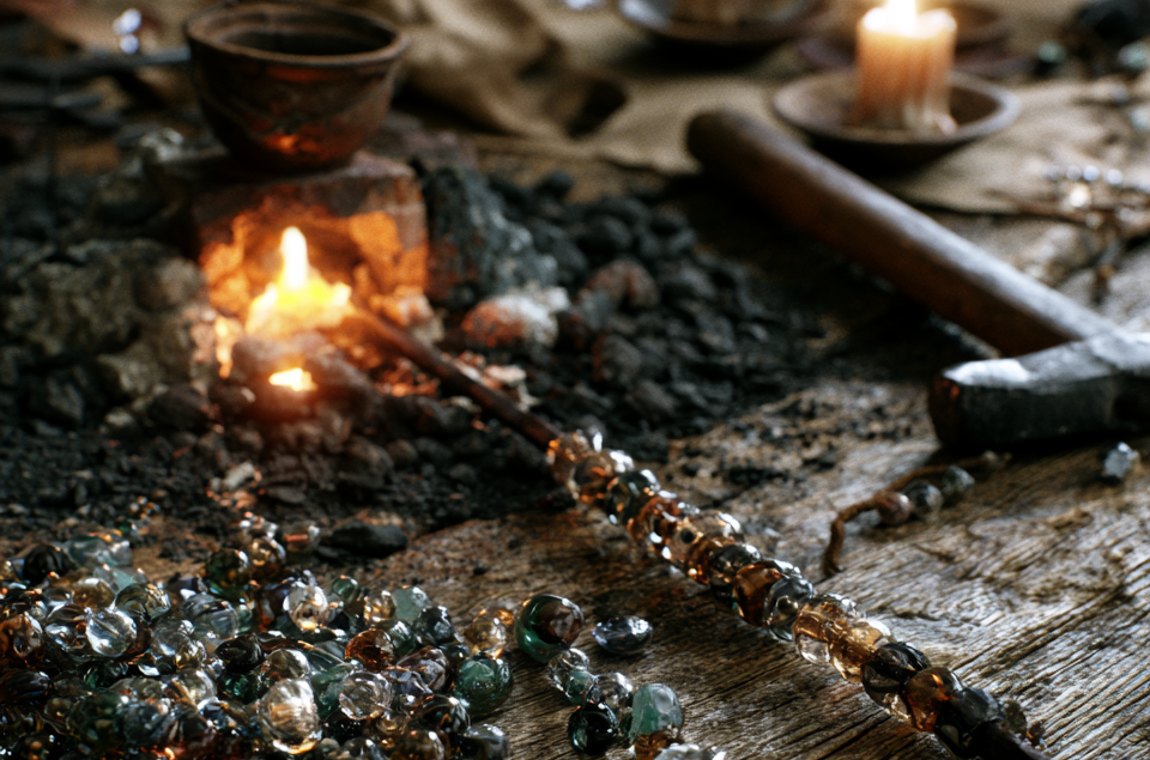
The most common method was winding. The beadmaker heated a piece of glass in the flame or at the furnace until it turned viscous, then wound the soft thread around a thin iron rod, the mandrel. The mandrel had first been coated with a separating layer of clay so that the finished bead could later be slipped off – the little hole running through every bead is exactly the imprint of that rod.
While the glass was still soft, it could be decorated: threads of another colour were laid on and drawn with a needle into waves, eyes or spirals, or the bead was pressed into a mould. The piece was then cooled slowly so it would not crack. From a handful of basic techniques – winding, trailing, drawing, pressing – came a remarkable variety: single-colour ring beads, multi-coloured eye beads, ribbed melon beads, and gilded or silvered beads with a wafer-thin metal foil sandwiched between two layers of glass.
Here lies the heart of the misunderstanding. The glass itself did not come from the North. In Ribe and the other workshops, beadmakers mainly re-melted imported glass: small cubes from wall mosaics, so-called tesserae, and ingots of raw glass that reached the North along the great trade routes from the Mediterranean and the Byzantine Empire. Broken Roman and late-antique vessels were recycled as well. The beadmaker was thus less a glassworks than a re-melter and shaper.
Chemical analyses confirm this strikingly: the natron needed to melt the glass comes from Egyptian sources, the base glasses from Mediterranean workshops. Coloured tesserae supplied ready-made, strong colours – red, green, blue, yellow, white – which the beadmaker only had to mix and form. This explains why beads appear so suddenly and in such numbers: not because the North invented glassmaking, but because it organised access to southern raw glass.
Anyone seeking the beginnings ends up in Ribe on the Jutland west coast, the oldest marketplace in Scandinavia. Already in the early 8th century – before the Viking Age proper had even begun – production was under way here on a large scale. Recent excavations have taken Ribe's workshop layers apart layer by layer, recovering thousands of beads, glass tesserae and production waste.
The pace is remarkable: beads from Ribe show that people were working here systematically around 700 to 750 – seasonally, in a specialised way, with imported raw glass. Ribe is therefore not only a trading place but one of the earliest documented glass-bead manufactures in the North. From here the whole later course of the craft can be read.
As the great trading places flourished, beadmaking spread. In Hedeby on the Schlei, in Birka on Lake Mälaren and in Åhus in Scania, workshops and production waste can be traced. These places were hubs of the long-distance routes: whoever sat here had access to raw glass, to markets and to customers from many lands.
Notably, beadmaking often took place in the same craft quarters as comb-, bronze- and amber-working. The beadmaker was part of a whole craftsmen's town. Åhus in turn shows how closely bead production and raw-glass import were linked – the workshop sat where the raw material arrived. Beads are therefore a fingerprint of the trade structure, not merely a fashion item.
The most elaborate beads are the millefiori beads. The name means "a thousand flowers": glass rods of different colours were bundled into a pattern, the bundle drawn out long, allowed to cool and then cut into thin slices. Each slice showed in cross-section a tiny, always identical flower or chequerboard motif, which was then fused onto the bead's surface. This technique was of southern and Byzantine origin; finished millefiori pieces reached the North partly as semi-finished goods, while beadmakers also worked imported mosaic canes further.
Equally demanding is the reticella technique, in which twisted, multi-coloured glass threads are worked into a net-like, spirally turned pattern. Such beads were expensive and rare – they were the showpieces of a string, proof that their wearer shared in the great trade.
Alongside glass stood a material the North had in abundance: amber. This fossil tree resin was gathered on the shores of the Baltic and North Sea, carved, drilled and worked into beads, pendants and amulets. Amber was light, warm to the touch and shimmered in the light – and so characteristic of the North that even ancient authors described it.
They also search the sea, and alone of all peoples they gather amber, which they themselves call glaesum, in the shallows and on the shore.Tacitus, Germania 45 (public domain, rendered into English)
Amber was at once trade goods and a material for one's own hands. Unlike glass or carnelian, it did not have to be imported – here the North was producer, not customer. Amber beads are found in countless graves, often together with glass and silver on a single string. Anyone wearing an amber necklace today wears one of the oldest jewellery materials in Europe.
Two further bead materials lead far beyond the North: carnelian and rock crystal. The glowing red carnelian and the clear rock crystal were not cut in the North but arrived as finished beads along the eastern route – down the Russian rivers, from the Caliphate and ultimately from western Asia and India. On the arm or string of a Norse woman there lay a stone that had travelled several thousand kilometres.
Carnelian and rock-crystal beads are therefore direct evidence of the North's connection to the east. They belong to the most valuable beads of all and appear above all in richly furnished graves. Only the mounting – a silver loop or cap – was sometimes added locally; the stone itself was an import.
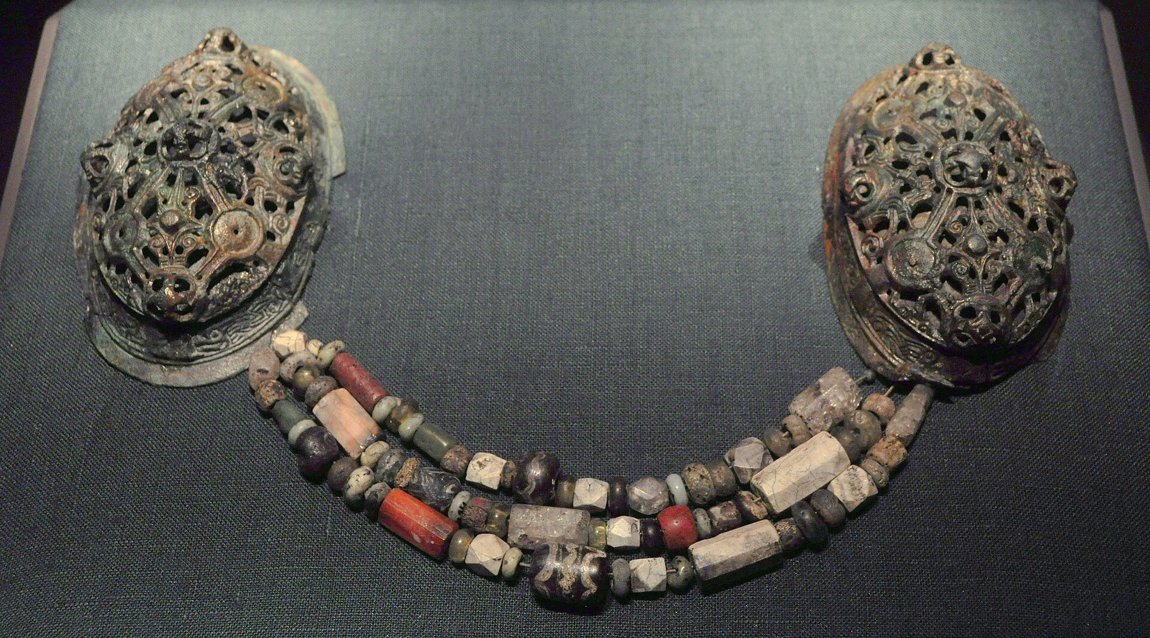
The bead meets us most clearly in women's dress. Over her strap dress a well-off Norse woman wore two oval brooches on her shoulders, and between these two brooches one or more strings of beads were slung. These strings were no random hanging but a visible sign of status and connections: the more colourful, rare and far-travelled the beads, the more the string said about its wearer.
Among the beads small pendants often mingled – miniature tools, amulets, a Thor's hammer, a piece of silver. The string was thus jewellery, status marker and personal store of tokens all at once. In the graves the beads lie exactly where they were worn, allowing the dress to be reconstructed piece by piece.
Beads were not only jewellery, however. In a world where silver was weighed and chopped, a bead too had a tangible value. It was small, durable, desirable and easy to carry – qualities that made it a practical means of exchange. A fine millefiori bead could be a small unit of wealth, a handful of plain glass beads the right return for an everyday item.
In an economy that as yet knew no fixed coinage, the bead thus stood between ornament and means of payment. It was decoration and value at once – and the beadmaker was therefore also a producer of something that could be traded.
Look closely and a string of beads reveals a whole scale of prices. Not every colour was equally easy to obtain. Simple opaque tones – plain yellow, white, brownish red – could be mixed from common raw glass and appear in masses; they were the beadmaker's bread, cheap and quickly made. Other colours demanded rarer additives and special tesserae. A deep, saturated red or a glowing turquoise was harder to achieve and therefore dearer.
Especially prized were the gilded and silvered beads, in which a wafer-thin metal foil was enclosed between two layers of glass. They sparkled like precious metal yet consisted almost entirely of glass – a clever trick to make shine affordable. On a single string, cheap everyday beads could hang beside expensive showpieces. The string was thus not only jewellery but a visible price tag of what its wearer could afford.
The beadmaker was often not a settled shopkeeper but followed the markets. The kit was light: a small furnace or hearth, a few iron rods, needles, tongs and a supply of raw glass. With this the craft could be practised wherever buyers and supplies met – at the seasonal markets of Ribe, in the craft quarters of Hedeby and Birka, along the great routes.
This mobility explains why bead types resemble one another over long distances and why the same techniques appear in so many places. The knowledge travelled with the hands that mastered it. The beadmaker was therefore not only a craftsman but also a carrier of skill and taste – a link between the workshops of the south and the dress of the North.
For researchers, beads are more than pretty finds – they are a fine clock. Because colours, shapes and decorative patterns changed over time, bead types can be arranged in sequences and assigned to individual decades. Bead chronologies are therefore among the most reliable tools for dating Viking-Age graves and layers.
This is a sober but important detail: a particular bead shape "dates" a grave because we know when that type was in fashion – not because it holds any secret power. The scholarly value of the bead lies precisely in its changeability.
The beadmaker of the Viking Age was a long-distance-trade craftsman: he combined southern raw glass, eastern stones and native amber into something that visibly linked every wearer with the wider world. It is exactly this honest core – good material, clean work, a story worth telling – that still draws us to natural stone and real materials today. In our Gemstone World and Natural Jewellery ranges we work with genuine stones and honest descriptions, without healing promises: a carnelian is a beautiful, warmly glowing stone with a long trading history – no more, but no less. Just as the old beadmaker would have seen it.
Next time you hold a string of beads, pause for a moment: between your fingers lie glass from Byzantium, stone from the Orient and resin from your own coast – an entire trade network, small enough to wear around your neck.
Gemstones in the North · Rock Crystal · Viking jewellery · Carnelian – the Vikings' red beads · Viking Trade.
All Everyday Life & Craft articles →
No longship would ever have put to sea, no sword ever been drawn, without the woman and man at the anvil. Ironworking …
Read more →There are tools that become legend. Among the Vikings it was a sword – or rather: a whole group of swords, all bearing …
Read more →No longship would ever have sailed, no warrior survived the winter, without perhaps the most important and most …
Read more →The Viking ship was not merely a tool – it was a status symbol. And at its top there often gleamed a masterpiece of …
Read more →